
Footfall Data Breach: Security Compliance Steps
What should you do when a footfall system raises an alert, but you don’t yet know whether personal information was exposed? Analytics outputs, CCTV footage and system access records can have different privacy implications. Effective people counting data security compliance starts with containing possible access, preserving evidence and establishing what data and systems were involved.
A privacy-first approach can reduce exposure, but it does not remove the need to assess an incident carefully. Footfall Australia’s service uses existing CCTV infrastructure, masks data at the source, and does not collect or store personally identifiable information. This guide sets out a practical response sequence, from recording an alert to assessing affected data and applicable Australian obligations. It also explains how operational, security and privacy teams can coordinate their response and strengthen controls without assuming what people-counting analytics can identify.
Key Takeaways
- Distinguish a security incident from a breach involving personal information by examining the affected systems, data, access and possible consequences.
- Start with a recorded alert, restricted access where appropriate, preserved evidence and a designated incident lead. Document facts, unknowns, decisions and timestamps.
- Apply people counting data security compliance by mapping data flows and assessing which Australian privacy obligations may apply before making notification decisions.
- Source masking, governed access, monitoring and documented data flows can support privacy-conscious operations. Footfall Australia’s fully managed service uses existing CCTV, masks data at the source and does not collect or store personally identifiable information.
People counting data security compliance: what counts as a footfall data breach?
A security incident is an event that may compromise a system or its information. It could involve unauthorised access, altered or deleted count data, a disrupted service or a weakness that creates further risk. A breach involving personal information is a narrower question: it depends on whether information that identifies, or could reasonably identify, an individual was accessed, disclosed, lost or otherwise affected. An incident still warrants investigation even when personal information does not appear to be involved.
A suspected footfall data incident is an event that may affect the confidentiality, integrity or availability of people-counting systems or data, without assuming that any individual was identified. For people counting data security compliance, assess the evidence rather than infer the answer from a system’s purpose or dashboard outputs. The Information privacy overview provides broader context on how data use and protection relate to privacy.
Does a people-counting incident necessarily involve personal information?
No. Systems and data flows differ. A system may produce aggregate counts, while connected footage, device records or other systems need separate examination. A count anomaly or unavailable service is not, by itself, proof that people were identifiable or that personal information was exposed. To establish the scope, identify which systems were affected, what data they held or accessed, who could reach it and what consequences may follow.
Footfall Australia’s fully managed service uses existing CCTV infrastructure, masks data at the source, and does not collect or store personally identifiable information. These controls support privacy-conscious people counting, but they do not make broader organisational security incidents impossible. An incident could still affect system access, availability or connected assets. Record what is known, keep uncertainties visible and assess each affected data flow before drawing conclusions about privacy or compliance.
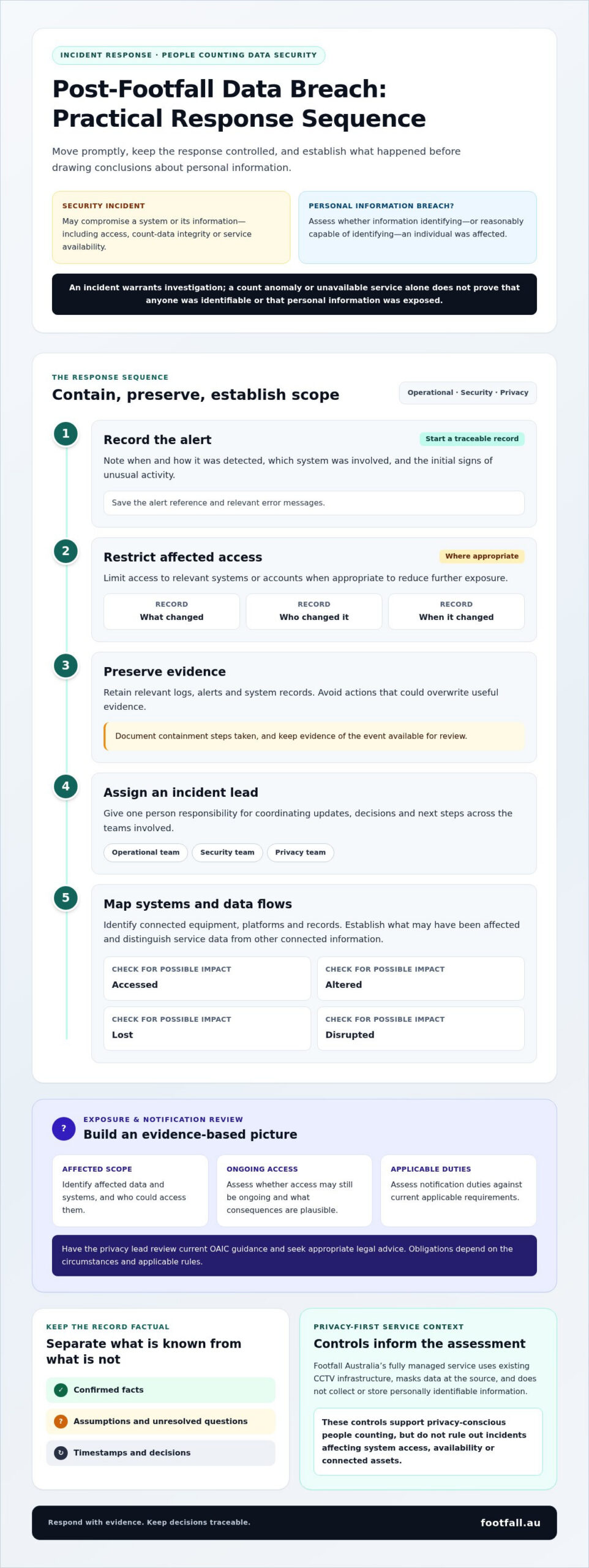
Post-Footfall Data Breach: Practical Response Sequence
Move promptly, but keep the response controlled. A clear record helps teams contain risk while separating confirmed facts from details that still need verification. For people counting data security compliance, appoint an incident lead to coordinate operational, security and privacy roles—supported by IT security partners such as AA Network Technologies—and keep decisions traceable.
- Record the alert. Note when and how it was detected, which system was involved and the initial signs of unusual activity. Save the alert reference and relevant error messages.
- Restrict affected access. Where appropriate, limit access to relevant systems or accounts to reduce further exposure. Record what changed, who made the change and when.
- Preserve evidence. Retain relevant logs, alerts and system records. Avoid actions that could overwrite useful evidence, and document any containment steps taken.
- Assign an incident lead. Give one person responsibility for coordinating updates, decisions and next steps across the teams involved.
- Map systems and data flows. Identify connected equipment, platforms and records. Document what may have been accessed, altered, lost or disrupted, and distinguish service data from other connected information.
How should an organisation assess exposure and notification duties?
Build an evidence-based picture. Identify affected data and systems, who could access them, whether access may still be ongoing and what consequences are plausible. Record confirmed facts separately from assumptions, including timestamps, decisions and unresolved questions. Organisations should assess notification duties against current applicable requirements. Have the privacy lead review current OAIC guidance and seek appropriate legal advice. Obligations depend on the circumstances and applicable rules.
For operational context on service and data integrity, consult the people counter support guide. Organisations reviewing privacy-conscious people counting can also explore Footfall Australia’s visitor and space intelligence service, which uses existing CCTV and masks data at the source.
How privacy-first people counting strengthens ongoing security compliance
Prevention depends on limiting unnecessary exposure and making system responsibilities clear. Source masking reduces privacy risk by masking data at the point of capture, while access governance helps ensure that only authorised roles can reach relevant systems. Monitoring, current data-flow records and defined escalation procedures give teams a firmer basis for spotting issues and responding consistently. These controls support people counting data security compliance, but they cannot prevent every incident across an organisation’s systems; organisations seeking broader enterprise threat detection and environment hardening often turn to specialists such as CyberOne to protect connected infrastructure.
Footfall Australia’s fully managed visitor and space intelligence service uses existing CCTV infrastructure. Its Privacy-First AI masks data at the source, and the service does not collect or store personally identifiable information. To understand how analysis can turn movement into operational insight, explore footfall data analysis and people counting technology.
What should organisations review after an incident?
Use the review to make practical improvements, not just close the incident record. Check who has access and whether permissions still match their responsibilities. Update system and data-flow documentation to reflect actual connections, and confirm that records make it possible to establish what happened, when it happened and how decisions were made. Review escalation steps with operational, security and privacy teams so responsibilities are understood before another alert occurs.
Footfall Australia’s fully managed service includes monitoring, maintenance, data validation, reporting and support. These service functions provide ongoing oversight and interpreted insights, but they do not replace an organisation’s own incident-response or legal processes. Explore the fully managed visitor intelligence service to see how privacy-first people counting can support responsible operations.
Make privacy and security part of everyday operations
Use each review to improve how teams govern data over time. Clear ownership, current system records and regular checks help make people counting data security compliance an operational habit, rather than a task revisited only after an alert. Align useful visitor insights with privacy-conscious processes and clear accountability.
Footfall Australia’s fully managed visitor intelligence service uses existing CCTV, masks data at the source and does not collect or store personally identifiable information. Monitoring, maintenance, data validation, reporting and support provide ongoing service oversight, without replacing your organisation’s own security or privacy responsibilities.
Explore Footfall Australia’s fully managed visitor intelligence service to see how privacy-first analytics can support your operational goals. With thoughtful governance and clear controls, you can use movement insights with greater confidence.
Frequently Asked Questions
Is a footfall data security incident automatically a notifiable data breach?
No. A footfall security incident does not automatically qualify as a notifiable data breach. It may involve service disruption or altered aggregate counts without personal information. For people counting data security compliance, assess what information was affected, whether individuals could be identified and the likely consequences. Compare verified facts with current Australian requirements, using OAIC guidance and appropriate legal advice before deciding whether notification is required.
What should we do first if we suspect a footfall data breach?
Start by creating a time-stamped incident record and limiting further access where appropriate. Capture the alert reference, affected account or system and any visible error messages. Preserve relevant logs before routine processes overwrite them, and appoint an incident lead to coordinate next steps. For example, distinguish a counter reporting unusual totals from evidence of unauthorised system access, then record which details remain unverified.
Can masked people-counting data still be involved in a security incident?
Yes. An incident may affect system availability, access permissions or the accuracy of operational counts, even where analytics are designed with privacy in mind. Footfall Australia’s service masks data at the source and does not collect or store personally identifiable information. Treat those controls as relevant context, not proof that no wider systems or operational information were affected.
How should an organisation decide whether to notify people or a regulator?
Base the decision on verified evidence about the information involved, access to it and potential harm, then assess that evidence against current Australian privacy requirements. The organisation’s privacy lead should consult current OAIC guidance and appropriate legal advice. Keep a record of the reasoning and any new facts that change it. Do not presume notification is required or dismiss the possibility before assessing the incident.