Luxury Retail Clienteling and Traffic Analysis: Turning Store Visits into Better Decisions
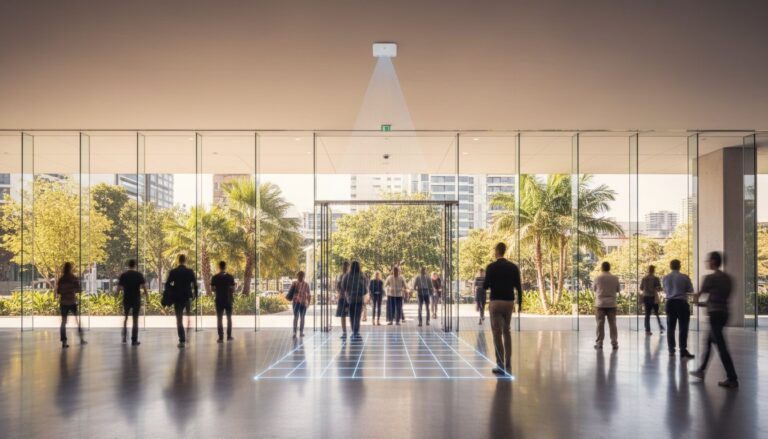
What if store traffic could help associates give more personal service, without identifying the people who walk through the door? Luxury retail clienteling and traffic analysis work best as complements: clienteling builds individual relationships, while visitor patterns reveal how people move through and engage with the store.
Personal service remains central to luxury retail, but footfall totals alone cannot show whether visitors reach a featured display, where browsing zones go unattended or whether staffing matches demand. Pairing relationship insights with privacy-first space intelligence helps retailers make better operational decisions without replacing the human judgement behind a meaningful client interaction.
This article explains how the two approaches inform different decisions, from appointment preparation and follow-up to roster planning and store layout. It also explores how interpreted insights can be delivered through existing CCTV infrastructure, with data masked at the source and no personally identifiable information collected or stored. The result is a clearer view of store activity without the burden of managing hardware or interpreting raw data.
Key Takeaways
- See how luxury retail clienteling and traffic analysis support different but complementary decisions, from relationship continuity to store operations.
- Compare the insights each approach provides to guide appointment preparation, follow-up, staffing and store layout.
- Use a clear decision sequence to turn visitor patterns and business context into practical changes, then evaluate their effect.
- Explore how AI for Analytics can combine staff, sales, location, weather and marketing data to inform operational decisions.
Luxury retail clienteling and traffic analysis: how the two work together
Luxury retail clienteling and traffic analysis answer different questions. Clienteling is relationship-led service: associates use a client’s preferences, purchase history and prior conversations to prepare relevant recommendations and maintain continuity. These clienteling techniques support personal, long-term relationships. Traffic analysis, by contrast, examines how visitors move through a store, where they pause and how they engage with different spaces.
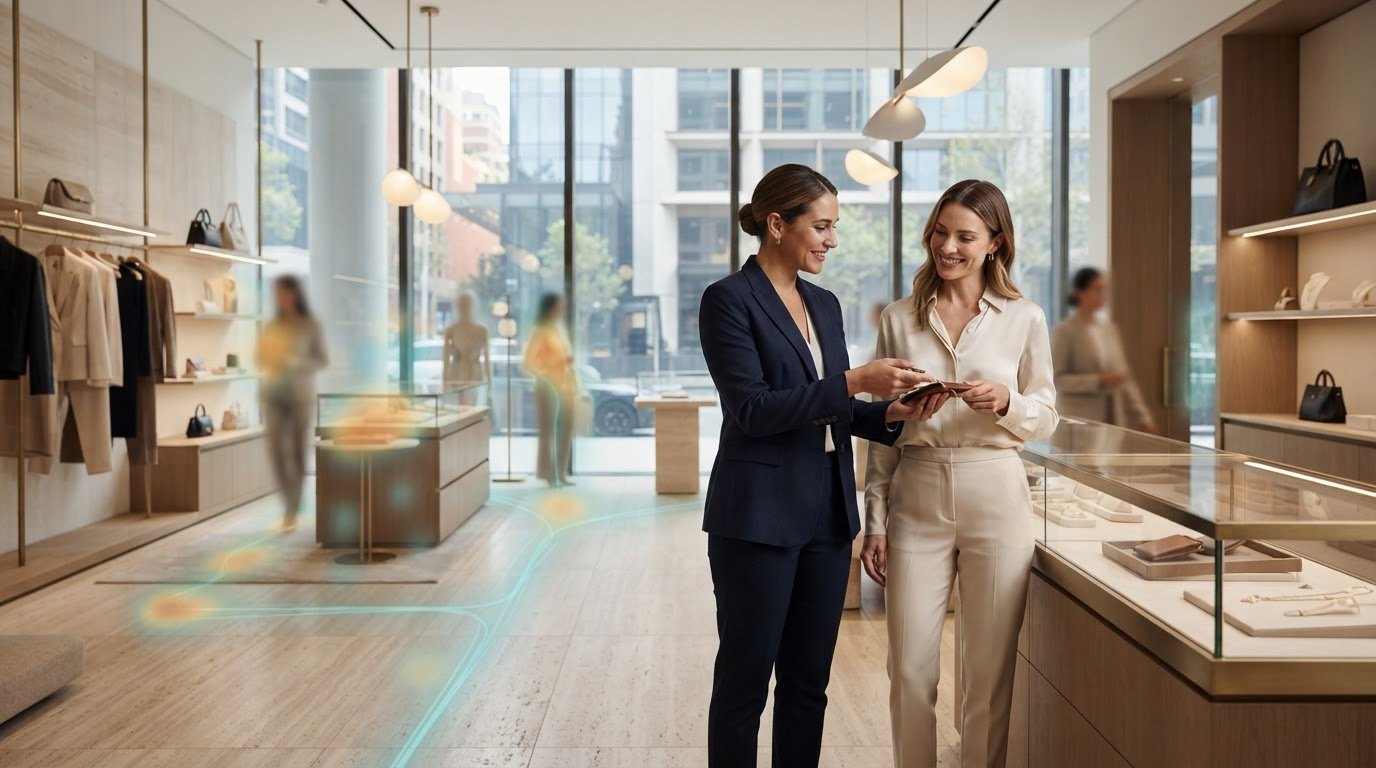
The distinction matters when deciding what to change. Clienteling works with individual customer relationships; privacy-first traffic analysis reveals broader store patterns. For example, an associate may know a returning client prefers a particular style, while store-level insights show visitors often browse a display area when nearby advisors are occupied. Managers can use that pattern to review floor coverage or the presentation of the space, without linking activity to a named customer.
Can traffic insights support personal service without identifying visitors?
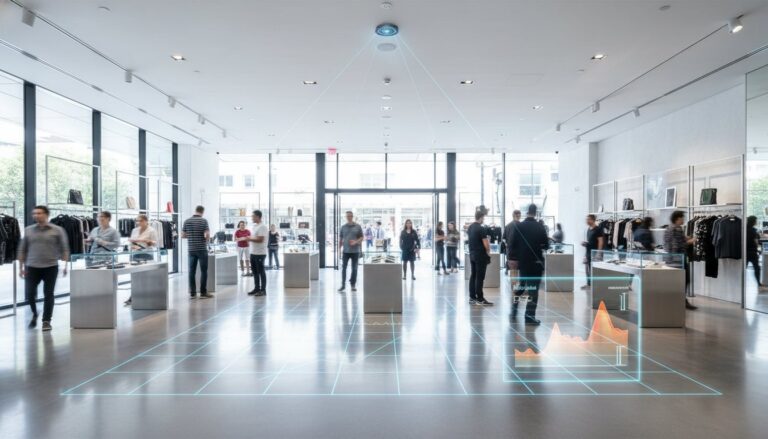
Yes. AI for Vision can interpret traffic paths and engagement across the store to help teams understand how the layout supports browsing and service. It complements, rather than replaces, the associate’s knowledge of a client and the context of an appointment. The two types of insight have separate roles: clienteling informs the personal interaction, while visitor patterns help shape the environment around it.
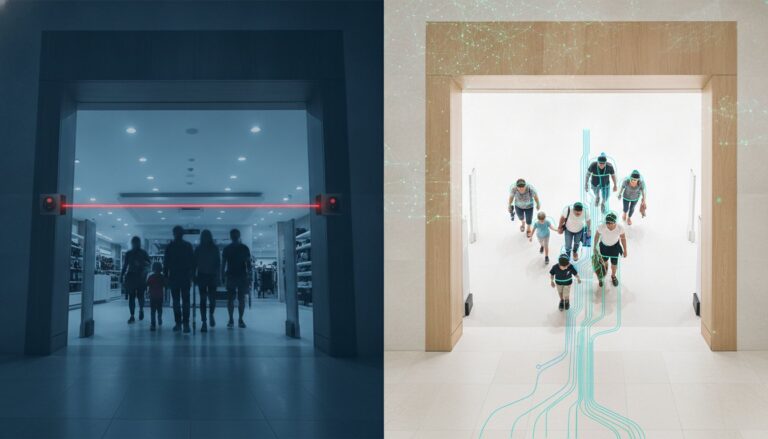
Privacy is especially important in luxury retail, where discretion is part of the experience. Data is masked at the source, and no personally identifiable information (PII) is collected or stored. Retailers can use interpreted store-level patterns to guide experience design without identifying specific visitors.
Traffic analytics informs store decisions without replacing personal relationships. Used together, relationship context and visitor movement patterns help retailers improve service conditions while keeping human connection at the centre. For enterprises looking to modernise shopper touchpoints, teams like pronix.ai help transition customer experience AI initiatives from early pilots into secure, scalable production outcomes.
Compare clienteling and traffic analysis by the decisions each supports
Luxury retail clienteling and traffic analysis can inform the same store strategy, but they answer different questions. One supports continuity with a known client; the other helps managers understand how visitors use the space. Keeping these roles distinct makes the resulting decisions more useful.
| Area | Clienteling | Traffic analysis |
|---|---|---|
| Purpose | Build and sustain individual client relationships. | Understand aggregated visitor movement and engagement. |
| Insight type | Client preferences, history and appointment context. | Traffic paths, zone activity and staff interactions. |
| Decisions supported | What to prepare for an appointment and how to personalise follow-up. | How to review layouts, service coverage and store operations. |
| Privacy boundary | Relationship information is used for personal service. | Data is masked at the source; no personally identifiable information is collected or stored. |
Which luxury retail decisions can visitor patterns inform?
Consider a hypothetical boutique where aggregated patterns show visitors moving through one display area but spending less time in another. The team could review sightlines, product presentation or how the space supports browsing. The pattern does not explain any one visitor’s preferences, but it can help frame a specific store-experience question: is the display easy to notice, and does the surrounding layout invite visitors to explore it?
Staff-interaction insights can also inform operational discussions. If patterns suggest visitors and associates are not connecting consistently in a particular area, managers can review coverage or service flow. The purpose is to understand how the store operates, not to monitor or rank individual employees.
Clienteling explains relationship context; traffic analysis reveals store-level visitor patterns. Combining those perspectives helps teams decide whether an issue calls for a more personal approach, a change to the environment or both. Explore visitor and space intelligence to see how interpreted traffic insights can support store decisions.
Turn luxury retail traffic analysis into managed, actionable next steps
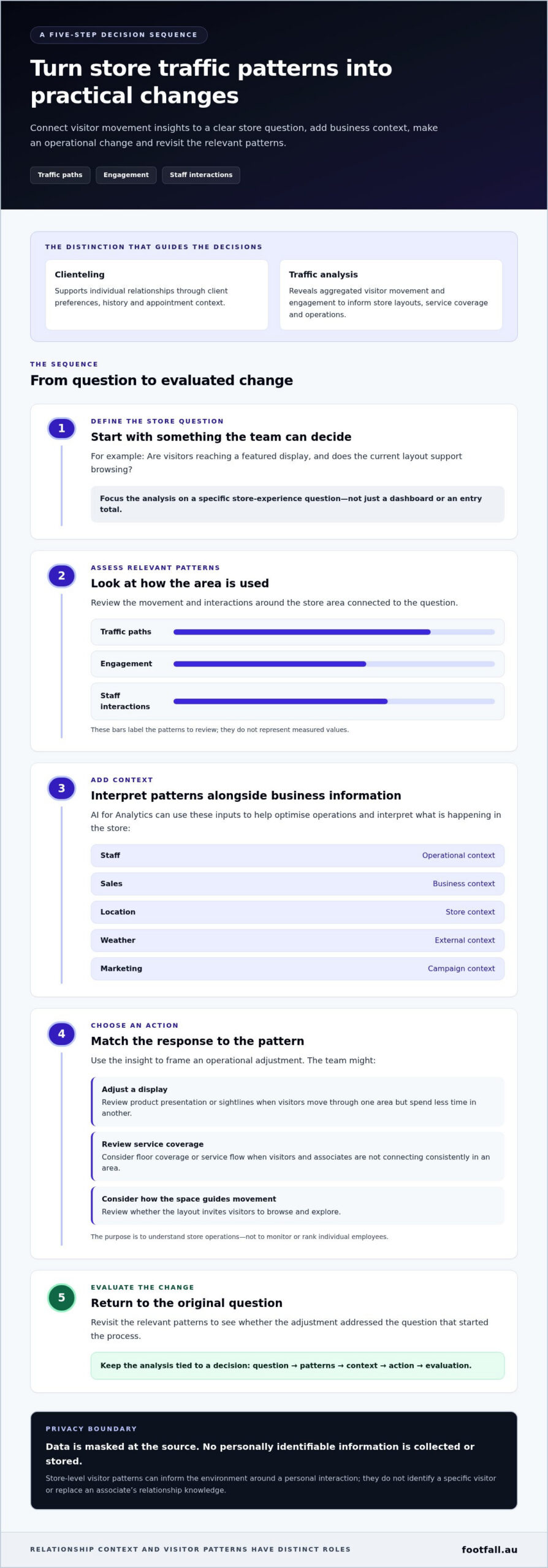
Make visitor insights useful by connecting them to a clear store decision. This sequence helps translate luxury retail clienteling and traffic analysis into practical operational action, rather than treating dashboards as an end in themselves.
- Define the store question. For example, are visitors reaching a featured display, and does the current layout support browsing?
- Assess relevant patterns. Review traffic paths, engagement and staff interactions around the area, rather than relying on entry totals alone.
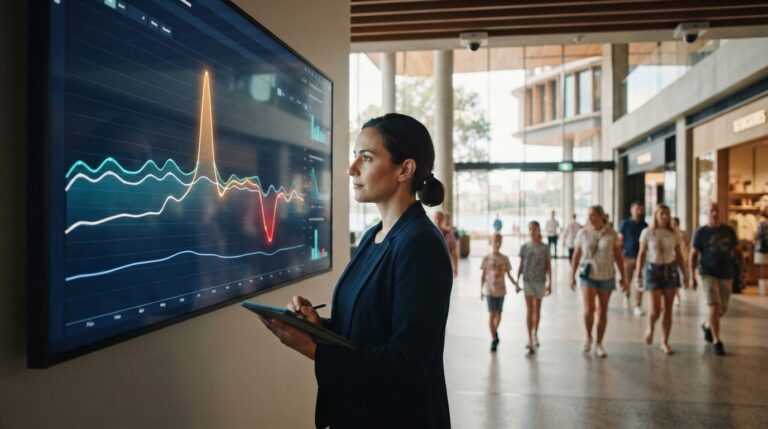
- Add context. AI for Analytics can use staff, sales, location, weather and marketing data to help optimise operations and interpret patterns in context.
- Choose an action. The team might adjust a display, review service coverage or consider how the space guides movement.
- Evaluate the change. Revisit the relevant patterns to see whether the adjustment addressed the original question.
This disciplined approach keeps analysis tied to decisions. A retail footfall analysis guide can help frame store questions, while a footfall data analysis guide explores how to turn patterns into useful insight.
What a fully managed visitor intelligence service changes
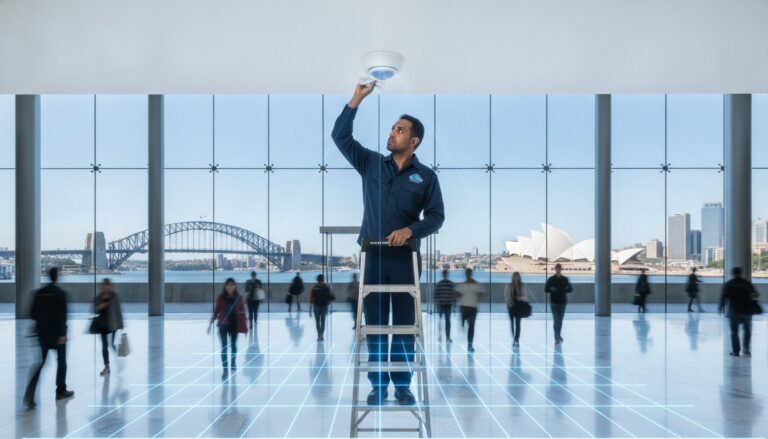
Footfall Australia’s fully managed visitor and space intelligence service covers design, installation, monitoring, maintenance, data validation, reporting and support. It uses existing CCTV infrastructure, so retailers do not need to manage hardware or interpret raw data. Information is masked at the source, and no personally identifiable information is collected or stored. Customisable dashboards present interpreted insights tailored to client requirements, supporting operational review without leaving teams to make sense of raw data.
For luxury retail teams seeking a managed path from observation to action, explore visitor and space intelligence.
Make your next store decision with confidence
The next opportunity may be to choose one store question worth investigating, then establish what evidence would help your team act. That gives luxury retail clienteling and traffic analysis a practical role in ongoing planning: not another metric to track for its own sake, but a way to assess whether the store environment supports the service you want to deliver.
Footfall Australia’s fully managed visitor and space intelligence service uses existing CCTV infrastructure. Privacy-first AI masks data at the source, with no PII collected or stored. Design, installation, monitoring, maintenance, data validation, reporting and support are included, while customisable dashboards present interpreted insights tailored to your requirements.
Explore Footfall Australia’s fully managed visitor and space intelligence service to see how privacy-first store insights can inform your next decision. A clearer evidence base can help your team plan with confidence while keeping personal service at the heart of the experience.
Frequently Asked Questions
Can traffic analysis tell a luxury retailer why a visitor did not buy?
No. Traffic patterns can show where visitors moved or engaged, but they cannot establish why a particular person left without purchasing. For example, a busy display area alongside limited sales may prompt a review of product presentation or service coverage. Luxury retail clienteling and traffic analysis can support that operational inquiry, but motives should not be assigned to identifiable visitors.
Does privacy-first traffic analysis identify luxury shoppers?
No. Footfall Australia’s service masks data at the source, and no personally identifiable information (PII) is collected or stored. The resulting insights describe visitor activity and use of space, not who an individual shopper is. Clienteling can remain focused on relationships managed through its own customer context, while traffic analysis informs broader store decisions.
How can a retailer assess whether an in-store event changed visitor traffic?
Compare relevant visitor patterns during the event with suitable baseline periods, then account for factors that may also affect activity. For example, a marketing campaign, different weather or changes to store operations could influence traffic at the same time. Treat the comparison as evidence for discussion, not proof that the event alone caused a change, and avoid claiming results without data.
Can traffic analysis measure retail conversion?
It can contribute to an aggregate conversion measure when relevant visit measures are compared with sales data. Define the period and measures consistently so the comparison is meaningful. Footfall Australia’s AI for Analytics can use sales and other business context to inform operational decisions. The analysis does not establish which individual visitor made a purchase or connect a sale to a specific person.