
People Counter Data Retention Best Practices: An Australian Checklist
What if retaining more footfall data makes your reporting less defensible, not more useful? The answer to “How long should we keep people-counter data?” depends on what the data can reveal and why you need it. Under Australia’s Privacy Act, information that identifies or could reasonably identify an individual may be personal information. APP 11.2 requires covered organisations to destroy or de-identify it when it’s no longer needed for its purpose. These people counter data retention best practices start with that purpose, not an arbitrary number of months.
Deleting raw records too soon could weaken trend analysis, while keeping them indefinitely increases privacy and security exposure. This practical Australian checklist helps you set defensible retention periods, distinguish raw, derived and aggregated data, and preserve the footfall insights your team needs. It also gives you a repeatable process for reviewing schedules, securely deleting or de-identifying data, and documenting each decision.
Key Takeaways
- Apply people counter data retention best practices by linking each data category to a clear purpose, useful detail level and accountable owner.
- Distinguish sensor or imagery data, event-level records, aggregated counts, reports and system logs before setting retention periods.
- Keep operational reporting needs separate from optional analysis so exploratory work doesn’t justify holding identifiable detail by default.
- Build a repeatable review process that checks whether data can be aggregated or de-identified, removes expired records and records completion.
People counter data retention: what data should your policy cover?
Retention means keeping information only as long as a documented operational, analytical or legal purpose requires. Your policy should map each people-counting data type to its purpose, owner, review point and disposal approach. Data retention policies define what data is kept, for how long, and how it’s disposed of. In Australia, check current OAIC guidance and applicable legal requirements. Under APP 11.2, covered organisations must take reasonable steps to destroy or de-identify personal information they no longer need, subject to exceptions.
How are raw, event-level and aggregated people-counting data different?
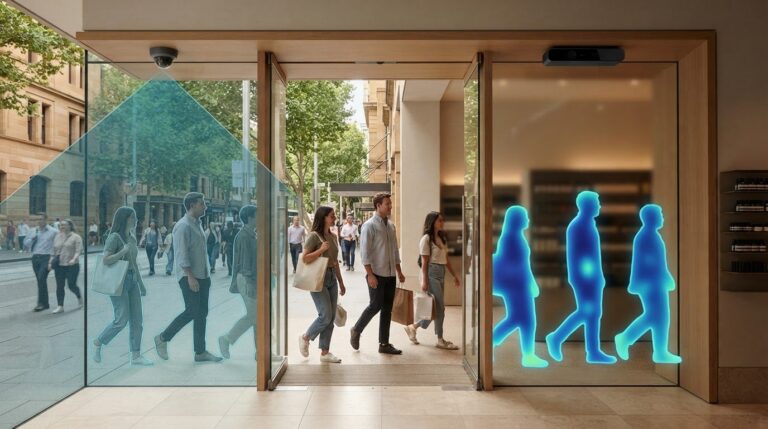
Raw inputs may include imagery or sensor data captured at a counting point. Event-level records are derived observations, such as entries, exits or movement events. Aggregated data combines observations into totals by time period or location. Reports present those summaries for operational decisions, while system logs record technical activity and may contain timestamps or identifiers.
Aggregation reduces detail, but it doesn’t automatically make information anonymous. A count from a small site at an unusual time, combined with CCTV or other records, could help identify someone. Assess identifiability in context, not by file label alone. The people counting technology guide explains how collection methods shape the information available for analysis.
For practical people counter data retention best practices, list these categories separately instead of applying one blanket period. For each, record the business purpose, minimum detail needed, retention period, accountable owner and deletion or de-identification method. Keep aggregated totals only while they support a defined reporting or planning need. Review reports and logs for identifiers that aren’t needed. This gives your team a traceable basis for preserving useful footfall trends without treating every source record as permanently valuable.
People counter data retention best practices: use this Australian checklist
Make retention a repeatable governance decision, not a default setting. For each dataset, define the business purpose, the minimum detail needed to meet it and the person accountable for reviewing continued use. For example, a daily entry-count report may support staffing decisions, while detailed movement records may no longer be necessary once that report is produced.
What should a people-counter retention checklist include?
- Purpose and detail: State the approved operational or analytical use, and why the retained level of detail is necessary. The footfall data analysis guide can help teams connect analytics to specific decisions.
- Ownership and access: Name a data owner, list authorised roles, and set a review date and retention trigger, such as the end of a reporting cycle.
- Period and rationale: Assign a period to each category and record why it is sufficient. Avoid using one blanket schedule for every record.
- Deletion and evidence: Specify how records are removed from active systems, exports and backups, and how completion is logged. Define an exception process for legal holds or investigations, with an owner and review date.
Check whether the Privacy Act 1988 and Australian Privacy Principles apply to your organisation and the information involved. Their application depends on scope and circumstances, so verify current OAIC guidance and have qualified counsel assess obligations before approving periods or exceptions. Revisit the schedule when collection purposes, reporting needs or system arrangements change. These people counter data retention best practices help keep governance aligned with actual use.
For organisations planning an integrated approach to counting and analytics, Footfall Australia supplies people-counting hardware and analytics software. Explore Footfall Australia’s people-counting hardware and analytics software as you plan how collection and reporting fit your retention policy.

How to preserve useful footfall analytics while limiting retained data
Long-term analysis doesn’t always require long-term access to source records. Start by naming the decision the analysis supports, such as comparing weekly visitor volumes or assessing changes in entry patterns. Then identify the least detailed output that still answers the question. If aggregated counts are sufficient, retain those for trend comparisons and apply the approved schedule to more detailed source data.
How can businesses keep long-term trends without keeping every source record?
Build a simple lifecycle: confirm the purpose, create or retain an appropriate aggregated or de-identified output, delete source records when their approved period ends, and log the action. Keep operational reporting needs separate from optional exploratory analysis. A possible future use isn’t, by itself, a reason to retain identifiable detail indefinitely.
Set review triggers to keep the schedule relevant. Reassess it when the analytical purpose changes, new access is requested, systems or data flows change, or legal requirements are updated. Check whether retained summaries still provide meaningful comparisons. Very small or unusual groups may need additional care if combined with other information. Related people counter support and data integrity guidance can inform governance around reliable reporting.
For people counter data retention best practices, make each review traceable. Record what was assessed, what was aggregated or deleted, any exception and its owner, and when the next review is due. This creates a clear history without requiring teams to keep unnecessary records as evidence of the process.
Retention planning should cover the full counting and reporting workflow. Footfall Australia’s people-counting hardware and analytics software, including FootfallCam Pro2 People Counters and FootfallCam V9 Software, give organisations a system context for considering how collection and reporting fit within their governance approach.
Build responsible data governance into your next system review
As reporting questions change, revisit whether retained data still supports a useful decision. Treat retention as part of ongoing system governance, alongside how teams interpret footfall trends and apply them to operations. The goal isn’t to keep every detail available. It’s to preserve the evidence your organisation needs while handling information with care.
Footfall Australia has operated in Australia since 2004, combining people-counting hardware with analytics software. Consider how its integrated system could fit your organisation’s approach to measurement and data governance. Explore Footfall Australia’s people-counting solutions to plan your next step towards insights your team can use with confidence.
Frequently Asked Questions
How long should a business keep people counter data?
There’s no single retention period that applies to every type of people-counter data in Australia. For organisations covered by the Privacy Act, APP 11.2 requires personal information to be destroyed or de-identified when it’s no longer needed for its purpose, subject to exceptions. A starting point for people counter data retention best practices is to document why each category is needed, then check other applicable legal obligations with qualified counsel.
Is aggregated people counter data personal information?
Not automatically. Aggregated totals may fall outside the definition of personal information if no individual is identified or reasonably identifiable. But a small count tied to a precise time and place might become identifying when combined with CCTV, rosters or other records. Assess the dataset in its real context, including who can access related information, rather than assuming aggregation alone makes it anonymous.
Should people counting systems retain video or images?
Retain video or images only where there’s a defined, necessary purpose that justifies keeping them, and consider whether a less detailed output can meet the need. For example, a team reviewing a counting error may need to assess a limited incident, but that doesn’t automatically justify retaining imagery for routine footfall reporting. Set access controls and a review or deletion trigger, and assess privacy obligations.
Can a business delete detailed people counter data but keep useful trends?
Yes, if the retained trend data still serves its purpose and doesn’t identify individuals in context. Keep consistent definitions for measures such as entry counts and reporting intervals so comparisons remain meaningful after source records are removed. Document changes to counting methods or site layouts as well. Otherwise, a shift in the data may look like a change in visitor behaviour when it reflects a measurement change instead.
Ready to connect people counting with analytics for your organisation? Explore Footfall Australia’s people-counting solutions.