Retail Foot Traffic Monitoring Systems: How to Measure Store Traffic Without a People Counter
What if you could estimate store traffic without installing a dedicated people counter? Retail foot traffic monitoring systems can provide structured visitor data, but sales figures alone don’t reveal how many people entered, and manual observations can be hard to sustain. Retailers can use practical proxies, as long as they distinguish an estimate from an actual visitor count.
This guide compares approaches such as sales patterns and staff observations, explains what each can and can’t tell you, and shows when existing CCTV—often installed by commercial security specialists like AlphaLVC—can support more structured insight. A fully managed service can use that infrastructure to interpret visitor activity, without a separate counting device for you to maintain. Data is masked at the source, and no personally identifiable information is collected or stored.
Key Takeaways
- Separate visitor traffic from transactions, conversion, occupancy and customer journeys so you measure the right thing.
- Use a clear question and a consistent proxy to compare store activity over time, while treating manual observations as estimates with coverage limits.
- Assess whether retail foot traffic monitoring systems can answer your operational questions, or whether a proxy is sufficient.
- See how a fully managed service can use existing CCTV to provide interpreted traffic insights, with data masked at the source and no personally identifiable information collected or stored.
How to Measure Retail Store Traffic Without a People Counter
Store traffic measurement estimates or counts visits over a defined period, such as a trading day or a particular hour. Without a dedicated counter, retailers can use proxies to understand activity, but each proxy measures something different. Retail foot traffic monitoring systems focus on visitor activity; a sales report alone cannot tell you how many people entered.
Sales totals alone cannot reveal total store entries. Transactions record purchases, while visitor traffic records visits. Sales conversion compares transactions with visitor numbers, so it can’t be calculated accurately from sales data alone if the visitor count is unknown. Occupancy is the number of people in the store at a particular moment. Customer journeys describe movement through the space, not simply entry volume.
What can you measure without a dedicated visitor counter?
Manual observation can help answer a narrow question, such as whether entry activity increases around lunchtime. Transaction records show when purchases occur, while operational information such as staffing schedules or opening hours can help explain patterns. None of these is a direct count of visitors. A People counter is designed to count people passing a point, while these alternatives capture observations or related activity.
Match each proxy to the question it can reasonably answer. For example, compare transaction volumes by hour to identify when sales peak, but don’t present those figures as store entries. Record manual observations consistently, noting the time and location, and treat them as a sample rather than a complete tally. The retail footfall analysis guide explains how to interpret traffic measures alongside broader store performance.
Label estimates clearly and keep the method consistent between comparisons. This helps ground decisions in what the data actually represents, and makes it easier to recognise when a proxy can no longer answer the question.
Three Practical Ways to Estimate Store Traffic, and Their Limits
A useful estimate starts with a clear method, not a guess presented as a count. Follow these steps to make proxy data more consistent and easier to interpret:
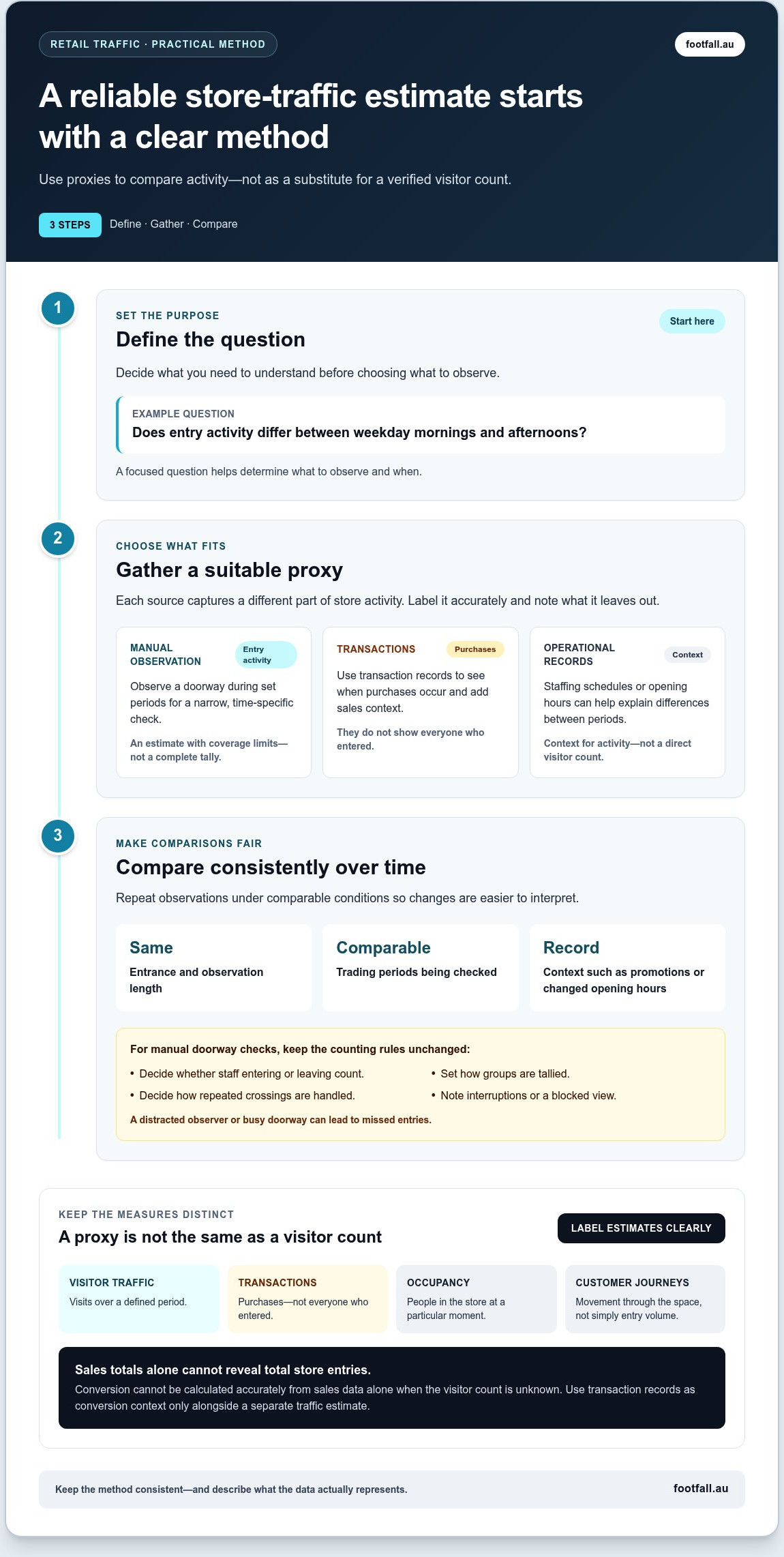
- Define the question. Decide what you need to understand, such as whether entry activity differs between weekday mornings and afternoons. A focused question helps determine what to observe and when.
- Gather a suitable proxy. For a short check, manually observe a doorway during set periods. Transaction records can add context about purchasing activity, while other operational records may help explain differences between periods. Label each proxy accurately and note what it leaves out.
- Compare consistently over time. Repeat observations at the same entrance, for the same length of time, and across comparable trading periods. Record context that could affect the comparison, such as changed opening hours or a promotion.
How to use manual counts and sales records responsibly
Manual doorway observations can answer a narrow question, but they’re vulnerable to missed entries when the observer is distracted or traffic is busy. Set a consistent observation period and clear rules: decide whether staff entering or leaving count, how groups are tallied, and how repeated crossings are handled. Keep the rules unchanged between checks, and note any interruption or blocked view that could affect the tally.
Transaction records measure purchases, not everyone who entered. Use them as conversion context only alongside a separate traffic estimate, and describe the result as an estimate rather than a verified visitor count. The guide to actionable footfall data analysis offers further context for interpreting measures together.
These methods can help with simple comparisons, such as checking whether observed entry activity appears different across comparable periods. If the question calls for more structured visitor insight, explore how retail foot traffic monitoring systems can support measurement beyond manual proxies.
When Existing CCTV Can Provide More Useful Retail Traffic Insight
Proxy estimates can help compare broad activity, but they have limits. If decisions depend on how visitor movement changes across the store, how people use different areas, or whether traffic patterns shift over time, occasional manual checks and transaction records may not provide enough evidence. Existing CCTV can offer a route to more structured insight without a separate counting device for you to maintain, especially when the underlying hardware is properly serviced—an approach detailed by Scaitec Security Solutions Ltd.
Footfall Australia provides a fully managed service that uses existing CCTV infrastructure. The service covers design, installation, monitoring, maintenance, data validation, reporting and support. It turns visitor activity into interpreted insights rather than handing over raw data for your team to analyse. This can help connect measurement to operational questions, such as how space is used or how visitor movement varies across the store.
From estimated visits to interpreted, privacy-first insights
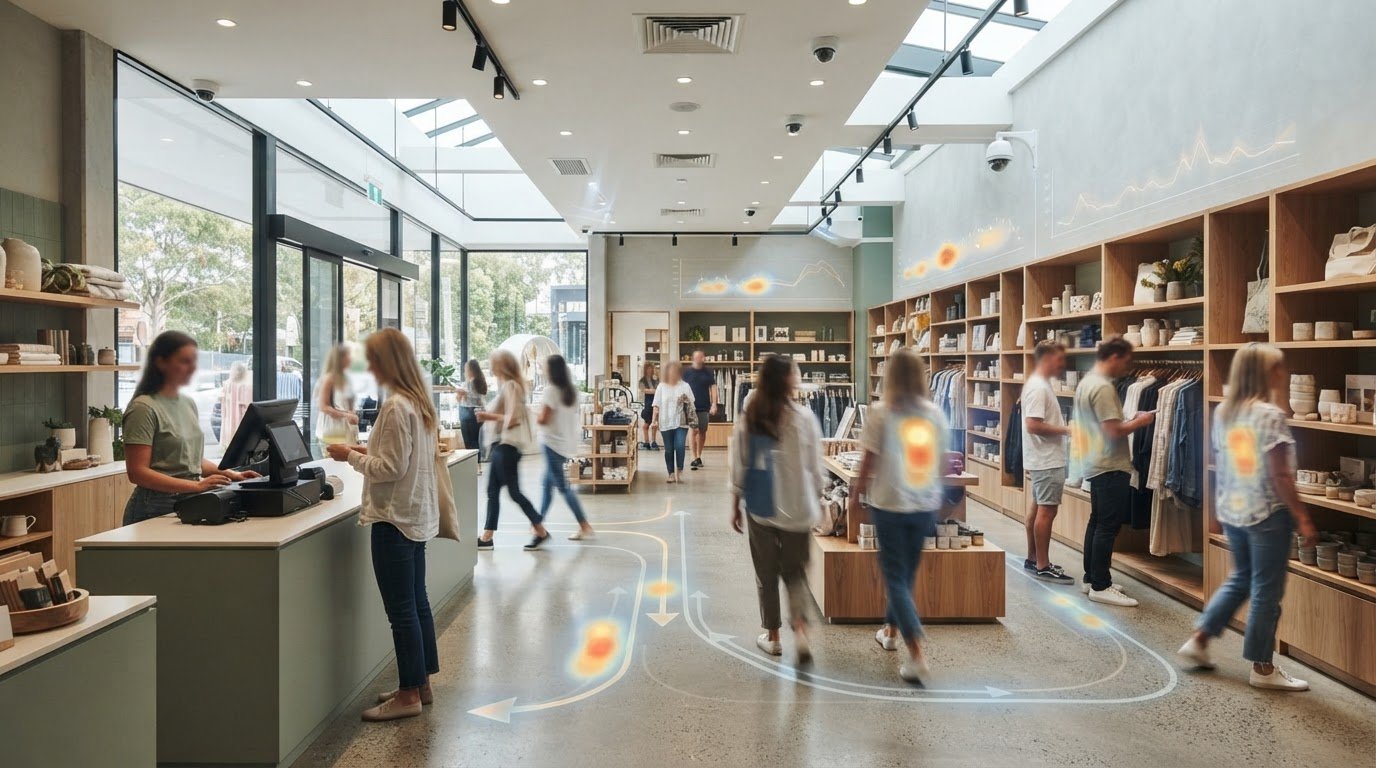
Footfall Australia’s AI for Analytics and AI for Vision turn visitor activity into actionable insights. AI for Analytics can bring visitor information together with staff, sales, location, weather and marketing data to support operational decisions. AI for Vision captures entry-to-exit journeys, traffic paths, engagement, demographics and staff interactions. Customisable dashboards and reporting present interpreted information to support decisions, rather than requiring clients to interpret raw data. Data is masked at the source; no personally identifiable information is collected or stored.
Retail foot traffic monitoring systems are most useful when their outputs answer a defined operational question. A fully managed approach brings the CCTV-based service and its reporting together, so insights can be reviewed consistently without requiring a separate counting device to maintain. To see how this approach can support retail decision-making, explore Footfall Australia’s visitor intelligence service.
Make Your Next Store Decision More Evidence-Led
Choose one operational decision you want to make with greater confidence, then identify the visitor insight that would help inform it. That focus can guide whether an estimate is sufficient or whether more structured measurement is needed. The right retail foot traffic monitoring systems should turn observations into information your team can use, not just another figure to track.
Footfall Australia’s fully managed service uses existing CCTV infrastructure and includes data validation and interpreted reporting. Data is masked at the source; no personally identifiable information is collected or stored. This gives retailers a privacy-first way to build a clearer picture of visitor activity without relying on proxies alone.
Take the next step towards more informed store decisions. Explore Footfall Australia’s fully managed visitor intelligence service to see how visitor insights can support your planning.
Frequently Asked Questions
Can sales data alone show how many people entered a store?
No. Sales data records completed transactions, so it can’t show visitors who browsed and left without buying. For example, if a promotion increases store entries but not purchases, transaction totals alone won’t reveal whether traffic changed or conversion did. Treat sales as purchase activity, and compare it with a separately labelled visitor estimate when assessing performance.
How can manual store traffic counts be made more consistent?
Test the counting method before using its results to guide decisions. Have two observers record the same short interval independently, then compare tallies and clarify differences in how entries were interpreted. Note interruptions, blocked views or periods when the entrance wasn’t covered. If counts diverge, report the uncertainty rather than averaging it into a precise-looking total.
Does privacy-first retail traffic analytics collect personal information?
No. Footfall Australia’s CCTV-based service masks data at the source; no personally identifiable information is collected or stored. It provides interpreted visitor insights without identifying individual visitors. This distinction matters when assessing retail foot traffic monitoring systems: teams can use activity-level reporting to consider store operations without treating it as a record of named or identifiable shoppers.
Can existing CCTV help measure retail foot traffic without a separate people counter?
Yes. Footfall Australia uses a retailer’s existing CCTV infrastructure as part of its fully managed visitor intelligence service, rather than requiring a separate people counter. The service covers design, installation, monitoring, maintenance, data validation, reporting and support. Its reporting presents interpreted insights; data is masked at the source, and no personally identifiable information is collected or stored.