Customer Traffic Counter for Shops: The 2026 Strategic Retail Guide
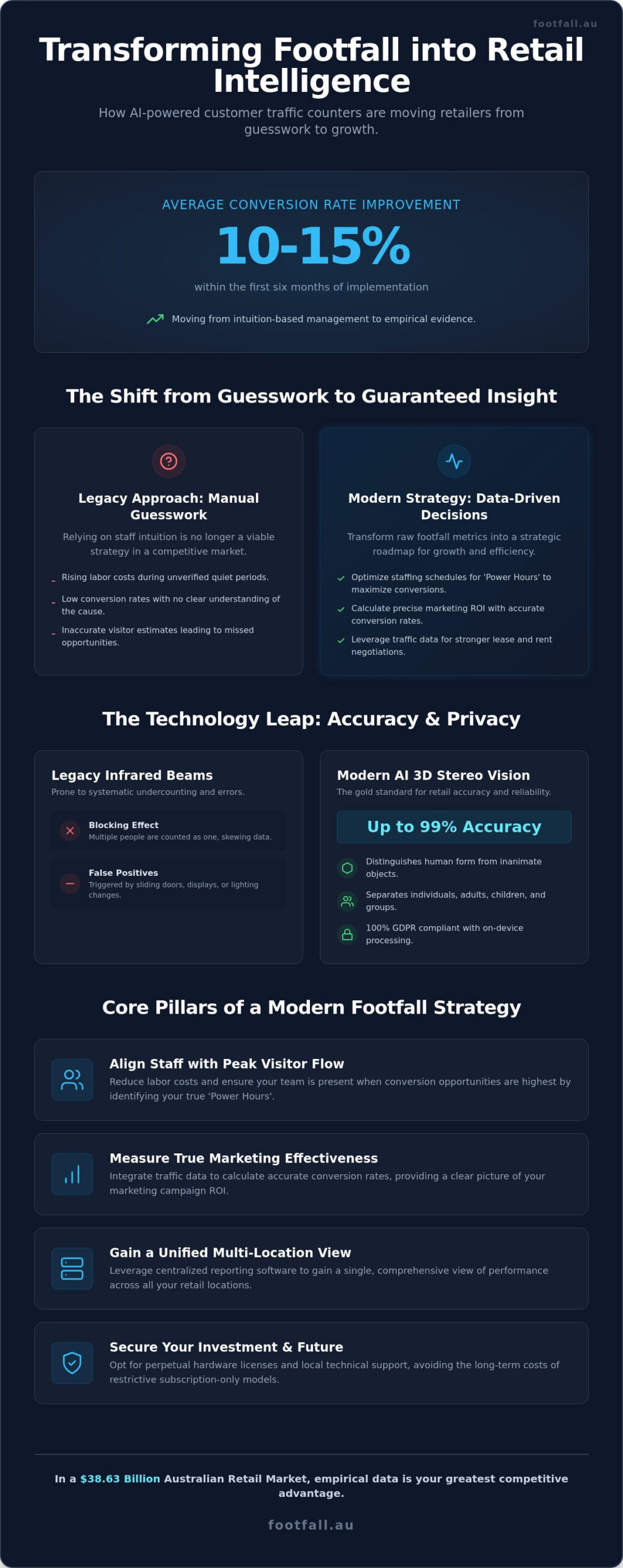
Retailers who implement a sophisticated customer traffic counter for shops report an average 10 to 15 percent improvement in conversion rates within just six months. This isn’t a result of luck. It’s the outcome of replacing manual guesswork with empirical evidence. In an environment where Australian retail spending reached 38.63 billion dollars in January 2026, relying on staff intuition to estimate visitor numbers is no longer a viable strategy for sustainable growth.
You likely feel the pressure of rising labor costs during quiet periods and the frustration of seeing low conversion rates without a clear understanding of the root cause. We agree that data only holds value when it drives specific, positive changes in your operations. This guide promises to show you how to transform raw footfall metrics into a strategic roadmap that optimizes staffing schedules and clarifies your marketing ROI. We’ll examine how advanced AI sensors and intuitive software integration turn human movement into actionable retail intelligence that respects customer privacy while maximizing floor efficiency.
Key Takeaways
- Adopt high-precision AI people counting to distinguish human movement from inanimate objects, ensuring your data reflects actual customer behavior.
- Align staff rosters with peak visitor flow to reduce unnecessary labor costs and ensure your team is available when conversion opportunities are highest.
- Integrate a modern customer traffic counter for shops to calculate accurate conversion rates, allowing you to measure the true effectiveness of your marketing campaigns.
- Leverage centralized reporting through FootfallCam V9 Software to gain a unified view of performance across multiple retail locations.
- Secure your investment with perpetual hardware licenses and local technical support, avoiding the long-term burden of restrictive subscription-only models.
The Strategic Role of Customer Traffic Counters in 2026 Retail
Success in the current retail landscape isn’t defined by how many people enter your building, but by what they do once they cross the threshold. In 2026, a customer traffic counter for shops is no longer a peripheral accessory; it’s the foundational layer of your entire operational strategy. It provides the empirical evidence needed to move away from intuition-based management. Without precise footfall data, your conversion rates and average transaction values are merely guesses based on half the equation.
Real-time visibility has become the standard for staying competitive. Retailers now use this data to understand the narrative of movement within their spaces. This shift allows management to treat physical presence as a sequence of human actions that can be analyzed and optimized. When you know exactly how many people are on the floor at any given second, you can make immediate adjustments to service levels and floor management.
From Door Counters to Behavioral Intelligence
The transition from legacy infrared ‘clickers’ to AI-powered behavioral sensors represents a fundamental change in retail philosophy. Modern people counting technology focuses on the utility of information. Data only holds value if it leads to a specific, positive change in operations. For instance, sophisticated sensors distinguish between staff, children, and shopping groups, ensuring your metrics aren’t inflated by non-buying movements. This level of accuracy is essential for high-stakes decisions like lease negotiations. If you can prove the exact volume of street traffic versus store entries, you gain significant leverage in real estate strategy and rent discussions.
Identifying the ‘Power Hours’ of Your Business
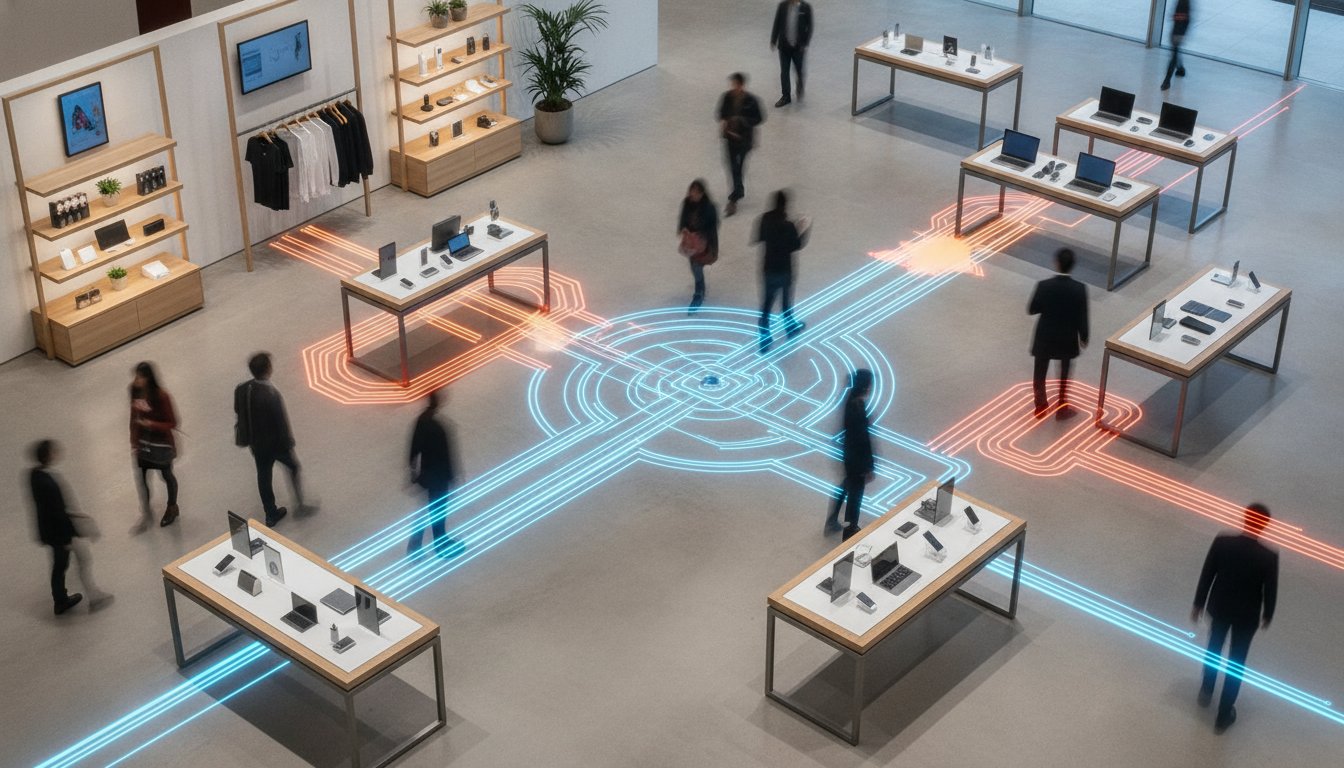
Most shop managers believe they know their peak periods through observation. However, manual estimates are frequently inaccurate, often missing the subtle shifts in visitor flow that occur throughout the day. By using a customer traffic counter for shops, you can define your ‘Power Hours’ with scientific precision. These are the specific windows where your conversion potential is at its peak. Failing to staff correctly during these times leads to significant missed opportunities. When you visualize the customer journey from the street to the point of sale, you can identify exactly where friction occurs. Retailers who actively interpret these journey patterns report an average 10 to 15 percent improvement in conversion rates within the first six months of implementation.
Advanced People Counting Technology: AI, Accuracy, and Privacy
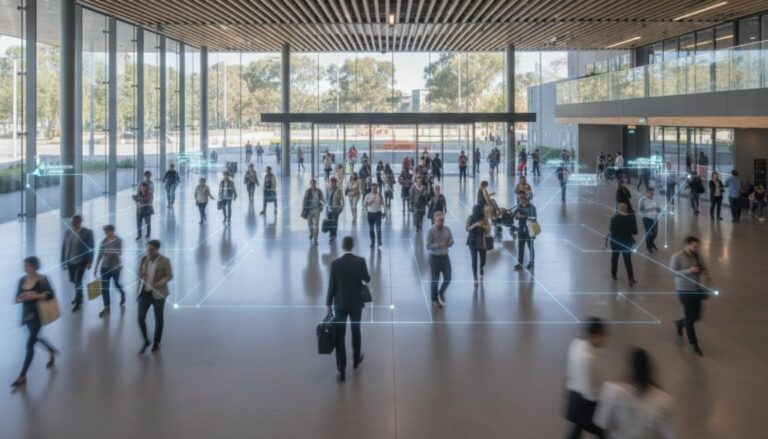
AI people counting represents the gold standard for 2026 retail accuracy by leveraging machine learning to distinguish human presence from inanimate objects with surgical precision. While legacy systems merely recorded events, modern sensors interpret human form and movement. This technological leap ensures that your customer traffic counter for shops provides a truthful representation of your floor activity rather than a collection of unverified pings. By analyzing body silhouettes and movement vectors, these systems filter out non-human factors such as moving displays, sliding doors, or lighting shifts that typically trigger false positives in older hardware.
AI Video Analytics vs. Legacy Sensors
Horizontal infrared beams, once common in retail, frequently fail in high-volume environments. These legacy sensors suffer from ‘blocking’ effects, where multiple people crossing the line simultaneously are recorded as a single individual. This leads to a systematic undercounting that skews your conversion data. In contrast, ceiling-mounted sensors like the FootfallCam Pro2 utilize 3D stereoscopic vision to see the floor in three dimensions. This depth perception allows the system to distinguish between adults and children or separate individuals walking closely in groups. Modern 3D stereo vision AI sensors can reach up to 99 percent accuracy, providing the reliable foundation necessary for strategic growth and accurate labor allocation.
Privacy-First Data Collection
Maintaining customer trust is as critical as maintaining data accuracy. The FootfallCam Pro2 achieves this balance by processing all video data locally on the device itself. No personal imagery is stored or transmitted to the cloud; instead, the sensor only exports anonymous numerical data. This ‘privacy by design’ approach ensures 100 percent compliance with international GDPR standards and the evolving requirements of the Australian Privacy Act. By December 10, 2026, Australian businesses must detail their use of substantially automated decision making in their privacy policies. Implementing a system that prioritizes anonymous processing allows you to meet these legal obligations without sacrificing depth of insight. If you’re looking to upgrade your current infrastructure, you can explore our range of high-accuracy AI people counters to find a solution that fits your floor plan.
Calculating ROI: How Traffic Data Transforms Shop Operations
Quantifying the success of a retail environment requires more than just a glance at the daily sales report. Sales figures only tell you what you’ve gained, not what you’ve missed. A customer traffic counter for shops provides the missing half of the retail equation by establishing the total opportunity available on any given day. By comparing visitor numbers against transaction counts, you move from measuring revenue to measuring effectiveness. This data-driven approach typically results in a 10 to 20 percent improvement in conversion rates as managers begin to address the specific friction points in the customer journey.
Justifying the investment in high-accuracy sensors is straightforward when you consider the primary drivers of ROI. Most retailers see a full return on investment within 3 to 6 months. This rapid recovery is fueled by two main factors: increased sales capture through better service and a 5 to 15 percent reduction in labor costs. When decisions are backed by empirical evidence, the path to profitability becomes a logical sequence of optimizations rather than a series of experiments.
The Conversion Rate Breakthrough
High sales volumes can often mask systemic inefficiency. A store might be reaching its revenue targets while simultaneously failing to convert 80 percent of its visitors. Without a customer traffic counter for shops, this underperformance remains invisible. Integrating footfall data with your existing POS system allows you to see the full funnel, from the moment a customer enters to the final transaction. This visibility enables you to set data-backed benchmarks for staff performance. Instead of judging a team solely on total sales, you can evaluate them on their ability to convert the specific traffic volume they handled during their shift.
Staffing Optimisation and Operational Efficiency
Labor is the most significant variable expense in physical retail. Traditional rostering often relies on historical sales data, which is a lagging indicator of when staff are actually needed. By analyzing real-time ‘traffic-to-staff’ ratios, you can ensure that every customer receives attention during peak periods without overspending on wages during verified quiet windows. This doesn’t just reduce costs; it empowers store managers with objective evidence. They no longer have to rely on intuition to request more support or justify a leaner team. This objective partnership between data and management ensures that your human resources are always aligned with the narrative of movement on your shop floor, maximizing both operational efficiency and the customer experience.
Implementation Strategy: Integrating Traffic Data into Your Ecosystem
Successfully deploying a customer traffic counter for shops requires a clear understanding of your existing infrastructure and long-term reporting needs. A fragmented rollout often leads to data silos that obscure the true health of your retail network. To avoid this, your implementation strategy must prioritize seamless integration between physical sensors and centralized analytical platforms. This approach ensures that data flows logically from the shop floor to the executive suite, allowing for a unified response to shifting consumer trends. For a deeper dive into the technical requirements of a national deployment, consult The Definitive Guide to People Counting Systems in Australia (2026).
Hardware Selection: Pro2 vs. Centroid
Choosing the right hardware depends on your specific environment and existing assets. The FootfallCam Pro2 is the ideal choice for purpose-built accuracy, specifically engineered to handle the complexities of high-volume retail entryways. However, if you’re looking to scale across a large network with existing infrastructure, the FootfallCam Centroid offers a cost-effective alternative. This AI-box solution upgrades your current CCTV cameras into high-precision counters, leveraging your existing hardware to provide sophisticated behavioral insights. When considering connectivity, wired Power-over-Ethernet (PoE) remains the preference for stability in permanent installations, while Wi-Fi options provide essential flexibility for temporary pop-ups or heritage buildings where cabling is restricted.
Software and Reporting: Making Data Actionable
Hardware is only as effective as the software that interprets its data. The FootfallCam V9 Software provides a centralized dashboard that translates raw movement into strategic insights for different stakeholders. Store managers can view real-time floor occupancy to manage queues, while area managers receive automated weekly reports that highlight performance trends across multiple sites. This customization ensures that the right information reaches the right person at the right time. Integrating these metrics with your POS data creates a ‘single source of truth’ for retail health, allowing you to correlate footfall directly with revenue. This unified view empowers you to make decisions based on empirical evidence rather than fragmented reports. To begin your integration process, you can request a consultation with our technical team to design a custom rollout plan for your retail network.
Footfall Australia: Future-Proofing Your Retail Space
Selecting a customer traffic counter for shops is a significant investment in your brand’s future. It requires a partner that understands the Australian retail landscape and provides the technical foundation for long-term growth. Unlike many international providers who lock users into restrictive, recurring subscription models, Footfall Australia prioritizes perpetual hardware licenses. This approach ensures you own your hardware and maintain control over your data, providing a stable cost structure that respects your long-term budget. By choosing a partner with a local presence since 2004, you gain access to a network that values accuracy and utility above all else.
Implementing a robust customer traffic counter for shops is only the first step. Maintaining the integrity of that data stream is what separates successful retailers from those who struggle with inconsistent metrics. We treat your footfall data as a critical business asset, ensuring that the narrative of movement within your stores is always captured with surgical precision. This commitment to reliability allows you to make high-stakes decisions with quiet confidence, knowing your strategy is backed by empirical evidence.
National Support and Maintenance
Reliability is the cornerstone of any analytical system. If your sensors aren’t active, your data is incomplete, and your operational strategy suffers. We offer Basic and Premium Support Plans designed to maintain 99% uptime across your entire national network. These plans include proactive system health checks that verify your sensors are performing at peak accuracy. For retailers managing aging infrastructure, our Legacy Swap Out Plan provides a structured pathway to modernize your counting system without the need to start from zero. This plan allows you to transition to AI-powered analytics while leveraging your existing setup, ensuring your technology remains forward-thinking and resilient.
The Footfall Australia Advantage
Our role extends beyond hardware provision. We act as a strategic consultant, turning complex technical systems into intuitive tools that empower your management team. We focus on the human behavior behind the metrics, helping you translate sequences of actions into positive operational changes. This authoritative, data-driven approach is what builds long-term retail success in an increasingly competitive market. For a comprehensive look at how our primary sensor fits your specific needs, read our FootfallCam Pro2: The Definitive Buying Guide for Australian Businesses.
We are dedicated to helping you stay prepared for shifting behavioral trends through precise measurement and logical reporting. Contact Footfall Australia to optimise your shop’s performance today.
Mastering the Narrative of Movement in 2026 Retail
Retail success in 2026 depends on your ability to interpret human behavior through accurate metrics. By deploying a modern customer traffic counter for shops, you replace subjective estimates with empirical evidence. This allows for precise labor allocation and a clear understanding of your true conversion potential. You’ve now seen how data transforms from raw numbers into a strategic roadmap for operational growth.
Footfall Australia has served as a trusted partner within the Australian network since 2004. We provide high-accuracy FootfallCam Pro2 AI technology backed by national maintenance and support plans to ensure your data stream remains uninterrupted. Our approach focuses on the utility of information, turning complex technical systems into intuitive strategic tools that empower your team. It’s the most reliable way to stay prepared for shifting behavioral trends. Request a strategic consultation for your retail traffic needs to transform your shop’s data into a roadmap for sustainable growth. You now have the framework to lead your retail space into a more efficient, data-driven future.
Frequently Asked Questions
How accurate are customer traffic counters for shops in 2026?
Modern 3D stereo vision AI sensors achieve up to 99% accuracy in most retail environments. This high level of precision allows the system to distinguish between adults, children, and staff members even during peak periods. It ensures that your strategic decisions are based on empirical evidence rather than the lower 80% accuracy range typical of legacy infrared technology.
Do people counters for retail record video of my customers?
No, advanced sensors like the FootfallCam Pro2 process video data locally and do not store or transmit personal imagery. The system immediately converts visual movement into anonymous numerical data strings. This “privacy by design” approach ensures your shop remains 100% compliant with the Australian Privacy Act and international GDPR standards while maintaining customer trust.
Can I integrate traffic counter data with my existing POS system?
Yes, you can integrate footfall metrics with your POS system to create a unified view of your retail health. By combining transaction data with visitor numbers, you calculate your true conversion rate with scientific precision. This integration is essential for identifying whether a drop in sales is due to lower floor traffic or a decrease in staff effectiveness.
What is the difference between a beam counter and an AI video counter?
A horizontal beam counter uses infrared light to detect breaks in a line, whereas an AI-powered customer traffic counter for shops uses ceiling-mounted 3D vision. Beam counters often suffer from “blocking” where multiple people crossing together are counted as one individual. AI video systems analyze the narrative of movement from above, providing far greater accuracy in high-traffic environments.
Do I need a traffic counter if I already have CCTV cameras?
You can leverage your existing CCTV infrastructure by integrating it with the FootfallCam Centroid. This AI-box solution upgrades standard security cameras into high-precision people counters without the need for a full hardware replacement. It’s an efficient way to gain sophisticated behavioral analytics across your national network while utilizing your current physical assets.
How does footfall data help in reducing retail operational costs?
Footfall data reduces costs by aligning your staff rosters with actual visitor flow rather than historical sales. By identifying verified quiet periods, you can scale back labor hours without impacting service quality. Retailers using a customer traffic counter for shops report labor cost reductions between 5% and 15% through more efficient, data-driven scheduling.
Is there a subscription fee for the footfall analytics software?
Footfall Australia prioritizes perpetual hardware licenses, which means there are no mandatory recurring subscription fees for the core analytics software. You own your hardware and your data from day one. While we offer Premium Support Plans for ongoing maintenance and 99% uptime, the fundamental cost structure remains stable and transparent for your long-term budget.
What happens if my shop’s internet connection goes down?
The sensor continues to count and store data locally on its internal memory if your internet connection is interrupted. Once the connection is restored, the device automatically uploads the cached data to the FootfallCam V9 Software. This ensures your historical records remain complete and your narrative of movement is never lost due to temporary technical outages.