Infrared vs. Video People Counters: Which Technology Drives Better ROI in 2026?
What if the A$2,000 you saved by installing basic beam sensors is actually costing your business A$45,000 in lost revenue every single year? Most Australian retailers recognize that foot traffic is their most valuable metric, yet many still struggle with the 15% error margins common in legacy hardware. Deciding between an infrared vs video people counter isn’t just a technical choice; it’s a strategic move to secure 98% or higher accuracy and unlock deep insights into conversion rates and dwell times. You likely want the precision of high-tech sensors but need to balance the budget while meeting the Australian Privacy Principles. This guide clarifies how to justify the investment in advanced spatial analytics to drive a superior ROI. We’ll examine the critical performance gaps between these technologies and provide a clear roadmap for your business’s growth in the 2026 landscape. By the end, you’ll understand how to turn simple visitor counts into a narrative of human movement that empowers your operational decisions.
Key Takeaways
- Identify why 3D video sensors eliminate the ‘occlusion’ errors common in infrared beams, ensuring your conversion rates are based on precise, high-integrity data.
- Evaluate the infrared vs video people counter choice to determine which technology aligns with your facility’s traffic volume and strategic growth objectives for 2026.
- Move beyond simple tallies to unlock behavioral intelligence, such as dwell time and heatmapping, that transforms raw footfall into actionable retail strategy.
- Navigate Australian Privacy Principles (APP) with confidence by understanding how modern video counting prioritizes data security and visitor anonymity.
- Pinpoint the specific environments where a modest infrared investment suffices versus where sophisticated video analytics become a non-negotiable requirement for ROI.
Understanding the Core: What is the Difference Between Infrared and Video Counters?
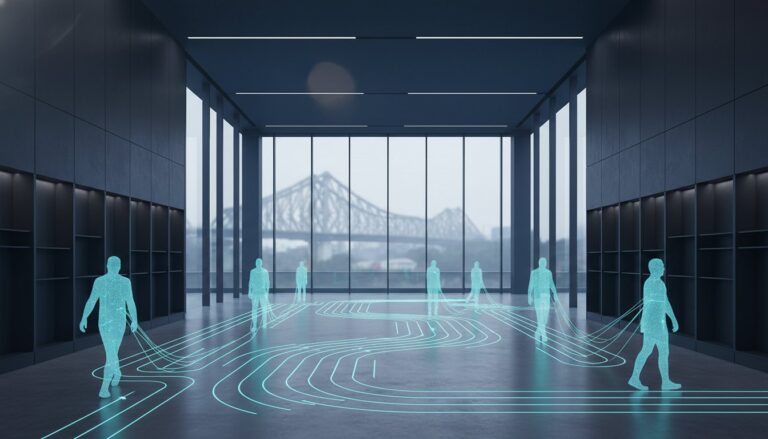
Decisions in the Australian retail sector no longer rely on gut feeling. Successful operators use precise data to drive conversion and optimize floor staff rosters. The infrared vs video people counter debate is the starting point for this shift from guesswork to evidence-based management. Early People counter technologies relied on manual tallying or basic pressure mats, methods that historically saw a 15% error rate in high-traffic environments. Today, technology has evolved into autonomous AI systems that process thousands of data points every second, providing a clear narrative of human movement within a physical space.
Understanding these tools is essential for modern business intelligence. You aren’t just counting bodies; you’re measuring the health of your investment. Whether you manage a boutique in Sydney or a regional shopping centre, the precision of your data dictates the quality of your strategy. Choosing the right sensor technology ensures that your KPIs, such as conversion rates and dwell times, are built on a foundation of facts.
How Infrared (IR) Sensors Work
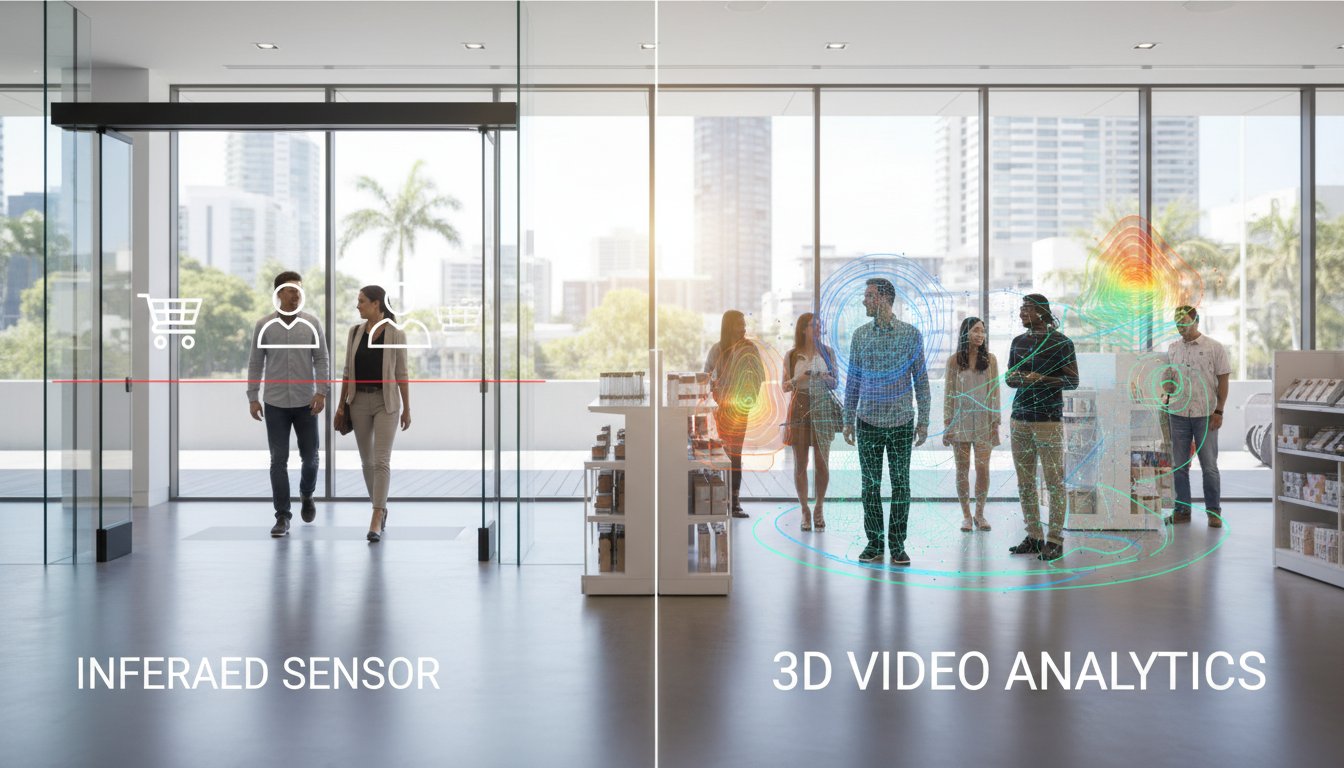
IR sensors operate on a simple beam-breaking principle. A transmitter sends an invisible light beam to a receiver across an entrance. When a visitor walks through the doorway, they break this beam, and the system records a count. Horizontal sensors typically sit at waist height on door frames, while vertical sensors mount on the ceiling to look downward. These systems offer a low entry cost, with basic battery-powered units often starting under A$350. They’re popular for their installation simplicity, as many don’t require complex wiring or network integration.
However, simplicity comes with functional limitations. IR sensors lack depth perception and spatial awareness. They can’t distinguish between a single shopper and a parent pushing a large pram. If two people enter side-by-side, the sensor records only one break in the beam, leading to significant undercounts during peak hours. In a busy Melbourne retail environment, this lack of granularity often results in data that’s 20% less accurate than visual alternatives. While they provide a basic tally, they don’t offer the reliable intelligence needed for complex spatial analytics.
How Video-Based Counting Technology Works
Video counters represent a technological leap from simple detection to sophisticated measurement. Modern 3D stereoscopic sensors use dual lenses to create a 3D depth map, mimicking the way human eyes perceive distance. This allows the device to calculate the exact height and mass of objects moving through the frame. AI algorithms then filter out non-human elements like shadows, cleaning robots, or shopping trolleys. By 2023, high-end video sensors achieved accuracy rates exceeding 98%, even in challenging lighting conditions or dense crowds.
Most current professional units utilize edge computing to maintain speed and security. This means the device processes all visual data locally on the internal hardware rather than sending raw video feeds to the cloud. It’s a privacy-first approach that delivers real-time insights without compromising visitor anonymity. These systems also recognize staff members wearing specific exclusion tags, ensuring your conversion data reflects genuine customer intent. When evaluating the infrared vs video people counter options, the video-based approach offers the depth required to track the entire visitor journey, from the moment they cross the threshold to the time they spend at a specific display.
- Precision: Video sensors offer 98% accuracy compared to the 75-80% often seen with IR.
- Intelligence: AI can distinguish between adults, children, and inanimate objects.
- Privacy: Edge computing ensures no personal video data ever leaves the device.
- Scalability: Digital reporting allows for seamless integration across multiple Australian store locations.
Accuracy and Performance: The 3D Video Advantage
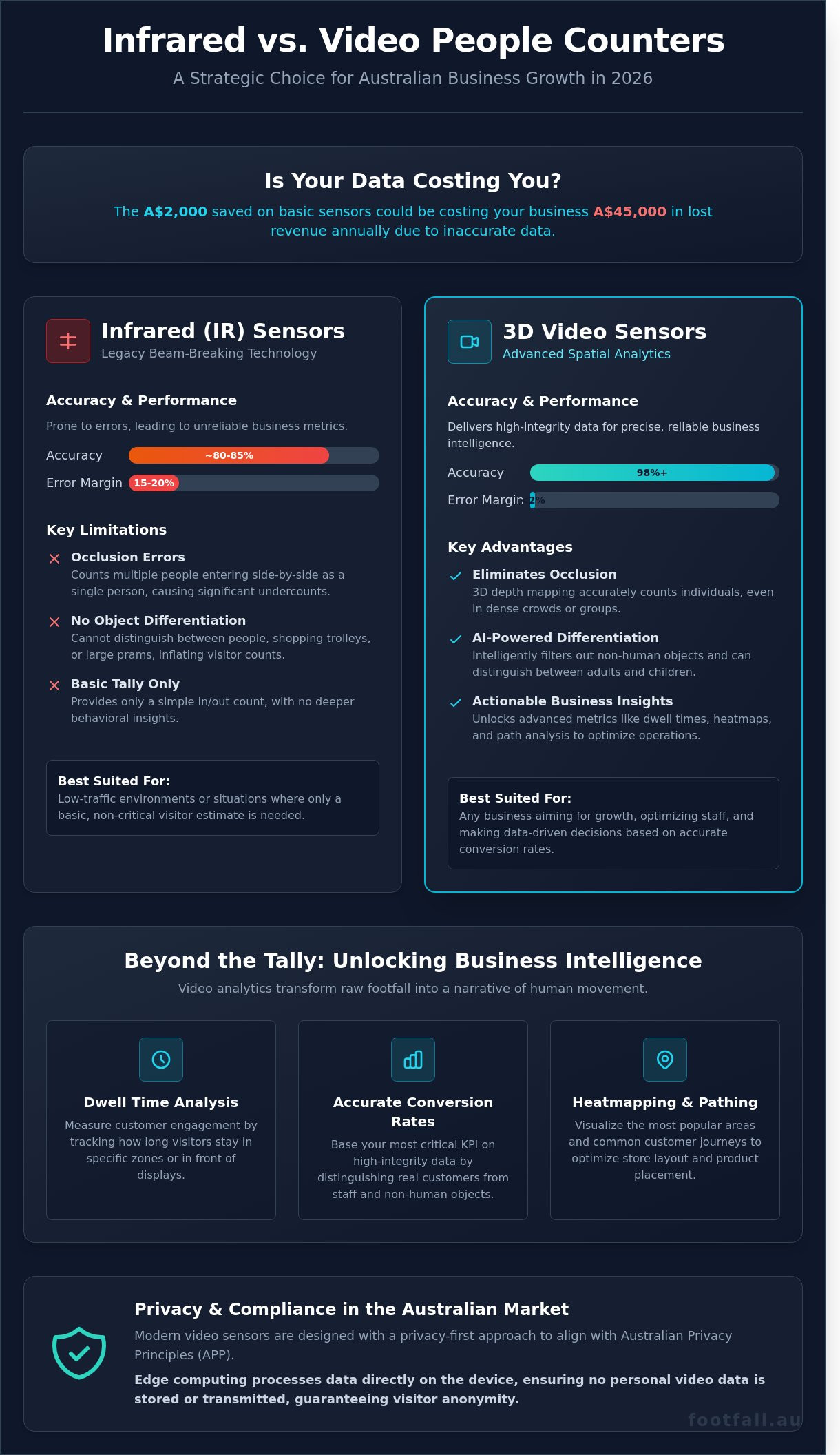
Precision is the only metric that matters when calculating your store’s performance. Relying on an infrared vs video people counter often reveals a stark disparity in data integrity. Traditional infrared (IR) sensors generally peak at 80% to 85% accuracy. While this might seem adequate, a 15% margin of error renders your sales conversion metrics unreliable. If your footfall data is inflated or undercounted, your calculated conversion rate becomes a guess rather than a strategic asset. High-performance 3D video counters eliminate this uncertainty by delivering accuracy rates exceeding 98%.
The primary failure of IR technology lies in the “occlusion” problem. Infrared sensors operate by projecting a horizontal beam across an entrance. When two people enter side-by-side or in a tight cluster, the beam breaks only once. The system records a single visitor, immediately compromising your data. Video-based AI overcomes this by using top-down spatial tracking. It identifies individual heat signatures or skeletal shapes from above, ensuring every person is counted even in dense crowds. This level of detail allows you to explore precision analytics that reflect the true reality of your floor traffic.
Environmental variables also disrupt older technologies. 2D video counters often struggle with shifting shadows, high-contrast lighting, or floor reflections that “trick” the software into recording false positives. 3D AI sensors are immune to these factors. By processing depth rather than just pixels, the technology distinguishes between a human being and a shadow on the carpet. This reliability is essential for Australian retailers operating in bright, glass-fronted high street locations where sunlight fluctuates throughout the day.
Handling High-Traffic Environments
Australian shopping centres often feature expansive entrances that exceed four or five metres in width. In these high-traffic zones, IR sensors fail because they cannot map the direction or volume of simultaneous crossings. 3D stereoscopic sensors, such as those offered by Footfall Australia, utilize dual lenses to calculate depth. This allows the system to set specific height thresholds, usually 120cm, to filter out children or pets. It ensures your data sets remain clean and focused on your primary adult demographic. You gain a clear view of peak traffic periods without the noise of non-buying entities.
Staff Exclusion and Group Counting
Data integrity depends on your ability to separate staff movements from genuine prospect traffic. In boutique environments, staff entering and exiting for breaks or stock runs can inflate footfall figures by as much as 20%. Video counters use advanced AI to identify staff via wearable tags or facial feature exclusion, maintaining a pure count of potential customers. IR technology fundamentally lacks this capability; it sees every movement as a generic “break” in the beam.
Additionally, 3D video technology identifies “buying groups.” When a couple or a family of three enters together, they represent a single sales opportunity. Video sensors recognize this proximity and movement pattern, allowing you to calculate conversion rates based on groups rather than individuals. This distinction is vital for realistic KPI setting. While capturing this granular data, your operations must remain transparent. We ensure all data processing aligns with the Australian Privacy Principles, protecting visitor anonymity while providing the deep insights necessary for modern retail management.
Beyond the Tally: Actionable Insights and Business Intelligence
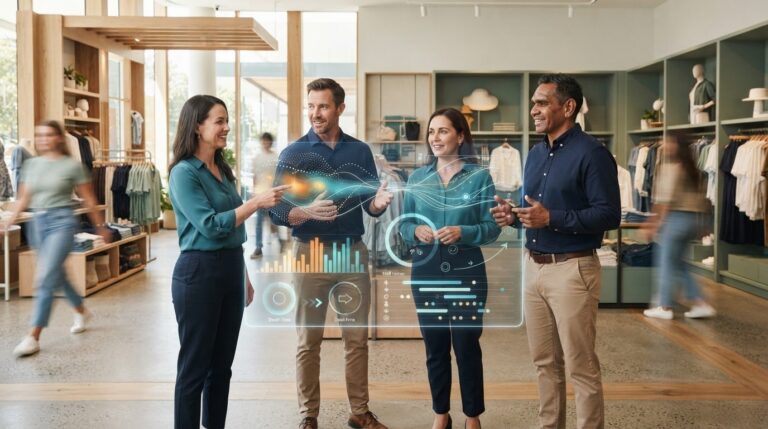
Simple beam-break sensors provide a raw number, but they lack the context required for strategic growth. When comparing an infrared vs video people counter, the primary differentiator is the depth of intelligence provided. Infrared systems signal that someone entered; video systems explain why they stayed or left. These visual sensors generate heatmaps that visualize high-traffic corridors and cold spots where inventory sits untouched. This spatial awareness allows managers to move beyond basic tallies and enter the realm of behavioral analytics.
Data from Loughborough University research indicates that while infrared is cost-effective for basic counts, its accuracy falters in crowded environments where bodies overlap. Video analytics solve this by utilizing advanced algorithms to track individual dwell times with precision. If a customer spends 4 minutes at a promotional end-cap but leaves without purchasing, you’ve identified a friction point in your sales funnel. Zone analytics allow managers to measure the ‘capture rate’ of specific departments, ensuring that high-rent floor space generates a proportional return on investment. This level of detail transforms a simple counter into a consultant for your floor plan.
Mapping the Customer Journey
Retailers use video data to eliminate ‘dead zones’ that can account for up to 25% of underutilised floor space in Australian shopping centres. You can calculate a physical ‘bounce rate’ by identifying visitors who leave within 60 seconds of entry. Integrating this data with Point of Sale (POS) systems transforms footfall into real-time conversion rates. If traffic increases by 10% on a Saturday but sales remain flat, your video data will likely show that queue wait times exceeded the 5-minute threshold, causing basket abandonment.
The Cost of ‘Cheap’ Data
Choosing a cheaper IR system often results in hidden operational costs that erode your bottom line. Inaccurate data leads to overstaffing during quiet periods or, worse, losing sales during peak hours because of a 15% undercount in traffic. While a high-precision video sensor might require an upfront investment of A$1,500 to A$3,000 per unit, the efficiency gains usually cover this cost within 6 to 12 months. Accuracy isn’t a luxury; it’s the foundation of your labor budget and inventory strategy. Achieving 98% footfall accuracy through video technology delivers a 12% average increase in staff productivity by aligning roster hours with actual visitor peaks.
The choice between an infrared vs video people counter ultimately depends on how you value your time and labor. IR sensors provide a snapshot, but video sensors provide a narrative. By capturing the nuances of how people interact with your environment, you gain the ability to predict future trends rather than just reacting to past mistakes. This shift from reactive counting to proactive management is what separates market leaders from those who are simply guessing. Smart retailers in Sydney and Melbourne are already moving away from basic sensors to embrace these sophisticated data streams to stay competitive in a tightening retail market.
Privacy and Compliance in the Australian Market
Deciding between an infrared vs video people counter requires a clear understanding of the Australian regulatory landscape. Many business owners hesitate to adopt video technology because they fear a ‘Big Brother’ stigma or potential pushback from staff and customers. This concern stems from a misunderstanding of how modern optical sensors function. Unlike traditional CCTV systems, high-end video counters don’t serve as surveillance tools. They operate as sophisticated data processors that translate physical movement into digital insights without ever identifying a specific individual.
Compliance in Australia is governed by the Privacy Act 1988 and the Australian Privacy Principles (APP). These regulations mandate that businesses protect Personal Identifiable Information (PII). Video counters are engineered to exceed these requirements. They don’t record footage for playback; instead, they analyze a live stream locally and instantly convert it into anonymous numerical data. By the time the data reaches your dashboard, it’s nothing more than a timestamp and a count. This approach ensures your facility remains a space of commerce rather than a zone of surveillance.
Privacy-by-Design in Modern Sensors
FootfallCam devices utilize edge computing to ensure 100% anonymity at the point of capture. The distinction between recording video and extracting vector data is fundamental to your legal compliance. The sensor identifies a human shape, tracks its path across a predefined line, and immediately discards the visual pixels. Only the resulting vector data-mathematical coordinates-is transmitted to the cloud. This process happens in milliseconds within the hardware itself.
Communicating these standards to your stakeholders builds trust. It’s effective to display privacy notices that explain data is processed anonymously. Since the sensors adhere to GDPR, the global gold standard for data protection, Australian businesses can operate with the confidence that they’re prepared for future local legislative shifts. You aren’t tracking people; you’re tracking patterns to improve their experience.
Data Security and Sovereignty
Data sovereignty is a critical consideration for Australian organizations managing large-scale retail or public infrastructure. Your data’s location and the method of its protection determine your long-term risk profile. FootfallCam utilizes secure cloud analytics with 256-bit encryption to safeguard all insights. Role-based access ensures that a store manager sees only the traffic for their location, while the executive team views the national aggregate. This hierarchy prevents unauthorized data exposure and maintains organizational integrity.
The debate of infrared vs video people counter technology often ignores that video is actually more compliant in modern audits. While infrared seems ‘safer’ because it doesn’t have a lens, it lacks the auditability of video. Video counters provide a short-term validation feature. This allows managers to verify count accuracy against a blurred, low-resolution sample for a few minutes before the data is permanently scrubbed. A 2023 industry report indicated that 89% of Australian enterprise retailers now prefer video-based systems because they provide this verifiable accuracy without compromising the Privacy Act. This balance of precision and protection makes video the logical choice for the modern strategist.
Ensure your business stays ahead of regulation while gaining deep visitor insights.
The Verdict: Which System Is Right for Your Australian Business?
Deciding between an infrared vs video people counter depends on your specific operational goals and the physical layout of your premises. Infrared sensors remain a viable, budget-friendly option for simple environments where high-level accuracy isn’t the primary driver. If you manage a small local library or a quiet suburban office with single, narrow entry points, the basic beam-break technology provides sufficient data for high-level occupancy monitoring. These systems work best when traffic is sequential and slow, allowing the sensor to register individual breaks in the beam without confusion.
High-traffic Australian retail environments or major transport hubs like Sydney’s Pitt Street Mall require more sophisticated tools. AI-powered video sensors offer 98% accuracy or higher, even during peak Boxing Day sales when crowds are dense. They distinguish between adults, children, and shopping trolleys; they also filter out staff movements to ensure your conversion rates reflect genuine customer intent. In facilities like airports or large shopping centers, the ability to track dwell time and heatmaps makes video the standard for the next decade. While infrared is a legacy technology that served the industry well for twenty years, the integration of computer vision is now essential for staying competitive.
Reliability in data collection is paramount for modern management. While infrared systems are cheaper upfront, the hidden cost of inaccurate data can lead to poor staffing decisions and lost revenue. Modern AI-video sensors act as the digital eyes of your operation, feeding real-time data into your management software to trigger instant alerts when queue lengths exceed four people or when a high-value zone becomes congested. This level of detail allows managers to optimize floor layouts and improve the customer experience based on actual movement patterns rather than guesses.
The Footfall Australia Strategy
- Legacy Swap Out Plan: We help businesses transition from outdated 2015-era hardware to modern AI-video systems, addressing the 15% to 20% data discrepancy often found in older beam-based systems.
- Customized Urban Solutions: Whether you operate a flagship store in Brisbane or a national network of showrooms in Melbourne, we customize the installation to your specific ceiling heights and lighting conditions.
- Ongoing Support: Our team ensures the hardware is just the foundation; we provide ongoing maintenance and data validation to keep your insights sharp.
Next Steps for Your Business
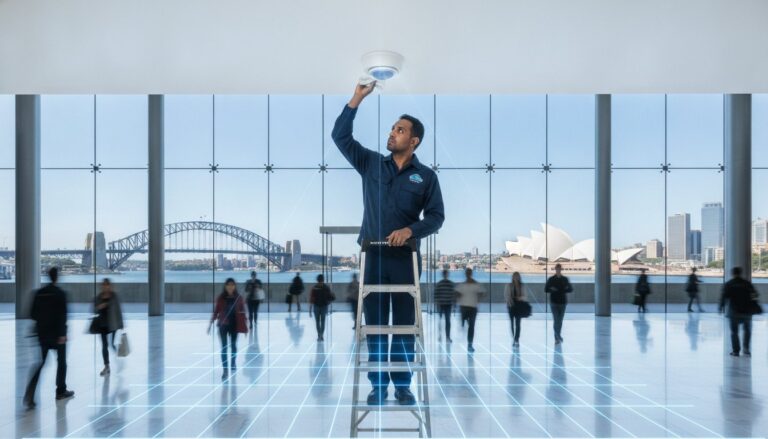
Professional site surveys are the first step in our process. We don’t guess where a sensor should go; we use spatial mapping to ensure 100% coverage of your entry points. Our specialists work with your historical data to calculate the potential ROI, often identifying opportunities to increase sales by 5% or more through better staff scheduling based on precise traffic flows. A mid-sized Australian retailer typically sees these systems pay for themselves within 8 to 14 months through optimized roster management and captured sales opportunities.
Contact Footfall Australia for a tailored technology assessment to determine the ideal infrared vs video people counter configuration for your specific location.
Securing Your Strategic Advantage in 2026
Success in the Australian retail landscape now requires more than just counting heads; it demands a clear understanding of the human narrative within your physical space. While legacy infrared systems offer basic tallies, they lack the depth needed for modern spatial analytics. Deciding between an infrared vs video people counter comes down to the necessity of precision. 3D video technology provides the granular data required to optimize staff rosters and increase conversion rates by mapping high-traffic zones and dwell times. Accuracy is the foundation of every profitable decision your team makes.
Footfall Australia brings 20+ years of local expertise to your operations, ensuring your business stays ahead of shifting consumer trends. We guarantee 98% accuracy with the FootfallCam Pro2, a benchmark that major Australian retail brands rely on to eliminate operational guesswork. Our systems ensure full compliance with local privacy regulations while delivering actionable intelligence that translates directly into A$ revenue growth. Don’t let your strategy rest on outdated estimates when you can harness evidence-based success today.
Upgrade your data with Footfall Australia’s AI-driven solutions and lead your market with confidence.
Frequently Asked Questions
Is a video people counter the same as a security camera?
No, a video people counter is a dedicated analytical sensor rather than a surveillance tool. While security cameras record footage for identification, high-end video counters process images locally and only transmit numerical data. This architecture ensures 98% accuracy in traffic counts without compromising the privacy of your visitors or staff members.
Can infrared people counters distinguish between adults and children?
Standard infrared counters can’t differentiate between adults and children because they rely on simple beam breaks. These sensors record a count whenever the 850nm light beam is interrupted, regardless of the person’s height. When comparing an infrared vs video people counter, the video option is superior for demographic segmentation because it uses 3D depth maps to filter out objects below 130cm.
How many video counters do I need for a wide entrance?
You typically need one video counter for every 3 to 4 metres of entrance width. Most 3D sensors cover a specific field of view based on a standard mounting height of 3.5 metres. For a 10-metre wide department store entrance, we would install 3 units and stitch the data together to create a single, seamless counting zone that eliminates double-counting.
Do video people counters work in low-light conditions?
Modern video counters function effectively in light levels as low as 2 lux. Devices equipped with Time-of-Flight technology or integrated infrared illuminators maintain 98% accuracy even in complete darkness. This ensures 24/7 reliability for bars or cinemas where lighting levels fluctuate between 5 and 50 lux throughout the business day.
Are people counters compliant with Australian privacy laws?
Yes, our systems comply with the Australian Privacy Act 1988 and the Australian Privacy Principles. Video-based sensors use privacy by design by processing all visual data on the device itself. No identifiable images of faces are stored or transmitted; the system only outputs anonymous digital coordinates and timestamps to your reporting dashboard.
What is the typical lifespan of a video-based counting system?
A high-quality video counting system has a functional lifespan of 7 to 9 years. Unlike infrared units that often require battery changes every 12 months, video sensors are typically Power over Ethernet devices. This hardwired setup reduces maintenance costs by 40% over the life of the hardware and ensures consistent firmware updates for long-term reliability.
Can I use my existing CCTV cameras for people counting with video analytics?
You can use existing CCTV, but accuracy often drops to 75% due to the camera’s angle. Security cameras are usually mounted at a 45-degree angle, which causes occlusion where one person hides another in the feed. To reach the 98% precision required for serious retail strategy, we recommend dedicated top-down sensors designed specifically for footfall analytics.
How much more expensive is a video counter compared to an infrared one?
A professional video counter typically costs between A$800 and A$1,500 per unit, while basic infrared sensors start around A$250. While the initial investment is higher, the 20% increase in data accuracy provides a faster return on investment. When evaluating an infrared vs video people counter, remember that accurate data allows you to optimize staff rosters, potentially saving a medium-sized store A$5,000 in annual labour costs.