People Counter Accuracy Standards: A Guide to Data Integrity in 2026
A recent industry study found that 15% of Australian retailers disregard their footfall data entirely when discrepancies between manual audits and automated reports exceed a 5% threshold. You likely understand the frustration of seeing your spatial analytics compromised by environmental variables like harsh afternoon shadows or dense group movement in high-traffic zones like major shopping thoroughfares. When your numbers don’t align with reality, justifying high-stakes staffing levels or A$2,000 per square metre leasing costs becomes an exercise in guesswork rather than strategy. It’s a common blind spot that prevents a true understanding of the visitor journey.
Establishing rigorous people counter accuracy standards is the only way to restore trust in your digital ecosystem and turn raw movement into intelligence. This guide provides the technical framework to ensure your data is precise, reliable, and actionable. You’ll learn how to calculate true accuracy using industry-standard formulas, implement a repeatable auditing method for your sensors, and calibrate your systems for 2026’s complex retail environments. We’ll show you how to move beyond simple statistics to a narrative of human movement you can bank on.
Key Takeaways
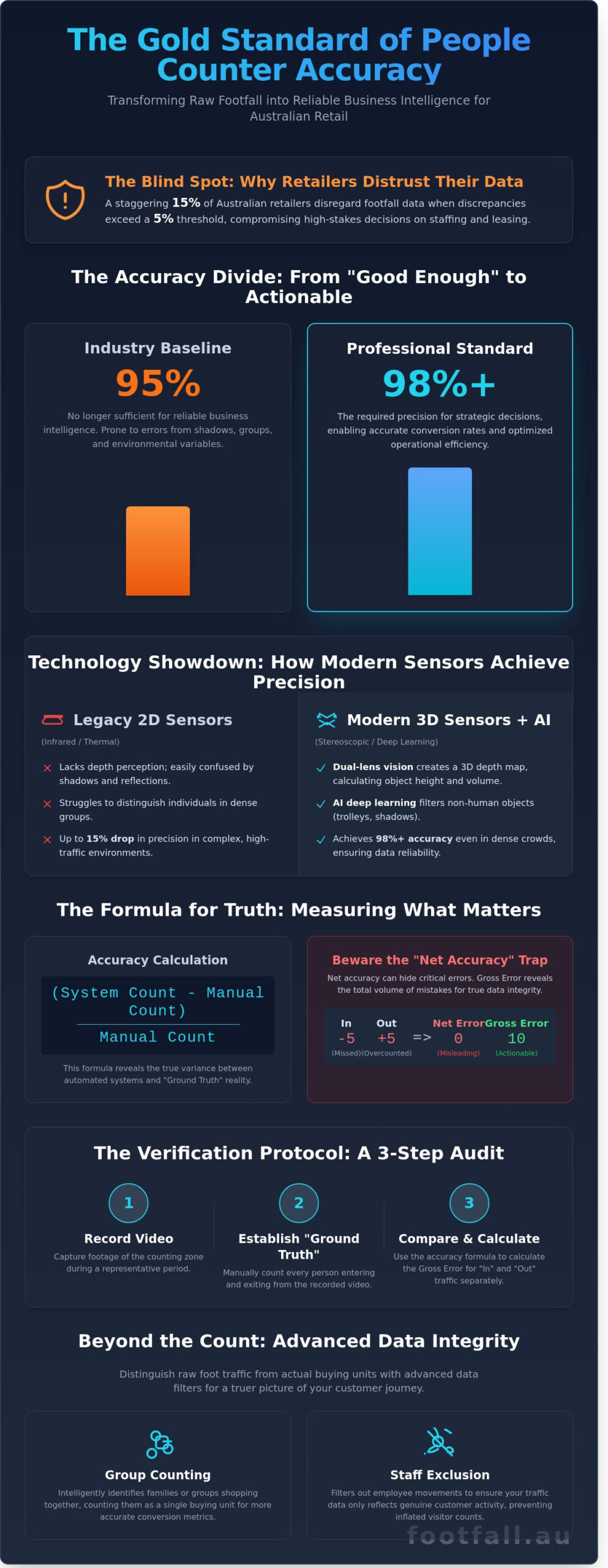
- Learn why the industry baseline of 95% is no longer sufficient and how to target the 98%+ professional standard for reliable business intelligence.
- Identify the hardware architecture and AI-driven deep learning capabilities that separate high-precision 3D sensors from outdated infrared technologies.
- Implement a rigorous verification protocol to audit your system against people counter accuracy standards using manual “Ground Truth” video comparisons.
- Distinguish between raw foot traffic and actual buying units by applying advanced data integrity filters like staff exclusion and group counting.
- Access Footfall Australia’s national support network for on-site calibration and remote auditing to ensure your data remains precise in any Australian environment.
Defining People Counter Accuracy Standards
Precision defines the divide between a tool that assists and a tool that misleads. In the Australian retail sector, where labour costs remain a significant overhead, relying on “good enough” data creates a strategic blind spot. Establishing high people counter accuracy standards ensures that every decision, from roster adjustments to marketing spend, rests on a foundation of truth rather than intuition. Data is only actionable if it’s reliable.
Industry benchmarks dictate a 95% baseline for entry-level systems, yet professional-grade solutions must exceed 98% to be considered reliable for enterprise use. This 3% difference might seem negligible, but it represents the margin between guessing your conversion rate and knowing it. Errors typically fall into two categories:
- Systematic Error: A consistent bias in the hardware or software, often caused by poor installation angles or incorrect height settings.
- Random Error: Sporadic fluctuations caused by environmental shifts, such as sudden glare on a glass floor or unusual visitor patterns.
Accuracy directly impacts the labour cost-to-sales ratio. If a sensor undercounts foot traffic by 10% during a peak Saturday rush in a Sydney CBD flagship store, management might understaff the next shift, leading to lost revenue and poor customer experiences. High-precision counting eliminates these invisible leaks in operational efficiency.
Theoretical vs. Real-World Accuracy
Manufacturers often quote performance figures derived from controlled laboratory environments. These “spec sheet” numbers rarely survive the complexity of a busy Australian shopping centre or a high-traffic transport hub. Real-world environments present challenges like groups walking abreast, children in strollers, or shoppers pushing trolleys. Understanding the evolution of People Counter Technologies reveals how modern AI-driven sensors outperform older infrared or thermal hardware by identifying these specific objects. We define the “Golden Standard” of truth through manual video verification, where human auditors review recorded footage to validate sensor data against actual human movement.
The Mathematical Formula for Accuracy
Accuracy isn’t a single, static figure. We calculate the variance using a specific formula: (System Count – Manual Count) / Manual Count. You must be wary of “Net Accuracy” because it can camouflage significant failures. If a sensor misses five people entering but overcounts five people exiting, the net error is zero, yet the data is fundamentally flawed. This is why we measure “Gross Error” to identify the total volume of mistakes. High-performing systems maintain separate, precise accuracy levels for both “In” and “Out” traffic. This distinction ensures your conversion metrics aren’t skewed by lopsided data, providing a transparent view of the visitor journey from entry to exit.
Technical Factors Influencing Sensor Precision
Hardware architecture dictates the baseline for all people counter accuracy standards. Legacy systems relying on 2D thermal or infrared sensors often fail in complex environments, as they lack depth perception and struggle to distinguish between a human and a shadow. Modern 3D stereoscopic sensors solve this by using dual lenses to mimic human binocular vision. This setup generates a high-resolution depth map, allowing the device to calculate the exact height and volume of objects moving through the field of view. By categorising objects based on spatial dimensions, these sensors achieve accuracy rates of 98% or higher, even in dense crowds where 2D sensors typically see a 15% drop in precision.
Stereoscopic Vision and AI Processing
Dual-lens technology creates a dynamic 3D environment that effectively eliminates false positives caused by floor reflections or moving shadows. AI people counting serves as a sophisticated method of pattern recognition that filters non-human movement from the data stream. By applying deep learning algorithms, the system identifies the specific skeletal shapes and gait patterns associated with human visitors. Research into AI-based People Counting confirms that these models significantly reduce the noise created by inanimate objects like shopping trolleys or display stands. Processing this data on the device itself, known as Edge computing, ensures real-time reporting while maintaining strict privacy compliance under Australian APPs, as no personal video data ever leaves the sensor.
Environmental and Installation Challenges
External variables can compromise even the most advanced hardware if not properly managed. Australian retail environments often face high-contrast lighting, where bright afternoon sun hits glass shopfronts while the interior remains relatively dim. High-dynamic-range (HDR) sensors are essential here to prevent “white-out” errors that obscure visitor movement. Installation height also plays a critical role. A sensor mounted at 3.5 metres provides a different Field of View (FoV) than one at 5 metres; failing to calibrate for these heights leads to overlapping “zones” and double-counting.
- The Doorway Swing: Physical doors that swing into the tracking zone can trigger false counts. Professional calibration creates “exclusion zones” to ignore these mechanical movements.
- Wide Entrances: Entrances wider than 4 metres often require multiple sensors stitched together. This creates a seamless tracking area where a single visitor is handed off from one sensor to the next without being counted twice.
- Floor Reflectivity: Polished marble or glass floors in high-end Australian boutiques can create ghost images. 3D depth sensing ignores these 2D reflections by focusing only on physical mass.
Precision is not a static feature but a result of meticulous setup. When you optimise your sensor placement, you transform raw foot traffic into a reliable metric for calculating conversion rates and staff ratios. These technical foundations ensure that your operational decisions rest on verified evidence rather than seasonal guesswork.
The Verification Protocol: How to Audit Your System
Precision in spatial analytics isn’t a one-time setup; it’s a continuous commitment to data integrity. To maintain high people counter accuracy standards, you must implement a structured verification protocol that moves beyond guesswork. This process ensures that the numbers appearing on your dashboard reflect the actual human movement within your Australian retail or public space.
- Step 1: Select a representative sample. Instead of a 24-hour window where traffic might be sparse, focus on a 15 to 30-minute peak period. High-density traffic challenges the sensor’s ability to distinguish between individuals walking in close proximity, providing a true stress test of the hardware.
- Step 2: Establish the ‘Ground Truth’. This involves a manual count performed via recorded video. By watching the footage and using a tally counter, you create a baseline that is 100% verified. This manual audit serves as the gold standard against which the sensor is measured.
- Step 3: Compare time-stamped logs. Align your manual tally with the sensor’s digital output. A side-by-side comparison reveals exactly where the system succeeds or fails. It’s not just about the total count; it’s about ensuring the sensor registered the movement at the correct moment.
- Step 4: Categorise errors. Identify ‘Missed Counts’ where a person wasn’t registered, and ‘False Positives’ where inanimate objects or environmental factors triggered a count. Understanding the nature of the error is vital for effective calibration.
- Step 5: Adjust and refine. Use the audit data to tweak exclusion zones. These are digital boundaries where staff or objects like security pedestals should be ignored. You can also adjust sensitivity settings to account for unique lighting conditions or floor reflections.
Setting Up Your Accuracy Audit
High-traffic bursts provide more actionable data than long periods of inactivity. If a sensor maintains 98% accuracy during a Saturday rush in a busy Sydney CBD storefront, it’ll likely exceed that during quieter weekday mornings. You’ll need basic video playback software and a simple tally counter to perform this manual verification. Modern systems often allow for remote support, where technicians use your audit findings to fine-tune sensor thresholds from a distance. This collaborative approach mirrors research from IEEE on advanced people counting, which emphasises the need for algorithmic precision in complex, high-occupancy environments.
Analyzing Audit Results
Audit results usually point to one of two issues: configuration errors or hardware limitations. Configuration issues, like poorly placed exclusion zones, are usually fixed with software updates. However, if an older sensor consistently fails to meet modern people counter accuracy standards, it’s time for a ‘Legacy Swap Out’. Replacing outdated hardware ensures your business isn’t making strategic decisions based on 10% or 15% error margins. For retailers looking to maintain peak performance, our people counter support services provide the technical oversight needed to keep your data clean and your ROI high.
Beyond the Count: Advanced Data Integrity Standards
Precision in data requires looking past the raw entry count. High-performance systems today rely on rigorous people counter accuracy standards to filter out non-sales data. Raw footfall often includes staff, security, and delivery personnel, which can inflate traffic figures by up to 15% in a typical Australian retail environment. This inflation skews conversion rates, leading to flawed labour scheduling and performance reviews. True data integrity ensures that every digit recorded represents a genuine sales opportunity.
To achieve this, advanced systems utilise specific protocols to maintain data purity across complex environments:
- Group Counting: Identifying “Buying Units” instead of individual visitors. A family of four represents four people but usually only one purchase decision. Algorithms now cluster these individuals to provide a more realistic view of sales potential.
- Multi-entrance Synchronisation: Complex layouts with multiple entry and exit points require real-time communication between sensors. This eliminates double-counting when a visitor enters through a mall-facing door and exits via a street-facing one.
- Path Tracking: Distinguishing between a customer who enters the store and a passer-by who merely steps over the threshold before turning back.
Staff Filtering and RFID Integration
AI-driven sensors now distinguish staff from shoppers by analysing movement patterns or identifying specific uniforms. For 100% accuracy, many Australian retailers use wearable RFID tags. These small, discreet devices signal the sensor to automatically subtract the wearer from the total count. Accurate staff exclusion is the primary factor in improving the reliability of your retail conversion rate metrics. It ensures you’re measuring your team’s performance against actual sales opportunities rather than just door swings. It’s the difference between guessing your potential and knowing it.
Behavioural Analytics Accuracy
Standardising the definition of an “engaged” visitor is essential for spatial analytics. Most high-end sensors define engagement as a dwell time exceeding 30 seconds in a specific zone. This prevents “pass-through” traffic from being counted as genuine interest. Heatmap accuracy relies on these thresholds to ensure spatial data reflects real intent. See how footfall data analysis transforms raw counts into strategy. By mapping the visitor journey with sub-metre precision, businesses can optimise floor layouts based on evidence rather than intuition. These people counter accuracy standards turn a simple tally into a sophisticated map of human behaviour.
Empower your business with evidence-based strategy. Contact us for a precision-engineered counting solution.
Footfall Australia: Your Partner in Data Precision
Footfall Australia understands that data is only as valuable as its precision. We provide the technical infrastructure necessary to meet and exceed global people counter accuracy standards across the diverse retail and public landscapes of Australia. Our approach combines industry-leading hardware with a rigorous verification process, ensuring that every visitor count reflects reality. We remove the guesswork from operations, allowing your leadership team to make decisions based on evidence rather than intuition.
The FootfallCam Pro2 Advantage
The FootfallCam Pro2 serves as the foundation of our accuracy promise. This device utilizes dual stereoscopic lenses to create a 3D depth map of the entrance, allowing it to distinguish between human beings and inanimate objects like shopping trolleys or shadows. When combined with advanced AI algorithms, this hardware achieves a verified 99.5% accuracy rate. It functions reliably in challenging Australian conditions, including high-glare glass shopfronts and varying lighting levels often found in CBD locations.
- Stereoscopic Vision: 3D depth sensing eliminates double-counting and ignores non-human objects.
- AI-Driven Analytics: Continuous machine learning improves counting logic in crowded environments.
- Privacy by Design: The system processes data locally on the edge, ensuring full compliance with GDPR and Australian Privacy Principles without capturing personally identifiable information.
Strategic Implementation Nationwide
Managing people counting systems Australia-wide requires more than just high-end sensors. It demands a structured deployment strategy. Footfall Australia maintains a national support network that handles everything from initial placement to on-site calibration. We don’t just ship boxes; we provide a complete Accuracy Guarantee. This includes video proof of performance, where we overlay counting lines on actual footage to audit the system’s precision manually. It’s a transparent way to prove the technology works exactly as promised.
For national portfolios, consistency is vital. Whether you’re managing 5 sites or 500, we ensure that every sensor meets the same high people counter accuracy standards. Our remote data auditing team monitors system health daily, identifying and resolving discrepancies before they impact your reporting. This proactive maintenance keeps your data clean and actionable for the long term. It’s about turning foot traffic into a narrative of movement you can trust. Book a data integrity consultation today to audit your current system and secure the precision your business strategy demands.
Securing Your Strategic Advantage Through Data Precision
High-quality spatial analytics transform raw foot traffic into a narrative of human movement. Adhering to rigorous people counter accuracy standards ensures your conversion rates and dwell time metrics remain beyond reproach. Precision matters because every 1% margin in operational efficiency directly impacts your bottom line. Footfall Australia brings over 20 years of experience to the Australian market, providing the technical eyes needed to decode the visitor journey with absolute certainty. We eliminate guesswork by delivering a video-verified 99.5% accuracy guarantee, supported by dedicated national maintenance plans designed for local conditions. Reliable data is the only foundation for growth in 2026. It’s time to validate your system and ensure your strategic decisions are powered by evidence rather than assumptions. Our team provides the clarity you need to lead your industry with confidence. Request a Professional Accuracy Audit for Your Business and start optimizing your physical space today. Your future operations deserve the highest level of technical integrity.
Frequently Asked Questions
What is the industry standard for people counting accuracy?
The industry benchmark for high-performance systems is 98% or higher. This level of precision ensures that retail managers can trust their conversion rate data for strategic planning. Achieving these people counter accuracy standards requires 3D stereoscopic technology that filters out non-human objects like prams or shopping trolleys. Systems falling below 95% often lead to skewed data that misrepresents store performance and staffing requirements.
How often should I audit my people counting system?
You should audit your system every 6 months to maintain peak performance. Physical changes in your store, such as new displays or modified lighting, can shift sensor perspectives over time. A bi-annual verification involves comparing manual video counts against system data for a 30 minute sample period. Regular checks ensure your data remains actionable and reflects true visitor behavior throughout the Australian retail calendar.
Can people counters distinguish between adults and children?
Modern 3D sensors distinguish between adults and children by measuring height with a 99% success rate. Most Australian retailers set a height threshold, often 1.3 meters, to filter out children who don’t influence primary purchasing decisions. This capability allows businesses to isolate buying units rather than just raw foot traffic. It provides a clearer picture of your actual sales opportunities and customer demographics without counting families as multiple leads.
Do environmental factors like shadows affect 3D people counters?
3D people counters are immune to shadows because they use dual lenses to create a three-dimensional depth map. Unlike older 2D systems that rely on color contrast, 3D technology identifies the physical volume of a person. This means bright sunlight or flickering shadows across a mall entrance won’t trigger false counts. You get consistent data regardless of the time of day or shifting weather conditions outside your storefront.
How does staff exclusion improve my data accuracy?
Staff exclusion improves data accuracy by removing employees from your total visitor count, which can inflate traffic figures by 15% in service-heavy environments. Using Bluetooth Low Energy tags or AI-driven shape recognition ensures your conversion rates reflect genuine customer interest. High-precision people counter accuracy standards rely on this distinction to prevent operational noise from distorting your key performance indicators. It allows for more precise labor scheduling based on actual customer arrivals.
What happens if my people counter doesn’t meet the 98% accuracy standard?
If your counter falls below the 98% threshold, you must recalibrate the sensor or check for mounting obstructions. A 5% error rate might seem small, but it can lead to a A$10,000 discrepancy in projected revenue calculations for high-volume sites. Inaccurate data results in poor staffing decisions and missed sales targets. Technical teams usually resolve these issues by adjusting the counting zones or updating the sensor’s firmware to better handle specific entrance dynamics.
Is video-based people counting compliant with Australian privacy laws?
Video-based counters are compliant with the Australian Privacy Act 1988 when they process data at the edge without storing personally identifiable information. These sensors convert live footage into anonymous coordinates or mathematical strings immediately. No images of faces or identifiable features ever leave the device or reach the cloud. This approach ensures your business gathers vital spatial analytics while fully respecting the privacy rights of every visitor entering your premises.
Can a people counter work accurately in low-light conditions?
Advanced sensors work accurately in low-light conditions by using integrated infrared illumination or Time-of-Flight technology. These systems function in environments with as little as 0.5 lux, making them ideal for cinemas or late-night venues. They don’t require visible light to map the environment, so they maintain 98% accuracy during after-hours events or in dimly lit corridors. You get reliable 24/7 monitoring without needing to increase your energy costs for additional lighting.