Footfall Data Analysis: A Strategic Guide to Actionable Insights
You have the visitor numbers. You know precisely how many people walk through your doors. But what story are those figures truly telling you about your business? For many Australian retailers and venue managers, this data remains a list of numbers rather than a roadmap for growth. This is where strategic footfall data analysis moves beyond simple headcounts. It provides the critical intelligence needed to decode the ‘why’ behind the ‘how many’, revealing the distinct patterns of human behaviour within your physical space.
This guide is designed to show you how to transform that raw data into your most valuable strategic asset. Prepare to make confident, evidence-based decisions that optimise everything from staffing schedules to store layout. We will walk you through the process of proving the ROI of your marketing campaigns and gaining a decisive competitive advantage. It’s time to stop operating on guesswork and start building a more profitable, efficient business backed by actionable insights.
Key Takeaways
- Move beyond simple visitor counts to understand foot traffic as a complete customer journey, revealing key patterns in visitor behaviour.
- Learn a repeatable framework that transforms raw numbers into a continuous cycle of strategic business intelligence.
- Translate insights from footfall data analysis into direct action, learning how to respond to specific trends with targeted operational changes.
- Discover the core metrics and technologies that form the foundation of accurate analysis, ensuring your strategic decisions are based on reliable data.
What is Footfall Data Analysis (And Why It’s More Than Just Counting Heads)
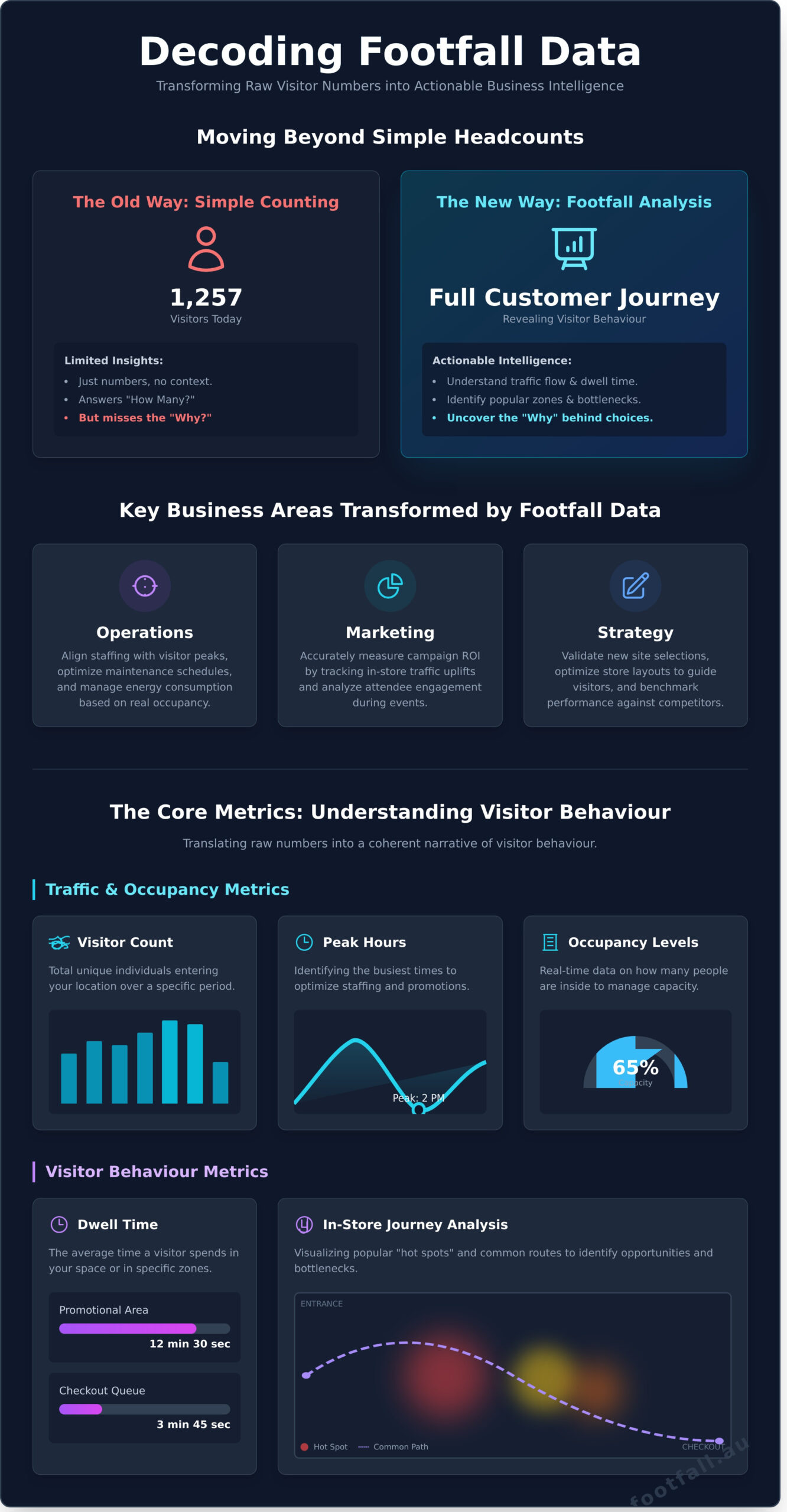
For decades, physical businesses have relied on a simple metric: the number of people walking through the door. But this is like judging a website’s success by its hit count alone. Modern footfall data analysis moves far beyond this, interpreting the rich patterns of how visitors move, interact, and behave within a physical space. It evolves traditional crowd counting techniques into a source of deep strategic intelligence. While your sales data shows you what was purchased, footfall analysis reveals the crucial context-the why behind customer decisions, illuminating the entire visitor journey from entrance to exit.
The core goal is to transform raw movement data into actionable business intelligence, empowering you to make decisions with precision and confidence.
The Foundational Importance for Physical Businesses
Think of it as the Google Analytics for your physical space. Just as e-commerce businesses optimise every click, physical venues must optimise every step a visitor takes. Understanding traffic flow, dwell times, and high-engagement zones is the first, essential step toward increasing conversions and revenue. This data provides an unbiased measure of a location’s true performance, revealing whether your store is capturing its full potential or if operational friction is turning potential customers away before they can convert.
Key Business Areas Transformed by Footfall Data
The insights generated are not merely interesting; they are actionable and drive efficiency across core business functions. By turning raw movement data into clear intelligence, you can make evidence-based decisions that deliver a measurable return on investment.
- Operations: Align staffing schedules with real-time visitor peaks and lulls, optimise maintenance and cleaning routines for minimal disruption, and manage energy consumption based on actual occupancy.
- Marketing: Accurately measure the effectiveness of campaigns by tracking in-store traffic uplifts. Quantify the ROI of events and promotions by analysing attendee behaviour and engagement within your venue.
- Strategy: Validate new site selections with predictive traffic models, optimise store layouts to guide visitors toward key products, and benchmark your performance against anonymised local competitors to understand your market share.
The Core Metrics: Understanding the Language of Visitor Behaviour
Effective footfall data analysis begins with a clear understanding of the core metrics that translate raw numbers into a coherent narrative of visitor behaviour. These key performance indicators (KPIs) are not just isolated statistics; they are the vocabulary your physical space uses to communicate its strengths and weaknesses. By tracking these metrics over time, you can move beyond simple counts to identify meaningful trends and make evidence-based strategic decisions. To provide clarity, we group these essential metrics into three distinct categories: Traffic, Behaviour, and Performance.
Traffic & Occupancy Metrics
This foundational category measures the volume and flow of people. Accurately measuring your visitor count is the first step, a process that has evolved significantly with the advent of Modernized Crowd Counting Strategies that leverage AI for superior precision. Key metrics include:
- Visitor Count: The total number of unique individuals entering your location over a specific period (hour, day, week).
- Peak Hours: Identifying the busiest times of day and days of the week to optimise staffing, promotions, and maintenance schedules.
- Occupancy Levels: Real-time data on how many people are inside your premises at any given moment, crucial for managing capacity and enhancing customer experience.
Visitor Behaviour Metrics
Once inside, what do your visitors do? Behavioural metrics decode the customer journey, revealing how people interact with your space. This layer of footfall data analysis provides deep, actionable insights into layout effectiveness and product placement.
- Dwell Time: The average duration a visitor spends within your entire space or in specific, defined zones. High dwell time in a promotional area can indicate strong engagement.
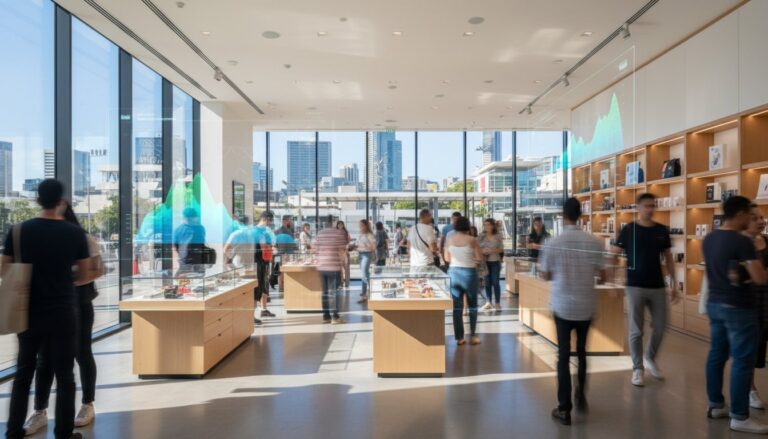
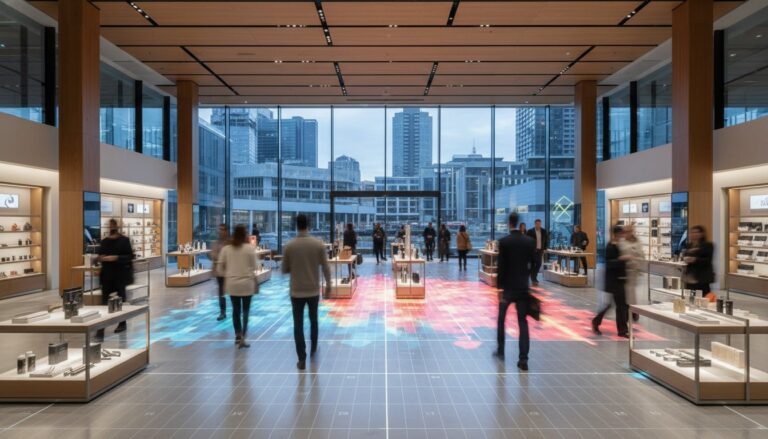
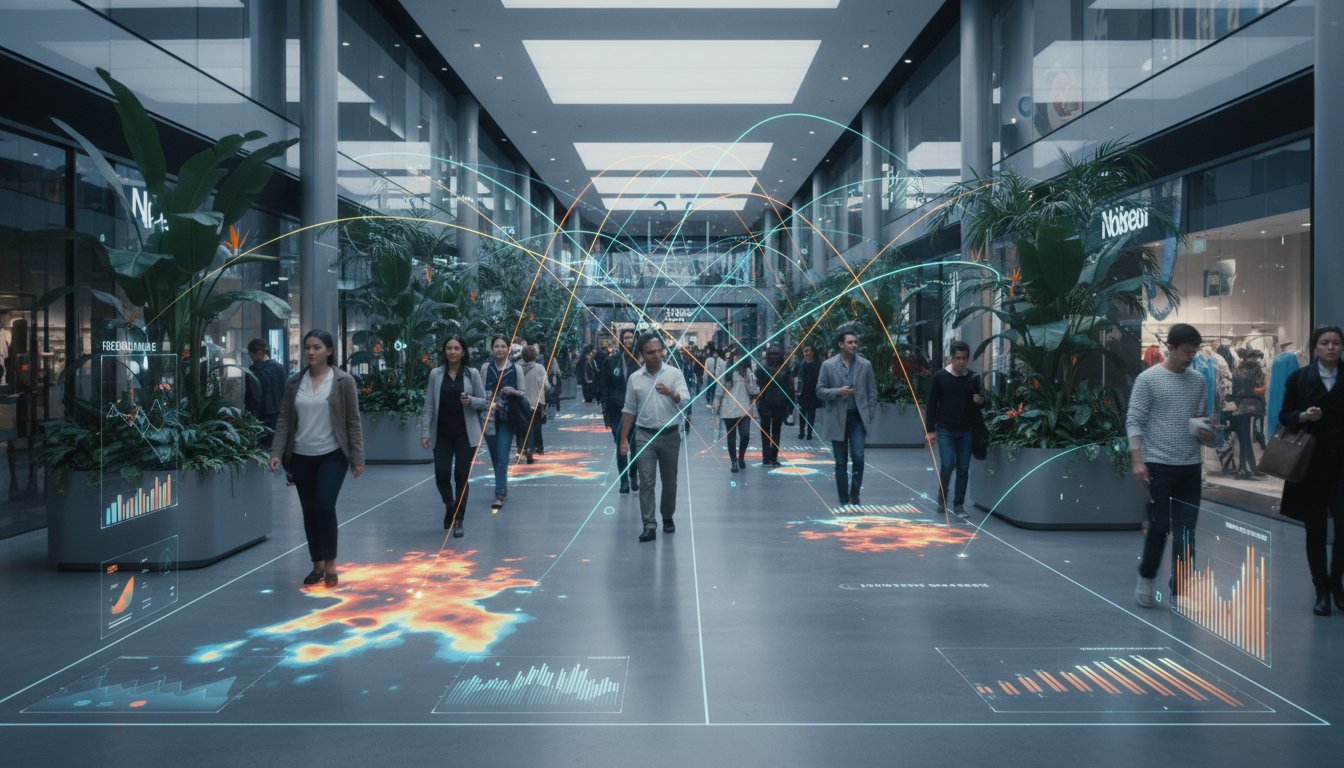
- Heatmaps: A powerful visual representation of your floor plan, highlighting areas of high and low traffic. Use this to identify popular “hot spots” and dead zones that may need revitalising.
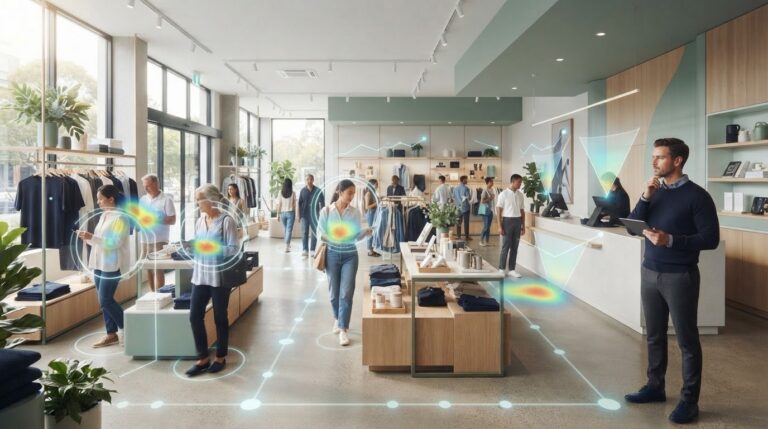
- Visitor Path: Analysis of the typical routes customers take, revealing popular journeys and potential bottlenecks.
Performance & Efficiency Metrics
This is where data connects directly to your bottom line. Performance metrics measure the commercial effectiveness of your foot traffic and operational efficiency, turning visitor insights into measurable business outcomes.
- Conversion Rate: The percentage of total visitors who make a purchase. This is the ultimate measure of your store’s ability to turn browsers into buyers.
- Capture Rate: The percentage of people passing by your storefront who choose to enter. A low capture rate may signal issues with window displays or external appeal.
- Staffing Ratio: The ratio of staff to visitors. Aligning employee numbers with real-time traffic ensures optimal customer service without over-staffing during quiet periods.
A 4-Step Framework for Effective Footfall Data Analysis
Raw data is just noise; strategic insight is the signal. To translate visitor counts into tangible business growth, you need a structured approach. Effective footfall data analysis is not a one-time report but a continuous cycle of observation, insight, and action. This simple, repeatable four-step framework ensures you extract maximum value from your data, empowering you to make decisions with quiet confidence.
Step 1: Establish Baselines and Identify Trends
Before you can identify what is exceptional, you must first understand what is normal. Begin by analysing historical data to establish a baseline for your typical traffic patterns. Compare visitor numbers day-over-day, week-over-week, and year-over-year to uncover recurring peaks, troughs, and crucial seasonal variations. This foundational understanding allows you to spot anomalies instantly and provides the context needed for all further analysis. As experts at Forbes note, effectively Measuring Foot Traffic Trends is fundamental to building a responsive and forward-thinking business strategy.
Step 2: Segment Your Data for Deeper Insights
With a baseline established, the next step is to look deeper. Segmenting your data reveals the nuanced behaviours behind the headline numbers. Break down overall traffic by time of day to identify power hours, or by day of the week to pinpoint your most valuable trading periods. For multi-entrance venues or large stores, compare performance across different zones or departments to understand the complete visitor journey and identify high-value areas that deserve more attention.
Step 3: Correlate with Other Business Data
Footfall data achieves its full potential when integrated with other key business metrics. This is where you connect visitor behaviour to commercial outcomes. By overlaying different data sets, you can answer critical operational questions and unlock a new level of business intelligence.
- Point-of-Sale (POS) Data: Move beyond simple visitor counts to calculate precise conversion rates and average transaction value per visitor.
- Marketing Calendars: Measure the direct impact of your campaigns by correlating advertising spend and promotional activity with traffic lift.
- Staffing Schedules: Optimise labour costs by aligning your team schedules with actual peak and lull periods, ensuring service levels are high when it matters most.
Step 4: Formulate Hypotheses and Test
The final step transforms insight into action. Use your analysis to formulate testable hypotheses about your physical space. For example, “Will moving our highest-margin products to the high-traffic zone near the entrance increase their sales by 10%?” Implement the change, then use your footfall data to precisely measure the impact on traffic flow, dwell time, and ultimately, sales. This iterative process of testing and measuring turns your business into a dynamic environment, continuously optimised for performance.
From Data to Decisions: Turning Analytics into Actionable Strategies
Raw data provides the what; strategic analysis reveals the why and the how. The true power of footfall intelligence is unlocked when metrics are translated into measurable business improvements. This process moves your organisation away from intuition-based decisions and towards a culture of evidence-backed strategy, de-risking change and maximising return on investment. The key is to connect specific data points to concrete operational, marketing, and strategic actions.
Optimising Operations and Staffing
Efficient operations are the backbone of a profitable physical location. By decoding visitor behaviour patterns, you can align resources with actual demand, enhancing customer experience and eliminating costly inefficiencies.
- If data shows a visitor peak every Saturday between 1 PM and 3 PM, then adjust staff schedules to ensure optimal coverage, reducing queue times and preventing lost sales.
- If heatmaps reveal a persistent bottleneck near the checkout, then redesign the store layout to improve traffic flow and create a more comfortable shopping environment.
- If dwell time is consistently low in a key promotional area, then re-merchandise the display or improve signage to better capture visitor attention and engagement.
Enhancing Marketing and Merchandising
Effective marketing drives traffic, but smart merchandising converts that traffic into revenue. Footfall data provides a direct feedback loop on your commercial initiatives, allowing for rapid, intelligent adjustments.
- If a new A$10,000 campaign increases traffic but not sales, then re-train staff on the promotion’s key selling points to better assist interested customers.
- If high volumes of traffic pass a window display but the entry rate is low, then test a new display. This A/B testing approach provides clear evidence of what truly attracts your target audience.
- If visitor path data shows a common journey, then place high-margin impulse items along these popular routes to maximise basket size.
Driving Strategic Business Growth
Beyond daily operations, a robust footfall data analysis program informs high-level strategic planning. It provides the objective evidence needed to make confident, forward-thinking decisions about the future of your physical network.
- Benchmark traffic and conversion rates against your other locations to identify top-performing sites and replicate their success factors across the portfolio.
- Use capture rate data from the surrounding area to accurately evaluate the viability of a potential new site before committing to a lease.
- Present data-driven reports to stakeholders to justify investments, prove the ROI of capital projects, and build a compelling case for expansion.
Ultimately, this approach ensures that every department-from marketing to operations to finance-is working from a single source of truth. It transforms abstract numbers into a clear roadmap for sustainable growth. Discover how to translate your data into decisive action at footfall.au.
Choosing the Right Tools for Accurate Footfall Analysis
The strategic value of your business intelligence is directly linked to the quality of its underlying data. To transform raw foot traffic into actionable insights, you need a system built on precision and reliability. An effective footfall data analysis solution consists of two critical components: the high-accuracy sensor that captures the data and the intelligent software platform that interprets it. Choosing the right combination ensures your decisions are based on hard evidence, not guesswork.
The Importance of High-Accuracy Sensors
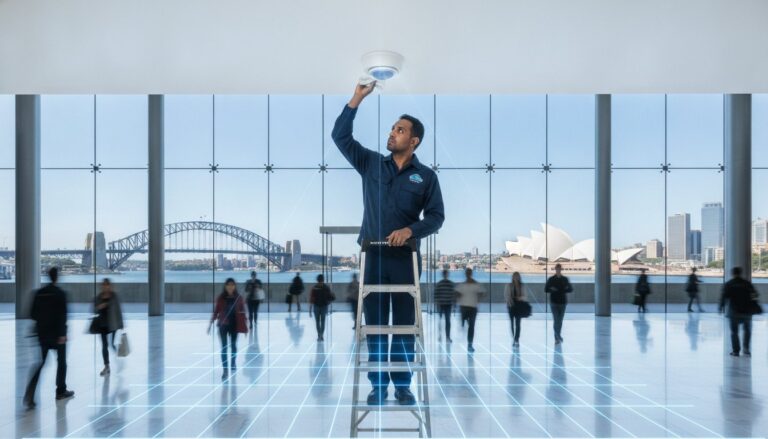
Modern people counting relies on advanced technology to deliver verifiable results. Technologies like 3D stereo vision provide a crucial advantage, achieving over 98% accuracy by distinguishing individuals with depth perception. This precision is non-negotiable; inaccurate counts lead to flawed conclusions about peak hours, staffing levels, and marketing effectiveness. Furthermore, superior sensors can intelligently filter out non-customer traffic-such as staff, children, and shopping trolleys-ensuring the data reflects genuine customer behaviour.
What to Look for in an Analytics Platform
Even the most accurate data is useless without a powerful and intuitive platform to make sense of it. The software is where numbers become a narrative of your customer journey. A robust analytics platform should provide:
- An Intuitive Dashboard: Complex metrics should be presented in clear, customisable visualisations for at-a-glance understanding. Modern platforms like FootfallCam V9 centralise data from multiple sites into one seamless interface.
- Automated Reporting: Save valuable time and ensure consistency by scheduling regular reports to be sent directly to key stakeholders, enabling proactive management.
- Seamless Integration: The ability to integrate with other business systems, such as Point of Sale (POS) terminals, unlocks deeper metrics like sales conversion rates and optimises the complete operational picture.
Ultimately, a successful footfall data analysis strategy is powered by technology designed for clarity and precision. Investing in an integrated hardware and software solution removes uncertainty and empowers you to make smarter, data-driven decisions for sustainable growth. See how precise people counting technology powers superior analysis and gives Australian businesses a competitive edge.
Transforming Visitor Data into Your Strategic Advantage
As we’ve explored, moving beyond simple headcounts to understand the nuances of visitor behaviour is fundamental. Effective footfall data analysis is the bridge between observing customer traffic and strategically influencing it for business growth. By applying a structured framework, you can decode the visitor journey, turning raw metrics into a clear roadmap for operational improvements and enhanced customer experiences.
For businesses ready to replace guesswork with certainty, the right partner is essential. Trusted by Australian businesses since 2004, Footfall Australia delivers high-precision technology with over 98% accuracy. Our powerful analytics software provides the seamless, actionable insights needed to optimise staffing, marketing, and layout decisions with confidence.
Ready to see the difference precision makes? Request a demo to see how our data can transform your business. Take the first step towards evidence-based success and unlock your location’s true potential.
Frequently Asked Questions About Footfall Data Analysis
How is footfall data analysis different from web analytics?
Web analytics provides intelligence on your digital storefront, tracking clicks, bounce rates, and online conversions. In contrast, footfall data analysis decodes the physical visitor journey within your space. It measures how many people enter, where they go, how long they stay, and what paths they take. This provides a precise, evidence-based understanding of in-person behaviour, allowing you to optimise your physical layout, staffing, and marketing with the same confidence you apply to your website.
What are the privacy implications of tracking footfall, and how is it managed?
Privacy is a paramount design principle in modern footfall systems. Our technology captures anonymous data points, counting individuals without collecting any personally identifiable information (PII) like faces or names. This ensures full compliance with the Australian Privacy Act. The focus is on aggregate trends and behavioural patterns-the ‘what’ and ‘where’ of movement, not the ‘who’. This allows businesses to gather actionable intelligence while respecting visitor anonymity and upholding data protection standards.
How much historical data do I need to start seeing meaningful trends?
You can begin identifying initial patterns, such as daily peak hours and weekend traffic variations, within just two to four weeks of data collection. However, for more strategic insights like seasonal trends or the impact of marketing campaigns, we recommend a baseline of at least three months. A full year of historical data provides the most comprehensive intelligence, allowing you to accurately forecast demand, plan staffing, and measure annual growth with a high degree of precision.
Can footfall analysis work for businesses other than retail stores?
Absolutely. While retail is a primary application, any organisation managing a physical space can gain immense value. Museums and galleries use it to understand exhibit engagement and manage crowd flow. Commercial properties analyse tenant and visitor traffic to optimise building services. Even transport hubs and smart cities leverage this data to improve public infrastructure and safety. The principles of understanding the visitor journey and optimising space based on movement patterns are universally applicable for enhancing efficiency.
How do I calculate the ROI of investing in a footfall analysis system?
Calculating ROI is a direct process of linking insights to measurable outcomes. For example, if data shows you can reduce staffing by one person during quiet periods, you can quantify the annual wage savings (e.g., over A$50,000). Similarly, you can measure the sales lift from a campaign or a store layout change informed by traffic data. By attributing specific revenue gains and cost reductions to data-driven decisions, you build a clear, evidence-based case for the system’s financial return.
What’s the difference between footfall and conversion rate?
Footfall is the total number of people who enter your space; it represents your total sales opportunity. The conversion rate is the percentage of those visitors who complete a desired action, typically making a purchase. For example, if 1,000 people enter (footfall) and 100 make a purchase, your conversion rate is 10%. Understanding both metrics is critical. High footfall with a low conversion rate might indicate issues with layout, pricing, or service that need strategic attention.