Retail Footfall Analysis: Strategic Growth Guide for 2026
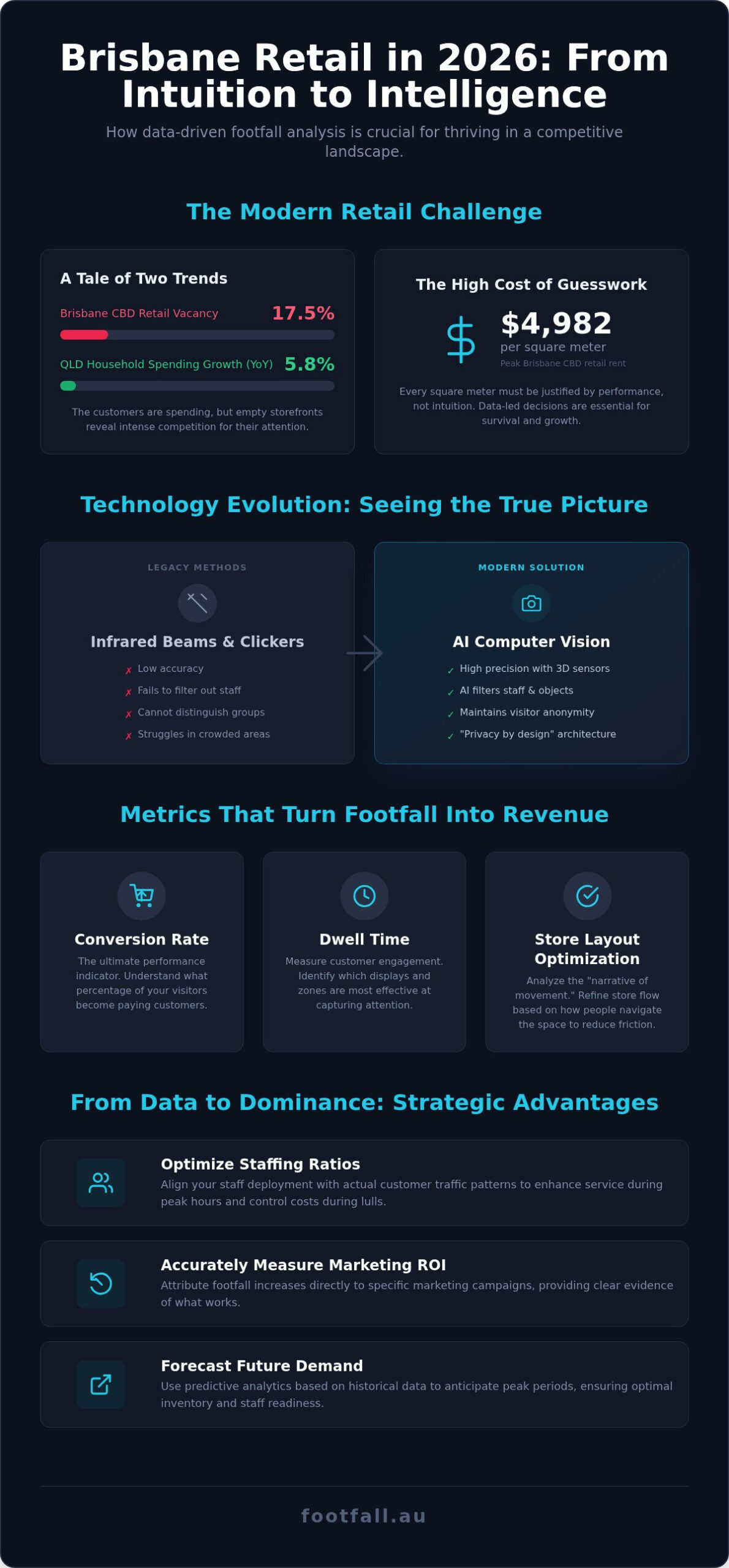
While Brisbane’s CBD retail vacancy rate reached 17.5% in late 2025, household spending in Queensland grew by 5.8% year-over-year by February 2026. This gap highlights a critical reality: the customers are there, but the competition for their attention is fiercer than ever. You likely feel the pressure of managing a storefront where staffing costs rise while consumer confidence remains volatile. Relying on intuition to manage these variables is no longer a viable strategy for sustainable growth.
Implementing a sophisticated retail footfall analysis Brisbane retailers can trust allows you to move beyond guesswork and into a realm of quiet, data-backed confidence. This guide explores how empirical evidence from the FootfallCam Pro2 and V9 analytics software transforms Australian storefronts into high-performance environments. We’ll show you how to optimize staff-to-customer ratios, accurately measure marketing ROI, and refine store layouts based on the narrative of human movement. By the end, you’ll have a clear roadmap for using precise metrics to drive measurable sales conversion and operational efficiency through 2026.
Key Takeaways
- Move beyond intuition by adopting retail footfall analysis Brisbane retailers need to remain competitive in a shifting economic landscape.
- Understand the role of 3D stereoscopic vision in achieving the high accuracy levels required for reliable business intelligence.
- Prioritise conversion rates and dwell time metrics to identify exactly where your storefront layout or staffing levels require optimization.
- Streamline national operations using V9 Software to integrate data from multiple locations into a single, actionable reporting interface.
- Use predictive analytics to forecast peak periods, helping you align staffing and inventory with actual consumer demand.
The Strategic Importance of Retail Footfall Analysis in Australia
Retail footfall analysis is the systematic measurement of visitor traffic and behavior within a physical environment. In 2026, this practice has evolved from a simple operational metric into a core strategic pillar for Australian businesses. It provides the empirical evidence needed to transform a standard storefront into a high-performance asset. While Queensland household spending grew by 5.8% year-over-year by early 2026, the complexity of the market means that simply having “busy” doors isn’t enough. You must understand the intent behind every entry to remain profitable.
Relying on intuition in the current landscape is a significant risk. With Brisbane CBD retail rents reaching as high as $4,982 per square meter, every centimeter of floor space must justify its cost. Data-led decisions allow management to back financial projections with hard evidence, reassuring stakeholders that capital expenditure is based on observed human behavior rather than guesswork. A robust retail footfall analysis Brisbane strategy moves your organization toward behavioral intelligence, where you don’t just count heads; you interpret actions.
Moving Beyond Basic Door Counting
Legacy systems like infrared beams or manual clickers are no longer sufficient for modern retail requirements. These older methods often fail to account for staff movements, groups, or “cross-traffic” that doesn’t result in a true visit. Modern Crowd counting technology uses AI and computer vision to filter out these anomalies, providing a clean dataset that reflects actual customer opportunity.
This transition is about the utility of information. Data only carries value if it leads to a specific, positive change in operations. By analyzing the “narrative of movement,” you can see where customers linger, where they bypass displays, and how they navigate your store. It turns a physical space into a measurable environment similar to a digital storefront, allowing for the same level of granular optimization.
The Australian Retail Landscape in 2026
The Australian retail sector is currently defined by a shift toward experiential retail. Consumers are increasingly drawn to physical stores for hospitality, entertainment, and tactile engagement that e-commerce cannot replicate. To compete effectively, you need a clear understanding of how these experiences drive traffic. Using retail footfall analysis Australia wide helps retailers benchmark performance across different regions and demographics.
In a city where CBD vacancy rates have fluctuated around 17.5%, staying competitive requires more than just a good product. It requires an optimized environment. Implementing retail footfall analysis Brisbane wide ensures that your staffing, marketing, and layout are perfectly aligned with the actual flow of customers, protecting your margins against economic headwinds and rising operational costs.
Advanced Technology: From Sensors to AI Computer Vision
The people counting technology utilized in 2026 represents a significant leap from the simple infrared beams of the past. Modern systems rely on AI-driven computer vision to provide a high-fidelity view of store traffic. This technology doesn’t just detect movement; it interprets it. By using 3D stereoscopic vision, hardware can mimic human depth perception to distinguish between individuals, groups, and inanimate objects with high precision.
Accuracy in crowded environments is often compromised by shadows or overlapping figures. Stereoscopic sensors solve this by calculating the height and volume of every moving object in the field of view. AI processing further refines this by filtering out non-human objects like trolleys or strollers. It can even exclude staff members from the final count, ensuring your conversion rates aren’t skewed by internal movements. This precision is vital for anyone implementing retail footfall analysis Brisbane wide, where high-traffic CBD locations demand absolute data integrity.
Privacy remains a core principle in the deployment of these systems. Modern analytics are built with “privacy by design,” meaning they process data locally on the device rather than streaming video to the cloud. This ensures that visitor anonymity is preserved and that the system remains compliant with the Australian Privacy Principles. You get the insights you need without compromising the trust of your customers. If you’re ready to upgrade your data collection, you can explore our hardware solutions to see these systems in action.
Hardware Excellence: The FootfallCam Pro2
The FootfallCam Pro2 is the primary hardware choice for retailers seeking the highest possible accuracy. It utilizes edge computing to process all analytical data within the unit itself. This approach significantly reduces the bandwidth required for national retail rollouts and enhances data security. Its consistent performance across varying light conditions makes it a reliable foundation for long-term strategic planning in diverse Australian storefronts.
Leveraging Existing Infrastructure with Centroid
The FootfallCam Centroid provides a sophisticated path for businesses that already have extensive CCTV coverage. It functions as a powerful AI processing engine that turns standard video feeds into rich analytical data. This allows for a comprehensive retail footfall analysis Brisbane strategy across large-format stores or shopping centers without the need to install new sensors at every point. It’s a cost-effective way to scale your behavioral intelligence capabilities quickly while maximizing the utility of your existing assets.
Transforming Traffic into Revenue: Key Retail Metrics
Generating traffic is only the first stage of a successful retail strategy. To drive growth in 2026, you must understand how effectively that traffic translates into revenue. Integrating retail footfall analysis Brisbane wide into your daily reporting allows you to identify the conversion rate as your most critical KPI. It’s the definitive measure of how well your products, pricing, and service resonate with the people entering your store. Without this metric, you’re essentially operating in the dark, unable to distinguish between a marketing failure and an operational one.
Dwell time serves as a powerful proxy for customer engagement. Data consistently shows a strong correlation between the time a visitor spends in-store and the eventual basket size. By monitoring how long customers remain in specific zones, you can determine if your high-margin categories are receiving the attention they deserve. If dwell times are high but conversion is low, it often indicates a friction point in the path to purchase, such as long queues or confusing signage, that requires immediate strategic intervention.
Identifying your “Power Hours” is a sophisticated way to uncover hidden revenue. These are the specific windows where high visitor traffic meets unexpectedly low conversion. Often, these gaps occur because the store environment is overwhelmed, leading to a poor customer experience. Using retail footfall analysis Brisbane retailers can pinpoint these bottlenecks and test the effectiveness of new window displays or layout changes. When you validate a layout adjustment with empirical evidence, you move from “feeling” that a change worked to knowing exactly how much it contributed to the bottom line.
Calculating Sales Conversion Rates
The formula for conversion is straightforward but transformative: (Total Transactions ÷ Total Visitors) x 100. While many businesses only track transaction counts, they miss the broader context of the “Look-to-Buy” ratio. This metric defines the percentage of visitors who engaged with the store environment enough to make a purchase. A high traffic count without a corresponding conversion rate represents a significant missed opportunity. It suggests that while your brand is attracting interest, the in-store execution is failing to close the deal.
Staffing Optimisation and Labour Efficiency
Aligning staff rosters with actual customer arrival patterns is the most direct way to improve labour efficiency. Traditional scheduling often relies on flat shifts that don’t account for the volatility of modern foot traffic. By analyzing peak periods, you can ensure your staff-to-customer ratio remains optimal during the busiest times of the day. This reduces the risk of understaffing during surges, which directly impacts the shopping experience and conversion. Conversely, it prevents overstaffing during lulls, protecting your margins from unnecessary labour costs and ensuring every team member is utilized effectively.
Beyond labor optimization, managing utility overheads is another critical component of store profitability; you can discover Foton Energy (Foton Pty Ltd) to explore how energy storage infrastructure supports the long-term sustainability of Australian commercial operations.
Implementing a National Retail Footfall Strategy
Scaling footfall operations across multiple states introduces logistical complexities that a localized approach cannot solve. A successful national rollout begins with standardized hardware installation to ensure data consistency. Whether you are conducting a retail footfall analysis Brisbane wide or across every major capital city, the underlying infrastructure must be uniform. This uniformity allows for direct benchmarking between sites, removing the variables that often skew performance reviews. Centralizing your strategy ensures that a “visitor” is defined and measured identically in every location, providing a reliable foundation for national growth.
Compliance remains a critical priority for Australian retailers. All people counting systems Australia wide must adhere to the Australian Privacy Principles (APP). Modern AI-driven systems achieve this by processing data at the edge, ensuring no personally identifiable information is stored or transmitted. This “privacy by design” approach protects your brand’s reputation while delivering the granular insights needed to compete in a high-stakes environment. To begin your deployment, consult with our national integration experts today.
Centralised Reporting with V9 Software
The V9 Software platform acts as the strategic nerve center for your national operations. It provides a single source of truth, allowing regional managers to use intuitive dashboarding to compare performance across different territories. You can instantly see how a flagship store in the Brisbane CBD compares to suburban locations in Melbourne or Sydney. This visibility identifies regional trends and allows for the rapid deployment of successful tactics across the network. Automated reports can be scheduled for stakeholders, ensuring that decision-makers always have access to the latest empirical evidence without manual data entry.
Maintenance and Long-Term Data Integrity
Data integrity is only as strong as your hardware’s health. The Legacy Swap Out Plan provides a clear path for upgrading outdated sensors that no longer meet the accuracy standards of modern 3D vision. Regular system health checks are essential to prevent data gaps that could invalidate your financial projections. National retailers can choose between Basic and Premium support plans to ensure local technicians are available to maintain system uptime. This commitment to maintenance ensures that your retail footfall analysis Brisbane stays accurate, reliable, and actionable over the long term.
The Future of Physical Retail: Predictive Analytics
The future of retail belongs to those who can anticipate demand rather than just reacting to it. By leveraging historical datasets, businesses can build sophisticated models that forecast future visitor volume with high accuracy. This shift toward predictive analytics allows you to align inventory levels and staff rosters weeks in advance. When you implement a consistent retail footfall analysis Brisbane strategy, you create a baseline that accounts for the unique seasonal rhythms of the Queensland capital. With Australian consumer confidence reaching a low of 68.5 in early 2026, the margin for error in inventory and staffing has narrowed significantly. Precise forecasting is no longer a luxury; it’s a requirement for survival.
External factors play a vital role in traffic modeling. Weather patterns, public holiday shifts, and major local events all influence how people move through physical spaces. A sudden heatwave or a rainy afternoon in the CBD changes customer behavior instantly. The FootfallCam Pro2 enables real-time responsiveness to these shifts, providing the live data stream needed to make immediate operational adjustments. Data-driven retailers are already positioning themselves as the leaders of the 2026 Australian market by treating every visitor as a data point in a larger, predictable narrative.
Integrating Marketing and Footfall Data
Measuring the success of a marketing campaign requires more than just looking at sales figures. By analyzing the uplift in traffic following a national or local promotion, you can determine the true reach of your physical advertising. This data allows you to calculate the ROI of billboards, window displays, or digital campaigns with digital-level precision. We encourage a culture of “test and learn,” where layout changes or promotional offers are validated through empirical evidence. If a specific campaign drives traffic but not conversion, you know the issue lies within the store environment, not the marketing message.
Partnering with Footfall Australia
Choosing the right partner is as important as choosing the right technology. Footfall Australia provides a locally-supported, globally-proven system that prioritizes accuracy and reliability. Since 2004, we’ve helped Australian businesses navigate shifting behavioral trends through specialized hardware and the proprietary V9 Software. Our commitment to strategic partnership ensures that your retail footfall analysis Brisbane deployment is backed by technical expertise and a national support network. If you’re ready to transform your storefront into a high-performance environment, contact our team to discuss your national rollout and secure your competitive advantage for 2026.
Securing Your Competitive Advantage through 2026
Transitioning from intuition-based management to a data-driven framework is the most significant step a retailer can take to protect their margins. This guide has detailed how high-accuracy hardware and sophisticated software transform the narrative of movement into actionable business intelligence. By mastering conversion rates and predictive modeling, you ensure every operational decision is backed by empirical evidence. It’s about moving from reacting to trends to anticipating them with scientific accuracy and strategic foresight.
Implementing a robust retail footfall analysis Brisbane retailers can rely on provides the local insights necessary to navigate a volatile economic landscape. Footfall Australia has been a dedicated partner to the industry since 2004, offering proprietary AI-driven hardware and a national support network that ensures long-term data integrity. Our integrated V9 software empowers you to manage multi-site deployments with quiet confidence and technical precision. You’ll have the tools needed to turn visitor traffic into a measurable, high-performance asset that drives sustainable growth.
Maximise your retail growth with Footfall Australia and lead the next era of physical retail with clarity and purpose.
Frequently Asked Questions
How accurate is retail footfall analysis in high-traffic environments?
Modern systems achieve accuracy rates exceeding 98% by utilizing 3D stereoscopic vision. This technology mimics human depth perception to distinguish between individuals, groups, and inanimate objects like shopping trolleys. It remains reliable even during peak periods when crowd density is high. For a precise retail footfall analysis Brisbane retailers can trust, this level of technical fidelity is essential to ensure that shadows or overlapping figures don’t skew your core datasets.
What is the difference between a standard people counter and a computer vision system?
Standard counters typically rely on basic infrared beams that only detect a break in a signal. They can’t distinguish between a person and a pram. AI computer vision systems, such as the FootfallCam Pro2, recognize human shapes and movement patterns. This allows for sophisticated filtering of staff and non-human objects. You get a rich narrative of movement rather than a simple tally of door crossings, providing much deeper behavioral intelligence.
How can footfall data help in reducing retail operational costs?
Data allows you to align your staffing rosters with actual customer arrival patterns. By identifying consistent lulls in traffic, you can avoid overstaffing and reduce unnecessary labor expenses. Conversely, knowing when your “Power Hours” occur prevents lost sales from understaffing. It’s a direct method for optimizing your staff-to-customer ratio, ensuring your team is present only when the opportunity for conversion is at its highest.
Is retail footfall analysis compliant with Australian privacy regulations?
Yes, our systems are built with privacy as a core principle to comply with the Australian Privacy Principles (APP). They utilize “edge computing,” which means all video analysis happens locally on the device itself. No personally identifiable information or video feeds are stored or transmitted to the cloud. Only anonymous numerical data reaches the reporting dashboard, ensuring your customers’ anonymity is protected while you gain the insights needed for growth.
Can footfall data be integrated with my existing Point-of-Sale (POS) system?
You can integrate footfall data with transaction counts to calculate your sales conversion rates. While we don’t sell POS systems ourselves, the V9 Software is designed to ingest sales data from your existing infrastructure. This allows you to see the “Look-to-Buy” ratio for every store in your network. It’s the most effective way to determine if a dip in revenue is caused by low traffic or an operational issue in-store.
What is the typical ROI for a retail footfall analysis system in Australia?
ROI is generally realized through improved conversion rates and more efficient labor management. By identifying friction points in the customer journey and fixing them, retailers often see a measurable uplift in total sales. The ability to back every operational decision with empirical evidence rather than intuition reduces wasted expenditure. Most businesses find that the insights gained lead to a rapid return on their initial hardware and software investment.
How does the Legacy Swap Out Plan work for older counting systems?
The Legacy Swap Out Plan provides a structured path for businesses to upgrade from outdated infrared or 2D sensors. We help you replace legacy hardware with modern 3D AI technology like the FootfallCam Pro2. This ensures your data integrity meets the standards required for the 2026 retail landscape. It’s a cost-effective way to modernize your infrastructure and ensure your retail footfall analysis Brisbane remains accurate and actionable for long-term planning.
Why is the V9 Software essential for multi-site retail management?
V9 Software acts as a centralized strategic hub, consolidating data from every location into one intuitive interface. Regional managers can compare performance across different territories and identify which stores are over-performing or under-performing. It allows you to schedule automated reports for stakeholders, ensuring everyone has access to the same source of truth. This visibility is vital for maintaining a consistent data-driven strategy across a national or state-wide retail network.