Store Traffic Analysis Software: Decoding the Visitor Journey in 2026
Guiding a retail business through Australia’s evolving landscape requires more than intuition; it demands precision. For too long, legacy beam counters have left local retailers navigating by guesswork, providing fragmented data that fails to justify staffing costs or measure the true impact of marketing spend. Modern store traffic analysis software changes this dynamic by decoding the human narrative behind every entry and exit. It moves beyond mere numbers, offering a sophisticated lens through which to view your physical space with quiet, data-driven confidence.
In this article, we explore how AI-driven analytics transform raw visitor data into a strategic roadmap for growth. You will discover how to achieve real-time visibility into store performance, allowing you to align staff rosters with actual peak hours and establish a clear framework for measuring retail ROI. By bridging the gap between high-tech spatial analytics and practical retail application, you can replace uncertainty with evidence-based strategy, ensuring every operational decision is backed by hard data and a deep understanding of the modern visitor journey.
Key Takeaways
- Transition from manual tallying to AI-driven automated intelligence to gain a precise, evidence-based understanding of visitor behavior in 2026.
- Decode the human path to purchase using spatial analytics and heatmapping to distinguish between staff, shopping groups, and genuine leads.
- Evaluate high-performance store traffic analysis software features, including intuitive dashboards and cross-store benchmarking for Sydney, Melbourne, and Perth locations.
- Optimise Australian retail operations by aligning staff rosters with peak traffic hours and measuring the direct ROI of local marketing campaigns.
- Leverage the integration of FootfallCam Pro2 sensors and V9 software to transform raw data into a strategic roadmap for long-term business growth.
What is Store Traffic Analysis Software and Why is it Essential in 2026?
At its core, store traffic analysis software is a sophisticated digital platform that transforms raw data from physical sensors into a narrative of human movement. In the Australian retail landscape of 2026, where every square metre of floor space must justify its cost, this technology has evolved from simple tallying into an AI-driven engine of automated intelligence. It no longer just counts entries; it decodes the visitor journey to provide a foundational understanding of how physical spaces perform.
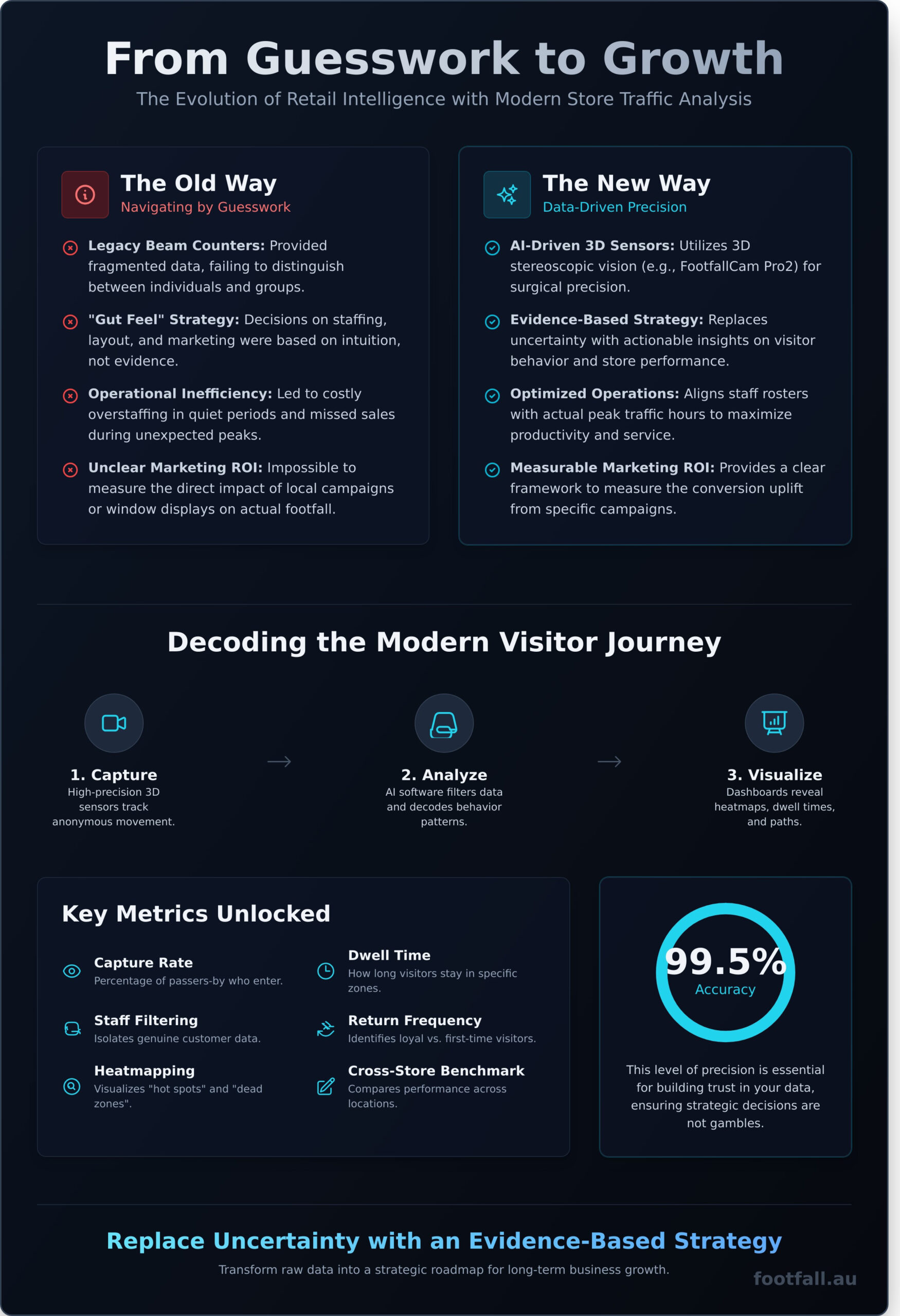
To survive the relentless pressure of e-commerce, physical retailers must master metrics that go beyond total footfall. Modern store traffic analysis software tracks capture rates-the percentage of passers-by who actually enter-as well as dwell times and return frequency. These KPIs provide the evidence-based foundation required to optimise store layouts and marketing spend in an increasingly competitive market. Decisions are no longer based on what managers think happened, but on what the data proves occurred.
The Evolution of Retail Measurement
The shift from manual counters to AI-driven spatial analytics represents a fundamental change in retail strategy. Early people counting technologies relied on basic infrared beams that often failed to distinguish between a single customer and a group. Today, 3D stereoscopic vision and cloud-based processing provide high-precision, real-time visibility. This software filters “noisy” environmental data to deliver clean, actionable insights, allowing managers to see their floor through the lens of objective reality rather than estimation.
Why ‘Gut Feel’ is No Longer a Business Strategy
Operating on intuition is a luxury the modern Australian retailer cannot afford. The cost of overstaffing during dead zones or understaffing during peaks can result in thousands of A$ in lost productivity and missed sales. Data-led operations allow for precision staffing and the validation of expensive window displays or local advertising campaigns. By moving from reactive management to proactive, data-led operations, businesses can identify blind spots and convert them into strategic advantages. This transition ensures that every operational change is backed by hard evidence, turning the store into a high-performance environment designed for growth.
How Modern Traffic Software Decodes the Human Visitor Journey
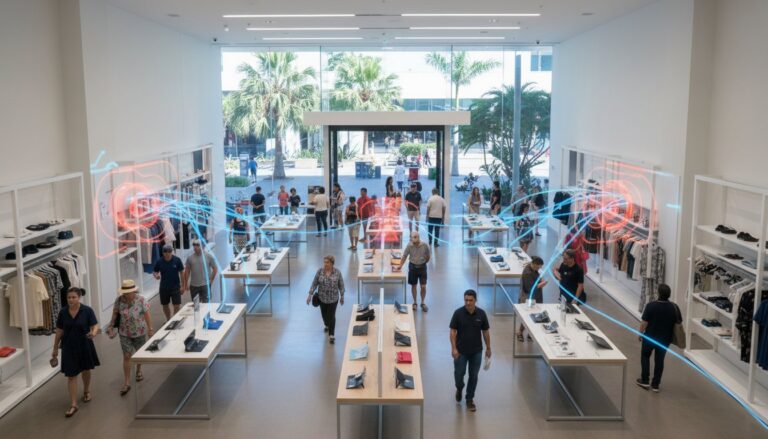
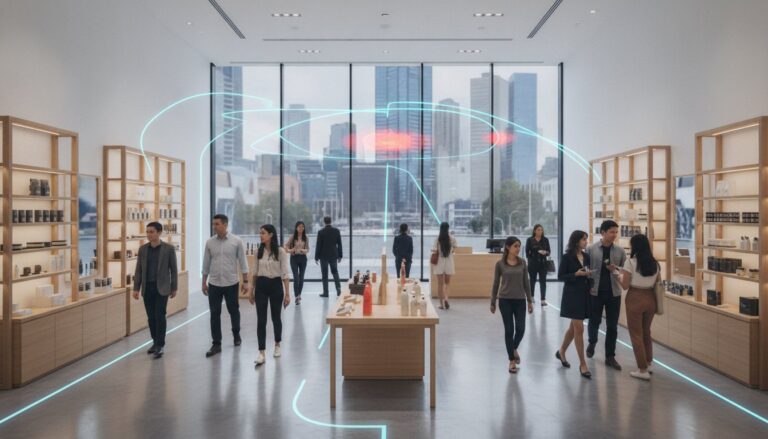
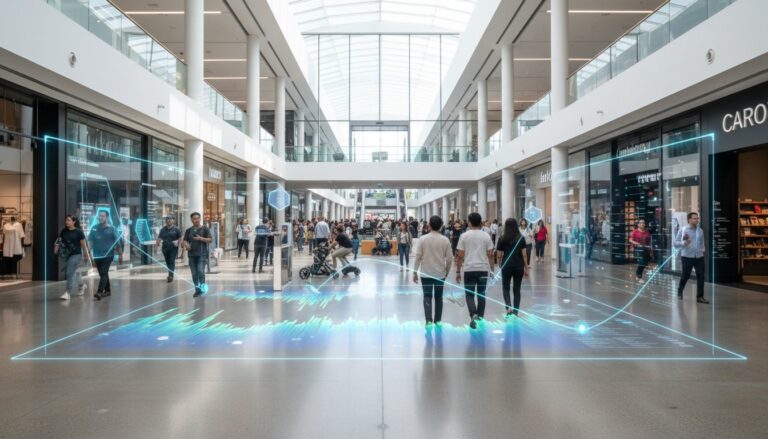
Understanding the “Path to Purchase” requires more than just counting heads at the door. Sophisticated store traffic analysis software transforms raw movement into actionable spatial analytics. By leveraging heatmapping and flow trajectories, retailers can see exactly where customers linger and where they accelerate, allowing for a data-backed approach to floor management. This intelligence eliminates guesswork, ensuring that every square metre of your retail space is working toward a conversion.
The Mechanism of AI Counting
Modern 3D sensors generate a high-resolution depth map to track movement with surgical precision. This technology ensures total privacy by focusing on physical coordinates rather than capturing Personally Identifiable Information (PII). Advanced algorithms filter out non-customer traffic-such as security guards on patrol or delivery drivers-to provide a clean dataset. To maintain this integrity, AI identifies a ‘unique visitor’ by assigning a persistent digital signature to a specific skeletal height and movement pattern within a single session, preventing double-counting if a customer briefly exits and returns.
Visualising the Store Floor
To effectively analyse the customer journey, retailers must look beyond the entrance. Heatmaps serve as a visual diagnostic tool, identifying “dead zones” where engagement is low and “hot spots” where interest peaks. By tracking dwell time at specific displays, you can measure the true effectiveness of a product launch or promotional end-cap. Mapping this flow allows you to strategically place high-margin items in high-traffic corridors, optimising the store layout for maximum profitability.
The value of store traffic analysis software lies in its 99.5% accuracy rate. This level of precision is essential for building trust in your data; without it, strategic decisions remain gambles. Furthermore, the software provides a holistic view of performance by integrating external Australian context. Your reports can automatically correlate footfall fluctuations with:
- Local weather events, such as heatwaves in Perth or sudden rain in Melbourne.
- Australian public holidays and long weekends that shift consumer habits.
- Specific regional events or school holiday periods.
By layering environmental factors over visitor data, you gain a transparent view of why traffic shifts, allowing for more intelligent staffing and inventory planning.
Key Features to Evaluate in a Store Traffic Analytics Platform
Selecting the right store traffic analysis software requires a focus on precision, scalability, and integration. An intuitive user interface, such as the FootfallCam V9 dashboard, is essential for translating complex data into clear visual narratives. For Australian retailers managing diverse portfolios, cross-store benchmarking allows for direct performance comparisons between flagship stores in Sydney’s CBD and regional locations in Melbourne or Perth, identifying which sites are over-performing and which require strategic intervention.
Scalability is equally critical. The platform must offer a seamless growth path, supporting a single boutique today and a national franchise tomorrow. Furthermore, robust API integration ensures that traffic data flows directly into your existing POS system, enabling a unified view of the customer journey and allowing for the calculation of exact conversion rates across your entire network.
Legacy Systems vs. Modern AI Software
Traditional infrared beam counters often fail in high-traffic environments or wide entrances, leading to inaccurate datasets that compromise decision-making. Modern AI-powered retail analytics provide the high-fidelity tracking necessary for complex spatial environments. To facilitate this transition, the Legacy Swap Out Plan offers a strategic path to upgrade outdated hardware with minimal disruption. When evaluating costs, consider the long-term value of a perpetual license-which can save thousands in A$ by eliminating recurring monthly fees-versus a subscription model that may impact your operational budget over time.
Actionable Reporting and Alerts
Data only yields value when it triggers action. Advanced store traffic analysis software provides real-time occupancy alerts, allowing managers to reallocate staff during peak periods or maintain safety compliance. By moving beyond raw numbers to strategic insights, businesses can optimize their workforce and enhance the visitor experience.
- Automated Reporting: Weekly summaries delivered directly to store managers and stakeholders to ensure alignment on business goals.
- Customisable KPIs: Tailor your dashboard to track specific metrics like dwell time, return rates, and peak hour trends.
- Real-time Notifications: Instant alerts for occupancy thresholds to ensure customer service standards remain high during busy periods.
Implementing Traffic Insights into Australian Retail Operations
Australian retailers operate in a high-cost environment where precision is the only path to sustainable growth. Implementing store traffic analysis software transforms raw visitor data into a strategic roadmap for operational excellence. By correlating footfall with sales conversion rates, management can move beyond intuitive guesswork to evidence-based decision-making that directly impacts the bottom line.
Staffing for Maximum Efficiency
Labour remains one of the largest controllable expenses for businesses in Brisbane, Sydney, and Melbourne. Data-driven rosters ensure your team is present when the profit potential is highest, rather than relying on outdated templates. Key advantages include:
- Predictive Scheduling: Use historical data to anticipate Saturday afternoon rushes in Brisbane boutiques or mid-week surges in Adelaide showrooms.
- Identifying Power Hours: Pinpoint specific windows where high-touch service is required to convert high-intent shoppers.
- Optimised Ratios: Maintain the ideal customer-to-staff ratio to ensure no sales opportunities are missed during peak periods.
Marketing Validation and ROI
Quantifying the impact of a local campaign has traditionally been a challenge for physical spaces. With sophisticated store traffic analysis software, the link between a Sydney CBD billboard and physical store visits becomes transparent. Retailers can now measure the ‘capture rate’-the percentage of passersby who actually enter the store-to compare the effectiveness of window displays across different states.
By linking footfall spikes to specific digital marketing pushes or social media campaigns, you can calculate a true ROI for every marketing dollar spent in A$. This level of intelligence allows for the seamless reallocation of budgets toward strategies that provide a proven uplift in visitor numbers.
Furthermore, improving store layout based on proven customer flow patterns ensures that once a customer is inside, their journey is intuitive and geared toward conversion. By identifying high-dwell zones and removing bottlenecks, you create an environment designed for maximum spend. To begin your transition to a data-led retail model, explore the tools available at footfall.au, where complex sensor technology meets actionable reporting.
Why Footfall Australia is Your Strategic Partner for Data-Led Growth
Footfall Australia bridges the gap between sophisticated global technology and the unique demands of the Australian retail landscape. By combining store traffic analysis software with the high-precision FootfallCam Pro2 hardware, we provide a foundation of quiet confidence for business owners. We believe that data is only as valuable as the decisions it informs; therefore, our focus remains on delivering actionable retail insights that move the needle on your bottom line.
Our approach is rooted in data-driven logic, replacing guesswork with hard evidence. When you partner with us, you gain access to a suite of tools designed to decode human movement within your physical spaces. This commitment to precision ensures that every metric-from dwell times to spatial analytics-is captured with a level of intelligence that empowers your management team to optimize operations seamlessly.
The FootfallCam V9 Advantage
The FootfallCam V9 software stands as a world-leading analytics platform, specifically engineered to serve as the “single source of truth” for your retail data. This store traffic analysis software simplifies complex datasets into intuitive, visual reports that highlight key performance indicators at a glance. By consolidating visitor journeys into a unified dashboard, V9 allows you to:
- Identify high-performing zones and dead spots within your floor plan.
- Benchmark conversion rates across multiple locations with ease.
- Align staffing levels with peak traffic periods to maximize service efficiency.
The software is designed for clarity over complexity, ensuring that your team spends less time interpreting charts and more time implementing strategic improvements.
Local Support for a National Reach
Operating a national retail chain requires a partner that understands the geography of the Australian market. Footfall Australia maintains an extensive network of local partners across Brisbane, Sydney, Melbourne, and beyond, ensuring that technical expertise is always within reach. We provide more than just hardware; we provide long-term reliability through our structured maintenance programs.
To ensure your data remains accurate and your systems stay online, we offer tailored support options:
- Basic Support Plans: Essential maintenance and software updates to keep your system current.
- Premium Support Plans: Comprehensive health checks and priority assistance for maximum uptime and precision.
Our goal is to provide the technological eyes your business needs to see the future of retail clearly. Discover how Footfall Australia can transform your store data today and start making decisions backed by the power of evidence.
Mastering the Visitor Journey with Data-Led Precision
As we navigate the complexities of retail in 2026, the ability to decode human movement has become the definitive competitive advantage. Transitioning from intuitive guesswork to evidence-based strategy requires a sophisticated store traffic analysis software that transforms raw footfall into actionable intelligence. By capturing the nuances of the visitor journey-from entry patterns to dwell times-retailers can optimize staffing, refine layouts, and significantly enhance conversion rates across their physical locations.
Footfall Australia remains the premier partner for this digital transformation, bringing over 20 years of experience to the local market. Our AI-driven technology delivers a 99.5% counting accuracy, providing a foundation of reliability that is already trusted by leading retailers across Sydney, Melbourne, and Brisbane. We bridge the gap between complex sensor data and intuitive reporting, empowering your team to make decisions that are both scientific and impactful. The future of Australian retail belongs to those who see the story behind the numbers.
Ready to replace uncertainty with precision? Request a Demo of our V9 Store Traffic Analysis Software and begin your journey toward optimized, data-driven growth today.
Frequently Asked Questions
Is store traffic analysis software compliant with Australian privacy laws?
Yes, our solutions are engineered to be fully compliant with the Australian Privacy Act 1988 and the Australian Privacy Principles (APPs). The software utilizes edge-processing technology to convert visual data into anonymous numerical strings instantly. No personally identifiable information or facial images are stored or transmitted, ensuring your business maintains high ethical standards while gathering the essential spatial analytics needed for operational growth.
How accurate is the software when stores are extremely crowded?
Modern high-precision sensors maintain up to 98% accuracy even during peak Australian retail events like Boxing Day. By utilizing 3D stereoscopic vision, the system distinguishes between individuals in dense crowds, effectively managing occlusion that often confuses standard 2D cameras. This level of precision ensures your conversion rate data remains reliable, allowing for confident, evidence-based decisions during your busiest trading periods.
Can the software distinguish between staff and customers?
Sophisticated AI algorithms and wearable exclusion tags allow the system to filter out employee movements with high accuracy. By identifying staff based on specific signal-emitting tags or predefined movement patterns, the store traffic analysis software removes these data points from the final count. This ensures your visitor journey metrics reflect genuine customer behavior, preventing internal operational movements from skewing your conversion insights.
Do I need to buy new hardware to use store traffic analysis software?
While some basic analytics can integrate with existing high-definition CCTV, we recommend dedicated 3D depth sensors for maximum precision. These specialized devices are purpose-built for spatial analytics and provide superior data quality compared to standard security cameras. Most professional installations utilize a simple Power over Ethernet (PoE) connection, making the hardware integration seamless and minimally invasive to your store’s physical aesthetic.
Can I integrate the traffic data with my current POS system?
Seamless integration with your existing Point of Sale (POS) system is a fundamental feature of our professional platform. By merging transaction data with footfall numbers via API, the software automatically calculates real-time conversion rates. This creates a holistic view of store performance, enabling management to identify whether sales fluctuations are driven by external traffic trends or internal service efficiency.
How much does a professional store traffic analysis system cost in Australia?
In the Australian market, a professional system typically involves an initial investment ranging from A$1,200 to A$3,000 per entrance for hardware and installation. Additionally, businesses should budget for a monthly SaaS subscription fee, generally between A$60 and A$180 per site. These costs reflect the high-grade sensor technology and the sophisticated reporting tools required to generate actionable business intelligence.
Is the software difficult for my store managers to learn and use?
The interface is designed with a focus on quiet confidence and intuitive navigation, empowering managers to access insights without technical friction. Dashboards present complex data through clear visualizations of dwell time and peak traffic periods. Most staff become proficient after a single orientation session, as the system prioritizes delivering actionable insights over raw data, streamlining the decision-making process for busy retail teams.
What happens if my internet connection goes down?
Should your internet connection fail, the hardware continues to collect and store data locally using robust on-board memory. Once the connection is restored, the sensors automatically synchronize the cached data with the cloud-based dashboard. This ensures there are no gaps in your historical reporting, maintaining the integrity of your store traffic analysis software trends and ensuring your long-term strategic planning remains data-driven.