The Strategic Guide to Customer Traffic Counters for Shops in 2026
In a retail landscape where high Australian labour costs make every staffing decision critical, relying on guesswork is a risk you can’t afford. You invest in marketing, but can you truly measure its ROI when your data can’t distinguish staff from shoppers? This is the core challenge that a modern customer traffic counter for shops is designed to solve, moving beyond simple tallies to provide strategic clarity.
By 2026, these systems are no longer just counters; they are intelligent, AI-driven analysers of the complete visitor journey. This guide provides the blueprint for transforming that raw data into profit. We will demonstrate how to leverage AI-filtered insights to create automated staffing schedules, prove the value of every marketing dollar spent, and systematically improve your conversion rates. Prepare to replace costly assumptions with the quiet confidence of evidence-based strategy.
Key Takeaways
- Discover how modern AI turns raw visitor data into a clear strategy for optimising staff rosters, marketing efforts, and shop layout.
- Learn the framework to calculate your true Sales Conversion Rate (Transactions ÷ Footfall) to accurately measure your store’s performance.
- An advanced customer traffic counter for shops uses AI Staff Exclusion technology to provide over 98% accurate data, ensuring your decisions are based on real customer numbers.
- Understand the critical differences between AI, thermal, and legacy beam sensors to see why modern systems excel in high-traffic Australian retail environments.
What is a Customer Traffic Counter and Why is it Vital for Shops Today?
In today’s hyper-competitive retail landscape, managing a shop based on gut feeling is no longer viable. Fundamentally, what is a customer traffic counter? It’s a device that measures visitor flow. Yet, the modern system has transformed into a sophisticated, AI-powered business intelligence tool. It solves the critical ‘Invisible Customer’ problem by converting anonymous footsteps into clear, actionable data, moving store management from guesswork to precision. This data is vital not just for optimising a single location but for benchmarking performance across different Australian regions, revealing granular insights into local consumer behaviour.
Beyond the Door: The Evolution of People Counting
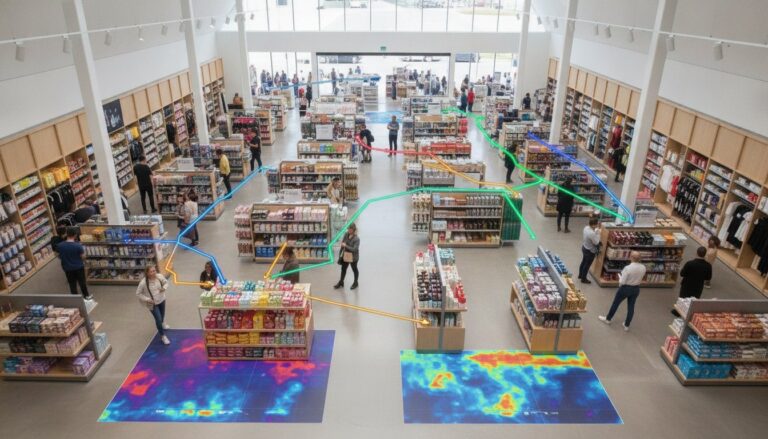
The technology’s journey from manual clickers and basic infrared beams to the current standard of 3D stereo vision sensors, like the FootfallCam Pro2, marks a monumental shift. Early systems were notoriously unreliable, often miscounting groups or failing in changing light conditions. As we move towards 2026, simple ‘in and out’ totals are insufficient. Modern retail demands a deeper understanding of the entire visitor journey. This is the essence of ‘Spatial Intelligence’-mapping precisely how customers navigate your space, where they linger, and which displays capture their attention, providing a complete narrative of in-store behaviour.
The Business Case for Traffic Monitoring in Australia
For Australian retailers grappling with high operating costs-from significant wages to some of the highest commercial rents globally in cities like Sydney and Melbourne-every decision must be data-driven. A modern customer traffic counter for shops provides the evidence to optimise the three core pillars of retail:
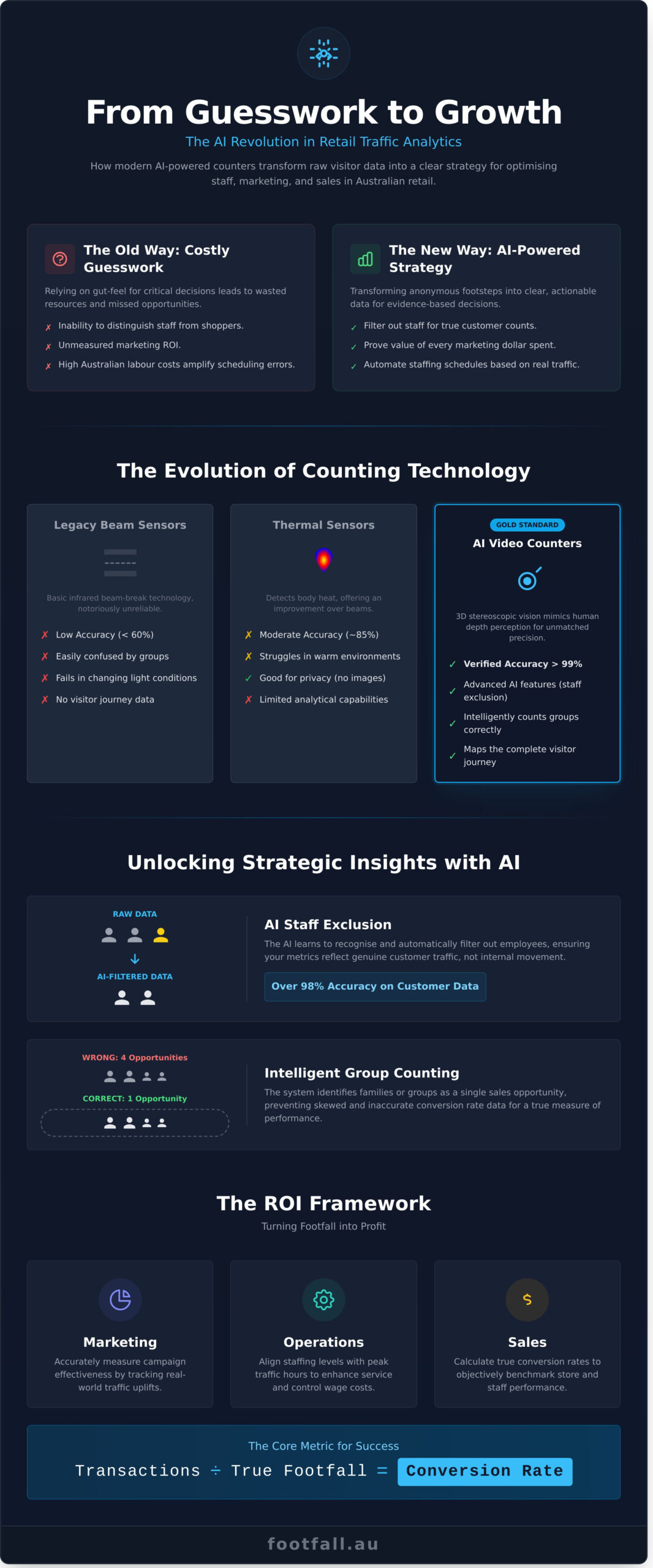
- Marketing: Accurately measure campaign effectiveness by tracking real-world traffic uplifts, justifying every dollar of your marketing spend.
- Operations: Align staffing levels with peak traffic hours to enhance customer service and control wage costs, ensuring optimal efficiency.
- Sales: Calculate true conversion rates (sales vs. traffic) to objectively benchmark store and staff performance across your entire network.
In essence, a traffic counter is the Google Analytics for your physical space.
How 2026 AI Traffic Counters Transform Shop Data into Strategy
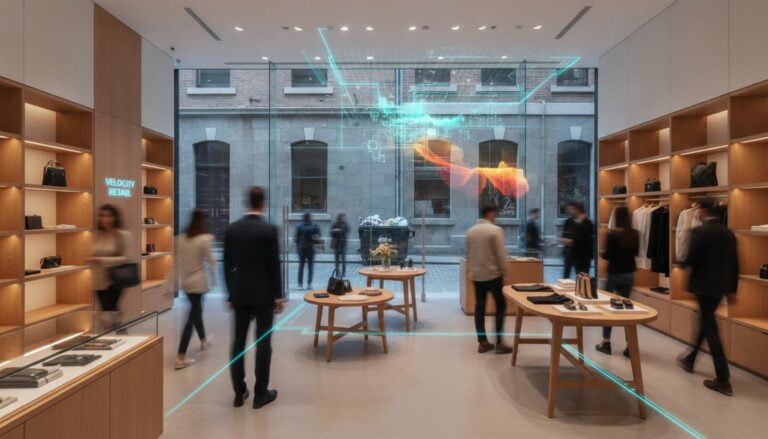
In 2026, the best customer traffic counter for shops is no longer a simple door sensor. It is an advanced business intelligence tool powered by AI video analytics and edge computing. This technology processes visual data directly on the device, ensuring rapid analysis and enhanced privacy. By interpreting movement patterns, it provides shop owners with a clear, objective view of customer behaviour. This shift from simple counting to deep analysis is how modern Australian retailers transform big data into strategy, moving beyond guesswork to make evidence-based decisions.
This intelligent system refines raw data through several key technologies:
- Staff Exclusion: The AI learns to recognise employee uniforms or designated staff-only zones, automatically filtering them out of footfall counts. This ensures your metrics reflect genuine customer traffic, not internal movements.
- Group Counting: Instead of counting a family of four as four separate opportunities, the system intelligently identifies and counts them as a single group, preventing skewed conversion rate data.
- Wi-Fi Tracking Integration: By anonymously detecting Wi-Fi signals from smartphones, the system can measure crucial metrics like customer dwell time, visit frequency, and return rates, offering a complete picture of visitor loyalty.
AI Video Analytics: The Gold Standard for Accuracy
At the core of a modern customer traffic counter for shops is 3D stereoscopic vision. This dual-lens technology mimics human depth perception, allowing it to accurately distinguish individuals from shadows, shopping trolleys, and strollers, even in challenging lighting conditions. Achieving a verified accuracy of 99.5% is the industry benchmark for creating credible business reports. For businesses with existing security infrastructure, the FootfallCam Centroid offers a seamless upgrade, transforming standard CCTV cameras into powerful AI-driven people counting sensors without requiring a complete hardware overhaul.
The Power of the FootfallCam V9 Software Platform
Raw data is only valuable when it becomes actionable insight. The FootfallCam V9 software platform translates complex datasets into intuitive, visual formats. Managers can view detailed dashboards with traffic trends, conversion rates, and zone-specific heatmaps to understand the complete customer journey. For 2026 and beyond, real-time occupancy monitoring provides live counts to ensure compliance with safety regulations and optimise customer experience. Crucially, the platform’s automated reporting features save management countless hours, delivering customised insights directly to their inbox for strategic planning.
Comparing Technologies: Beam vs. Thermal vs. AI Video Counters
The technology inside a customer traffic counter for shops directly determines the quality and depth of your data. While legacy systems offer a basic tally, modern solutions provide actionable business intelligence. Understanding the core differences in technology is crucial for calculating the true return on your investment, moving beyond initial cost to evaluate the total cost of ownership (TCO).
Why Infrared Beams are No Longer Sufficient
Horizontal infrared (IR) beam counters represent the first generation of traffic monitoring. These devices, often priced between A$150 and A$500, work by registering a “count” each time a person breaks a single beam of light. While affordable, their limitations render them insufficient for serious retail analysis. They struggle with wide entrances, frequently miscount groups entering together (“piggybacking”), and basic models cannot differentiate between customers entering and exiting. Simple battery-powered display counters offer no way to analyse trends over time, providing a number with no context and, therefore, no strategic value.
The Rise of 3D Stereoscopic Vision
While thermal imaging sensors offered an improvement over beams, they often struggle with accuracy in the high ambient temperatures of busy Australian shopping centres. The definitive modern solution is 3D stereoscopic video, powered by Artificial Intelligence. Systems like the Pro2 use dual lenses to mimic human depth perception, allowing the sensor to accurately track individuals, measure height to exclude children, and map complex customer journeys-all with over 98% accuracy.
Crucially, this intelligence is delivered through “Edge AI,” where all data is processed directly on the sensor itself. This anonymises individuals before the data is transmitted, ensuring full compliance with privacy regulations like GDPR and the Australian Privacy Principles (APP). This level of intelligence is a key reason how retailers are turning to high-powered analytics to transform raw footfall data into a strategic asset for optimising layouts, staffing, and marketing.
When evaluating a modern AI video counter, ensure the hardware is built for a commercial environment. A robust sensor should feature:
- A high IP rating for protection against dust and moisture.
- A wide operating temperature range suitable for Australian conditions.
- Power over Ethernet (PoE) for stable, single-cable connectivity.
- A durable, vandal-resistant casing for long-term reliability in high-traffic shops.
The ROI Framework: Turning Footfall into Profit
A modern customer traffic counter for shops delivers its greatest value when it moves beyond simple counting and becomes the core of your strategic decision-making. The real return on investment is found by translating raw footfall data into actionable intelligence. This framework provides a clear, four-step process to link operational changes directly to financial outcomes, turning visitor analytics into a powerful profit engine.
By implementing this data-driven approach, you can:
- Calculate your true Sales Conversion Rate: Understand precisely how many visitors become paying customers.
- Optimize staffing for “Power Hours”: Align your roster with peak traffic to maximise service and minimise wasted wages.
- Measure marketing “Capture Rate”: Get hard data on how effectively window displays and campaigns draw people inside.
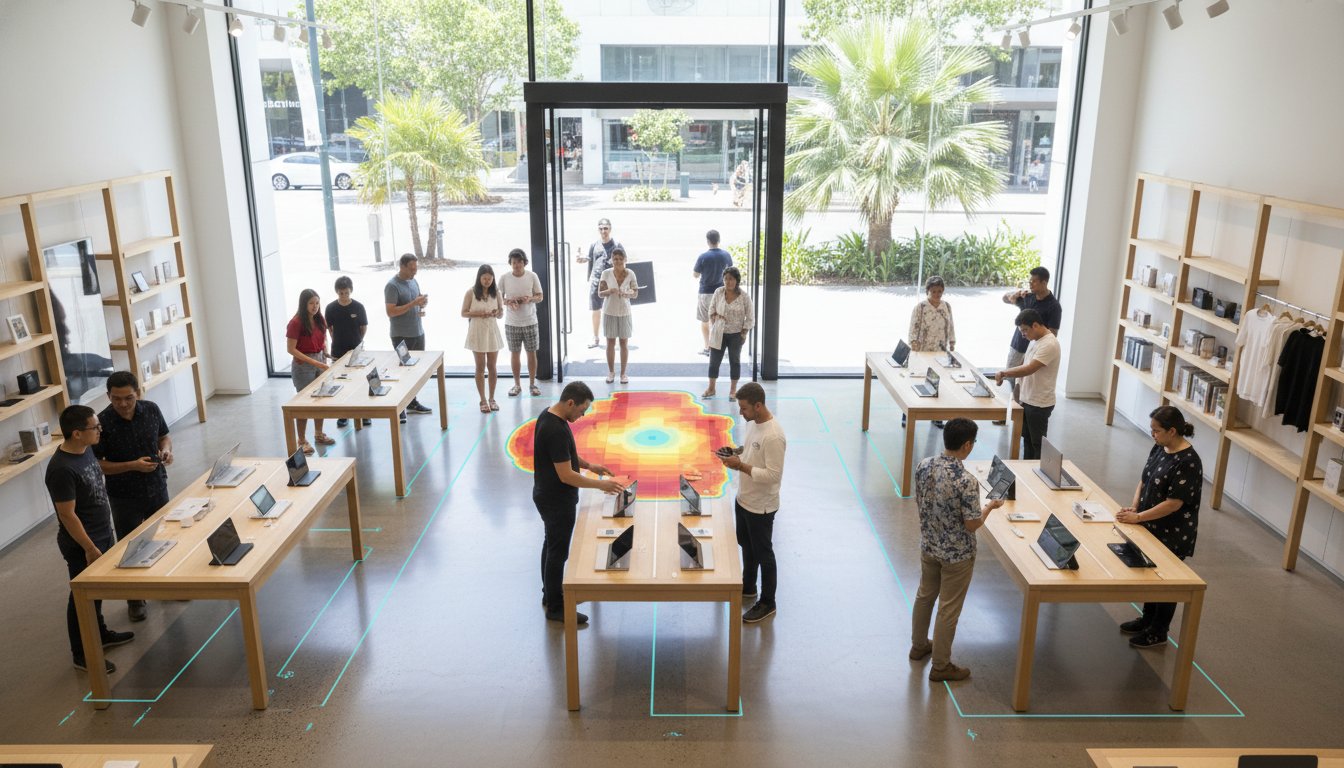
- Activate “Dead Zones”: Use heatmapping to refine your store layout for maximum engagement and sales.
Mastering the Sales Conversion Rate
Total sales volume alone can be a deceptive metric. The Sales Conversion Rate (Total Transactions ÷ Total Footfall) is the ultimate KPI for in-store performance, telling you exactly how effectively your team and layout are converting opportunities. A sudden drop in sales is no longer a mystery; if footfall is steady but conversions are down, the issue lies with in-store execution, not external traffic. This clarity allows you to solve the right problem. For a deeper dive into this and other crucial metrics, explore our comprehensive Retail Footfall Analysis Guide.
Australian Staffing Optimization
Payroll is one of your largest operational expenses. Footfall data enables precision rostering, ensuring you have optimal coverage during a bustling Saturday rush in Sydney’s CBD or Melbourne’s Bourke Street Mall. By identifying your store’s “Power Hours,” you can prevent lost sales from long queues and unavailable staff. Conversely, you can confidently reduce overstaffing during quiet periods, directly improving profitability. This data provides the concrete evidence needed to justify new hires or adjust hours with complete confidence.
Implementing Your System with Footfall Australia
Selecting the right hardware is the first step. Transforming that technology into a source of actionable intelligence requires a precise implementation strategy and dedicated support. At Footfall Australia, we manage the entire lifecycle of your system, ensuring your investment delivers measurable returns from day one.
Our process is built on a foundation of national expertise and local presence. We offer a streamlined “Legacy Swap Out Plan” designed to transition your business from outdated beam sensors or inaccurate systems to our advanced AI platform with minimal disruption. Whether you operate a single boutique or manage a large-scale Australian shopping centre, our solutions are customised to your unique spatial environment, providing the clarity needed to optimise operations and enhance the customer journey.
Seamless Installation and Local Support
Our deployment process is designed for precision and efficiency. It begins with a comprehensive site survey to determine optimal placement for your customer traffic counter for shops. With local technical teams in Brisbane, Sydney, Melbourne, and Perth, we provide prompt, professional installation. The FootfallCam Pro2 is engineered for a “Plug-and-Play” setup, after which our experts conduct remote calibration and verification to guarantee data accuracy of over 98%.
Choosing the Right Support Plan
Data integrity is not a one-time setup; it requires continuous oversight. To meet the evolving business needs of 2026 and beyond, we offer tailored support plans. While our Basic plan covers essential maintenance, our Premium support is designed for businesses that depend on high-fidelity data for strategic decisions. This includes proactive data health checks, periodic sensor recalibration, and priority access to our strategists, ensuring your analytics remain consistently reliable.
Secure the long-term value of your foot traffic data. A robust support plan is the key to turning raw numbers into a sustainable competitive advantage. Book a consultation with our Smart Strategists today to design the perfect implementation and support package for your business.
Transforming Footfall into Foresight: Your Next Step
As we look towards 2026, it’s clear that the role of a customer traffic counter for shops has evolved from a simple tallying device to an indispensable strategic asset. The shift towards AI-powered analytics means that understanding the complete visitor journey-from entry to conversion-is no longer a guess but a science. This intelligence is the foundation for optimising everything from staff rosters to marketing campaigns, directly impacting your bottom line.
Partnering with the right provider is crucial to unlocking this potential. At Footfall Australia, we deliver this strategic advantage with an industry-leading 99.5% counting accuracy. Trusted by over 1,000 global retail brands and supported by a national Australian network, our systems provide the clarity you need to make evidence-based decisions.
The future of your retail success lies in understanding your customers more deeply. Get a Tailored Footfall Analysis for Your Shop today and step confidently into the future of retail.
Frequently Asked Questions
How accurate are modern customer traffic counters in 2026?
By 2026, the accuracy of leading customer traffic counters is projected to exceed 99.5%. Leveraging advanced 3D stereo vision and AI-driven algorithms, these systems deliver exceptional precision even in high-volume, complex environments. This level of accuracy provides businesses with a reliable data foundation, ensuring that strategic decisions regarding staffing, marketing, and layout are based on hard evidence rather than estimates. The technology is engineered to overcome challenges like shadows, group counting, and variable lighting.
Can a traffic counter distinguish between a staff member and a customer?
Yes, sophisticated systems provide robust staff exclusion capabilities. Using methods such as AI pattern recognition or discreet staff-worn tags, the counter can intelligently identify and filter out employee movements from the final footfall data. This ensures the analytics reflect genuine customer behaviour, which is critical for calculating accurate metrics like sales conversion rates and dwell times. This refinement provides a pure, actionable dataset for operational optimisation.
Do people counting systems comply with Australian privacy laws?
Absolutely. Reputable people counting systems are designed with privacy as a core principle, ensuring full compliance with the Australian Privacy Act. These devices capture and process anonymous data, tracking human shapes and movement patterns without recording or storing any personally identifiable information (PII) such as faces. This “privacy by design” approach allows businesses to gather valuable spatial analytics while upholding the privacy rights of both customers and staff, making it a secure and responsible technology.
How much does a customer traffic counter for a shop typically cost?
The investment in a customer traffic counter for shops varies based on store size and complexity. For a small Australian retail store with a single entrance, the initial hardware cost typically ranges from A$800 to A$1,500, plus a monthly or annual software subscription for data analytics and support. This investment provides actionable insights into traffic patterns and conversion rates, delivering a strong return by enabling data-driven decisions on staffing, marketing, and store layout optimisation.
Can I integrate my traffic counter data with my existing POS system?
Yes, seamless integration is a key feature of modern footfall systems. Using a robust API (Application Programming Interface), traffic counter data can be synchronised directly with most contemporary Point of Sale (POS) systems. This powerful connection automates the calculation of crucial key performance indicators, such as sales conversion rates and average transaction value per visitor. It transforms raw data from two separate systems into a unified, actionable intelligence platform for your business.
What is the difference between a people counter and a security camera?
While both may be ceiling-mounted, their functions are fundamentally different. A security camera’s purpose is surveillance; it records video footage to identify individuals and monitor for loss prevention. In contrast, a people counter is an analytics device. It uses sensors to anonymously count people and analyse movement patterns, generating data on traffic flow and behaviour. It is engineered for data collection, not identification, ensuring visitor privacy is maintained.
How long does it take to install a FootfallCam system in an Australian store?
Installation is designed for maximum efficiency to minimise operational disruption. A standard FootfallCam installation for a single-entrance store can typically be completed by a certified technician in under two hours. This includes mounting the device, connecting it to the network, and performing initial calibration. The streamlined process ensures your business can begin gathering precise footfall data and unlocking actionable insights on the same day.
Does the system work in low-light conditions or at night?
Yes, performance is consistent across all lighting conditions. Advanced people counters utilise active stereo vision or infrared technology, which does not rely on ambient light to function. This ensures the system maintains its high accuracy of over 98% in dimly lit environments, during late trading hours, or even in complete darkness. This capability provides a reliable, uninterrupted stream of data, allowing you to analyse traffic patterns 24/7 without compromise.