AI People Counting Technology: The 2026 Strategic Guide for Businesses
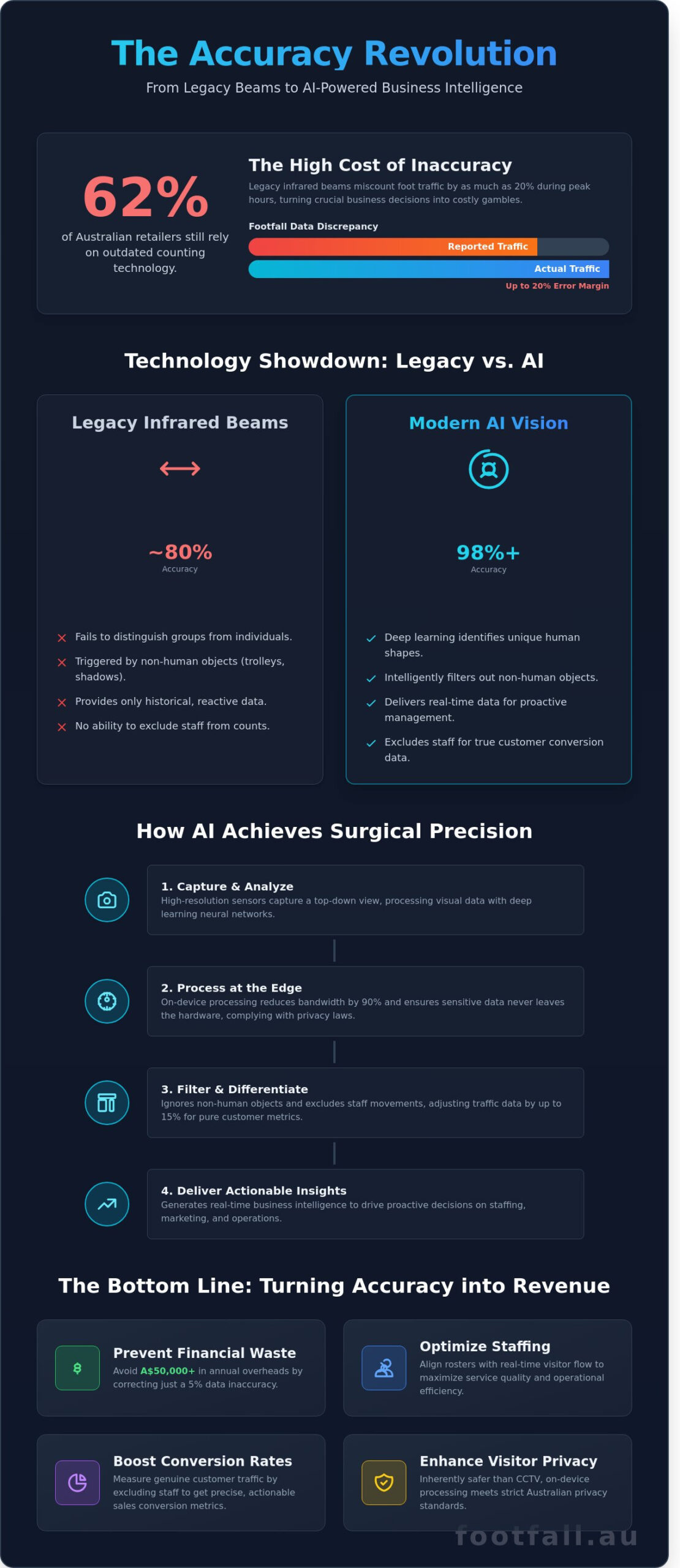
Recent industry audits show that 62% of Australian retailers still rely on legacy infrared beams that miscount foot traffic by as much as 20% during peak Saturday trade. When your entry data is flawed, every decision regarding staff rosters and marketing spend becomes a costly gamble that drains your A$ budget. Implementing advanced AI people counting technology isn’t just a technical upgrade; it’s a strategic pivot toward precision. You’ve likely felt the frustration of paying for high labor hours while your sales floor remains quiet, or worse, losing customers because your team was stretched too thin during an unpredicted rush.
It’s clear that gut feelings are no substitute for the data-driven logic required to thrive in the current economic climate. This guide promises to show you how to transform raw visitor movement into actionable business intelligence that drives revenue and optimizes every square metre of your space. We’ll explore the specific spatial analytics and reporting tools that will empower your management team to make evidence-based decisions through 2026.
Key Takeaways
- Understand why modern deep learning has replaced legacy sensors to achieve consistent 98%+ accuracy across your Australian business locations.
- Learn how AI people counting technology distinguishes between staff and customers to ensure your performance data remains precise and actionable.
- Discover the methodology for converting raw footfall into sophisticated spatial analytics and sales conversion metrics that drive measurable revenue growth.
- Implement a national scaling strategy that prioritises visitor privacy by using data-driven insights that are inherently safer than standard CCTV monitoring.
- Optimise your operational efficiency by decoding the visitor journey to align staff scheduling with real-time human movement patterns.
The Evolution of People Counting: Why AI is the New National Standard
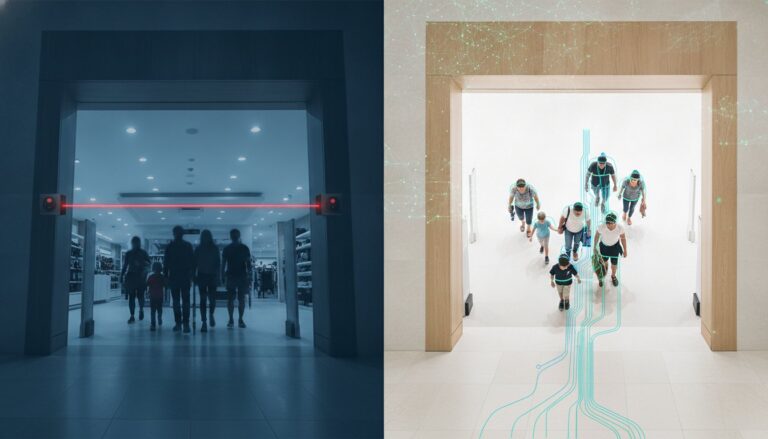
The history of tracking physical traffic has moved from manual guesswork to high-precision science. Twenty years ago, Australian store managers stood at entrances with manual clickers, a method prone to human error and fatigue. By 2015, infrared beams became common in retail strips across Sydney and Melbourne. However, these sensors often failed to distinguish between a single customer and a group of three walking closely together, leading to data inflation. Modern AI people counting technology has rendered these legacy methods obsolete by providing accuracy rates that consistently exceed 98%.
In 2026, relying on “good enough” data is an operational liability. When a major shopping centre miscalculates footfall by even 5%, the resulting errors in staffing levels and energy consumption can cost upwards of A$50,000 annually in wasted overheads. Precision is the new baseline for competitive survival. This technology doesn’t just count heads; it identifies patterns. The primary goal is to generate actionable insights, transforming raw numbers into strategic decisions that drive revenue and operational efficiency across every square metre of a facility.
What is AI People Counting Technology?
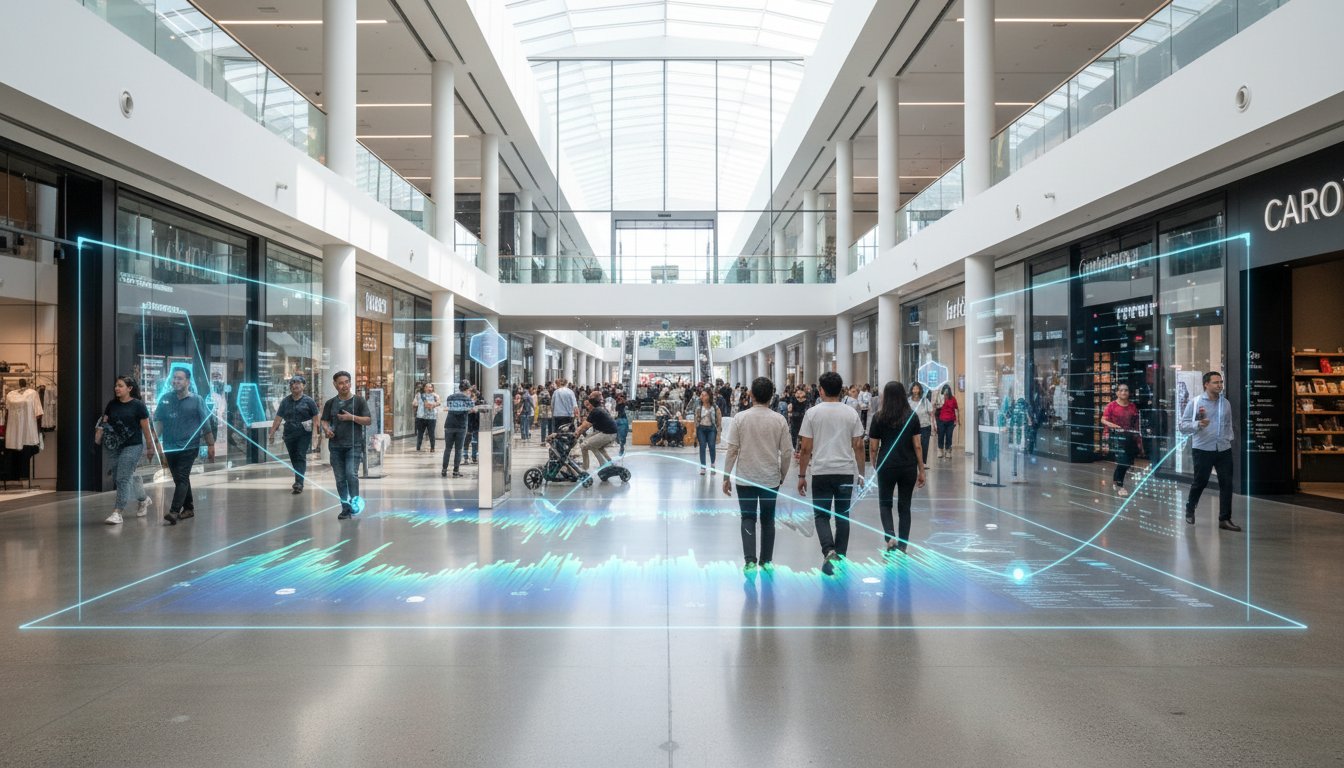
At its core, this system utilizes advanced computer vision paired with deep learning neural networks. Unlike basic motion sensors, AI people counting technology processes visual data to identify human shapes and movement trajectories with surgical precision. This intelligence allows the system to ignore non-human objects such as shopping trolleys, strollers, or cleaning robots. These units operate 24/7 without human intervention, maintaining consistent performance in varied lighting conditions and high-density crowds. It’s a silent, objective observer that never blinks.
The Shift from Reactive to Proactive Management
Legacy systems were historical; they told you what happened yesterday, acting as an autopsy of store performance. Modern AI provides the framework for proactive management. By analyzing real-time flow, facility managers can reassign security or cleaning staff to busy zones before bottlenecks form. This data-driven approach is essential for optimizing the visitor journey and ensuring seamless transitions through physical spaces. For a deeper look at how these metrics influence business growth, consult the ultimate guide to people counting. Transitioning to proactive, real-time adjustments ensures that every operational dollar is backed by evidence rather than intuition.
How AI People Counting Technology Works: Beyond Simple Motion
Modern AI people counting technology has evolved far beyond the basic infrared beams used in the early 2000s. Today, sophisticated sensors capture high-resolution imagery and process it in real-time to distinguish human movement from environmental noise. This process begins with image acquisition, where the sensor captures a top-down view of the entrance or zone. Instead of sending raw video to a central server, edge computing allows the device to process data locally. This reduces bandwidth requirements by 90% and ensures that sensitive visual data never leaves the hardware, addressing the strict privacy requirements of the Australian Privacy Act 1988.
The system relies on precise mounting protocols to maintain data integrity. For instance, a sensor placed at a height of 3.5 metres provides a field of view that maintains 99.5% accuracy, even during peak periods like Boxing Day sales or Saturday morning rushes. Deep learning is the ability for a system to improve its recognition accuracy over time through data exposure. This allows the technology to learn the specific layout of your Australian retail space and adapt to changes in lighting or floor displays without manual recalibration. By processing these variables at the edge, the system delivers actionable insights in milliseconds.
Object Recognition and Filtering
Precision in data requires the ability to ignore distractions. AI filters out non-human objects such as shadows, cleaning robots, or swinging doors that would trigger false positives in older systems. One of the most critical advancements is staff exclusion. By identifying specific patterns or using wearable tags, the system removes employee movements from the final count. This ensures your conversion rates reflect genuine customer intent rather than your team’s restocking efforts. Businesses using these filters often see a 15% adjustment in their baseline traffic data, providing a much clearer picture of true demand. If you’re ready to see how these filters impact your bottom line, you can view our latest sensor benchmarks for local retail environments.
3D Stereoscopic Vision vs. Monocular AI
Choosing the right sensor architecture is vital for high-traffic Australian environments like major shopping centres or transport hubs. Monocular AI uses a single lens and can struggle with depth perception, occasionally miscounting groups or failing in low-light conditions. In contrast, 3D stereoscopic vision uses dual lenses to create a depth map, much like human eyes. This allows the system to separate individuals walking side-by-side or overlapping in a crowded doorway. These binocular systems remain stable in variable lighting, maintaining high performance even when harsh afternoon sun glare hits a glass storefront. This depth perception is the foundation of modern AI people counting technology, ensuring that children are distinguished from adults and that shopping trolleys don’t inflate your visitor numbers.
AI vs. Traditional Sensors: Which Technology Suits Your Business?
Choosing the right hardware defines the integrity of your data. Traditional sensors like Passive Infrared (PIR) and thermal imaging served the industry for decades, yet they often fall short in 2026’s high-traffic retail environments. AI people counting technology has fundamentally shifted the benchmark for accuracy, moving from an average of 85% in legacy systems to a consistent 98% or higher in modern deployments.
Legacy sensors operate on binary logic. They detect a break in a beam or a moving heat signature. This lack of visual intelligence means they struggle to distinguish between a single shopper and a family of four walking closely together. In Australian retail settings, where staffing costs average A$30 to A$45 per hour, a 15% error rate in footfall data leads to significant miscalculations in labor allocation and conversion tracking. Relying on flawed data creates a ripple effect of inefficiency across your entire operation.
Infrared Beams and Thermal Imaging
Infrared ‘break-beam’ sensors remain a low-cost option for small boutiques with narrow doorways and low traffic. However, their utility ends there. They cannot differentiate between incoming and outgoing traffic, nor can they filter out non-human objects like shopping trolleys or prams. Thermal imaging attempts to solve this by detecting body heat, but it faces severe limitations during Australian summers. When ambient temperatures exceed 35°C, thermal sensors often lose the contrast required to identify human heat signatures accurately. Understanding the hardware gap is essential; you can explore the technical nuances in our guide on people counter vs CCTV to see how optics change the outcome.
The Case for AI in Complex Environments
Modern AI people counting technology uses deep learning to map spatial coordinates and recognize human shapes with surgical precision. This technology excels where legacy sensors fail. It processes visual data in real-time to provide a granular view of visitor behavior that was previously impossible to capture.
- Wide Entrances: AI maintains accuracy across 10-meter spans where beams would overlap or fail to cover the gap.
- Loitering and Groups: Intelligent algorithms ignore staff members or people standing near the entrance, ensuring data isn’t skewed by non-shoppers.
- Advanced Metrics: AI provides exclusive insights like Dwell Time and Queue Management, allowing managers to open registers before a line becomes a bottleneck.
- Environmental Adaptability: AI ignores shadows, glare, and high ceiling heights that typically confuse older optical or thermal sensors.
While an AI-based sensor might require a higher initial investment compared to a A$200 PIR beam, the long-term ROI is found in the reliability of the evidence. Precise data allows for the optimization of A$100,000+ annual marketing budgets, making the tech an essential strategic asset rather than a mere utility.
Turning AI Data into Actionable Business Intelligence
Raw footfall numbers tell you how many people walked through the door. Analytics tell you why it matters. The transition from counting heads to generating intelligence is where AI people counting technology proves its value. By synchronising entry data with your Point of Sale (POS) system, you can calculate your Sales Conversion Rate with surgical precision. If 1,200 visitors enter your Sydney showroom but only 150 transactions occur, your 12.5% conversion rate becomes a clear benchmark for performance. This data removes the guesswork from management; you no longer wonder if a slow day was due to low traffic or poor sales execution.
Optimising Staffing and Operations
Aligning labour costs with visitor demand is the most direct way to protect your margins. AI insights identify “Power Hours,” those specific windows where high traffic volumes require maximum floor coverage to prevent lost sales. Leveraging retail footfall analysis in Australia allows managers to reduce wage leakage by trimming staff during documented lulls. In a high-cost labour market like Australia, cutting just four hours of unnecessary roster time per week can save a single site over A$6,200 annually based on standard retail award rates.
Measuring Marketing and Campaign Success
Marketing spend shouldn’t be a sunk cost. Use the “Attraction Rate” to measure how effectively your window displays or street-side activations pull passersby into the store. If a new A$4,000 campaign in your Brisbane location doesn’t move the needle on entry percentages compared to your Melbourne baseline, you have the evidence needed to pivot quickly. This data also serves as a powerful lever during rent reviews. If a shopping centre’s promised traffic drops by 15% over a six-month period, your recorded footfall data provides the objective proof required for lease renegotiations or site selection strategy.
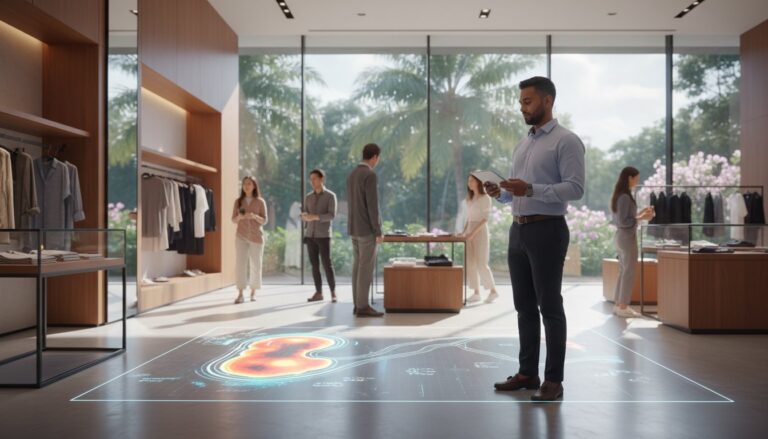
Spatial analytics and heatmaps take this intelligence deeper into the physical environment. By tracking dwell time and movement flow, AI sensors reveal which store zones are high-value and which are dead space. If your high-margin seasonal stock is sitting in a “cold” zone that 70% of customers bypass, moving it to a high-traffic path can result in an immediate revenue lift. It’s about making the floor work harder for every square metre you pay for, and for those looking to upgrade their physical surfaces to match their data-driven layouts, Frankly Flooring provides the high-durability Karndean solutions required for modern retail environments.
Implementing AI People Counting: Strategy and Compliance
Deploying a unified system transforms fragmented data into a national asset. For Australian businesses managing 20 or more locations, a fragmented approach to data collection creates silos that obscure the bigger picture. A national strategy ensures that every site, from a Sydney flagship to a regional Perth outlet, operates under the same performance benchmarks. This consistency allows executives to identify high-performing regions and apply those localized successes across the entire network. Integration remains a critical pillar of this strategy. Connecting AI people counting technology to your Point of Sale (POS) or Building Management System (BMS) turns raw numbers into actionable intelligence. For instance, linking footfall data with POS transactions can reveal that a 15% increase in weekend traffic only resulted in a 2% sales lift, signaling a clear need for better staff optimization or stock management.
Privacy by Design and Australian Standards
Privacy is often the first concern for stakeholders, yet AI sensors are significantly more secure than traditional CCTV. Unlike standard security cameras that record and store identifiable footage, AI sensors utilize “Anonymous Counting” through edge processing. The device analyzes movement patterns in real-time and converts them into numerical data packets without ever storing personal images or facial features. This methodology ensures full compliance with the Australian Privacy Act 1988 and aligns with global GDPR-like standards. Transparency remains vital for customer trust. We recommend placing clear, professional signage at entry points to inform visitors that anonymous occupancy sensors are in use to improve their shopping experience. It’s a proactive step that builds confidence while maintaining total data integrity.
Choosing the Right AI Hardware and Software
Selecting hardware requires a focus on long-term reliability and precision. The FootfallCam Pro2 is the leading choice for Australian retailers because it maintains 99.5% accuracy even in challenging lighting or high-density environments. This hardware works in tandem with the FootfallCam V9 dashboard, a centralized platform that provides real-time reporting across a national fleet of sensors. This software allows managers to view dwell times, heatmaps, and zone analytics from a single interface, removing the need for manual data collation. Footfall Australia provides both the hardware and the strategic support to ensure long-term ROI, guiding you from the initial site survey through to complex API integrations. Choosing a partner that offers ongoing technical support ensures your AI people counting technology remains a functional tool rather than a legacy expense. Success in 2026 relies on this marriage of high-spec hardware and expert local strategy.
Securing Your Competitive Edge in 2026
Adopting AI people counting technology isn’t just a technical upgrade; it’s a fundamental shift toward evidence-based management for Australian businesses. By 2026, the gap between data-led retailers and those relying on guesswork will widen significantly. The transition from simple motion sensors to 98%+ accurate spatial analytics allows you to decode the visitor journey with precision. These insights enable you to optimize staff rosters and floor layouts based on actual human behavior rather than intuition. It’s about turning every entry point into a source of strategic advantage.
Success in the modern market requires a balance of high-tech innovation and strict privacy standards. Our GDPR-compliant systems ensure your data collection remains ethical and secure, while our national support network across Australia provides the local expertise your business needs. Transitioning from raw numbers to actionable intelligence is the most direct path to increasing your conversion rates and operational efficiency. It’s time to replace uncertainty with a foundation of hard evidence. Request a strategic consultation for your national business today and start building a more predictable future for your operations.
Frequently Asked Questions
Is AI people counting technology the same as facial recognition?
No, AI people counting technology is fundamentally different from facial recognition. It identifies human silhouettes and movement patterns rather than scanning individual features to identify specific persons. Modern sensors process data at the edge, meaning they never record or store biometric identifiers. This approach ensures your business gathers actionable spatial analytics while remaining 100% anonymous for every visitor who enters your space.
How accurate is AI people counting in very crowded environments?
AI sensors achieve 98% accuracy even in dense crowds or high-traffic events. Unlike older systems that struggle when people walk side-by-side, AI algorithms use 3D depth mapping to distinguish between individuals in a group. This precision allows managers to trust their data during peak Saturday trade or major 2026 holiday sales. You get a clear picture of true occupancy levels without the overcounting errors common in legacy hardware.
Does AI people counting work in low-light or outdoor conditions?
AI sensors perform reliably in lighting conditions ranging from 0.1 lux to direct Australian sunlight. Advanced Time-of-Flight technology doesn’t rely on visible light, so it works in total darkness or through heavy glare at glass entrances. This versatility makes it ideal for 24-hour fitness centres or outdoor entertainment precincts in Sydney and Melbourne. You won’t lose data because of shadows or changing weather conditions throughout the day.
What is the difference between AI and infrared people counters?
AI counters use neural networks to recognize human forms, while infrared sensors simply detect broken light beams. Infrared systems often fail when two people enter at once, leading to an average undercount of 15% in busy retail settings. AI people counting technology maintains consistent precision by tracking the entire visitor journey through the doorway. It provides deeper insights like dwell time and path mapping that simple beams can’t capture.
Can AI people counters distinguish between staff and customers?
Yes, AI systems use staff exclusion technology to separate employee movements from customer traffic. By using wearable tags or identifying specific behavioural patterns, the system filters out staff members who frequently cross the entrance threshold. This refinement can improve your conversion rate accuracy by 10% or more. It ensures your KPIs reflect genuine sales opportunities rather than internal operational noise that can skew your strategic planning.
Is AI people counting compliant with Australian privacy laws?
AI people counting is fully compliant with the Australian Privacy Act 1988 and the Australian Privacy Principles. These systems utilize privacy-by-design by processing all visual data locally on the device and only transmitting numerical counts to the cloud. No images or identifiable videos are stored or transmitted. This ensures your business meets strict local regulations while providing the data-driven logic needed for long-term strategic growth.
What kind of internet bandwidth is required for AI people counters?
These systems require very low bandwidth, typically consuming less than 10MB of data per sensor per day. Since the intelligence happens on the device itself, the sensor only sends small text-based packets of data rather than heavy video files. You don’t need to upgrade your existing NBN connection to support a fleet of sensors. This makes it a seamless addition to your current IT infrastructure without impacting other critical business operations.
How long does it take to see an ROI from AI people counting technology?
Most businesses achieve a full return on investment within 3 to 6 months of implementation. For a retailer with an average transaction value of A$85, a mere 1% lift in conversion rates driven by better staffing alignment can cover the system cost in 90 days. The data allows you to optimize labour costs and marketing spend based on evidence. You’ll stop guessing and start making decisions that directly impact your bottom line.