

Gym Membership Traffic Analysis: The 2026 Data-Driven Growth Guide
Your gym floor tells a story every day, but are you truly listening? The silent exodus of members, the frustration of overcrowded squat racks while other zones remain empty, and the costly guesswork of staff scheduling are all symptoms of a single, solvable problem: a disconnect between your operations and actual member behaviour. This gap can be bridged. The solution lies in moving beyond simple entry counts and embracing a comprehensive gym membership traffic analysis.
This 2026 growth guide is engineered to provide that precision. We will demonstrate how to decode the narrative of member movement within your facility, transforming raw foot traffic data into actionable intelligence. Prepare to build a framework that not only lowers operational overheads but also boosts member engagement and retention, securing your gym’s long-term profitability.
Key Takeaways
- Understand the critical difference between your membership roster and active facility usage to accurately measure your gym’s true financial health.
- Identify the specific behavioural patterns in visit frequency and duration that act as early warning signs for member churn, allowing you to intervene proactively.
- Pinpoint your gym’s ‘true peak’ hours to align staffing, cleaning, and personal training schedules for maximum operational efficiency and member satisfaction.
- Learn how to implement a complete gym membership traffic analysis strategy to transform raw data into actionable insights for retention and long-term profitability.
Beyond the Membership Roster: Why Real-Time Traffic Analysis is Critical
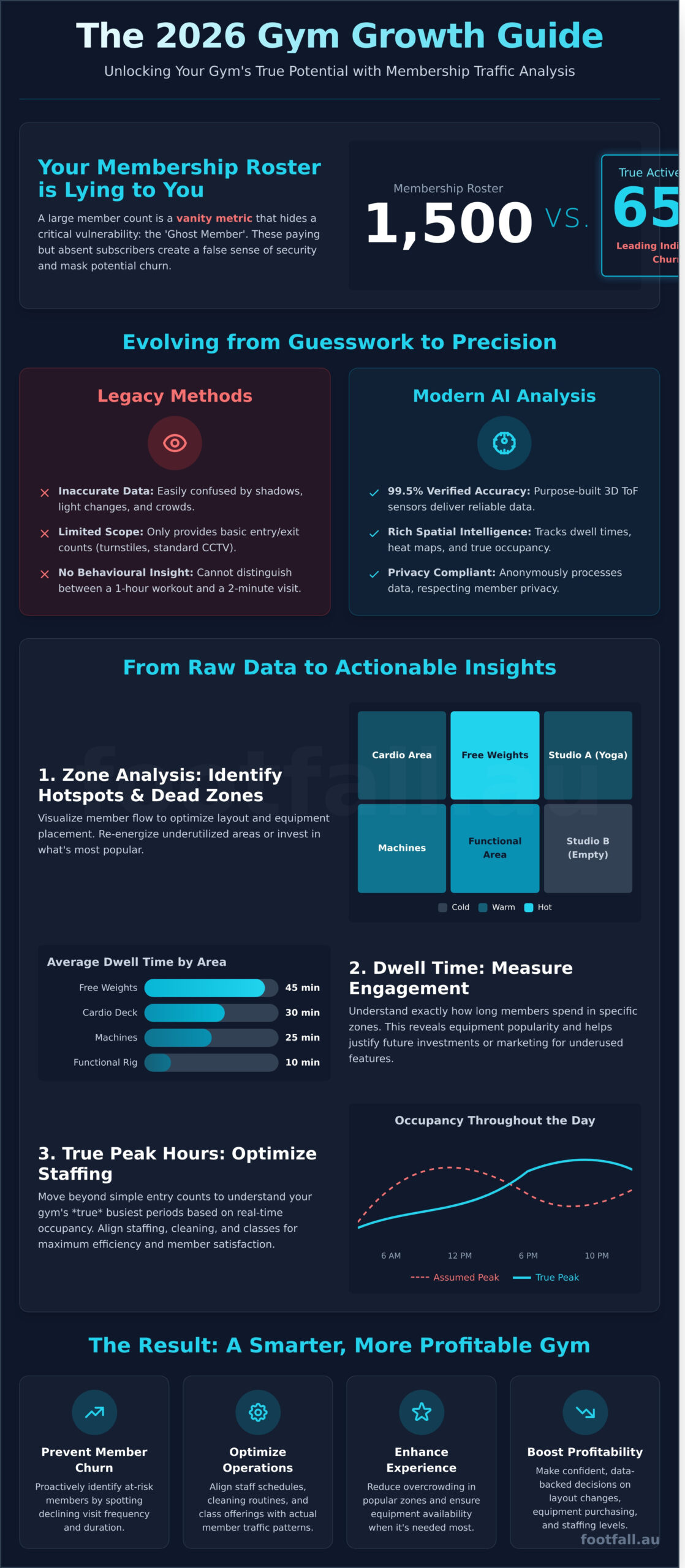
Your membership roster might look healthy, but it often hides a critical vulnerability: the ‘Ghost Member’. These are subscribers who pay their dues but rarely use your facility, creating a false sense of security that masks potential churn and deep-seated dissatisfaction. True gym membership traffic analysis moves beyond simple headcounts to study the real-time movement and engagement patterns within your space, offering a precise, unfiltered view of your facility’s operational health.
For years, gate turnstiles provided a basic entry count. However, this legacy technology cannot distinguish between a member using the squat rack for an hour and one who simply grabs a water bottle and leaves. In contrast, modern AI-driven overhead sensors deliver unparalleled accuracy. They track not just entries but dwell times, heat maps of popular zones, and true occupancy levels, transforming raw data into a strategic asset for growth.
Vanity Metrics vs. Actionable Insights
A large membership count is a classic vanity metric; it looks impressive on paper but can conceal a fragile business model. The metric that truly matters for long-term financial forecasting is the ‘active usage rate’. This figure is a powerful predictor of retention, as low engagement is the leading indicator of churn. By applying principles of customer behavior analytics, traffic data reveals the truth about member satisfaction and how your facility is actually being used.
The 2026 Australian Fitness Landscape
As we approach 2026, the Australian fitness market is shifting toward high-engagement, sustainable habits. The competitive dynamics between Sydney’s high-density urban gyms and Melbourne’s community-focused studios highlight a nationwide trend: members demand more value and better experiences. With the rise of 24/7 boutique studios, autonomous monitoring becomes essential for optimising staffing, class schedules, and equipment layout without constant supervision. For independent gyms, data-backed decision-making is no longer optional-it is the foundation of a resilient and profitable future.
The Technology of Precision: From AI Sensors to Spatial Intelligence
Effective gym management hinges on moving beyond guesswork. Traditional door counters provide a raw tally, but modern facilities require a more sophisticated approach. This is where 3D Time-of-Flight (ToF) sensors and AI-powered people counting technology deliver unparalleled clarity. These systems don’t just count heads; they provide the spatial intelligence needed for a truly effective gym membership traffic analysis, capturing the nuances of how your space is actually used.
Advanced devices, such as the FootfallCam Pro2, leverage AI to distinguish between different types of visitors. By setting height thresholds and analysing movement patterns, the system can accurately differentiate between members, staff, and even temporary visitors like delivery personnel. This ensures your key metrics aren’t skewed by non-member traffic. With a verified accuracy of 99.5%, you gain the confidence to make high-stakes operational decisions, from optimising class schedules to justifying investment in new equipment, based on hard evidence.
Crucially, this precision is achieved while upholding strict privacy standards. Modern people counting technology processes data anonymously, tracking movement as non-personally identifiable data points. This ensures full compliance with Australian privacy regulations, giving both you and your members complete peace of mind.
AI People Counting vs. Standard CCTV
While standard CCTV is essential for security, it is fundamentally unsuited for accurate traffic measurement. Security cameras are easily confused by changing light conditions, shadows, and crowded entranceways, leading to unreliable data. In contrast, AI-driven 3D sensors are purpose-built for accuracy in any environment. For gyms looking to leverage existing infrastructure, solutions like FootfallCam Centroid can integrate with your current cameras, upgrading them with AI analytics to deliver actionable insights without a complete hardware overhaul.
Metrics That Matter: Dwell Time and Zone Analysis
Understanding entry and exit numbers is only the beginning. The real value lies in decoding member behaviour within your facility. Key metrics include:
- Dwell Time: This measures the average time members spend in specific areas. Are they spending 30 minutes in the cardio section but only 10 minutes near the new functional fitness rig? This data reveals equipment popularity and engagement levels.
- Zone Analysis: By mapping your gym floor into distinct zones (e.g., free weights, machine area, studios), you can identify high-traffic hotspots and underutilised ‘dead zones’. As highlighted in a comprehensive study on fitness patterns, understanding these behaviours is key to optimising layouts and enhancing the member experience.
By tracking the complete visitor journey-from the front desk to the locker room and every piece of equipment in between-you transform raw numbers into a clear narrative of member engagement.
Decoding Member Behaviour: Predicting and Preventing Churn
Member retention is the bedrock of a profitable gym. Acquiring a new member can cost significantly more than keeping an existing one, yet many facilities overlook the predictive power hidden within their daily footfall. A sophisticated gym membership traffic analysis moves beyond simple check-in counts; it decodes the narrative of member engagement, allowing you to act decisively before a cancellation notice is ever handed in. Understanding these patterns is crucial because, as highlighted by analyses of the top trends in the fitness industry, a sense of community and routine are powerful retention drivers. A sudden break in that routine is your first and most important warning sign.
The data consistently shows a direct correlation between a drop in visit frequency and a member’s likelihood to churn. By segmenting your members into cohorts-such as ‘Power Users’ (4+ visits/week) versus ‘Occasional Visitors’ (1-2 visits/month)-you can tailor marketing efforts with precision. An offer for a new class might energise a Power User, while an Occasional Visitor may respond better to a flexible, lower-commitment pass.
Consider a boutique Melbourne studio that used predictive traffic data to reduce churn. They identified members whose weekly visits dropped by 60% for two consecutive weeks. An automated, personalised SMS was triggered, offering a complimentary session with a trainer to “rediscover their motivation.” This proactive outreach successfully re-engaged over a third of this at-risk group, contributing to a 15% reduction in their overall quarterly churn.
The Frequency Threshold
Define your facility’s ‘danger zone’-the point at which a member’s visit frequency becomes a critical risk. Is it dropping from three weekly visits to just one? Or no visits for 14 days? With intelligent analytics, you can automate alerts when a high-value member deviates from their established pattern, such as a regular 6 AM visitor who suddenly stops appearing. This enables timely, personalised re-engagement campaigns that are based on actual behaviour, not guesswork.
Evaluating Class Performance
Effective gym membership traffic analysis extends to specific zones within your facility. Measure the true ‘draw’ of instructors by analysing entrance and exit data for group fitness studios, not just booking numbers. This helps identify the ‘no-show’ gap between bookings and actual attendance, revealing which classes retain engagement. Use this footfall intelligence to justify adding popular time slots or replacing underperforming classes with data-backed confidence.
Operational Excellence: Optimising Staffing and Layout
Gut-feel is no longer sufficient for running a profitable fitness facility. True operational excellence is built on empirical data, transforming your two largest expenses-staff and space-into strategic assets. A comprehensive gym membership traffic analysis provides its greatest ROI by revealing precisely how your members interact with your gym, allowing you to make smarter, evidence-based decisions.
This process moves from insight to action in four clear steps:
- Step 1: Map your ‘True Peaks’—Identify the precise hours of highest demand, which are often different from what staff perceive.
- Step 2: Align staffing shifts—Schedule cleaners and personal trainers to coincide with verified high-traffic periods for maximum impact.
- Step 3: Reconfigure equipment layout—Use heatmapping data to understand zone popularity and eliminate bottlenecks.
- Step 4: Manage utility costs—Leverage ‘Live Occupancy’ data to automate HVAC and lighting, reducing waste during quiet hours.
Dynamic Staffing Models
Move beyond the standard 9-5 and 5-8 PM roster. Our data frequently reveals a gym’s true peak might be 6:30 AM or even a Saturday mid-morning. Aligning your roster with these verified peaks can reduce payroll costs by 10-20% while ensuring trainers and front-desk staff are available when the member experience matters most. For 24/7 facilities, automated alerts based on live occupancy ensure you can respond to issues even during unmanned hours, maintaining safety and service standards around the clock.
Data-Driven Gym Floor Design
Heatmapping technology visualises the member journey across your gym floor. It pinpoints high-demand zones, like a congested free-weights area, and highlights underutilised spaces. This intelligence allows you to justify equipment ROI-is that A$15,000 cross-trainer earning its keep? By strategically reconfiguring your layout, you can ease congestion and create a natural flow that guides members to discover new equipment, enhancing their workout and your facility’s perceived value.
This level of precision, driven by detailed gym membership traffic analysis, is the new standard for profitable gym management. It ensures every dollar spent on operations directly contributes to member satisfaction and retention. To learn how to apply these strategies in your facility, explore the solutions at Footfall.
Implementing Smart Solutions with Footfall Australia
Transitioning from raw data to strategic growth requires a specialist partner. At Footfall Australia, we provide the technology and the expertise to transform your facility’s foot traffic into actionable intelligence. With a dedicated national support and installation network, we deliver precision-engineered solutions tailored to the unique demands of the Australian fitness industry, from bustling city centres to regional community hubs.
For operators managing multiple locations, the FootfallCam V9 Software provides a decisive advantage: a ‘single pane of glass’ to view and compare performance across your entire portfolio. This centralised dashboard eliminates data silos, allowing for consistent and effective decision-making. We also recognise that many established gyms are held back by inaccurate legacy systems. Our Legacy Swap Out Plan is designed to seamlessly replace outdated beam counters and unreliable cameras with 98% accurate 3D sensor technology, ensuring your strategies are built on a foundation of truth.
Technology is only as effective as its support system. That is why local Australian expertise is at the core of our service. Our technicians ensure your hardware is precisely calibrated for your specific layout and provide ongoing maintenance to guarantee data integrity. This local presence means faster response times and a deeper understanding of market conditions, giving you a reliable partner in your growth journey.
Scalable Solutions for Every Facility
Our systems are engineered to scale, providing the same granular insight for a single-room boutique studio as for a multi-level commercial health club. We deliver customisable dashboards that present the most relevant KPIs to different stakeholders-from facility managers monitoring peak hours to marketing teams assessing campaign impact. Crucially, our technology integrates seamlessly with most existing POS and membership management software, enriching the data you already have.
Getting Started with a Traffic Audit
Initiating a comprehensive gym membership traffic analysis is a straightforward process. It begins with a complimentary site survey and technical consultation to understand your objectives and map out the optimal sensor placement. Following a swift and professional installation, we establish a data baseline, allowing you to start seeing meaningful patterns within weeks. Take the first step towards data-driven management. Contact Footfall Australia for a tailored gym traffic analysis solution.
Secure Your Gym’s Future with Data-Driven Precision
The era of managing a fitness facility on intuition is over. As we’ve explored, the key to sustainable growth lies in understanding the real-time behaviour of your members-how they use your space, when they visit, and what keeps them returning. This shift from simple roster counts to dynamic spatial intelligence is critical. A strategic approach to gym membership traffic analysis is what separates a thriving community hub from a struggling business, enabling you to optimise staffing, refine layouts, and proactively reduce churn before it happens.
Since 2004, Footfall Australia has been the trusted partner for Australian businesses seeking this competitive edge. With our proprietary AI-driven FootfallCam Pro2 technology and a dedicated national installation and maintenance network, we deliver the seamless, actionable insights you need to make evidence-based decisions with confidence. Don’t leave your most critical operational choices to chance.
Take the definitive step towards operational excellence. Book a consultation with Footfall Australia to optimise your gym’s traffic and begin building a more intelligent, responsive, and profitable future for your facility today.
Frequently Asked Questions
Is gym traffic analysis different from membership tracking software?
Yes, they serve distinct and complementary functions. Membership software tracks *who* enters, managing check-ins and payments. In contrast, traffic analysis tracks *how many* people are present and *where* they go within the facility, including non-members. It provides spatial analytics on occupancy and equipment usage, offering a layer of operational intelligence that membership software alone cannot provide. Together, they create a complete picture of gym performance.
How accurate are AI people counters in a high-movement gym environment?
Modern AI-powered sensors are engineered for precision in high-movement environments, consistently achieving over 98% accuracy. Using advanced algorithms and 3D depth-sensing technology, they reliably differentiate between individuals, even in crowded group fitness classes or busy free-weight areas. This level of accuracy ensures your occupancy and usage data is a reliable foundation for strategic operational decisions, from staffing to class scheduling.
Can I use footfall data to justify an increase in membership fees?
Absolutely. Footfall data provides the objective evidence to support your pricing strategy. By demonstrating consistently high occupancy during peak hours or increased demand for specific equipment and classes, you can validate a price adjustment. This data-driven approach allows you to transparently communicate the value members receive-a well-maintained, in-demand facility-which helps to justify the increase and mitigate member pushback. It replaces guesswork with hard evidence.
Will installing people counters infringe on my members’ privacy?
Privacy is paramount, and our systems are designed to protect it. The sensors capture anonymous metadata, counting human shapes and movement patterns without recording any personally identifiable information (PII) like faces. This process is fully compliant with the Australian Privacy Principles. You gain invaluable, actionable insights into how your space is being used without ever compromising the privacy and trust of your individual members.
Can footfall data help me decide whether to open a second gym location?
Yes, it is a critical tool for any expansion strategy. By analysing traffic patterns at your current gym, you can build a precise model of peak hours, member dwell time, and capacity limitations. If your data consistently shows you are operating at or near maximum capacity, it provides a powerful, evidence-based business case for a new site. This approach significantly de-risks the substantial investment of opening a second location.
How does traffic analysis help with gym equipment maintenance schedules?
Traffic analysis optimises your maintenance by enabling a shift from a time-based to a usage-based schedule. By identifying which specific machines-like treadmills or squat racks-receive the most use, you can prioritise their servicing to prevent unexpected downtime. This predictive approach not only extends equipment lifespan but also elevates member satisfaction by ensuring the most popular assets are always in peak operational condition.
What is the ROI of a people counting system for a mid-sized gym?
For a mid-sized gym in Australia, the return on investment is typically realised within 12-18 months. This is driven by direct cost savings from optimised staffing during off-peak hours (potentially A$15,000+ annually) and revenue growth from data-informed class scheduling. A comprehensive gym membership traffic analysis system provides actionable insights that improve efficiency and profitability, making it a strategic investment rather than a simple expense.