Smart Office Occupancy Sensors: The Strategic Guide to Workspace ROI in 2026
With commercial lease costs in Sydney and Melbourne pushing record highs, every square metre of your office must justify its existence. Yet, many organisations still base multi-million dollar real estate strategies on outdated PIR technology and manual headcounts. This approach provides a blurry, inaccurate picture of workspace utilisation, leading directly to wasted space and frustrated employees. A modern smart office occupancy sensor offers the precision required to move beyond guesswork, providing the anonymous, high-fidelity data needed to make confident, evidence-based decisions.
This strategic guide will demonstrate how to leverage this intelligence to achieve tangible outcomes. Discover how to transform raw spatial analytics into actionable insights that can reduce your real estate footprint by over 20%, improve meeting room availability, and help meet your critical ESG and NABERS energy targets. We will show you how to turn your office from a costly overhead into a high-performing strategic asset for 2026 and beyond.
Key Takeaways
- Master the ‘3-30-300’ framework to precisely calculate real estate savings by identifying and consolidating underutilised office space.
- Discover why legacy motion detectors are insufficient and how AI-powered sensors with 99.5% accuracy provide the data integrity needed for strategic decisions.
- Learn a strategic process to plan your smart office occupancy sensor deployment, starting with identifying your most critical data “blind spots.”
- Translate raw utilisation data into actionable strategies for enhancing workplace design, optimising resource allocation, and improving employee experience.
What is a Smart Office Occupancy Sensor and Why is it Essential in 2026?
A smart office occupancy sensor is more than a simple motion detector; it is an advanced IoT device engineered to provide a precise, real-time understanding of how your workspace is actually used. These sensors move beyond basic motion detection to deliver actionable intelligence, accurately counting individuals and mapping spatial utilisation across your entire floor plan. They provide the critical data layer needed to transform a static office into a dynamic, responsive environment.
By 2026, the hybrid work model will have stabilised as a permanent fixture of the Australian business landscape. This shift makes guesswork about office usage not just inefficient, but financially unsustainable. Operating a workspace without precise occupancy data leads to wasted expenditure on energy, cleaning, and underutilised real estate. Furthermore, leveraging this technology is now central to achieving ambitious Environmental, Social, and Governance (ESG) targets and improving your NABERS rating by demonstrating tangible reductions in energy consumption.
The Evolution of Office Monitoring
Legacy systems, primarily based on first-generation Passive Infrared (PIR) technology, are fundamentally unsuited for the modern workplace. A traditional occupancy sensor detects motion, not presence, often failing in quiet, focused work settings by mistakenly switching off lights or HVAC for employees sitting still at their desks. Today’s AI-driven sensors use advanced machine learning to identify human forms anonymously, ensuring true presence detection without capturing any personally identifiable information. This provides both real-time data for immediate automation and rich historical analytics for long-term strategic planning.
Key Use Cases for Modern Workspaces
The actionable insights generated by a smart office occupancy sensor unlock immediate operational efficiencies and significant cost savings. Key applications include:
- Automated Meeting Room Release: Eliminate “ghost meetings” by automatically freeing up booked-but-empty rooms, increasing resource availability and reducing employee frustration.
- Dynamic Cleaning Schedules: Deploy cleaning resources based on actual area usage, focusing efforts on high-traffic zones while reducing costs for spaces that went unused.
- HVAC and Lighting Automation: Achieve substantial energy reductions by intelligently heating, cooling, and lighting only the spaces that are actively occupied, directly impacting your bottom line and sustainability credentials.
The Technology Breakdown: PIR vs. ToF vs. AI People Counting
Selecting the right smart office occupancy sensor is not a one-size-fits-all decision. The technology powering the device dictates its accuracy, application, and ultimately, the value of the data you collect. Understanding the core differences between the dominant sensor types in the Australian market is the first step toward building a truly intelligent workplace.
Passive Infrared (PIR) vs. Time of Flight (ToF)
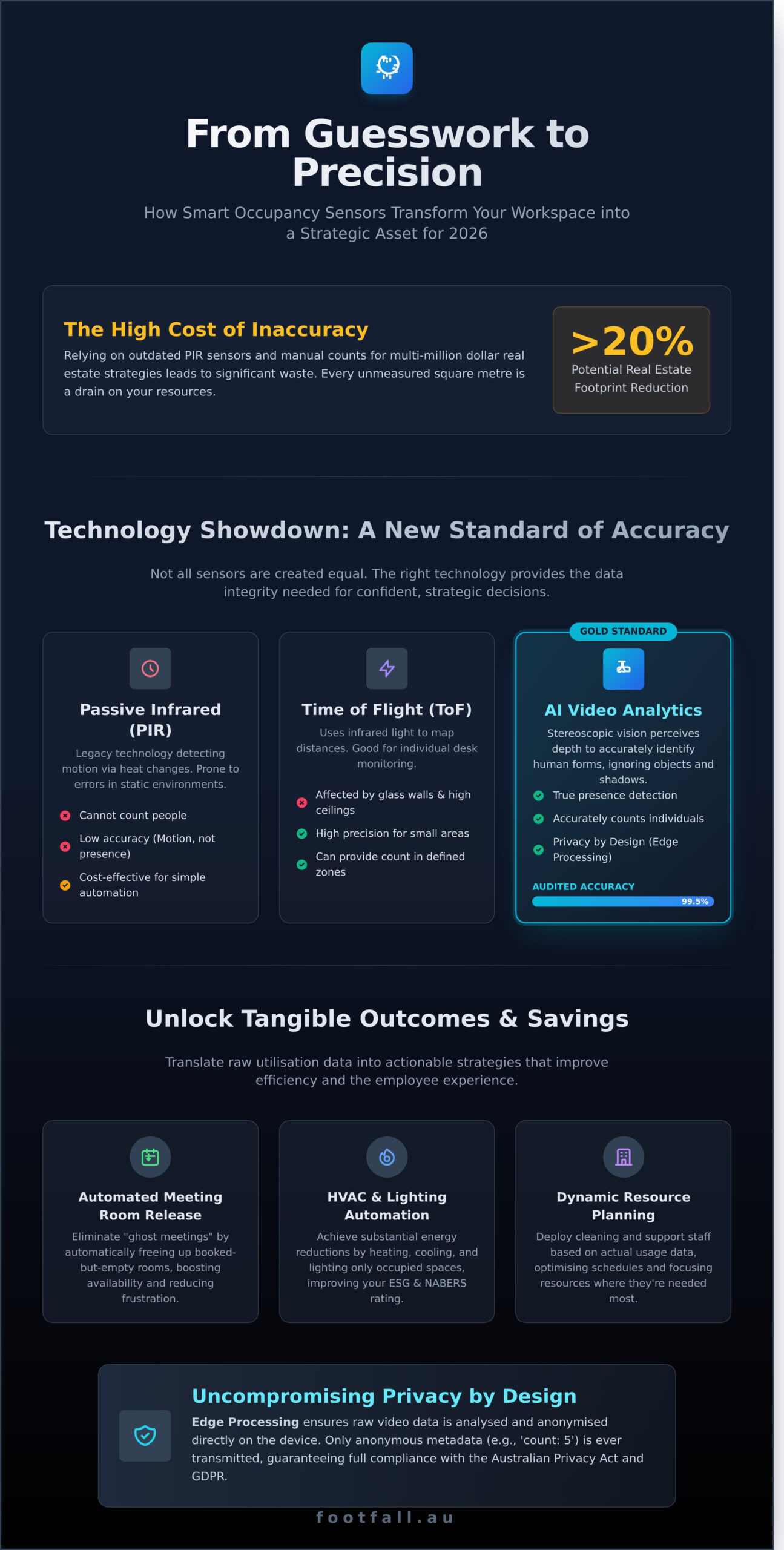
PIR sensors are the most common entry-level technology, detecting motion by sensing changes in infrared heat. While cost-effective for simple tasks like automated lighting control, their accuracy is fundamentally limited. They register presence but cannot count individuals, making them unsuitable for spatial analytics.
Time of Flight (ToF) sensors represent a significant advancement, using infrared light to map distances with high precision. This makes them a strong choice for monitoring individual desks or small cubicles. However, their performance can be compromised in environments with high ceilings or extensive glass walls, as reflective surfaces can distort their light-based measurements.
AI-Based Video Analytics: The FootfallCam Advantage
For enterprise-grade data integrity, AI-powered video analytics provides the definitive solution. The FootfallCam Pro2 operates on stereoscopic vision, using dual lenses to perceive depth and form in 3D, much like human eyes. This advanced capability allows it to distinguish accurately between people, inanimate objects, and environmental factors like shadows, eliminating the false positives that plague simpler systems. This is how we achieve the industry gold standard of 99.5% accuracy, verified by independent audits.
This intelligence is delivered with an uncompromising commitment to privacy. Edge Processing is the method where raw video data is analysed and anonymised directly on the device, ensuring only anonymous metadata is ever transmitted from the sensor. This “Privacy by Design” architecture guarantees full compliance with the Australian Privacy Act and GDPR from the moment of installation.
A truly effective smart office occupancy sensor must not only be accurate but also secure and seamlessly integrated. Understanding the nuances between these different technologies of occupancy detection is crucial for designing a system that delivers actionable insights. Beyond the core processing, connectivity options are tailored to your infrastructure needs:
- Power over Ethernet (PoE): The benchmark for reliability, delivering both power and a stable data connection through a single network cable.
- Wi-Fi: Offers greater installation flexibility in areas where deploying new cabling is impractical or cost-prohibitive.
- LoRaWAN: A low-power, wide-area network ideal for large-scale deployments across entire buildings or corporate campuses.
Calculating the ROI of Smart Office Occupancy Sensors
Investing in a smart office occupancy sensor system delivers returns far beyond the initial hardware cost. The value is best understood through the “3-30-300” rule, a framework that breaks down average corporate spending per square foot per year: A$3 on utilities, A$30 on rent, and A$300 on payroll. Occupancy data provides a clear pathway to optimise spending at every level, turning workplace analytics into a powerful financial tool.
The most immediate return comes from energy savings. By integrating occupancy data with your Building Management System (BMS), you can automate lighting and HVAC, ensuring energy is consumed only in occupied spaces. This strategy consistently yields utility savings between 15-30%, directly addressing the “3” in the rule.
Real Estate Footprint Optimization
The most significant direct savings are found in real estate-the “30” of the rule. With the average CBD desk costing upwards of A$15,000 per year, every underutilised space represents a substantial financial drain. Occupancy data provides the evidence needed for decisive action. For example, a Sydney-based professional services firm used sensor heatmaps to identify persistently empty zones, allowing them to consolidate their footprint and sub-lease a floor, saving over A$200,000 annually. This data transforms “dead zones” from liabilities into opportunities for redesign, such as creating high-demand collaborative hubs.
Operational Efficiency and Staffing
Beyond property, occupancy analytics refine the A$300 payroll component by boosting productivity and optimising operational costs. Precise data on peak traffic allows for smarter scheduling of facilities management and concierge staff, aligning service levels with actual demand. This same principle applies to maintenance; cleaning schedules can shift from a fixed rota to a dynamic, usage-based model, focusing resources where they are most needed.
This data-driven approach also reduces “search time”-the minutes employees waste daily looking for available desks or meeting rooms, a hidden cost that erodes productivity. By providing real-time visibility, you empower staff and create a more seamless, efficient work environment. As research on Advanced Sensor Technologies and the Future of Work highlights, deploying sensors is a key step toward creating smarter, healthier, and more responsive workplaces. To quantify the potential savings for your specific environment, you can use our detailed guide on Calculating the ROI of a People Counting System.
Implementation Strategy: Planning Your Sensor Deployment
A successful smart office occupancy sensor system is built on a foundation of strategic planning. Deploying hardware without a clear methodology can lead to inaccurate data and missed opportunities. This five-step process ensures your investment translates directly into actionable intelligence, transforming your workplace management from guesswork to a data-driven science.
- Step 1: Define Your Blind Spots. Identify the critical areas where occupancy data will deliver the most value. Is it underutilised meeting rooms, congested breakout areas, or understanding peak desk usage in open-plan zones? Pinpointing these goals focuses the entire project.
- Step 2: Conduct a Site Survey. Analyse the physical environment of each target area. A thorough survey assesses mounting heights, potential obstructions, and ambient lighting conditions to guarantee optimal sensor performance and data precision.
- Step 3: Select Your Hardware. Choose the technology that aligns with your infrastructure. The FootfallCam Pro2 offers dedicated, high-accuracy sensing for new installations. Alternatively, our Centroid solution can upgrade your existing CCTV cameras into intelligent occupancy counters, maximising the value of your current assets.
- Step 4: Initiate a Pilot Phase. Before a full-scale rollout, deploy sensors in a controlled zone. This pilot phase allows you to validate data accuracy, fine-tune configurations, and demonstrate the system’s value to key stakeholders with hard evidence.
- Step 5: Integrate for Centralised Reporting. Once validated, scale the deployment and integrate all sensors with the FootfallCam V9 Software. This creates a single, unified dashboard for monitoring your entire workplace portfolio and generating comprehensive reports.
Placement and Coverage Optimization
Achieving data accuracy hinges on correct sensor placement. Ceiling-mounted sensors provide a top-down view that minimises “occlusion”-where people or objects block the sensor’s line of sight in busy areas. In large, open-plan offices, careful planning is required to prevent “cross-talk” between adjacent sensors. For precise total occupancy counts, it is essential to ensure 100% coverage of all entry and exit points.
Software and Integration
The true power of a smart office occupancy sensor is unlocked through seamless integration. Our robust API connects occupancy data to your existing workplace tools, such as Outlook, Google Workspace, or Slack, enabling automated room booking and status updates. Within the FootfallCam V9 dashboard, you can visualise this data through heatmaps and utilisation charts, turning raw numbers into clear, actionable insights for strategic decision-making. For a detailed guide on retrofitting existing cameras, explore the FootfallCam Centroid solution.
The Footfall Australia Approach: Precision Meets Strategy
Implementing technology is only the first step; true optimisation comes from a strategy built on precision and supported by local expertise. For businesses with a national footprint, having on-the-ground support across major hubs like Sydney, Melbourne, and Perth is not a luxury-it is essential for a seamless and effective rollout. Footfall Australia combines world-class technology with a dedicated Australian network to deliver not just data, but a clear competitive advantage.
At the core of our solution is the FootfallCam Pro2, an AI-powered sensor refined over a 20-year pedigree. This is not a simple counter; it is a sophisticated analytics device designed for the complexities of modern workplaces. For organisations currently relying on outdated infrared beams or basic counters, our “Legacy Swap Out Plan” provides a streamlined pathway to upgrade. We replace imprecise technology with a state-of-the-art smart office occupancy sensor system, transforming your data collection from a liability into a strategic asset.
Our entire philosophy is built on moving clients from merely “counting heads” to truly “optimising journeys.” We decode the patterns of movement within your space to reveal opportunities for enhanced efficiency, improved staff experience, and smarter resource allocation.
Authoritative Data for Australian Businesses
We provide the verified, high-accuracy data required to meet stringent Australian environmental standards, including Green Star and NABERS reporting. Our national network of certified partners ensures every installation is executed flawlessly, providing consistent data integrity from day one. We believe that “Data is only an asset if it dictates a decision; otherwise, it is just digital noise.” Our platform is designed to turn that noise into clear, actionable direction.
Next Steps: From Data to Decision
Transforming your workplace begins with understanding it. We invite you to request a customised “Space Utilisation Audit” to identify key optimisation opportunities. For long-term success, our Premium Support Plan ensures your data remains accurate and your insights stay relevant. Take the definitive step towards a data-driven workplace. Speak with a Footfall Australia strategist today.
Your Next Strategic Move: Data-Driven Office Optimisation
As we move towards 2026, the strategic value of your physical workspace is defined by its efficiency and adaptability. The key takeaway is clear: understanding precisely how your office is used is no longer a competitive advantage, but a commercial necessity. By leveraging the right technology and a clear implementation strategy, you can transform operational costs into a powerful, measurable return on investment.
Ultimately, a strategically deployed smart office occupancy sensor is the foundation of a responsive, future-ready workspace. At Footfall Australia, we provide the actionable intelligence to make it happen. With over 2,000 Australian installations, a proven 99.5% counting accuracy, and NABERS & Green Star compatible reporting, our solutions are built to deliver certainty.
Ready to replace guesswork with precision? Request a Custom Office Occupancy Quote and discover how our data can unlock the true potential of your commercial space.
Frequently Asked Questions
Are smart office occupancy sensors legal under Australian privacy laws?
Yes, when implemented correctly. Under the Australian Privacy Act 1988, the key consideration is the collection of personally identifiable information (PII). A smart office occupancy sensor designed to gather anonymous data-by counting people without recording video or identifying individuals-is compliant. These systems provide valuable spatial analytics on how spaces are used while respecting employee privacy, ensuring you can optimise your workplace without breaching legal obligations.
How much does a smart office occupancy sensor system cost in 2026?
Projecting to 2026, a complete system cost in Australia is based on hardware, installation, and software. Expect hardware costs to range from A$150 to A$400 per sensor. In addition, most enterprise-grade solutions include a monthly Software-as-a-Service (SaaS) fee, typically between A$15 and A$30 per sensor, for access to the analytics dashboard, data processing, and support. A detailed quote depends on the scale and complexity of the deployment.
Can I use my existing CCTV cameras as occupancy sensors?
While some modern IP cameras have people-counting capabilities, using them for occupancy analytics is not advisable. CCTV systems inherently capture PII, creating significant privacy compliance risks under Australian law. Dedicated occupancy sensors are purpose-built for anonymity and provide far greater accuracy for spatial analysis. Relying on specialised hardware ensures you receive precise, actionable data without compromising privacy or data integrity.
What is the difference between a motion sensor and an occupancy sensor?
A motion sensor is a simple device that detects movement to trigger an immediate action, such as activating lights. It cannot determine the number of people or detect stationary individuals. In contrast, an occupancy sensor provides superior intelligence by confirming the actual presence of people, whether they are moving or still. This technology delivers precise counts and dwell time data, which is essential for true workplace utilisation analysis.
Do occupancy sensors work in dark or low-light office environments?
Absolutely. High-performance occupancy sensors are engineered to function with complete accuracy regardless of lighting conditions. They typically use technologies such as infrared (IR) or Time-of-Flight (ToF), which detect body heat or measure distances with invisible light pulses. This ensures consistent and reliable data collection 24/7, making them ideal for monitoring all areas of your office at any time of day or night.
How many sensors do I need for a 1,000 square metre office?
The required number of sensors is determined by your office layout and specific data goals, not just square meterage. As a general guideline, you would need one sensor for each enclosed room (e.g., meeting rooms, private offices) and approximately one sensor per 15-25 square metres in open-plan areas. For a precise and effective deployment, a professional site survey is recommended to map sensor placement to your unique floor plan.