Shopping Centre Footfall Tracking: The 2026 Guide to Retail Asset Optimisation
Lease negotiations based on guesswork and tenant disputes over traffic claims are the costly symptoms of outdated visitor data. In the complex ecosystem of a modern Australian retail centre, legacy systems often fail to map the intricate visitor journeys that define an asset’s true value. This is where modern shopping centre footfall tracking moves beyond simple counts, transforming ambiguity into actionable intelligence and providing the defensible data required to make critical decisions with confidence.
This 2026 guide is your strategic roadmap to mastering this essential technology. We will explore how to leverage precise spatial analytics to justify rental values, optimise operational workflows for cleaning and security, and share powerful insights that foster stronger tenant relationships. Prepare to unlock a new level of asset performance, turning complex human movement into your most valuable strategic advantage.
Key Takeaways
- Justify rental rates with evidence-based logic. Learn how to calculate the ‘Rent-to-Traffic’ ratio to establish fair leasing models and resolve tenant disputes with objective data.
- Move beyond simple door counts to mapping the complete visitor journey. This reveals how different zones and pathways truly perform, unlocking new opportunities for operational and layout optimisation.
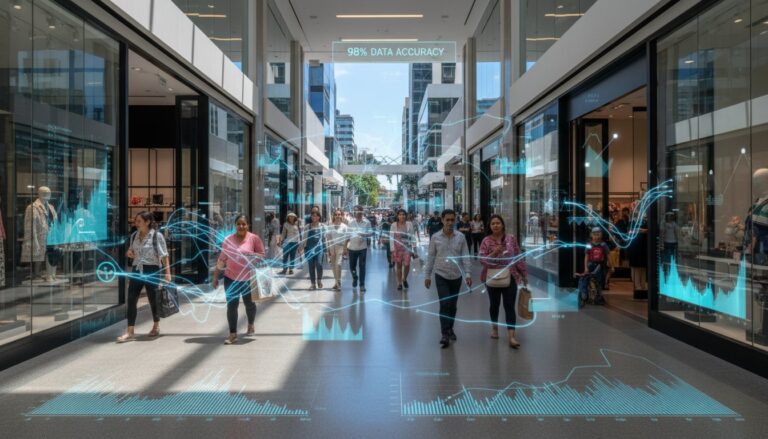
- Harness AI-driven sensor technology for 98%+ accuracy. Base your critical leasing and operational decisions on a reliable data foundation that remains precise even in high-density crowds.
- Master modern shopping centre footfall tracking to optimise your asset portfolio. Discover a strategic framework for implementing a scalable, data-driven management strategy across your Australian properties.
The Strategic Evolution of Shopping Centre Footfall Tracking in 2026
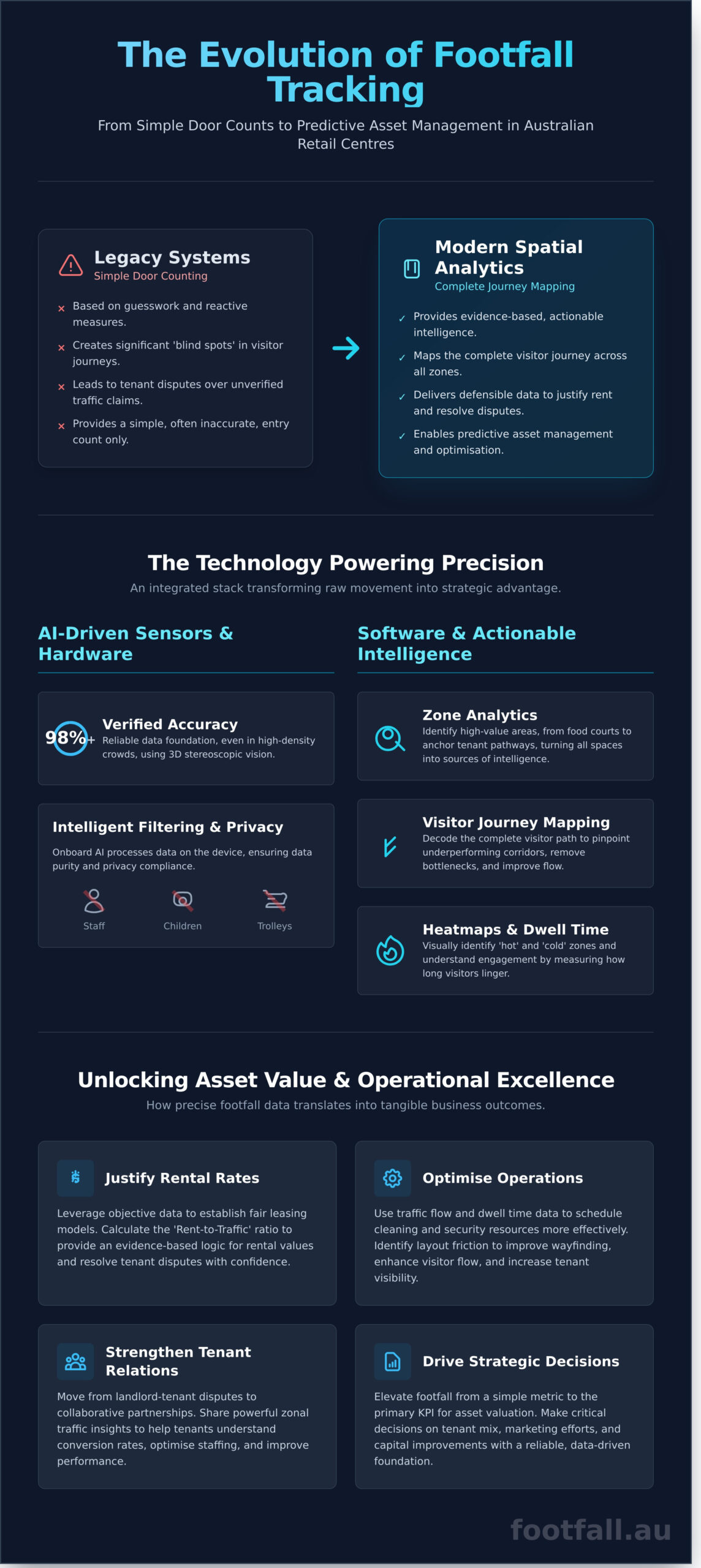
In 2026, the practice of shopping centre footfall tracking has moved far beyond simple visitor counts. It has matured into a multi-dimensional spatial analytics framework, designed to decode the complex narrative of consumer behaviour within physical retail environments. The industry has decisively shifted from legacy ‘door counting’-a reactive measure of popularity-to modern ‘journey mapping’ that provides a comprehensive view of movement across all common areas. This evolution transforms data from a historical report into a tool for predictive asset management, offering the only evidence-based defense against the persistent erosion of market share by e-commerce.
Why Simple Door Counting is No Longer Enough
For large-scale Australian malls, relying solely on entrance data is like trying to understand a novel by reading only the first page. It confirms a visitor has arrived but reveals nothing about their intent or engagement. This creates a significant ‘blind spot’ problem, especially in complex, multi-level centres where shopper paths diverge unpredictably. The evolution of various people counting technologies has enabled far greater precision than ever before. The solution is ‘Zone Analytics’, which provides granular data on high-value areas, from busy food courts to the pathways leading to major anchor tenants, turning previously unmeasured spaces into sources of actionable intelligence.
The Business Intelligence Value of Footfall Data
The true power of modern footfall data lies in its ability to connect raw traffic numbers to critical business intelligence. It allows centre managers to correlate visitor flow with key performance indicators like ‘dwell time’-how long shoppers linger in a specific area-and to work with tenants to understand ‘conversion rates’ by comparing zonal traffic to sales figures. This rich data stream elevates footfall from a simple metric to the primary KPI for asset valuation and operational efficiency. It positions the data as a ‘Smart Strategist’ in the hands of management, empowering them to optimize tenant mix, justify rental values, and make strategic decisions with quiet confidence.
The Technology Stack: AI Sensors, Journey Mapping, and Precision
Effective shopping centre footfall tracking moves beyond simple door counters; it relies on a sophisticated technology stack where hardware, software, and AI converge. This ecosystem is engineered to transform raw movement data into a clear, strategic advantage for centre management, ensuring every decision is backed by empirical evidence.
From Hardware to Actionable Intelligence
The foundation of this stack is the FootfallCam Pro2, a sensor that utilises AI-driven edge computing to process data directly on the device. Its advanced 3D stereoscopic vision delivers a verified accuracy of over 98%, reliably distinguishing individuals even in high-density crowds. The onboard AI intelligently filters out non-customer traffic such as staff, children, and shopping trolleys to ensure data purity. For centres with existing infrastructure, FootfallCam Centroid can repurpose security camera feeds for analytics, offering a cost-effective path to visitor intelligence.
Crucially, this technology operates on a privacy-first principle, fully compliant with Australian privacy regulations. All data is anonymised at the point of capture, tracking movement patterns without using facial recognition. The FootfallCam V9 Software then translates this raw data into actionable intelligence. This methodical approach, which aligns with principles found in academic research on footfall, transforms simple counts into intuitive heatmaps and reports through a seamless, integrated dashboard.
Mapping the Visitor Journey
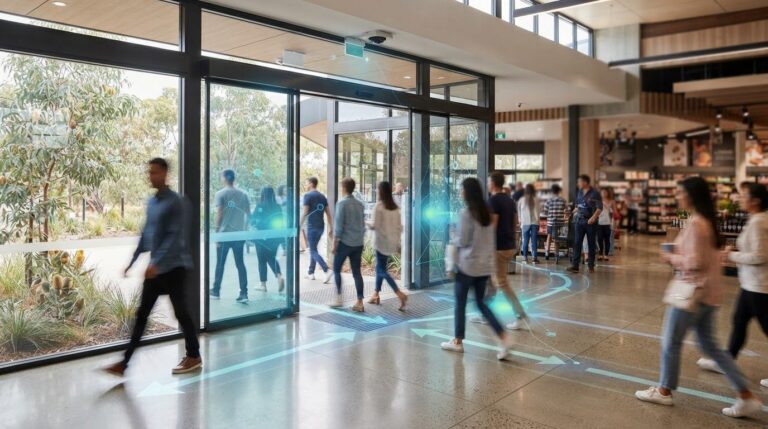
Understanding where visitors go is as important as knowing how many there are. The technology stack enables precise path analysis, decoding the complete visitor journey from the moment they enter the car park to their path through various retail zones and food courts. This granular view reveals critical behavioural patterns:
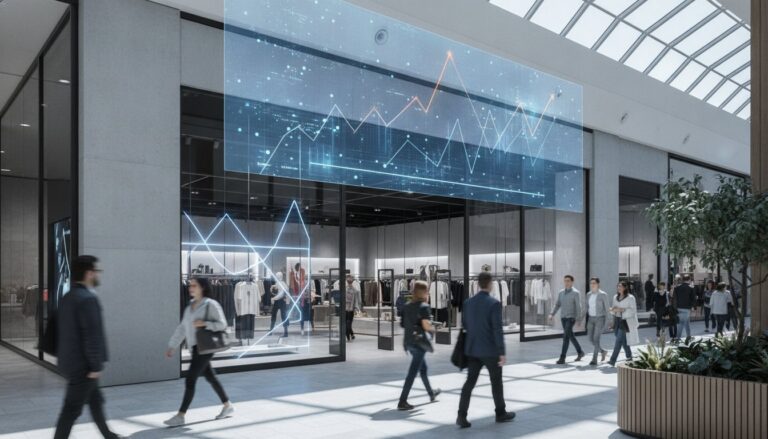
- Identifying ‘Hot’ and ‘Cold’ Zones: Heatmaps visually display high-traffic areas and underutilised spaces, empowering management to optimise tenant mix, kiosk placement, and promotional activities.
- Optimising Layouts: Spatial analytics pinpoint underperforming corridors or confusing layouts that create friction. By understanding these bottlenecks, you can improve wayfinding and enhance visitor flow, directly impacting dwell time and tenant visibility.
This deep understanding of movement transforms the entire centre into a measurable, optimisable asset, turning spatial data into a direct driver of rental income and operational efficiency.
Leveraging Footfall Data for Tenant Management and Rent Justification
The relationship between a shopping centre and its tenants is a complex partnership. Historically, lease negotiations and performance reviews have relied on sales figures and subjective observations. Today, precise shopping centre footfall tracking replaces ambiguity with objective, actionable intelligence. This data transforms tenant management from a reactive process into a proactive, evidence-based strategy that fosters mutual success.
By moving beyond outdated estimations, management can build a transparent framework for rent justification and tenant support. This data-driven approach not only strengthens landlord-tenant relationships but also directly impacts the centre’s profitability and long-term viability.
Data-Driven Lease Negotiations
Shift your lease discussions from debate to data. By integrating verified sensor data into contracts, you can definitively prove the value of a specific location. Justify premium rental rates for ‘power aisles’ and high-traffic entrance zones with clear metrics showing thousands more potential customers passing by daily. For example, a location near the food court might command a A$400 per square metre premium, backed by data showing 40% higher traffic than a quieter corridor. This same data helps manage tenant expectations during renovations, providing a clear picture of temporary traffic dips and projected recovery timelines.
The Shared Value Model: Helping Tenants Succeed
A thriving tenant is your greatest asset. Empower them with the insights they need to optimise their own operations, creating a powerful shared value model. Providing tenants with actionable data is a strategic investment in your centre’s overall performance. Consider offering:
- Staffing Optimisation: Share peak-hour and day-of-week traffic reports so tenants can align staffing levels with actual customer flow, improving service and controlling labour costs.
- Strategic Adjacency Insights: Use ‘cross-shopping’ data to reveal visitor journey patterns. Proving that shoppers visiting a major fashion anchor are highly likely to visit a nearby cosmetics store can inform your tenant mix and leasing strategy.
- Performance Benchmarks: Provide anonymised reports comparing a tenant’s footfall and capture rate against the category average within the centre, giving them a clear benchmark for success.
Ultimately, a comprehensive understanding of visitor behaviour allows you to attract high-value anchor tenants by proving category demand before they even sign a lease. This strategic application of leveraging footfall data transforms your leasing team from salespeople into strategic consultants, equipped to build a more resilient and profitable retail ecosystem.
Implementing a National Footfall Strategy Across Australia
Transitioning from single-site monitoring to a cohesive national strategy demands precision and a structured approach. A unified system for shopping centre footfall tracking provides portfolio-wide intelligence, enabling asset managers to benchmark performance, optimise tenant mix, and allocate resources with confidence. This implementation follows a logical, five-step framework designed for scalability and accuracy.
- Step 1: Conduct a Site-Wide Audit. We begin by mapping all critical visitor touchpoints-every entrance, escalator, food court, and anchor tenant adjacency-to create a comprehensive blueprint for optimal sensor placement.
- Step 2: Select Optimised Hardware. Based on the audit, we deploy the right technology for each location. Our Pro2 sensor offers unparalleled accuracy for complex, high-traffic zones, while the Centroid provides a robust, efficient solution for standard entryways, aligning technology with your existing infrastructure.
- Step 3: Ensure Privacy Compliance. All data collection is anonymous and engineered to be fully compliant with the Australian Privacy Principles (APPs), ensuring visitor trust and complete legal integrity from day one.
- Step 4: Establish Local Maintenance. We establish a proactive maintenance and calibration rhythm with local Australian technicians to guarantee consistent data accuracy and system uptime across all sites.
- Step 5: Train for Strategic Growth. Your asset managers receive dedicated training to interpret V9 analytics, empowering them to translate raw data into actionable strategies for marketing ROI and operational efficiency.
Local Considerations for Australian Retail Hubs
A successful national strategy must adapt to local nuances. In Brisbane and Perth, our systems help you manage climate-driven traffic shifts between indoor and outdoor precincts. For high-density CBD centres in Sydney and Melbourne, we focus on decoding complex pedestrian flows and peak hour patterns. Meanwhile, in regional hubs like Canberra and Adelaide, the challenge is often understanding dwell time and visitor loyalty to drive repeat visitation.
Logistics and Support: The Footfall Australia Network
Consistent data requires consistent, localised support. Our network of Australian partners ensures expert installation and precise calibration with minimal disruption to your operations. For centres with outdated systems, our ‘Legacy Swap Out Plan’ provides a seamless transition to modern, high-accuracy technology. This commitment to national performance is backed by Footfall Australia’s support plans, designed to maintain peak accuracy across your entire property portfolio.
Future-Proofing with Footfall Australia: Integrated Intelligence
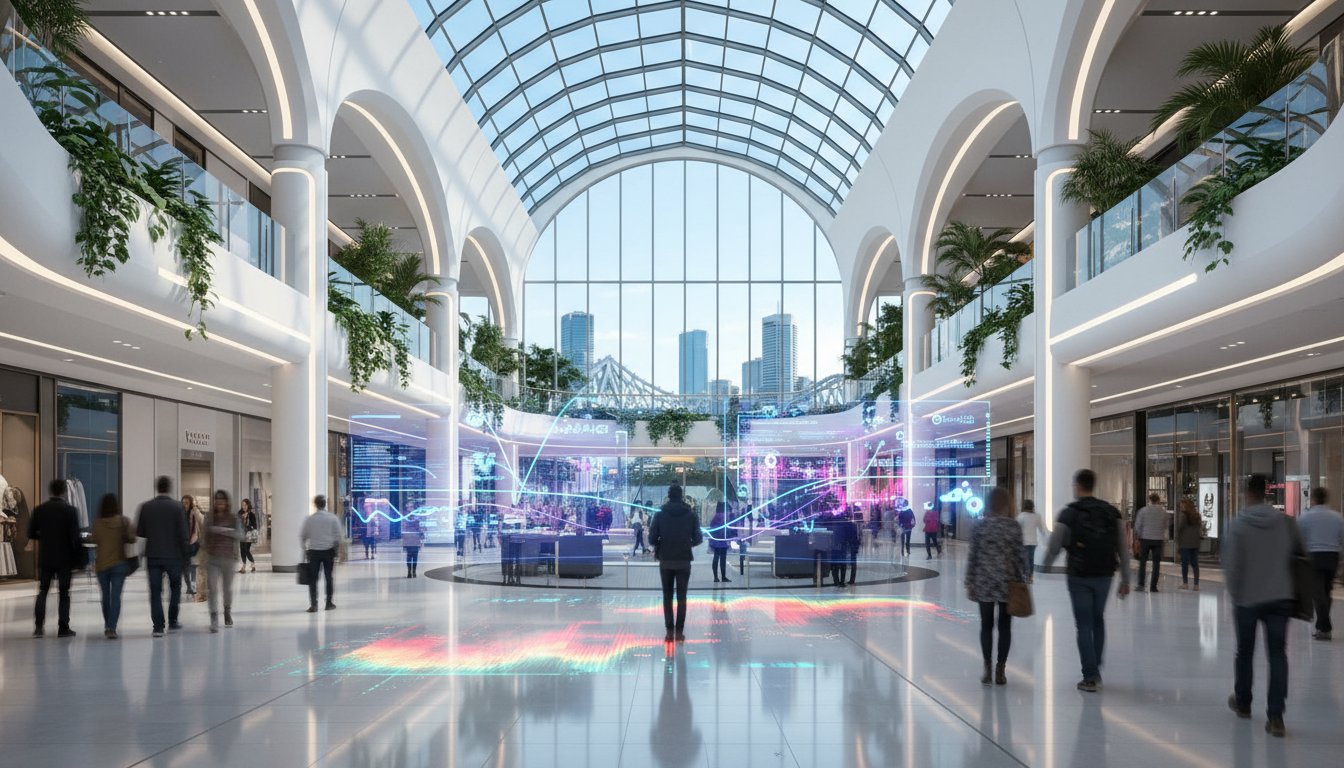
In the evolving retail landscape, staying ahead requires more than adaptation; it demands foresight. Footfall Australia acts as your high-tech consultant for the next decade, providing the integrated intelligence to transform your shopping centre from a passive space into a dynamic, responsive environment. We bridge the gap between proprietary hardware and advanced AI software, delivering a seamless flow of actionable data. The return on investment is clear: you move from speculative management to a model based on hard evidence, optimising tenant mix, marketing spend, and operational staffing with precision.
This is the future of strategic asset management. By understanding the complete visitor journey-from entry points to dwell times in specific zones-you gain the empirical data needed to justify leasing rates and prove the value of your physical space to current and prospective tenants. Our comprehensive shopping centre footfall tracking solution is not just about counting people; it’s about decoding behaviour to drive revenue.
The FootfallCam Pro2 Advantage
We believe in empowering our clients, not locking them into expensive, recurring fees. Our FootfallCam Pro2 system is offered as a one-time hardware purchase with a perpetual software license. This model provides long-term budget certainty and treats your analytics system as a permanent asset, a stark contrast to predatory subscription models that inflate costs over time. The FootfallCam Pro2 is engineered to be the industry standard for accuracy and AI-driven analytics, setting the benchmark for 2026 and beyond.
Next Steps: Your Data-Driven Roadmap
Embarking on your journey to data-driven management is a structured and straightforward process. Your roadmap to enhanced profitability and operational excellence begins here:
- Request a Custom Estimate: Use our device calculator to determine the precise hardware requirements for your centre’s unique layout and entrances.
- Unlock True Conversion Metrics: The ultimate goal is integration. By combining footfall data with your tenants’ Point-of-Sale (POS) systems, you can calculate true sales conversion rates, basket size, and spend-per-visitor-the most powerful metrics in retail management.
- Plan Your Strategy: Work with our experts to map out an implementation plan that aligns with your business objectives, ensuring a seamless transition to an evidence-based operational model.
Take the definitive step towards future-proofing your retail asset. Contact Footfall Australia for a Strategic Consultation today and let us build your roadmap to integrated intelligence.
Transforming Data into Your Definitive Asset Strategy
The era of passive observation is over. As we’ve explored, the evolution of shopping centre footfall tracking has transformed it from a simple metric into the strategic cornerstone of retail asset management. By leveraging AI-powered sensors and sophisticated journey mapping, property managers can now decode visitor behaviour, justify rental structures with empirical evidence, and orchestrate a cohesive national strategy. This shift from counting people to understanding their purpose is the definitive advantage in the competitive 2026 retail landscape.
The next step is to translate these insights into action. Footfall Australia provides the integrated intelligence to make it happen. With a legacy of serving Australia since 2004, guaranteed 98%+ counting accuracy, and dedicated local support in all major Australian cities, we deliver the clarity you need for evidence-based decisions. Optimise your retail asset with Footfall Australia’s precision tracking and turn your visitor data into your most valuable asset.
The intelligence to build a more profitable, responsive, and future-proof retail environment is within your reach.
Frequently Asked Questions
How accurate is shopping centre footfall tracking in high-traffic environments?
The accuracy of modern shopping centre footfall tracking exceeds 99%, even in dense crowds and complex lighting conditions. Our systems utilise advanced 3D stereo vision and Time-of-Flight (ToF) sensors that differentiate individuals with exceptional precision. This ensures your strategic decisions are based on reliable, verifiable data, providing a true measure of visitor traffic patterns and peak operational periods.
Is people counting technology compliant with Australian privacy laws?
Yes, our people counting technology is engineered for full compliance with Australian privacy legislation, including the Privacy Act 1988 (Cth). The sensors capture anonymous metadata by counting human forms without recording any personally identifiable information (PII) like facial features. This focus on anonymised spatial data ensures you gather powerful, actionable insights while upholding the highest standards of visitor privacy.
Can I use my existing CCTV cameras for footfall tracking?
While some integrations are possible, using CCTV for footfall tracking is not recommended for achieving high accuracy. Security cameras are designed for identification and surveillance, often with angles and lighting unsuitable for precise, anonymous counting. Dedicated footfall sensors are purpose-built for this task, delivering the consistent, high-precision data required for effective operational and leasing strategies.
What is the difference between a footfall counter and a visitor journey map?
A footfall counter provides a fundamental metric: the total number of people entering a space. A visitor journey map delivers a strategic narrative. It visualises shopper pathways, identifies high-traffic zones, measures dwell time, and reveals how visitors interact with your entire centre. One is a simple headcount; the other is actionable intelligence for optimising layout, tenant mix, and marketing efforts.
How does footfall data help in justifying shopping centre rent increases?
Footfall data provides irrefutable evidence of a location’s commercial value. By demonstrating consistently high traffic and prolonged shopper engagement in specific zones, you can objectively justify premium rental rates. Sharing this data with prospective tenants proves the opportunity, transforming lease negotiations from subjective discussions into evidence-based partnerships valued in A$.
What are the maintenance requirements for a national people counting system?
Modern national people counting systems are engineered for minimal hands-on maintenance. Our devices feature remote diagnostics and automated system health checks, allowing our support team to resolve most issues without a site visit. A comprehensive service plan covers remote firmware updates and proactive monitoring, ensuring consistent data accuracy and seamless reliability across your entire property portfolio.
Can footfall tracking distinguish between staff and actual shoppers?
Yes, advanced systems can effectively distinguish staff from shoppers to ensure data purity. This is achieved by implementing staff exclusion zones (e.g., behind service counters), applying time-based rules to filter pre-trade movements, or using sophisticated AI to recognise staff uniform patterns without identifying individuals. This delivers a true and accurate count of your potential customers.
How long does it take to install a complete system in a major mall?
A complete system installation for a major shopping centre is a phased process designed for zero disruption to trade. Following a detailed site audit and strategic planning, the physical installation of sensors is typically completed outside of trading hours. For a large mall, a full rollout across all entrances and key zones can be strategically executed over several weeks to ensure a seamless deployment.