The Strategic Guide to People Counter Systems for Commercial Buildings in 2026
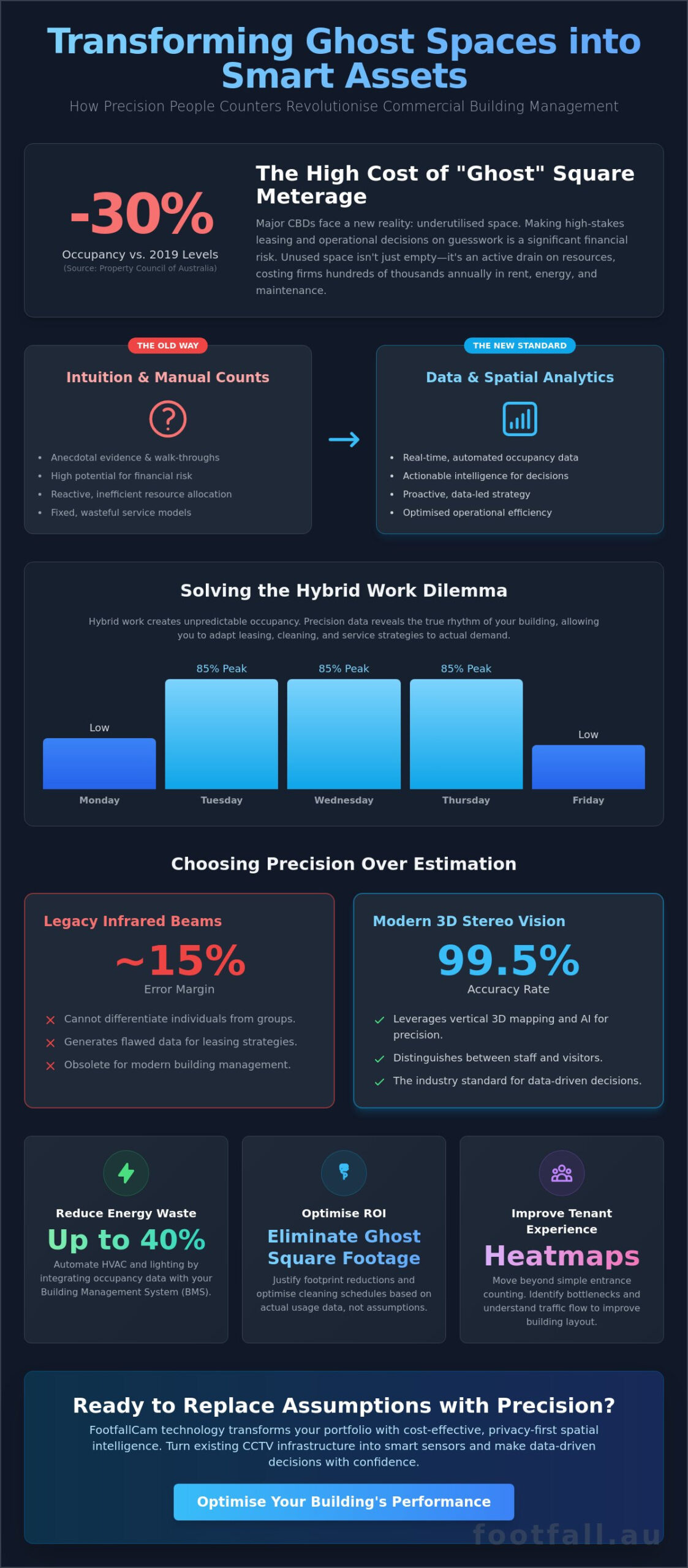
Recent data from the Property Council of Australia indicates that office occupancy in major CBDs often fluctuates 30% below 2019 levels, highlighting the urgent need for a precise people counter for commercial buildings to avoid paying for “ghost” square meterage. You likely realize that your current floor plates aren’t being used efficiently, yet making high-stakes leasing decisions based on manual walk-throughs or anecdotal evidence is a significant financial risk. Managing a modern asset requires more than just intuition. It demands hard evidence of how people move through your space.
This strategic guide demonstrates how advanced counting technology transforms spatial guesswork into actionable intelligence. By capturing real-time occupancy data, you can automate HVAC and lighting systems to match actual usage, potentially reducing energy waste in unoccupied zones by up to 40%. We’ll examine the technical implementation of these sensors and show you how to leverage this data to justify footprint reductions or floor-plan overhauls that reflect the reality of the 2026 hybrid workforce. It’s time to replace assumptions with the precision of spatial analytics.
Key Takeaways
- Learn why 3D stereo vision technology is the industry standard for distinguishing staff from visitors, ensuring your spatial data is built on precision rather than estimation.
- Discover how to integrate a people counter for commercial buildings with your existing BMS to automate energy usage and optimize common area maintenance.
- Transition from simple entrance counting to full spatial intelligence by using heatmaps to identify bottlenecks and improve the tenant experience across your Australian portfolio.
- Master the logistics of a national rollout while maintaining strict adherence to privacy-by-design principles, ensuring your data collection is both ethical and compliant.
- Explore how FootfallCam technology transforms existing CCTV infrastructure into smart sensors, providing a cost-effective path to data-driven building management.
The Strategic Role of People Counters in Modern Commercial Buildings
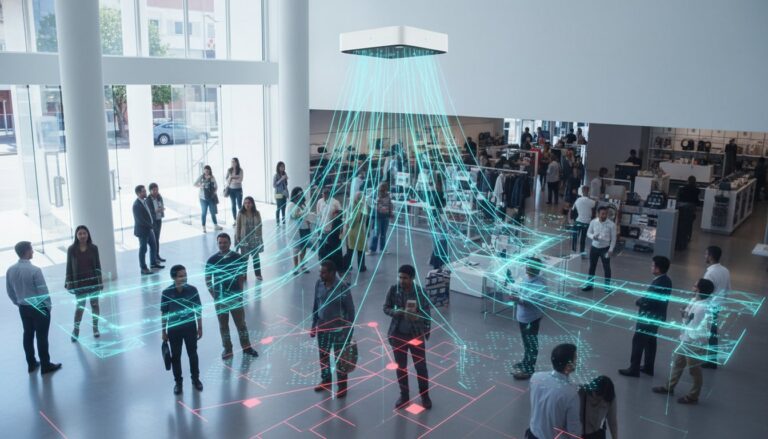
Modern commercial management has moved beyond the clipboard and the guesstimate. A sophisticated people counter technology setup now functions as a high-precision IoT sensor, delivering the granular spatial analytics required for 2026 portfolio optimization. The shift from manual tracking to real-time automated occupancy monitoring is no longer optional for those managing high-value assets. It’s a fundamental requirement for staying competitive. Using a people counter for commercial buildings provides a level of clarity that intuition cannot replicate, turning raw movement into actionable intelligence.
The 2026 environment demands data over gut feeling. Facility managers face increasing pressure to justify every cent of their operational budget. By integrating automated systems, they secure three primary pillars of success: reduced operational costs, improved tenant satisfaction, and guaranteed safety compliance. This technology serves as the eyes of the building, providing a continuous stream of evidence to support complex management decisions. It allows for a transition from reactive fixes to proactive, data-led strategy.
Solving the Hybrid Work Dilemma
Hybrid work patterns in Australian CBDs have created a distinct, often unpredictable rhythm of occupancy. Data reveals that Tuesday through Thursday often reach peak loads of 85%, while Monday and Friday usage frequently plummets. This volatility makes traditional fixed-service models obsolete. High-precision sensors identify “dead zones” in large office complexes, allowing owners to repurpose underutilised space into flexible meeting rooms or collaborative hubs. These insights provide the evidence needed for flexible leasing and hot-desking strategies that adapt to how tenants actually behave, rather than how they’re expected to work.
The Economic Impact of Footfall Data
Unused space represents a significant financial drain. With prime office rents in cities like Sydney and Melbourne often exceeding A$1,300 per square metre, “ghost square footage” can cost a firm hundreds of thousands of dollars annually. Accurate utilization metrics allow managers to justify cleaning and maintenance schedules based on actual area usage. If a specific floor remains empty on a Friday, cleaning resources can be redirected to high-traffic lobbies or end-of-trip facilities. This targeted approach ensures every dollar spent on facility management correlates with actual demand.
Advanced Sensing Technologies: Choosing Precision Over Estimation
Legacy infrared beam systems are obsolete in 2026. These horizontal sensors typically suffer from a 15% error margin because they cannot differentiate between a single person and a group entering simultaneously. For Australian property managers, relying on such data leads to flawed leasing strategies and inefficient facility management. A high-performance people counter for commercial buildings must provide granular data to be useful. Modern sensors now achieve 99.5% accuracy by leveraging vertical 3D mapping and artificial intelligence. The strategic role of people counters in modern facility management involves linking occupancy data with HVAC systems to reduce energy waste by up to 30% in large-scale commercial assets.
Hardware durability is a primary concern for high-traffic entrances in Sydney and Melbourne CBDs. Sensors must withstand constant operation and environmental factors like glare from glass-heavy architectural designs. High-ceiling commercial lobbies, often reaching heights of 6 to 10 metres, require specialized wide-angle lenses. Standard sensors lose precision at these heights; however, advanced 3D optics maintain a crisp field of view, ensuring every visitor is accounted for without blind spots. You can optimise your building’s performance by selecting hardware designed for these specific spatial challenges.
3D Stereo Vision vs. Time-of-Flight (ToF)
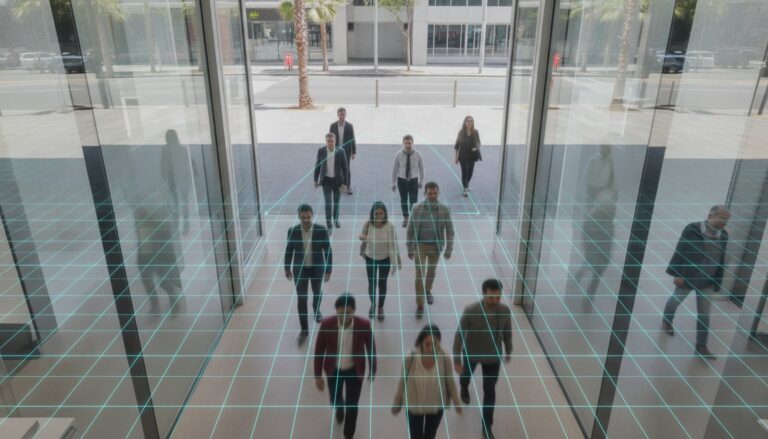
3D stereo vision technology mimics human sight by using two distinct lenses to create a depth-perceiving image. This allows the system to distinguish between a person and a shadow or a pram with 99.5% precision. In contrast, Time-of-Flight (ToF) sensors emit light pulses and measure the time they take to bounce back. ToF is superior in low-light environments or areas with zero ambient light. For most Australian commercial foyers, 3D stereo vision is the standard choice due to its ability to handle the high-contrast lighting typical of our sun-drenched entrances. Mounting heights must be calibrated precisely; a sensor placed at 3.5 metres covers a different floor area than one at 5 metres.
AI-Powered Feature Sets
AI transforms raw counts into actionable intelligence. Staff exclusion technology is perhaps the most vital feature for commercial offices. Counting your 50-person security and maintenance crew as visitors daily creates a massive skew in monthly occupancy reports. Modern AI identifies staff through height, gait analysis, or wearable tags to ensure data remains pure. Additionally, these systems differentiate between adults and children, which is essential for mixed-use developments. Real-time data streaming also serves a critical safety function. During emergency evacuations, the system provides live occupancy counts to first responders, ensuring no one is left behind in a high-rise structure. This level of detail turns a simple people counter for commercial buildings into a comprehensive safety and strategy tool.
Spatial Intelligence: Beyond Entrance Counting to Building Optimization
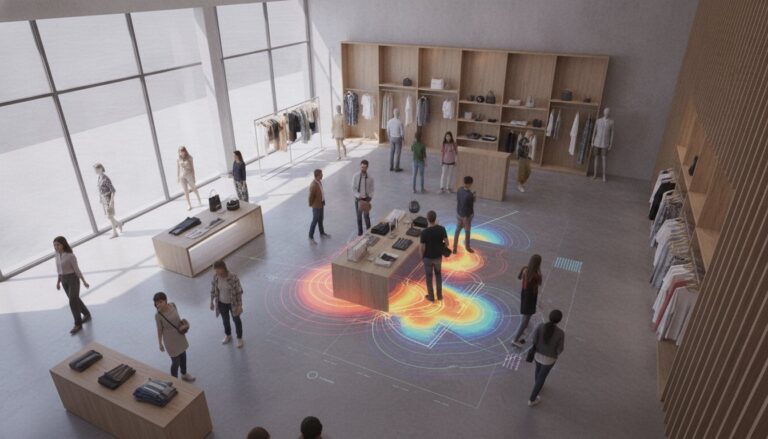
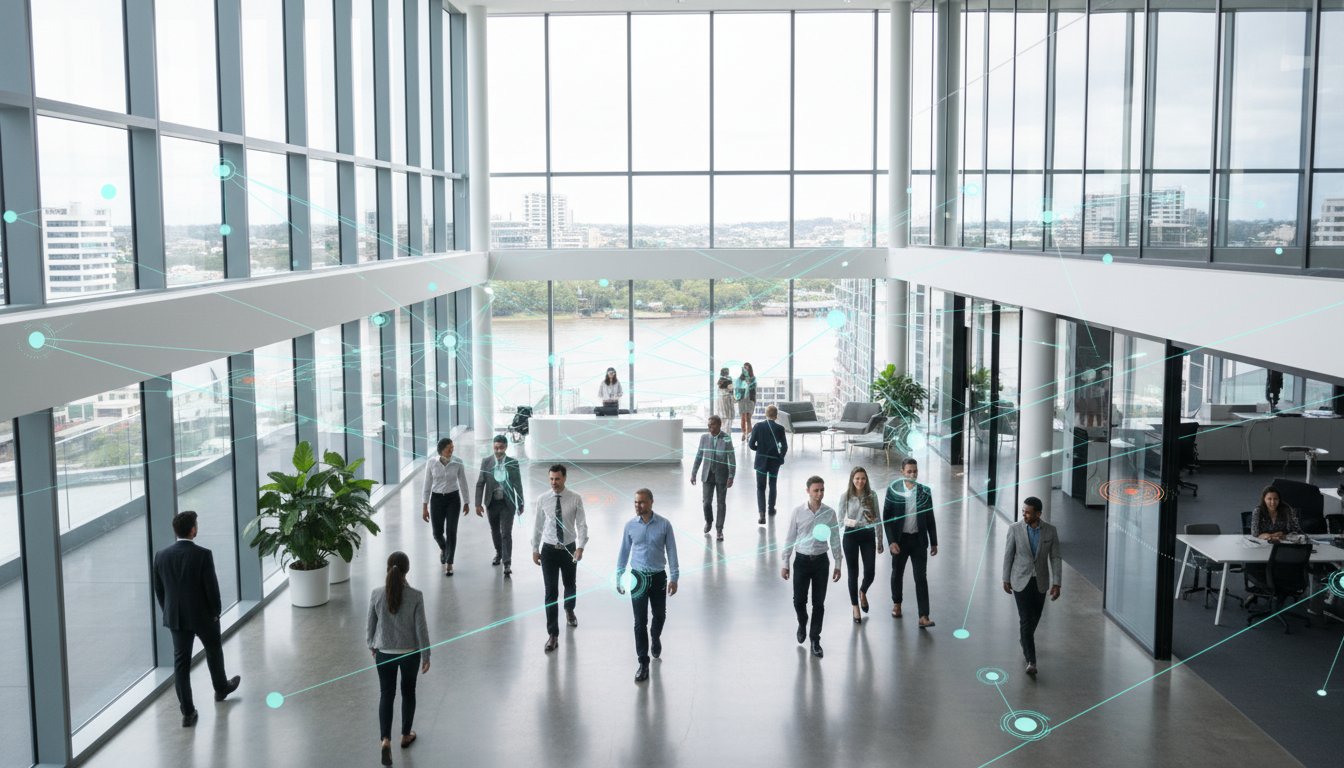
Modern facility management has evolved from reactive maintenance to proactive spatial intelligence. A people counter for commercial buildings no longer serves a single purpose at the entrance. Instead, it acts as the central nervous system for a Building Management System (BMS). By integrating live occupancy data, building managers can eliminate the guesswork that leads to wasted resources. Heatmaps provide a visual representation of tenant movement, identifying underutilised zones or common area bottlenecks that affect daily operations.
This granular visibility transforms commercial leasing strategies. Property managers can now enter negotiations armed with evidence of high-traffic zones, justifying premium rates for specific lobby placements or retail tenancies. When a significant portion of commercial tenants cite efficient space usage as a top priority, providing hard data on how people move through the building becomes a powerful competitive advantage. Key data points for these negotiations include:
- Peak occupancy rates across different floors and wings.
- Average dwell times in shared retail or lounge spaces.
- Conversion of foot traffic into amenity usage.
It moves the conversation from perceived value to proven performance, ensuring that every square metre is working toward the building’s bottom line.
HVAC and Lighting Synchronization
Climate control accounts for approximately 40% of a commercial building’s energy consumption in Australia. Integrating people counting technology with smart building protocols allows for real-time automation. Systems can power down lighting and reduce HVAC output on floors where occupancy drops below 10%. The Evolution Of Smart Buildings highlights how this shift from fixed schedules to occupancy-based logic is essential for meeting modern ESG targets. It’s a direct path to reducing carbon footprints while maintaining peak comfort for active zones. Building owners see immediate reductions in utility overheads, directly impacting the net operating income.
Tenant Experience and Amenities
The visitor journey defines the reputation of a Tier-A asset. Using footfall data analysis helps managers monitor high-use facilities like end-of-trip showers, gyms, and cafeterias. If data shows a 25% increase in lobby dwell time during the 8:30 AM peak, managers can adjust lift call algorithms to mitigate congestion. Precision in tracking these movements ensures that amenities remain accessible and never overcrowded. High-quality people counter for commercial buildings solutions provide the actionable insights needed to refine these touchpoints. This level of responsiveness turns a standard office block into a high-performance workspace that tenants are eager to occupy.
Implementing a National People Counting Strategy: Privacy and Logistics
Deploying a people counter for commercial buildings across a national portfolio requires a shift from tactical installation to strategic infrastructure. By 2026, 85% of tier-one commercial assets in Australia will have transitioned to Power over Ethernet (PoE) connectivity. PoE provides a dedicated, stable data path that Wi-Fi often lacks in high-density CBD environments. Logistical planning for 2026 must account for this density of IoT devices; Wi-Fi congestion in commercial towers can lead to a 15% packet loss, which compromises the accuracy of occupancy data. PoE bypasses this entirely, offering a hardwired connection that also delivers power, reducing the need for separate electrical outlets at every ceiling point. When evaluating people counting systems Australia wide, scalability depends on choosing hardware that integrates seamlessly into existing building management systems (BMS). Managing a multi-state rollout involves synchronizing local electrical contractors with central IT teams to ensure consistent data tagging across every entrance from Perth to Sydney.
Privacy and GDPR/APP Compliance
Modern sensors prioritize privacy by design. Unlike CCTV, video-based people counters don’t record or transmit visual footage. They use on-device “edge” processing to convert movement into anonymous X-Y coordinates instantly. This ensures zero Personally Identifiable Information (PII) ever leaves the sensor, aligning with the 13 Australian Privacy Principles (APP). Commercial landlords can confidently share spatial analytics with tenants, demonstrating data transparency without risking security vulnerabilities. By 2026, the focus has shifted from simple counting to understanding visitor journeys while maintaining 100% anonymity. Clear communication with employees and tenants about this non-intrusive data collection is essential for maintaining trust in the workplace environment.
National Maintenance and Support
Data integrity is the foundation of ROI. A national rollout across Melbourne, Sydney, and Brisbane demands a proactive people counter support structure. Remote health checks now detect 98% of sensor heartbeat irregularities before they impact data accuracy. Upgrading legacy hardware doesn’t require structural changes; modern sensors often fit existing mounting points, allowing for a 30% faster deployment time compared to 2021 standards. High-uptime operations require 24/7 monitoring to ensure that foot traffic narratives remain uninterrupted. This systematic approach ensures that every decision, from HVAC scheduling to leasing renewals, is backed by verified evidence. Precision in maintenance ensures that a people counter for commercial buildings remains a strategic asset rather than a forgotten sensor.
Footfall Australia: Precision Hardware for National Commercial Portfolios
Selecting a people counter for commercial buildings requires more than just picking a sensor; it demands a strategic partnership with a provider that understands the nuances of the Australian property market. Footfall Australia has spent 20 years refining this approach. They offer a blend of high-precision hardware and localized technical support that ensures data remains accurate across thousands of square meters. This long-term presence in the market provides building owners with the stability needed for decade-long infrastructure investments. It’s about moving away from estimates and toward a culture of evidence-based management.
The FootfallCam Ecosystem
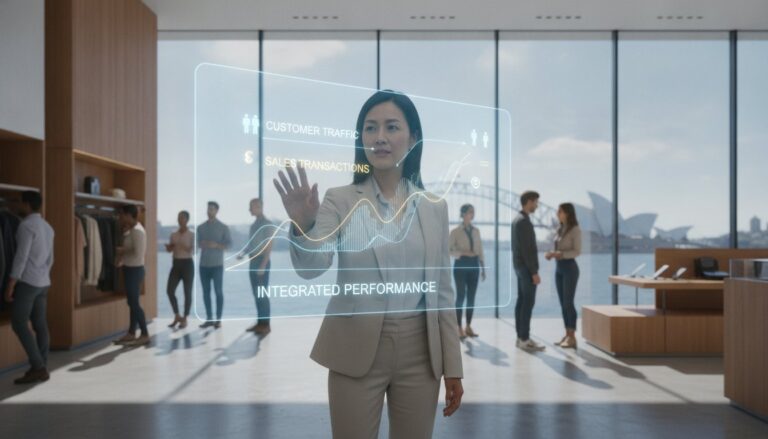
The FootfallCam Pro2 stands as the primary hardware choice for modern commercial foyers. It handles complex environments where traditional sensors often fail. High ceilings of up to 10 meters and intense glare from floor-to-ceiling glass facades don’t compromise its 99.5% accuracy rate. For managers looking to scale without massive hardware outlays, the FootfallCam Centroid offers a breakthrough. It connects to existing CCTV networks, using AI to transform standard video streams into sophisticated spatial analytics sensors. This hybrid approach allows for rapid deployment across national portfolios, turning legacy security systems into high-value business intelligence tools. The accompanying V9 Software then consolidates this data into customizable dashboards. Facility managers can drill down into specific lift lobby congestion, while C-suite executives view high-level occupancy trends across multiple states through a single interface.
Partnering for Long-Term Growth
Reliable data isn’t a one-time setup; it’s a continuous process. Footfall Australia manages the entire lifecycle, beginning with a comprehensive site survey to identify optimal mounting points. Their team handles national installations, ensuring every device is calibrated to the specific foot traffic patterns of the building. Regular accuracy audits and automated firmware updates maintain data integrity over time. This proactive maintenance prevents the “data drift” that often plagues unmanaged systems. By choosing a partner with deep local roots, you ensure that technical support is always in the same time zone and understands Australian building regulations. Use evidence to drive your property strategy. Optimize your commercial building with Footfall Australia and gain the clarity needed to lead the market in 2026.
Secure Your Strategic Edge with Precision Analytics
Commercial real estate in 2026 relies on granular data to drive operational efficiency and tenant satisfaction. You can’t manage what you don’t measure with absolute certainty. Deploying a sophisticated people counter for commercial buildings transforms raw footfall into a detailed narrative of human movement. This intelligence allows for the proactive optimization of HVAC systems and the strategic allocation of maintenance resources across your entire national portfolio. It’s about turning spatial data into a long-term competitive advantage.
Footfall Australia provides the technical foundation for this evolution. We back our solutions with 20+ years of Australian market expertise and a 99.5% accuracy guarantee. Our hardware offers seamless integration with V9 Analytics Software, turning complex spatial data into clear, actionable reporting for your stakeholders. We help you bridge the gap between high-tech innovation and practical building management. It’s time to replace estimation with evidence and lead your assets into a more efficient future.
Contact Footfall Australia for a National Building Portfolio Consultation
Frequently Asked Questions
How accurate are people counters in high-traffic commercial lobbies?
Modern 3D LiDAR and Time-of-Flight sensors achieve 98% or higher accuracy in dense Australian commercial lobbies. These systems process overlapping paths simultaneously to ensure precision even during peak morning rushes. High-traffic environments require sensors capable of handling 20 people per second without signal degradation. This ensures data integrity for building managers overseeing large-scale assets in Sydney or Melbourne.
Do people counters for commercial buildings record video or store faces?
Professional people counter systems don’t record video or store identifiable facial data. They use low-resolution heat mapping or anonymous silhouettes to protect individual privacy at all times. This design ensures total compliance with the Australian Privacy Act 1988 and the Australian Privacy Principles. Data is processed at the edge, meaning only numerical traffic counts leave the device to keep occupant identities secure.
Can people counting data be integrated with my existing HVAC or BMS?
You can integrate a people counter for commercial buildings directly with your Building Management System via BACnet or Modbus protocols. This connection allows your HVAC system to adjust airflow based on real-time occupancy levels rather than fixed schedules. Research by the Australian Renewable Energy Agency indicates that demand-controlled ventilation can reduce building energy consumption by up to 30% annually.
What is the difference between a people counter and a security camera?
Security cameras focus on visual identification and forensic evidence, while people counters are dedicated analytical tools for spatial optimization. People counters use top-down 3D sensors to eliminate perspective errors and shadows that often trigger false counts on standard CCTV. This specialized hardware provides a 15% higher accuracy rate for traffic data compared to basic security software analytics.
How many sensors are typically required for a multi-story commercial building?
You typically need one sensor for every primary entry and exit point, plus additional sensors for lift lobbies and end-of-trip facilities. A standard 10-story commercial building usually requires between 12 and 18 sensors to map the complete visitor journey accurately. This placement ensures building managers can track vertical movement and floor-specific occupancy rates with 99% reliability across the entire site.
What infrastructure is needed for a modern people counter?
Modern sensors require a single Power over Ethernet cable to provide both electricity and internet connectivity. This setup eliminates the need for separate power outlets near the ceiling and simplifies installation in Australian Grade-A office spaces. Most devices consume less than 15 watts of power and use minimal bandwidth, as they only transmit small numerical data packets to the cloud reporting dashboard.
Can people counters differentiate between staff, visitors, and delivery personnel?
Advanced AI sensors differentiate between groups by using height filtration and staff exclusion tags. By equipping employees with small Bluetooth Low Energy tags, the people counter for commercial buildings can automatically subtract staff movements from total visitor counts. This level of granularity provides a clearer picture of actual customer traffic and delivery frequencies for more precise logistics planning.
What is the typical ROI period for a commercial people counting system?
Most commercial buildings achieve a full return on investment within 12 to 18 months through energy savings and optimized cleaning schedules. By shifting to occupancy-based cleaning, facilities managers often reduce labor costs by 20% in low-usage zones. These tangible operational savings, combined with improved tenant retention, make the technology a fiscally responsible addition to any Australian property portfolio.