

GDPR Compliant People Counters: The 2026 Guide to Privacy-First Analytics
Did you know that under the 2022 privacy reforms in Australia, a single data breach can now result in penalties exceeding A$50 million? It’s a staggering figure that explains why many business owners hesitate to adopt advanced tracking technology. You likely recognize that foot traffic data is the lifeblood of retail strategy, yet the distinction between anonymous counting and intrusive surveillance often feels blurred. This tension creates a significant hurdle for those who want to deploy GDPR compliant people counters to optimize their floor space without risking a legal catastrophe.
We believe you shouldn’t have to choose between precision and privacy. This guide shows you how to implement high-accuracy systems that provide 98% data reliability while adhering to the strictest global and Australian standards. You’ll learn to extract actionable insights from the visitor journey without storing personal images or biometric data. We’ll walk through the specific sensor technologies that guarantee total anonymity, ensuring your data remains a strategic asset rather than a liability.
Key Takeaways
- Distinguish between invasive video surveillance and anonymous sensor technology to protect visitor identities while gathering essential foot traffic data.
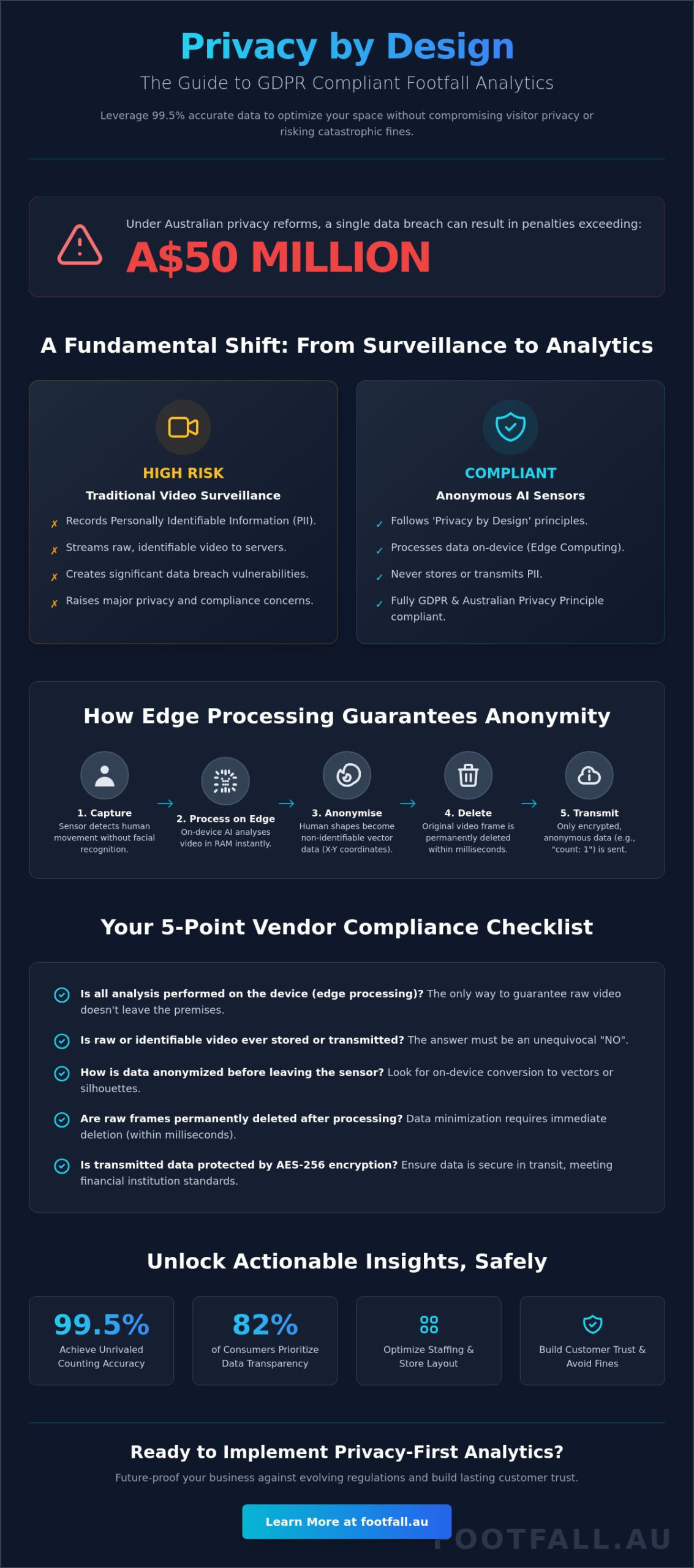
- Discover why edge processing is the industry benchmark for GDPR compliant people counters, ensuring all data is processed on-device without the privacy risks of cloud streaming.
- Align your operations with both the European GDPR and the Australian Privacy Principles (APPs) to ensure full regulatory compliance within the Australian market.
- Identify the five critical questions to ask your technology vendor to verify that raw video data is never stored or transmitted off-site.
- Learn how to achieve 99.5% counting accuracy using privacy-first AI sensors that transform human movement into actionable business intelligence.
What Defines a GDPR Compliant People Counter in 2026?
Distinguishing between video surveillance and modern footfall sensors is the first step toward operational transparency. Traditional CCTV systems capture high-resolution imagery intended for identification and security. In contrast, GDPR compliant people counters use Time-of-Flight (ToF) or AI-driven edge processing to convert human presence into anonymous X-Y coordinates. This technology ensures that Personally Identifiable Information (PII) never enters the storage phase. By 2026, the gold standard has shifted entirely to ‘Privacy by Design,’ where the hardware itself is incapable of facial recognition. You’re no longer tracking who a person is, but rather how a human shape moves through a physical environment. This transition from individual tracking to aggregate spatial analytics allows businesses to capture 98.5% accuracy in footfall data without compromising visitor anonymity. High-tech sensors now interpret human behavior as mathematical patterns, providing the strategic intelligence needed to optimize layout and staffing without ever recording a face.
The General Data Protection Regulation (GDPR) has fundamentally changed how we view spatial data. It demands that privacy isn’t just a policy, but a core component of the hardware architecture. Modern systems must treat every visitor as a data point rather than a profile. This ensures that even in the event of a network breach, there’s no biometric data to be exploited.
The Core Principles of Data Minimisation
The “Purpose Limitation” principle dictates that systems should only collect data essential for their specific function. Modern sensors strip away biometric identifiers at the edge, meaning the raw video stream is processed within the device’s RAM and never transmitted to a cloud server. This prevents the creation of a digital paper trail for individuals. To achieve this, GDPR compliant people counters follow strict protocols:
- Edge Processing: All visual analysis happens on the device hardware.
- Anonymisation: Converting pixels into non-identifiable vector data immediately.
- Data Deletion: Removing temporary frames once the count is registered.
A GDPR compliant people counter is defined by its ability to process visual data locally and delete the raw source frames within milliseconds of generating a numerical count.
Why Global Compliance Matters for Australian Businesses
While the Australian Privacy Act governs local operations, the 2024 updates to domestic privacy frameworks have aligned closely with European standards. Adopting GDPR compliant hardware future-proofs Australian retailers against shifting local regulations and meets the expectations of 82% of consumers who prioritize data transparency. Using high-spec hardware ensures that mapping visitor journeys across a 500-square-metre floor plan remains a strategic tool rather than a liability. It transforms foot traffic into a narrative of movement, providing the evidence needed to optimize staffing levels and store layouts. By adhering to these global standards, Australian firms avoid the risk of regulatory fines and build long-term trust with their customer base. This approach treats data as a tool for empowerment, not surveillance.
The Technology of Anonymity: How Edge Processing Works
Edge computing transforms the sensor into a self-contained analytical unit. Unlike legacy systems that stream raw video to central servers, GDPR compliant people counters interpret visual data locally on the device. This mechanism ensures that the sensor only transmits numerical data, such as a timestamp and a count, rather than identifiable imagery. By processing data at the “edge” of the network, businesses eliminate the most significant privacy vulnerability: the interception of video streams during transit.
Streaming raw video to the cloud introduces a high-risk surface area for data breaches. If a cloud server is compromised, thousands of hours of identifiable footage could be exposed. Privacy-first technology mitigates this by using anonymisation techniques like silhouettes and heatmaps. The sensor identifies a human shape based on height, shoulder width, and movement patterns without ever capturing facial features or unique identifiers. To maintain the highest security standards, all data stored at rest or sent to the dashboard is protected by AES-256 encryption, the same standard used by Australian financial institutions to secure sensitive transactions.
Edge Computing vs. Cloud Processing
Edge processing ensures that no raw video ever leaves the physical sensor. This local interpretation is a critical security benefit for retail and public spaces, as it guarantees that visitor faces are never stored on a hard drive or transmitted over the internet. The FootfallCam Pro2 utilises advanced AI to count visitors in real-time while discarding visual frames within milliseconds. This approach aligns perfectly with ICO guidance on GDPR, which emphasises data minimisation and the importance of only collecting what is strictly necessary for the intended purpose.
Sensor Types and Their Privacy Profiles
Different sensors offer varying levels of privacy and precision. Time-of-Flight (ToF) and Thermal sensors provide high anonymity because they lack the resolution to identify faces, but they often struggle with accuracy in high-traffic Australian shopping centres. AI Stereo Vision provides the best balance of accuracy and anonymity. It uses dual lenses to create a 3D depth map, allowing it to distinguish between adults, children, and objects like prams with over 99% precision. It’s a common myth that camera-based systems are inherently non-compliant; when powered by edge AI, these GDPR compliant people counters are actually the most secure tools for modern spatial analytics. To see how these insights can transform your operations, you can explore our range of privacy-first solutions tailored for the Australian market.
GDPR vs. Australian Privacy Principles (APPs): A Comparison
Managing data in Australia requires a nuanced understanding of the Australian Privacy Principles. While GDPR is often viewed as the more prescriptive framework, the Australian Privacy Act 1988 shares the same core objective: protecting individual identity. For retailers, the intersection of these laws centers on APP 3, which dictates how businesses collect solicited personal information. GDPR compliant people counters align with these local standards by ensuring that the data collected isn’t “personal” by definition. If a sensor doesn’t capture or store identifiable features, it doesn’t trigger the heavy compliance burdens associated with sensitive data handling.
Anonymous people counting falls outside the scope of “Personal Information” because it tracks movement, not people. Using 3D LiDAR or Time-of-Flight technology, sensors convert human shapes into mathematical coordinates. No faces are recorded. No MAC addresses are harvested. This “Privacy by Default” approach is the most efficient way to satisfy Australian regulators. It allows businesses to focus on spatial analytics and conversion rates without the risk of a data breach involving identifiable customer records. Logic dictates that the safest data is the data you never collect in the first place.
Navigating Local Compliance Requirements
To satisfy the Australian “reasonable steps” requirement for data security, businesses must implement robust internal protocols. This includes ensuring all hardware uses encrypted edge processing, where data is analyzed on the device rather than in the cloud. Transparency is equally vital. Clear, accessible signage at entry points informs visitors that anonymous traffic monitoring is in use, fulfilling the disclosure obligations of APP 1. For a comprehensive breakdown of regional standards, see our people counting systems Australia guide for 2026.
Avoiding the Pitfalls of Facial Recognition
The legal distinction between counting a visitor and identifying them is a critical boundary for Australian businesses. High-profile investigations by the OAIC in July 2022 into major retailers like Bunnings and Kmart demonstrated the significant legal and reputational risks of biometric tracking. Footfall Australia recommends avoiding biometric capture entirely for general footfall monitoring. It’s an unnecessary liability. Modern GDPR compliant people counters provide 98% accuracy in occupancy and dwell time metrics without ever capturing a single biometric template, ensuring your strategy remains evidence-based and legally sound.
- Accuracy: Maintain 98%+ precision without identifying individuals.
- Liability: Eliminate the risk of storing sensitive biometric data.
- Compliance: Meet both GDPR and APP standards through edge-based processing.
- Trust: Build customer confidence through transparent, non-intrusive technology.
Auditing Your Vendor: 5 Questions for Compliance
Selecting GDPR compliant people counters involves a rigorous vetting process that goes beyond a simple feature list. For Australian businesses, this means ensuring the hardware and software stack respects the Australian Privacy Act while meeting international standards. You must treat your vendor as a strategic partner in risk management. Use these five questions to verify their commitment to privacy-first analytics.
- Is raw video ever stored or transmitted? Secure systems process all imagery on the edge. This means the sensor converts movement into anonymous metadata within the device itself, ensuring no identifiable human faces ever leave the unit.
- Is there a Data Processing Agreement (DPA)? Request a DPA that explicitly references GDPR and the Australian Privacy Principles. This legal contract ensures the vendor acknowledges their role as a data processor and commits to your security standards.
- Which independent certifications do you hold? Look for ISO 27001. This certification proves the vendor undergoes regular audits of their information security management systems.
- Where is the data stored? Confirm whether data resides on-shore in Australian data centres or off-shore. Local storage in regions like Sydney or Melbourne simplifies compliance with domestic data sovereignty expectations.
- Can you explain the anonymisation algorithm? Transparency is essential. The vendor should clearly explain how they strip Personal Identifiable Information (PII) before the data reaches your dashboard.
The Importance of a Data Protection Impact Assessment (DPIA)
A DPIA is a formal process designed to identify and mitigate privacy risks before you deploy new technology. It’s a proactive step that demonstrates your business takes its obligations seriously. Modern people counting technology makes this process easier by providing documented privacy-by-design features. These systems come with pre-built compliance templates that save your legal team hours of work. Automated reporting reduces human error in data handling by removing the need for manual exports and spreadsheets.
Software Security and Access Controls
Data is only as secure as the people who can see it. Implementing Role-Based Access Control (RBAC) allows you to restrict sensitive metrics to specific management levels. Your footfall data analysis platform must support granular permissions to prevent data leaks. Some organisations prefer perpetual licenses over cloud-based subscriptions because they offer greater control over the internal network environment. This setup allows you to manage updates and security patches on your own schedule, ensuring your analytics remains a closed loop.
Ensure your business stays ahead of regulatory changes by choosing a partner that prioritises data integrity. Contact Footfall today for a consultation on privacy-first analytics.
Implementing Privacy-First Analytics with Footfall Australia
Footfall Australia delivers the precision required for 2026 retail standards without the legal risks of intrusive tracking. The FootfallCam Pro2 leads this effort, maintaining a verified 99.5% accuracy rate while remaining 100% compliant with global and local privacy laws. It achieves this through edge processing. The device counts humans without ever recording or transmitting personally identifiable information (PII). This ensures your facility utilizes GDPR compliant people counters that respect visitor anonymity at the hardware level.
For businesses with existing infrastructure, the FootfallCam Centroid offers a sustainable path forward. It retrofits legacy CCTV systems with privacy-safe AI, turning standard video feeds into anonymized data streams. This shifts the focus from surveillance, which often carries negative connotations, to strategic business intelligence. You gain insights into dwell times and heatmaps while your customers enjoy total privacy. Footfall Australia supports these deployments with local expertise, ensuring global standards meet the specific operational needs of the Australian market. We provide a bridge between sophisticated sensor technology and practical, evidence-based management.
Seamless Integration and Peace of Mind
Our unified hardware and software ecosystem protects data integrity from the moment a visitor enters your space. You’ll receive actionable insights through a simplified dashboard, removing the need for complex data processing. This transparency builds trust with your visitors and your board. We invite you to contact Footfall Australia for a national compliance consultation to audit your current traffic monitoring systems. Our team ensures your data collection is both ethical and efficient.
The Future of Ethical Data Collection
AI technology is evolving to prioritize privacy by design. Industry forecasts suggest that by 2027, over 80% of top-tier retailers will adopt ethical data practices to avoid the heavy fines associated with data breaches. By implementing GDPR compliant people counters now, you position your brand as a leader in ethical retail technology. It’s a proactive step that secures your data pipeline against future regulatory shifts. Ready to upgrade your analytics? Consult with Footfall Australia for a compliant solution to future-proof your business operations.
Future-Proof Your Analytics Strategy
Navigating the intersection of spatial intelligence and data privacy requires a shift toward edge-based AI processing. By 2026, the standard for GDPR compliant people counters relies on technology that eliminates the storage of personal data at the source. This approach ensures 100% anonymity while providing the precise dwell time and conversion data needed to optimize physical spaces. Aligning your operations with both GDPR and the Australian Privacy Principles protects your brand from regulatory risk and strengthens the trust of your visitors. It’s a strategic move that turns compliance into a competitive advantage.
Footfall Australia leverages over 20 years of experience in the local market to deliver actionable insights through sophisticated sensor technology. We’ve partnered with national retail chains and public institutions to deploy systems that balance high-tech innovation with practical application. It’s time to replace guesswork with hard evidence, using a platform designed for long-term growth and technical precision. Secure your business with GDPR-compliant people counters from Footfall Australia and start making data-driven decisions with total confidence in your privacy standards. Your journey toward smarter, safer spatial analytics begins here.
Frequently Asked Questions
Is people counting legal under GDPR and the Australian Privacy Act?
Yes, people counting is fully legal under the Australian Privacy Act 1988 and GDPR, provided the system doesn’t collect Personally Identifiable Information (PII). Modern GDPR compliant people counters process data at the edge, meaning no individual identities are stored. According to the Office of the Australian Information Commissioner (OAIC), privacy concerns are mitigated when data is sufficiently de-identified at the point of capture.
Do people counters record video of customers?
Most advanced people counters don’t record or store video footage of customers. They use Time-of-Flight (ToF) sensors or AI-driven processors that convert visual shapes into anonymous digital coordinates in real-time. Once the sensor counts the person, the visual data is instantly deleted. This hardware-level processing ensures that no video stream ever leaves the device or reaches a server.
How is data anonymised in a people counting system?
Data anonymisation occurs through edge computing, where the sensor processes images locally and only transmits numerical values. Instead of saving a face, the system records a “1” for an entry or exit. Any temporary metadata used for tracking is hashed using 256-bit encryption. This process ensures that 100% of the data stored in your dashboard is purely statistical and cannot be traced back to a specific individual.
Do I need to put up signs if I am using people counters?
You don’t legally require signage if the system is non-intrusive and doesn’t collect personal information. However, APP 1.3 of the Australian Privacy Act suggests transparency in data collection. Many Australian retailers display a small “Privacy Collection Notice” at entry points to inform visitors that anonymous foot traffic data is being gathered for operational efficiency. This builds trust without impacting the visitor journey.
Can people counters be used for facial recognition?
Standard GDPR compliant people counters are technically incapable of facial recognition. These sensors are typically mounted overhead to capture a top-down view of shoulders and heads, which lacks the detail required for biometric mapping. By 2026, privacy-first hardware specifically excludes high-resolution facial sensors to prevent the accidental collection of biometric data. This distinction is vital for maintaining compliance with evolving privacy regulations.
Where is the data from people counters stored?
Data is typically stored on secure, Australian-based cloud servers to ensure low latency and compliance with local data sovereignty preferences. Footfall data is encrypted during transit using TLS 1.2 protocols. By housing data in domestic data centres, businesses satisfy the requirements of the Australian Privacy Principles regarding the overseas disclosure of information. You maintain full ownership and control over your historical analytics.
What happens if our people counting data is breached?
The risk of a data breach is significantly lower because the system doesn’t store personal identifiers like names or credit card details. If a breach occurs, you must follow the Notifiable Data Breaches (NDB) scheme established on 22 February 2018. Since the data consists only of timestamps and numerical counts, it’s highly unlikely to cause “serious harm” to individuals, which is the threshold for mandatory reporting to the OAIC.
Is a Wi-Fi tracker more or less private than a video-based counter?
Video-based counters with edge processing are more private than Wi-Fi trackers. Wi-Fi tracking relies on capturing a device’s unique MAC address, which is considered personal information under several jurisdictions. In contrast, modern overhead sensors only see anonymous shapes. A 2023 industry study found that video-based sensors achieve 98% accuracy without ever identifying a specific smartphone or individual user.