People Counting System Cost Australia: The Complete 2026 Pricing & ROI Guide
A cheap A$450 sensor often becomes the most expensive mistake an Australian retailer makes when hidden integration fees and 15% data inaccuracy gaps surface. You likely recognize that guessing your store traffic isn’t a viable strategy for 2026. Still, calculating the total people counting system cost Australia remains difficult when initial hardware quotes omit recurring software licenses and specialized AU electrical compliance requirements.
We’ve analyzed current market benchmarks to provide a transparent view of the investment required for precision spatial analytics. This guide outlines the specific price differences between basic infrared beams and enterprise 3D LiDAR systems, including a framework to recover your initial spend through a documented 12% boost in staff efficiency. You’ll gain a clear roadmap of upfront capital versus monthly operational costs, ensuring your data-driven decisions rest on a foundation of total financial clarity rather than guesswork. We’ll examine the shift from simple hardware purchases to sophisticated data subscriptions that drive long-term retail growth.
Key Takeaways
- Identify the critical performance gap between budget beam counters and professional-grade 3D sensors to ensure your data remains accurate and actionable.
- Evaluate the total people counting system cost Australia by breaking down upfront hardware investments, software licensing, and essential PoE infrastructure.
- Uncover the “hidden” costs of professional installation and calibration services necessary for high-precision operation within major Australian retail hubs.
- Learn how to calculate a rapid return on investment by leveraging spatial analytics to drive conversion rates and optimize staff rosters.
- Determine the ideal system configuration for your specific business footprint, from boutique single-entrance shops to complex multi-sensor shopping centre environments.
What Drives People Counting System Costs in Australia?
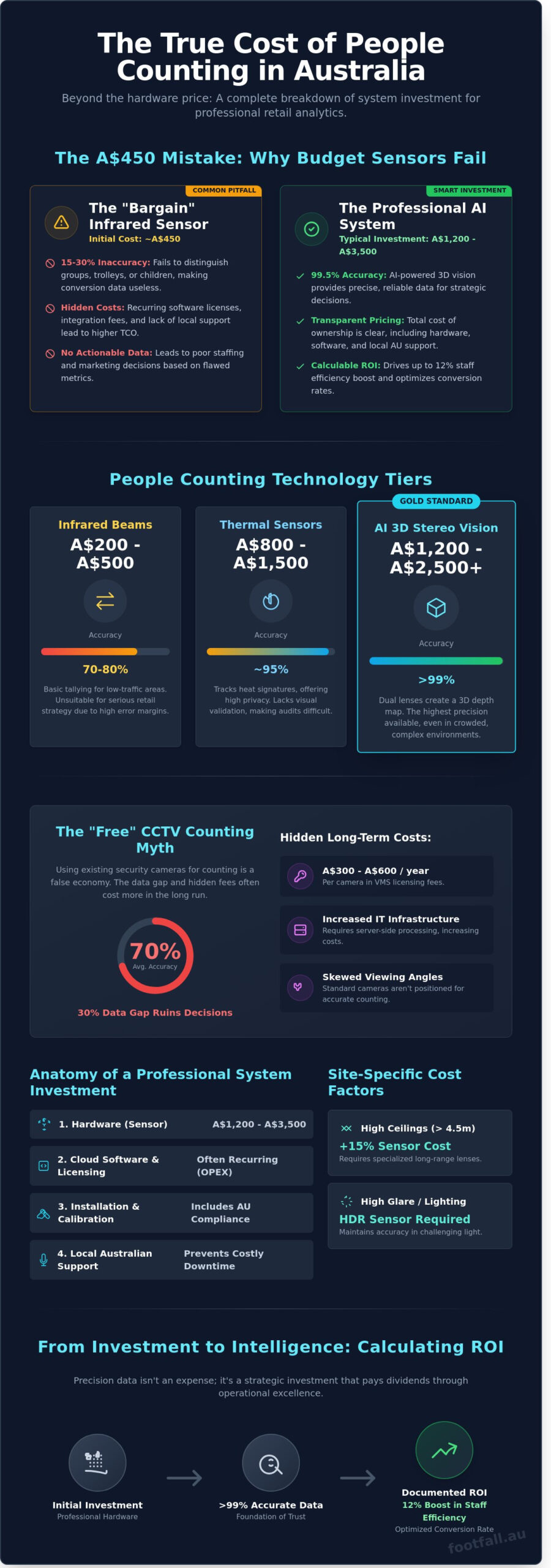
Investing in a professional analytics solution requires a shift in perspective. You aren’t just buying a plastic sensor; you’re purchasing an intelligence layer for your physical space. A complete system encompasses three core components: the physical hardware, the cloud-based analytics platform, and ongoing technical support. For 2026, the average people counting system cost Australia businesses encounter typically ranges from A$1,200 to A$3,500 per entrance for a professional, high-accuracy setup.
Low-cost infrared beam counters, often priced around A$150, frequently fail to meet modern retail standards. These devices struggle with “grouping,” where two people walking side-by-side are recorded as a single visitor. This leads to a 20% to 30% margin of error, which effectively renders your conversion data useless. Professional systems solve this through sophisticated people counting technology that identifies individual human shapes and movement patterns with surgical precision.
Australian market conditions add specific layers to the final price tag. Local businesses must account for 10% GST and international shipping costs if the vendor lacks a domestic warehouse. Choosing a provider with local Australian technical support is critical. While it might add A$200 to the initial setup, it prevents costly downtime when network configurations change or firmware updates are required. A system is only as valuable as the data it consistently produces.
Physical environment factors also dictate the final invoice. Ceiling heights exceeding 4.5 metres require specialized long-range lenses, which often adds 15% to the sensor cost. Similarly, entrances with high-glare glass or fluctuating lighting conditions demand sensors with High Dynamic Range (HDR) capabilities to maintain 98% accuracy. Precision is a result of matching the right hardware to the specific architecture of your entrance.
The Technology Tier Hierarchy
- Infrared Beam Counters (A$200 – A$500): These devices suit basic tallying in low-traffic environments. They lack the intelligence to distinguish between a customer and a shopping trolley, making them unsuitable for serious retail strategy.
- Thermal Sensors (A$800 – A$1,500): These units track heat signatures. They offer high privacy compliance but lack visual validation, making it difficult to audit the data for accuracy during peak periods.
- AI-Powered 3D Stereo Vision (A$1,200 – A$2,500+): This is the gold standard for precision. These sensors use dual lenses to create a 3D map of the entrance, achieving 99.5% accuracy even in crowded conditions.
Why “Free” CCTV Counting Often Costs More
Many businesses attempt to use existing security cameras for counting, lured by the promise of “free” software. This often proves to be a false economy. Video Management Software (VMS) plugins frequently require annual licensing fees ranging from A$300 to A$600 per camera. More importantly, standard CCTV cameras often achieve only 70% accuracy because of their skewed viewing angles. This 30% data gap ruins conversion rate calculations and leads to poor staffing decisions. Relying on server-side processing also increases IT infrastructure costs. Modern AI sensors process data “at the edge” on the device itself, which reduces long-term bandwidth expenses. Understanding the total people counting system cost Australia means looking past the initial hardware price to the long-term value of the data produced.
Breaking Down the Components: Hardware, Software, and Licensing
Calculating the people counting system cost Australia requires a granular look at both physical assets and the digital infrastructure supporting them. Modern systems have evolved beyond simple infrared beams. They’re now sophisticated edge-computing devices that process data locally to ensure 98.5% accuracy. Business owners must weigh initial capital expenditure (CAPEX) against ongoing operational costs (OPEX) to understand the total cost of ownership over a five-year lifecycle.
Hardware Investment: More Than Just a Lens
The physical sensor represents the most visible portion of your investment. High-end units like the FootfallCam Pro2 utilize an aluminium unibody design. This choice of material serves a functional purpose; it dissipates heat generated by the powerful onboard AI processor. Plastic housings, while cheaper, often degrade in the varied Australian climate or fail to manage the thermal load of continuous video processing. Expect to pay between A$850 and A$1,250 per unit for enterprise-grade hardware that includes dedicated AI chips for edge computing.
Installation logistics also impact the hardware budget. Australian retail ceilings vary from standard 2.4-metre heights to 10-metre industrial voids in Sydney flagship stores. Standard mounting brackets are typically included, but specialized telescopic poles or high-ceiling mounts can add A$75 to A$150 per device. Investing in quality hardware ensures the device can handle complex tasks like shadow filtration and adult-child differentiation without relying on external server power.
Software and Analytics Dashboards
Data only provides value when it’s accessible and interpretable. Software costs are generally split between perpetual licenses and Subscription-as-a-Service (SaaS) models. A perpetual license might cost A$1,100 upfront with no recurring fees, whereas a SaaS model typically ranges from A$25 to A$55 per month, per site. These digital tools are now essential for improving the in-store shopping experience by aligning staff levels with real-time visitor demand.
Premium analytics packages offer deeper insights beyond basic headcounts. Features such as heatmaps, dwell time analysis, and path tracking allow managers in Melbourne or Brisbane to visualize how customers move through a space. For companies operating across multiple states, multi-site management dashboards are vital. These platforms centralize data from every branch into a single interface, often requiring an API integration fee of A$500 to A$2,000 to link footfall metrics directly with Point of Sale (POS) systems for automated conversion rate calculations.
Maintenance, Hosting, and Compliance
Ongoing costs include data hosting and firmware maintenance. Cloud storage for video evidence, used primarily for audit trails and accuracy verification, usually incurs a monthly fee of approximately A$15 per device. This ensures that data remains secure and accessible for historical trend analysis. Security is a non-negotiable expense. Maintaining GDPR and Australian Privacy Act compliance involves regular firmware updates that anonymize data at the source.
Predicting the people counting system cost Australia also means accounting for periodic recalibration. As store layouts change, sensors may need remote adjustment to maintain precision. Most reputable providers include basic remote support in their software subscriptions, but on-site technician visits in regional areas can cost upwards of A$300 per call-out. To find the most efficient configuration for your specific floor plan, you can request a customized hardware breakdown from our technical team.
The “Hidden” Costs: Installation, Calibration, and Maintenance
Hardware purchase prices only represent 60% of the initial investment. To calculate the total people counting system cost Australia retailers face, you must account for specialized labor and technical precision. Deploying a 3D LiDAR or AI-stereo sensor requires more than a ladder and a drill. It demands a structured approach to infrastructure that ensures your data remains actionable and precise. Neglecting these elements leads to “dirty data,” where false positives from shadows or staff movements render your analytics useless.
Australian Installation Standards
Australia’s strict telecommunications regulations require a licensed ACMA data cabler for all permanent network installations. Expect to pay between A$150 and A$220 per hour for professional labor in Sydney, Melbourne, or Perth. A single-entrance boutique typically requires 3 to 4 hours for a clean installation, including cable runs and mounting. If your site is regional, such as in Wagga Wagga or Broome, travel surcharges often add A$120 to A$400 to the invoice. Most modern systems utilize Power over Ethernet (PoE) to minimize costs. This eliminates the need for a separate electrical outlet at the ceiling point, though you’ll need a PoE-enabled switch, which adds roughly A$85 to A$160 to your hardware budget.
Calibration and Verification Fees
Precision is the product. A sensor that’s 90% accurate is essentially useless for calculating conversion rates, as a 10% margin of error can hide your entire profit margin. Achieving 98% accuracy requires meticulous calibration. Remote calibration services generally cost between A$150 and A$320 per sensor. During this process, a technician virtually “draws” counting lines and exclusion zones to filter out staff, children, or shopping trolleys.
On-site verification provides the highest level of certainty. In this scenario, a technician performs manual “ground truth” counts to compare against the sensor digital output. This service often costs A$450 or more per site. It’s a necessary step for Smart Retail Technologies that aim to transform foot traffic into predictive revenue models. You’ll also need to budget for re-calibration if you move your POS counters or change the store layout. These physical shifts alter the sensor field of view and require a digital update to maintain accuracy.
Ongoing Support and Maintenance
The people counting system cost Australia businesses should budget for includes long-term health monitoring. Hardware rarely fails, but network configurations and lighting conditions change. Remote technical support plans typically range from A$25 to A$65 per month. These plans cover critical operational needs:
- Firmware updates: These improve AI detection and patch security vulnerabilities.
- Daily data integrity checks: Automated alerts notify you if a sensor stops heartbeat signals.
- Remote troubleshooting: This avoids expensive call-out fees for connectivity drops.
Staying proactive prevents data gaps that could skew your quarterly performance reviews. A system without a support plan often becomes an expensive ceiling ornament within 18 months. By investing in a maintenance agreement, you ensure the “eyes” of your business never blink. This steady flow of information allows you to make staffing and marketing decisions based on evidence rather than intuition.
Tiered Pricing Models: Finding the Right Fit for Your Budget
Every Australian business requires a different level of granularity. A local pharmacy in Perth does not need the same infrastructure as a multi-level shopping precinct in Melbourne. Choosing the right tier ensures you don’t overspend on redundant features or underspend on unreliable data. The people counting system cost Australia businesses face depends heavily on the complexity of the visitor journey and the physical environment of the site.
Small boutiques and single-entrance kiosks typically focus on entry/exit metrics to calculate conversion rates. In contrast, large-format retail and shopping centres require multi-sensor synchronisation. This process “stitches” together data from various units to track a single visitor across a 20,000 square metre floor plan without double-counting. Public sector entities, such as the 540 public libraries across Australia, often prioritise reporting-heavy models. These systems provide the audited evidence required to secure government funding and justify operational budgets. For corporate offices, the focus shifts to occupancy tracking. By monitoring real-time desk and meeting room usage, firms can optimise their real estate footprint, often identifying 25% to 30% of underutilised space.
Budget Range: A$500 – A$1,200 per entrance
This tier typically includes basic infrared beam counters or entry-level thermal sensors. You receive a basic tally of “ins” and “outs,” which often requires manual data export via USB or a local network. Accuracy levels hover between 80% and 85%, largely because these sensors struggle with groups or shadows. These units are best for low-traffic community centres or temporary pop-up shops. The primary trade-offs involve high maintenance and a lack of visual verification; you cannot “see” what the sensor sees to verify if a count was a human or a shopping trolley.
Professional Range: A$1,500 – A$3,000 per entrance
The professional tier is where 72% of Australian retailers and high-traffic public spaces find their solution. This investment provides 98% accuracy through AI-driven 3D stereoscopic vision. Systems like the FootfallCam Pro2 offer automated cloud dashboards and scheduled PDF reports delivered to your inbox. The people counting system cost Australia in this bracket is justified by the Total Cost of Ownership (TCO). While the upfront price is higher, these devices are designed for a 10-year lifespan with minimal recalibration. You gain access to sophisticated metrics like dwell time, heatmaps, and return-visitor analytics that transform raw numbers into actionable strategy.
Enterprise Range: Custom Pricing
Enterprise solutions are built for national chains and major Australian airports that demand high-level integration. Pricing is customised based on the scale of the deployment and the depth of the software requirements. These systems offer full API integration, allowing footfall data to flow directly into existing Business Intelligence (BI) tools or ERP systems. Key features include staff exclusion tags, which use wearable technology to remove employees from the final count, and complex spatial analytics. This level of precision is essential for sites managing over 1 million visitors annually, where a 1% margin of error represents thousands of missed data points.
Understanding your specific operational needs is the first step toward a high-ROI installation. To see how these tiers apply to your specific site, request a tailored quote for your facility from our local Australian consultants.
Calculating ROI: Why Footfall Australia is the Strategic Choice
Viewing technology as a simple expense rather than a long-term asset is a common pitfall in retail management. When you evaluate the people counting system cost Australia, the focus must shift from the initial price tag to the measurable yield it produces. High-precision data doesn’t just count heads; it identifies profit leaks in your daily operations and provides the evidence needed to plug them. It’s the difference between guessing why a store is underperforming and having a technical roadmap to fix it.
The ROI Framework
We use a direct formula to measure success: (Increase in Sales – System Cost) / System Cost. For a typical mid-sized retailer with A$1.5 million in annual turnover, a 1% lift in conversion rates often pays for the entire hardware installation within 90 to 120 days. In a 2024 study involving a 12-store retail group, our analytics identified a consistent staffing gap during the 4:00 PM to 6:00 PM window in their Sydney and Melbourne flagship locations. By adjusting rosters to match this peak traffic, the client saved A$5,000 per month in labor inefficiencies while increasing their capture rate by 8%.
Operating without spatial intelligence means you’re likely paying an invisible tax. You might be overspending on staff during quiet Tuesday mornings or losing customers during unmanaged Saturday peaks because nobody was available to assist them. Our V9 software transforms these blind spots into actionable insights, allowing you to align your largest controllable expense-labor-with actual customer demand.
Why Partner with Footfall Australia?
We aren’t a faceless software provider based overseas. Footfall Australia has provided local expertise since 2004, ensuring our clients never deal with timezone lags or offshore support hurdles. Our proprietary V9 software is built for the Australian business environment, delivering intelligence that’s sophisticated yet easy to interpret. We focus on the visitor journey, treating foot traffic as a narrative of human movement rather than just a set of dry statistics.
- The Legacy Swap Out Plan: Many Australian businesses struggle with inaccurate 2D sensors installed years ago. We provide cost-effective pathways to upgrade to modern 3D AI technology, often utilizing existing infrastructure to keep the people counting system cost Australia manageable for growing brands.
- Marketing Validation: If you spend A$15,000 on a Brisbane radio campaign, you need to know if it drove bodies through the door. Our systems distinguish between a failure in marketing (no traffic) and a failure in sales execution (high traffic, low sales).
- Proven Reliability: With over two decades of experience, we’ve refined our implementation process to be seamless, ensuring your data stream is never interrupted by technical glitches.
Choosing Footfall Australia means you’re investing in a partnership that values accuracy and long-term thinking. We help you decode human behavior to build a more resilient, data-backed business model. It’s time to stop relying on intuition and start making decisions backed by hard evidence.
Ready to optimize your operations and see the numbers for yourself? Request a tailored quote for your Australian business.
Master Your Physical Space with Data-Driven Precision
Investing in spatial intelligence is a definitive move toward operational transparency. You’ve seen how hardware, licensing, and professional installation shape the total people counting system cost Australia, yet the most significant variable remains the hidden price of inaccurate data. Footfall has been a trusted partner for Australian retailers since 2004, providing the technological eyes needed to optimize conversion rates and staff allocation. We don’t just sell sensors; we deliver a 98%+ accuracy guarantee backed by local AU technical support and professional installation. This ensures your 2026 business strategy rests on hard evidence rather than guesswork. By bridging the gap between high-tech innovation and practical application, you transform simple foot traffic into a decoded narrative of human movement. It’s time to replace business blind spots with a seamless flow of actionable intelligence that drives growth targets of 10% or more. High-quality data is the foundation of every strategic advantage.
Get a Precision Quote for Your People Counting System
Frequently Asked Questions
How much does a basic people counter cost in Australia?
A basic 3D sensor starts between A$600 and A$900 for the hardware. The total people counting system cost Australia organizations encounter usually includes the sensor and a one-time configuration fee for remote calibration. High-precision AI sensors for complex environments or wide entrances range from A$1,200 to A$1,800 per unit. These prices reflect the 2026 market rates for enterprise-grade technology that maintains 98% accuracy in all lighting conditions.
Are there ongoing monthly fees for people counting systems?
Professional systems typically require a software subscription ranging from A$15 to A$45 per month per device. This covers cloud hosting, automated reporting, and secure data storage on local servers. FootfallCam offers a lifetime data plan for a one-time fee of approximately A$350, which is ideal if you want to avoid recurring operational expenses. It’s a strategic choice that simplifies long-term budgeting for retail managers and public space coordinators.
Can I install the FootfallCam system myself to save on costs?
You can certainly install the FootfallCam system yourself to save between A$250 and A$400 in professional labor fees. The hardware uses Power over Ethernet (PoE) technology, so it only requires a single Cat5 or Cat6 cable for both power and data. FootfallCam provides a remote verification service to ensure your sensor is positioned correctly. This ensures you reach the 98% accuracy threshold without paying for an on-site technician.
Is it cheaper to use CCTV for people counting?
CCTV software plugins might seem cheaper at A$150, but they lack the 98% accuracy of dedicated 3D sensors. Standard security cameras often struggle with shadows and lighting changes, leading to skewed data. A dedicated people counting system cost Australia retailers choose often pays for itself by providing the precise spatial analytics needed to optimize staff rosters. Don’t rely on repurposed security hardware if you need evidence-based insights for your business strategy.
What is the average ROI timeframe for a retail people counter?
Most Australian retailers achieve a full return on investment within 4 to 9 months of installation. By using footfall data to improve conversion rates by just 2%, a store with A$50,000 monthly turnover generates an additional A$1,000 in profit every month. This measurable growth quickly offsets the initial capital expenditure. It’s a logical investment that transforms raw visitor numbers into a clear roadmap for increasing your store’s total profitability.
Does the price include GST and delivery across Australia?
Prices quoted by FootfallCam or local Australian distributors usually exclude the 10% Goods and Services Tax (GST). Delivery fees for a single sensor typically range from A$25 for metro areas like Sydney and Melbourne to A$60 for regional Western Australia or Queensland. You’ll receive a formal tax invoice that identifies the GST component for your business records. Always confirm if your final quote includes shipping before you authorize the purchase.
Do I need to pay for software updates and technical support?
Software updates and basic technical support are included in your monthly subscription or lifetime data plan. You won’t pay extra for the latest AI firmware improvements that enhance tracking precision. However, on-site maintenance visits or advanced custom integration work in 2026 can cost between A$150 and A$300 per hour. Most issues are resolved remotely by our technicians, which keeps your maintenance costs predictable and manageable throughout the year.
How much does it cost to upgrade an old infrared system?
Upgrading from a legacy infrared beam to a 3D AI sensor costs between A$800 and A$1,500 per entrance. Infrared systems often miss 20% of traffic because they can’t distinguish between groups or shopping trolleys. Modernizing your system provides advanced metrics like dwell time and heat mapping that old hardware can’t capture. It’s an essential move for businesses that want to decode the human behavior behind their visitor statistics and improve site efficiency.