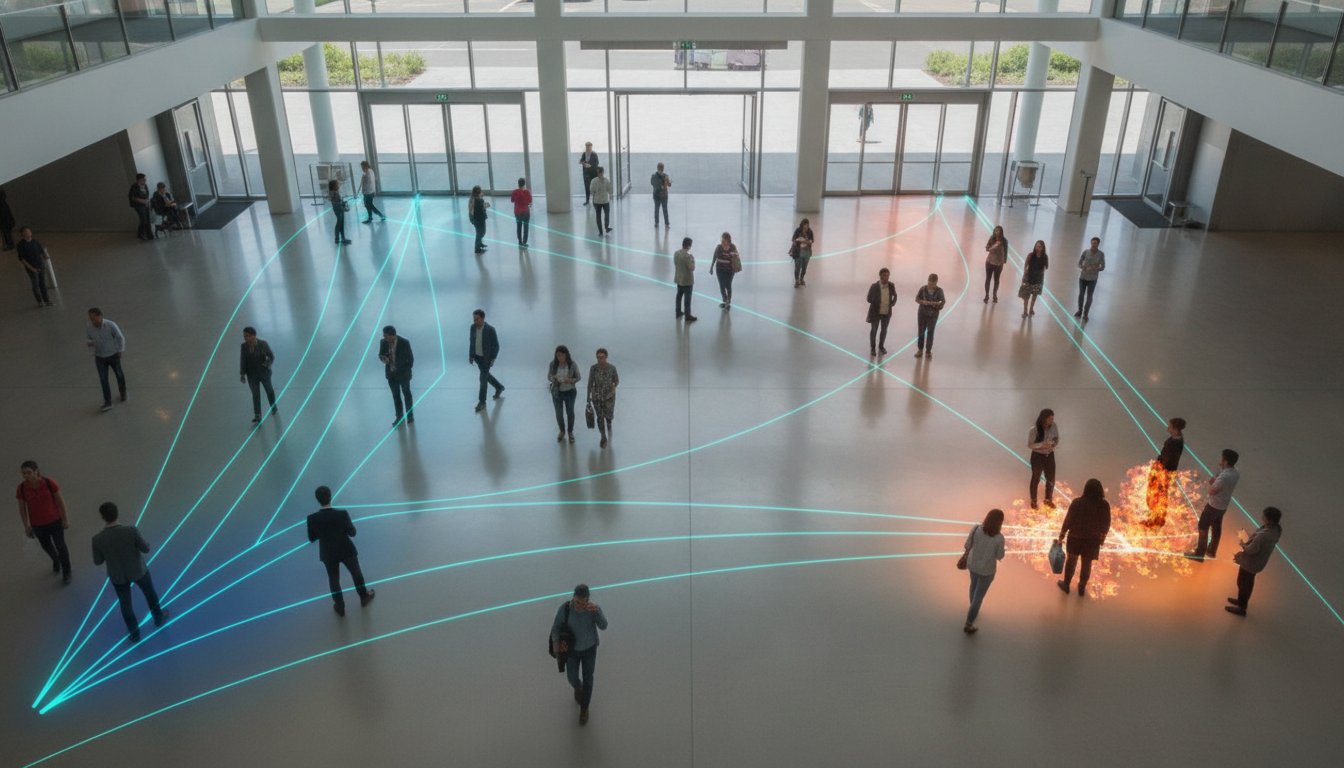
FootfallCam Pro2 vs Centroid: Which People Counting Solution is Best for Your Site?
The most cost-effective path to 98% counting accuracy might not involve installing a single new sensor. For many Australian site managers, the decision between FootfallCam Pro2 vs Centroid isn’t just about hardware; it’s a choice of deployment architecture that determines your long-term ROI. You’re likely already feeling the pressure of rising installation costs for new cabling or the frustration of seeing your existing CCTV infrastructure sit underutilised. It’s a common challenge to balance the need for high-precision data with the practicalities of site management and budget constraints.
This article breaks down the technical and operational differences between the FootfallCam Pro2 and Centroid to help you select the architecture that fits your specific environment. We’ll explore how each solution integrates with the V9 analytics software to eliminate data silos and provide a unified view of visitor behavior. By the end of this comparison, you’ll understand which system delivers the strategic advantage your business needs to stay ahead of shifting consumer trends through empirical evidence and logical implementation.
Key Takeaways
- Identify the core differences between edge-based processing and centralised AI hubs to determine how data flows across your network.
- Assess why 3D stereo vision remains the gold standard for accuracy in high-traffic environments where distinguishing between human movement and objects is critical.
- Discover how to transform existing CCTV cameras into powerful analytical tools using the Centroid to capture heat mapping and queue data without additional cabling.
- Compare the total cost of ownership and installation requirements of FootfallCam Pro2 vs Centroid to identify the most efficient analytics architecture for your specific site.
- Explore the strategic advantages of local Australian support and the Legacy Swap Out Plan for maintaining high system uptime and modernising aging hardware.
Understanding the Core Architecture: FootfallCam Pro2 vs Centroid
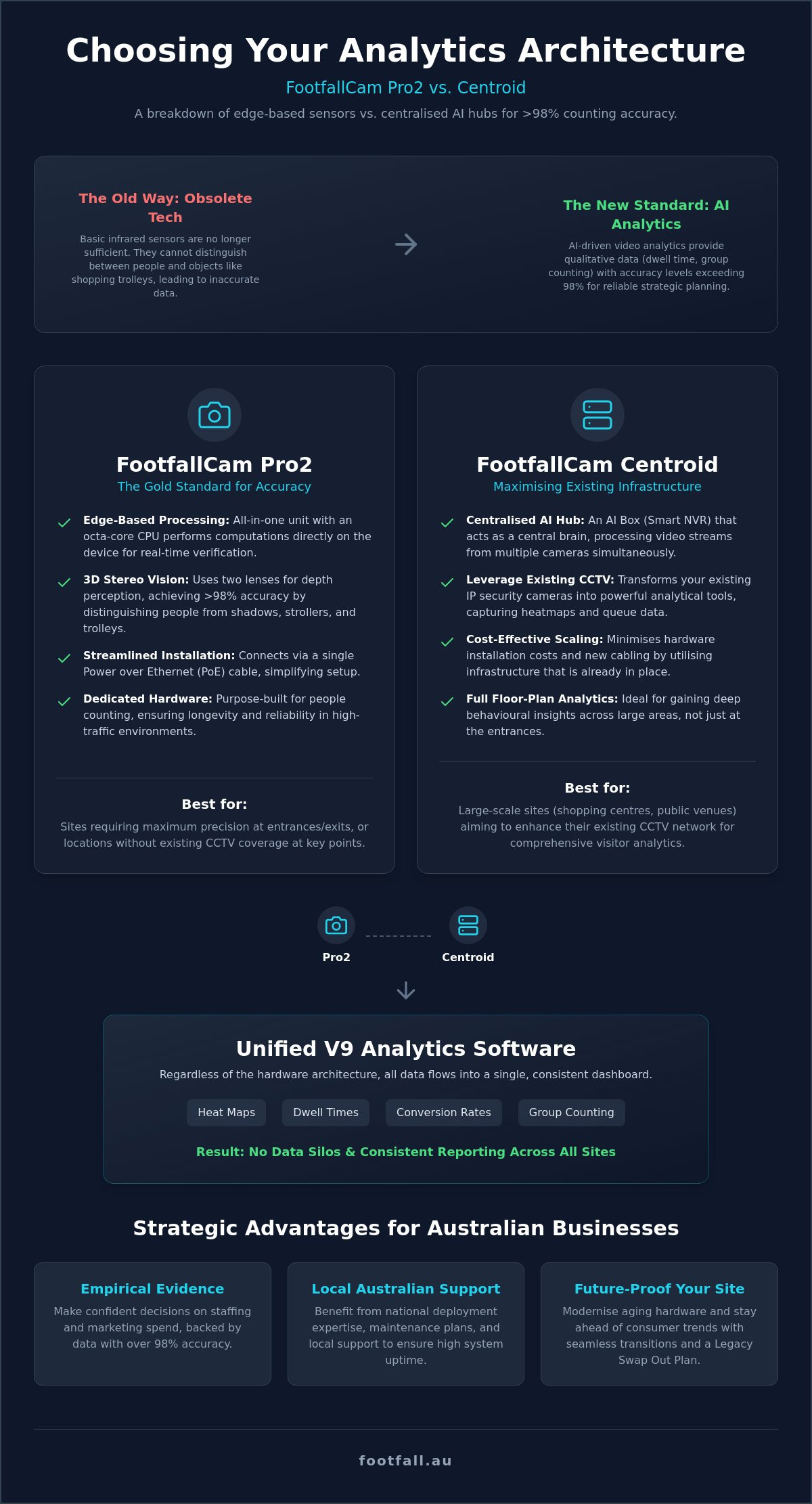
In 2026, the demand for precision has rendered basic infrared sensors obsolete. Modern retail and public space management require more than just a tally; they need a sophisticated people counter capable of distinguishing between human movement and physical objects. This evolution has led to two distinct architectural paths: edge-based sensors and centralised AI hubs. Choosing between FootfallCam Pro2 vs Centroid depends entirely on your site’s existing infrastructure and your long-term operational goals.
The fundamental difference lies in where the data processing occurs. The Pro2 handles all computations locally on the device, while the Centroid acts as a central brain for multiple existing cameras. Despite these structural differences, both systems feed directly into the FootfallCam V9 Software. This ensures that whether you use a dedicated sensor or an AI box, your dashboard remains consistent, providing unified insights into dwell times, heat maps, and conversion rates. This consistency allows managers to compare performance across different sites without worrying about data silos or varied reporting formats.
Footfall Australia has managed national deployments since 2004, helping organisations navigate these technical choices. Their expertise ensures that the transition from legacy systems to AI-driven video analytics is seamless. By providing local support plans and maintenance across the country, they ensure that the data driving your business decisions remains accurate and reliable. Organizations are increasingly adopting these AI-driven systems for three main reasons:
- Infrared counters cannot distinguish between people and objects like shopping trolleys or strollers.
- Video analytics provide qualitative data, such as dwell time and group counting, which simple beams cannot capture.
- AI-driven systems offer accuracy levels exceeding 98%, providing a foundation of empirical evidence for strategic planning.
What is the FootfallCam Pro2?
The FootfallCam Pro2 is a dedicated, overhead 3D stereo vision sensor designed for maximum precision at entry points. It functions as an all-in-one unit, meaning the camera, processing power, and storage are contained within a single housing. For sites without existing CCTV at entrances, this is often the most logical choice. It connects via a single Power over Ethernet (PoE) cable, making it a streamlined solution for high-accuracy requirements where 3D depth sensing is non-negotiable. It effectively excludes non-human objects like shadows, ensuring the integrity of your metrics.
What is the FootfallCam Centroid?
The FootfallCam Centroid represents a shift toward processing-in-the-rack. It is an AI Box or Smart NVR that ingests video streams from your existing IP cameras. Instead of installing new hardware at every doorway, you leverage your current security infrastructure. The Centroid applies advanced AI algorithms to standard video feeds, transforming them into intelligent sensors. This approach is highly efficient for large-scale sites looking to minimise hardware installation costs while gaining deep behavioral analytics across the entire floor plan.
Deep Dive into the FootfallCam Pro2: The Gold Standard for Accuracy
Precision at the entrance is the foundation of any reliable retail strategy. While the choice of FootfallCam Pro2 vs Centroid often depends on existing infrastructure, the Pro2 remains the benchmark for sites requiring absolute data integrity. This dedicated sensor is engineered specifically for high-traffic doorways where environmental variables, such as varying light levels or physical obstructions, can compromise lesser systems. By processing data at the edge, the Pro2 ensures that every visitor count is verified in real-time before it ever reaches your dashboard.
The Pro2 2025 model represents the latest iteration of this technology, featuring an octa-core CPU and enhanced AI capabilities. This hardware is built to last, often outperforming multi-purpose security cameras in longevity because its components are optimised for a single, critical task. For Australian shopping centres and flagship retail stores, this dedicated approach provides the empirical evidence needed to justify staffing levels and marketing spend with total confidence.
Stereo Vision and Depth Perception
The technical superiority of the Pro2 lies in its ability to perceive the world in three dimensions. 3D stereo vision is a method using two offset lenses to calculate distance and object volume. This depth map allows the device to distinguish between human shapes and inanimate objects with surgical precision. Unlike 2D counters that might struggle with shadows or floor patterns, the Pro2 identifies the physical mass of a person.
This depth perception is vital for height filtering. The system can be configured to exclude children or shopping trolleys from the primary visitor count, ensuring that your conversion rates aren’t skewed by non-purchasing entities. By focusing on adult visitor metrics, management teams gain a clearer picture of their true sales opportunities. This level of granularity is a key reason why many professionals consult the definitive guide to people counting systems in Australia 2026 when designing their analytics framework.
Optimising the Pro2 for Retail Entrances
Achieving 99.5% accuracy requires more than just high-end hardware; it requires strategic installation. The Pro2 performs best when mounted directly overhead at heights between 2.1 and 4.5 metres. It relies on a single PoE cable for both power and data, which simplifies the footprint at the entrance. To avoid blind spots in wide thoroughfares, multiple units can be “stitched” together, creating a seamless counting line that covers even the most expansive mall entries.
Onboard AI algorithms further refine the data by handling complex human behaviours. The system automatically accounts for “U-turns” where a person enters and immediately exits, preventing double counting. It also features sophisticated staff exclusion capabilities, using wearable tags or gait analysis to ensure employees don’t inflate your traffic numbers. If you’re unsure if your current ceiling height or lighting is suitable, you can speak with an Australian specialist to review your site plans. This proactive approach ensures your hardware investment delivers actionable insights from day one.
FootfallCam Centroid: Maximising Existing CCTV Infrastructure
The FootfallCam Centroid represents a strategic shift from site-specific hardware to a centralised AI processing model. While the Pro2 focuses on high-precision edge counting at entrances, the Centroid acts as a powerful AI hub that ingests video streams from your existing IP cameras. This architecture significantly reduces the total cost of ownership (TCO) by eliminating the need for new cabling and sensor mounting in environments that already have a robust security footprint. For large-format stores, warehouses, and transport hubs, the decision between FootfallCam Pro2 vs Centroid often rests on how much of the current infrastructure can be repurposed for advanced analytics.
Scalability is a core advantage of this centralised approach. The Centroid-32 and Centroid-64 models are designed to handle high-volume data streams, making them ideal for expansive sites that require widespread coverage. By consolidating the processing power into a single backroom server or “AI Box,” businesses can monitor dozens of zones simultaneously. This setup isn’t just about counting heads; it’s about extracting maximum utility from every pixel your security cameras capture. Organisations with high-quality existing CCTV find this method provides a faster deployment timeline and a more cohesive data ecosystem.
Converting Video Streams into Actionable Data
The integration process is straightforward for sites running modern IP-based security. The Centroid connects to your cameras via the local network using standard ONVIF or RTSP protocols, ensuring compatibility with most professional-grade hardware. Once the connection is established, the system applies sophisticated AI models to the raw video feed to identify and track human movement. Centroid uses computer vision to track shopper journeys across multiple camera views. This multi-camera tracking allows managers to see how visitors move from the entrance to specific aisles, providing a complete map of the physical environment rather than just a snapshot of a single doorway.
Multi-Functional Analytics: Loss Prevention and SOPs
The Centroid extends its value far beyond simple entrance metrics by offering a suite of multi-functional tools. Because it has access to the full security feed, it can monitor staff adherence to standard operating procedures (SOPs), such as ensuring checkout lanes are opened when queues reach a specific threshold. This level of operational oversight helps maintain service standards without requiring manual audits. It also provides a unique synergy between loss prevention and visitor analytics, allowing security teams to correlate footfall patterns with high-shrinkage zones in a single dashboard.
By leveraging people counting technology in this way, Australian retailers can transform a passive security expense into an active revenue-optimisation tool. The data gathered provides the empirical evidence needed to adjust store layouts or reallocate staff based on real-time heat mapping and queue density. This transition from basic surveillance to intelligent observation ensures that your existing infrastructure is working as hard as possible to drive business growth. If your site already features a dense network of IP cameras, the Centroid offers a logical path to sophisticated analytics without the disruption of a full hardware overhaul.
Comparison Framework: Which Solution Fits Your Site?
Selecting the right analytics architecture is a strategic decision that impacts both your immediate capital expenditure and your long-term operational efficiency. Choosing between the FootfallCam Pro2 vs Centroid requires a balance of current infrastructure and future growth objectives. While the Pro2 offers a plug-and-play solution for dedicated entry points, the Centroid provides a scalable hub for environments with extensive existing surveillance. The “total cost of data” over a 5-year period often reveals that the most expensive hardware isn’t always the most expensive solution when installation and maintenance are factored in.
| Feature | FootfallCam Pro2 | FootfallCam Centroid |
|---|---|---|
| Primary Role | Dedicated High-Accuracy Entry Counting | Multi-Camera AI Analytics Hub |
| Installation | New PoE cabling to the doorway | Network-based setup in the server room |
| Accuracy | Up to 99.5% (3D Stereo Vision) | 98%+ (Dependent on CCTV quality) |
| Scalability | Linear (one device per entrance) | Exponential (up to 64 channels per hub) |
When evaluating these systems for 50 or more national locations, the availability of local IT support becomes a deciding factor. The Pro2 is an edge-based device, meaning if one unit fails, the rest of the network remains unaffected. Conversely, the Centroid centralises processing, which simplifies software updates and maintenance across multiple zones but requires a robust local network to handle the video streams. Explore our national maintenance plans to ensure your chosen architecture remains calibrated for peak performance regardless of your site’s location.
Scenario-Based Recommendations
Small boutiques typically benefit from the Pro2. These sites often lack comprehensive CCTV coverage at the entrance, and the high-precision 3D depth sensing provides the most accurate conversion data for limited staff teams. It’s the fastest path to insights without a complex network overhaul. The dedicated hardware handles the processing, so there’s no need for an on-site server or high-bandwidth backhaul.
Large supermarkets and department stores find the Centroid significantly more efficient. With dozens of cameras already positioned for security, the Centroid repurposes those streams to provide heat mapping and queue management across the entire floor. It eliminates the cost of installing 20 or 30 individual sensors while providing a unified view of the shopper journey. Public spaces, such as libraries or galleries, often lean toward the Pro2 because its 3D depth maps naturally protect visitor privacy by processing movement patterns without needing to record or store identifiable facial data.
Implementation and Support for Australian Businesses
Successful deployment of the FootfallCam Pro2 vs Centroid requires more than just high-end hardware; it demands a robust support infrastructure tailored to the Australian landscape. Footfall Australia provides national coverage, ensuring that whether your site is in a metropolitan hub or a regional centre, your analytics system remains operational and calibrated. This local presence, established in 2004, bridges the gap between sophisticated global technology and practical, on-the-ground implementation. By aligning your hardware choice with comprehensive retail footfall analysis in Australia, you transform raw data into a strategic roadmap for growth.
Choosing between the Basic Support Plan and the Premium Support Plan allows you to tailor your maintenance level to your operational needs. While the Basic plan covers essential software updates, the Premium tier provides deeper data integrity assurance and prioritised response times. This structured approach to support ensures that your investment continues to deliver the empirical evidence required for strategic planning. It’s not just about installing a device; it’s about maintaining a foundation of reliable metrics that your management team can trust implicitly.
Upgrading Your Old System
The transition from aging infrastructure is simplified through the Legacy Swap Out Plan. This initiative allows businesses to migrate from inaccurate infrared or 2D counters to the advanced capabilities of the Pro2 or Centroid while maintaining data continuity. Ensuring that historical trends remain accessible during a hardware upgrade is vital for long-term year-on-year comparisons. Footfall Australia manages national rollouts for multi-site enterprises by coordinating logistics and installation to minimise operational downtime. This managed transition ensures your data stream remains uninterrupted as you move toward more sophisticated AI-driven analytics.
Long-Term Data Integrity and Support
Maintaining 98% accuracy over time requires proactive oversight rather than reactive fixes. Our people counter support plans are designed to protect your investment through continuous monitoring and remote health checks. These systems identify potential issues, such as camera obstructions or network drops, before they skew your metrics. Through a network of national partners, Footfall Australia provides on-site maintenance to ensure every sensor or AI hub continues to perform at its peak. This commitment to data integrity ensures that your business decisions are always backed by the most accurate human behaviour metrics available.
Selecting the Optimal Path for Your Data Strategy
Choosing between the FootfallCam Pro2 vs Centroid is a strategic decision that aligns your physical infrastructure with your long-term analytical goals. The Pro2 offers unmatched precision for dedicated entry points through 3D depth sensing, while the Centroid transforms existing security cameras into multi-functional sensors for heat mapping and queue management. Regardless of your choice, integrating these technologies with V9 software ensures a seamless flow of information that empowers your management team to act on logic rather than intuition.
Footfall Australia supports your transition with over 20 years of experience in the Australian market and a national network of certified installers. Our exclusive Legacy Swap Out Plan provides a clear pathway for businesses to modernise their systems without losing historical data continuity. We’re committed to ensuring your site intelligence remains accurate, reliable, and scalable across any national footprint.
Contact Footfall Australia for a custom Pro2 vs Centroid quote and start building a more responsive, efficient environment today. We’re ready to help you turn visitor movement into a strategic advantage.
Frequently Asked Questions
Does the FootfallCam Pro2 require a separate server for data storage?
No, the FootfallCam Pro2 does not require an on-site server because it is an edge-based device. It handles all data processing and computations locally within the hardware unit itself. Once processed, the device uploads the resulting metrics directly to the cloud-based V9 software. This architecture simplifies installation and reduces the load on your local network infrastructure, making it ideal for sites with limited backroom space.
Can I use my existing analog CCTV cameras with the FootfallCam Centroid?
No, the Centroid specifically requires IP cameras that support ONVIF or RTSP protocols to function. Legacy analog cameras cannot provide the digital video streams necessary for the AI Box to perform computer vision analytics. If your site currently uses analog hardware, those cameras must be upgraded to IP-based systems before they can be integrated into the Centroid’s centralised processing hub for people counting.
What is the minimum internet speed required for the Centroid to upload data?
The Centroid operates efficiently on standard ADSL or 4G/5G connections because it only uploads text-based metadata rather than raw video files. A stable connection is more important than raw speed, as the data packets are extremely small. This low bandwidth requirement is a significant advantage when comparing FootfallCam Pro2 vs Centroid, as neither system will strain your primary business internet connection during daily operations.
Is the FootfallCam Pro2 more accurate than the Centroid?
The FootfallCam Pro2 generally offers higher accuracy, reaching up to 99.5% due to its dedicated 3D stereo vision lenses. While the Centroid provides 98% accuracy, its performance depends on the quality and mounting angles of your existing CCTV cameras. If your site has complex lighting or high-traffic entrances where children and trolleys must be excluded, the Pro2’s depth-sensing hardware remains the gold standard for precision.
How many cameras can a single FootfallCam Centroid-64 handle?
A single FootfallCam Centroid-64 can process video streams from up to 64 individual IP cameras at once. This massive channel capacity allows large-format retailers and transport hubs to consolidate their analytics into one central AI hub. It provides an efficient way to scale behavioral tracking across an entire floor plan without the need to install and manage dozens of individual sensors at every internal junction.
Do I need a specialist to install the FootfallCam Pro2 at my store?
We strongly recommend using a certified technician to ensure the device is correctly positioned and calibrated for your specific ceiling height. While the Pro2 uses a simple PoE connection, the accuracy of the 3D depth map relies on precise mounting angles and “counting line” configuration. Footfall Australia manages a national network of installers who ensure your system is optimised to deliver reliable, empirical evidence from the moment it goes live.
What happens to my data if the internet connection goes down?
Both systems feature internal storage to cache your data locally if the internet connection is interrupted. The hardware will automatically synchronise and upload all stored records to the V9 software as soon as the network is restored. This fail-safe mechanism prevents any loss of visitor metrics during temporary outages, ensuring your long-term conversion reports and traffic trends remain complete and accurate for strategic analysis.
Is there a monthly subscription fee for the V9 analytics software?
FootfallCam typically utilises a one-time license model for the V9 software, though many businesses choose to add a Basic or Premium Support Plan for ongoing maintenance. These plans include remote health checks and data integrity audits to keep your system calibrated. When weighing the FootfallCam Pro2 vs Centroid, consider which support tier best matches your internal IT capacity to ensure long-term ROI and system uptime.