What is a 3D People Counter? The Strategic Guide to Depth-Sensing Analytics (2026)
Up to 20% of foot traffic data collected by legacy infrared sensors in Australian retail hubs is statistically irrelevant because of simple environmental factors like floor shadows or shopping trolleys. You’ve likely suspected that making staffing or leasing decisions based on these “estimated” visitor numbers is a gamble your bottom line can no longer afford. To stay competitive in 2026, you must understand exactly what is a 3D people counter and why depth-sensing technology has become the new standard for operational intelligence.
We’ll show you how these advanced sensors deliver 98% accuracy by filtering out non-human objects and distinguishing between adults and children, even in high-glare environments. You’ll learn how to turn raw movement into actionable insights regarding conversion rates and spatial analytics while remaining fully privacy compliant. This guide breaks down the technical implementation and the strategic advantage of moving from guesswork to evidence-based management.
Key Takeaways
- Eliminate business guesswork by understanding what is a 3D people counter and how stereo-vision technology provides the depth perception legacy sensors lack.
- Explore the science of binocular vision and onboard AI that transforms raw foot traffic into actionable spatial intelligence with human-like precision.
- Compare the total cost of ownership between 2D and 3D systems to ensure your data investment delivers long-term strategic value and superior accuracy.
- Discover how to leverage high-precision analytics to optimise staffing levels, manage occupancy safety, and calculate true conversion rates in retail environments.
- Streamline your digital transformation with the FootfallCam Pro2, an industry-leading solution designed for seamless, plug-and-play Australian business integration.
Defining 3D People Counting: Beyond Simple Motion Detection
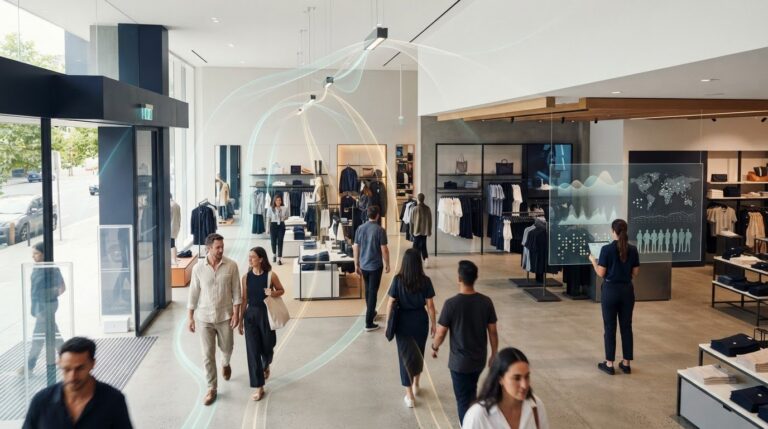
Understanding what is a 3D people counter requires moving past the concept of simple motion detection. It’s a sophisticated stereo-vision technology that perceives depth and volume in real time. By using dual lenses, these sensors mimic human sight to calculate the physical dimensions of objects within their field of view. This shift from simple counting to Spatial Intelligence represents the next phase of physical space management. It’s about more than just numbers; it’s about high-fidelity data that reflects actual human behaviour.
For decades, Australian businesses relied on infrared “break-beam” sensors or basic 2D video analytics. These legacy methods often fail in high-traffic environments, such as major shopping centres in Sydney or Melbourne. Modern People counting technology has evolved to meet a higher standard of precision. The primary goal for a 2026 strategy is achieving 95% to 99.9% accuracy, even in complex real-world conditions where lighting and floor reflections vary.
The Limitations of Legacy 2D Systems
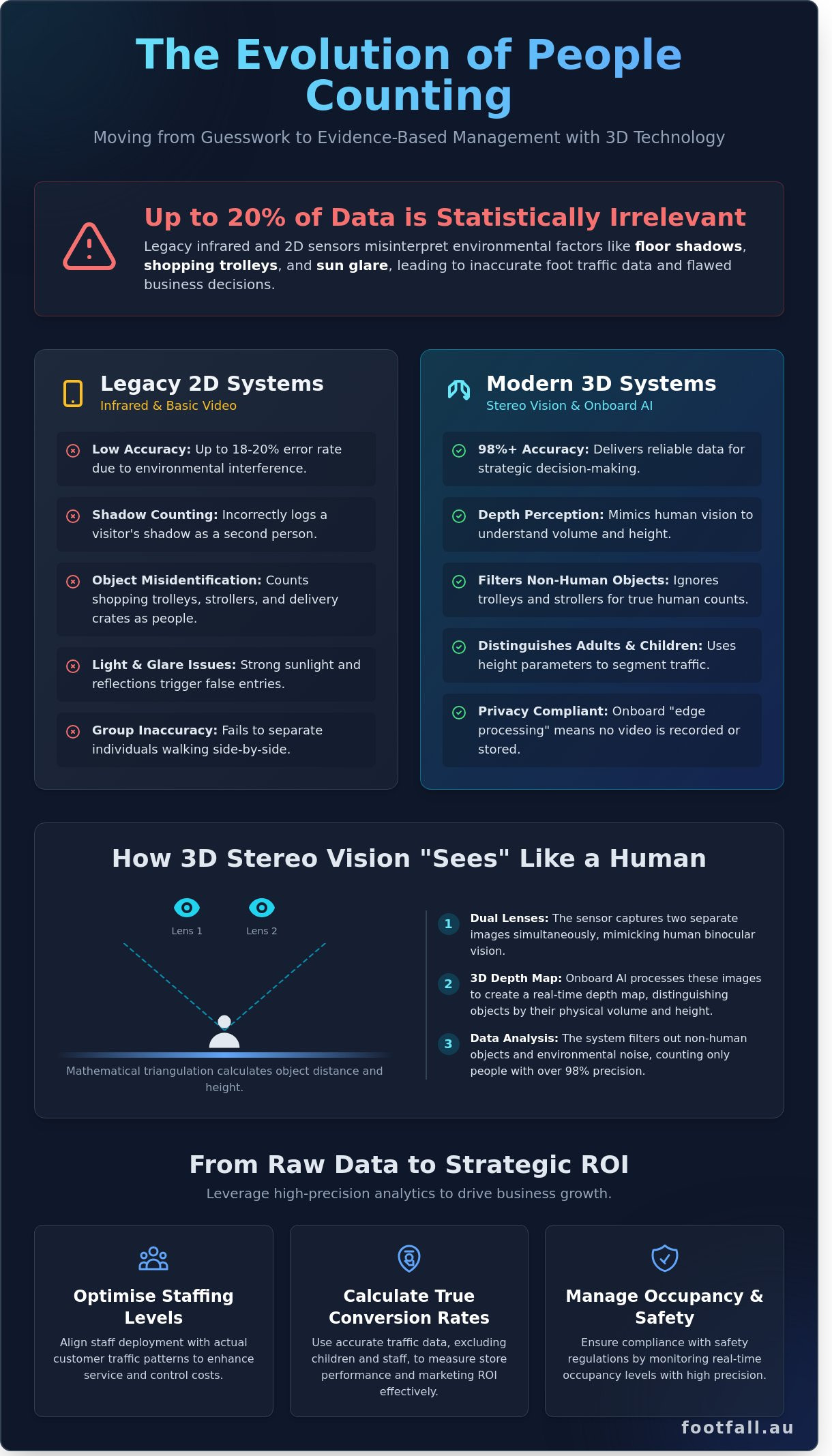
2D sensors operate on flat, two-dimensional images. They struggle with “shadow counting,” where a visitor’s shadow is incorrectly logged as a second person. Light fluctuations, like sun glare through a storefront window, often trigger false entries. In 2024, industry audits revealed that 2D systems can miscount groups by as much as 18% because they fail to separate individuals walking side-by-side. This inaccuracy directly impacts retail conversion rate calculations. If your traffic data is inflated, your performance metrics look worse than they actually are, leading to poor strategic choices regarding staff levels and store hours.
Why Depth Changes Everything for Data Integrity
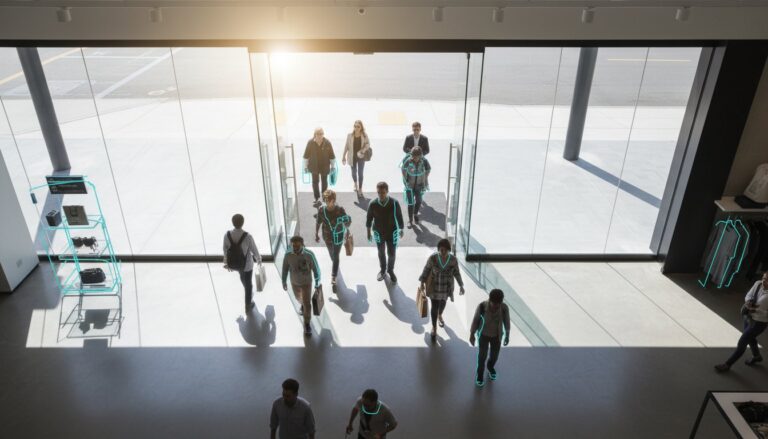
Depth-sensing capabilities bring a level of clarity that 2D systems cannot match. Height-sensing allows the system to distinguish between adults and children based on specific height parameters. This is essential for businesses that need to separate “buying units” from total footfall. 3D sensors also ignore non-human objects. Shopping trolleys, strollers, and delivery crates are filtered out of the count automatically. 3D people counting is the use of dual-lens technology to create a three-dimensional map of a doorway. By removing the noise of inanimate objects, you ensure your data reflects true human engagement. This precision allows for better staff allocation and more accurate ROI tracking for marketing campaigns across your Australian locations.
The Science of Stereo Vision: How 3D Sensors “See” Like Humans
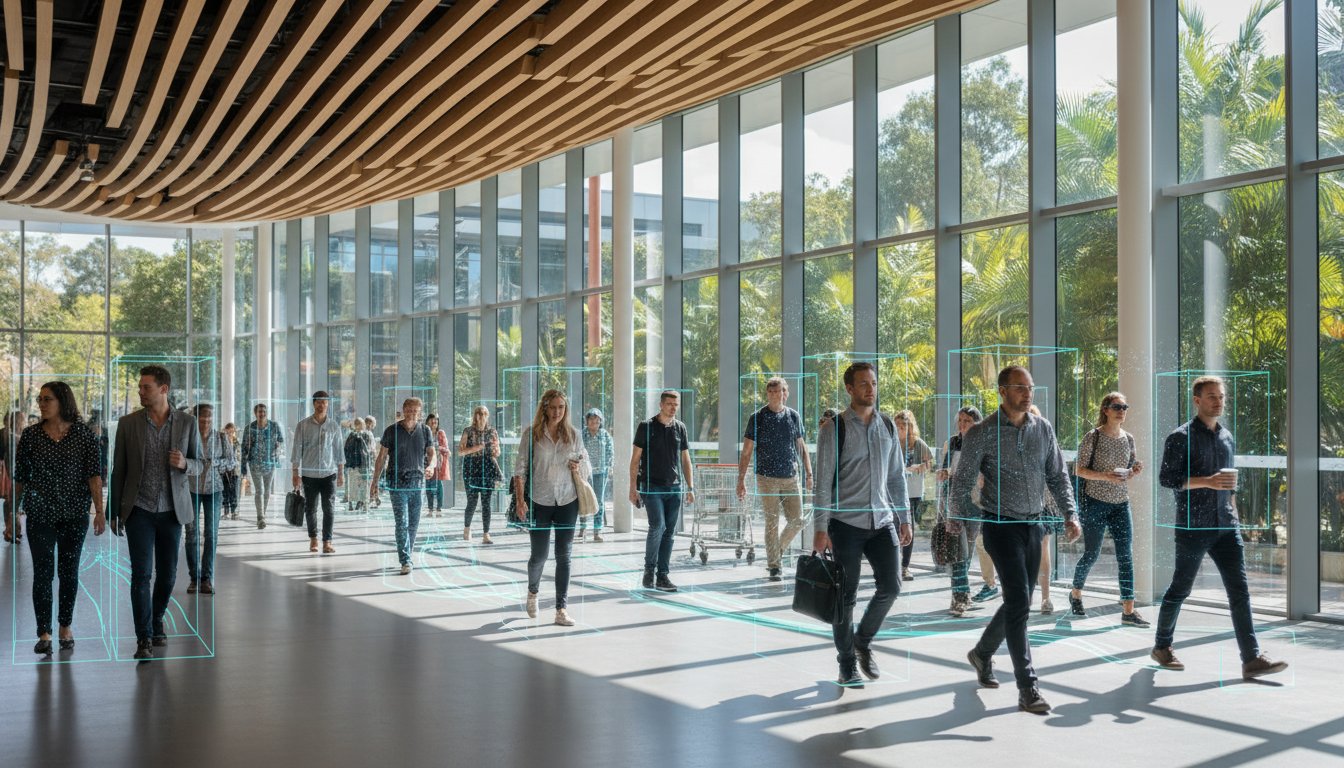
Modern spatial analytics relies on dual-lens architecture. Much like human eyes, these sensors capture two distinct images from slightly different angles. This binocular approach allows the device to perceive depth, which is the fundamental answer to what is a 3D people counter in a technical sense. Instead of flat pixels, the system generates a 3D depth map that categorizes every object by its physical volume and height.
Onboard AI processors analyze these maps in real-time. We call this “edge processing” because the data crunching happens on the device itself. This eliminates the latency of cloud-based video processing and ensures sensitive imagery never leaves the sensor. It translates visual movement into anonymous X and Y coordinates. No video is recorded. No faces are identified. The result is a privacy-first data stream that complies with the strictest Australian privacy standards. It’s a method that prioritizes security without sacrificing the granular detail needed for high-level strategy.
Stereoscopic Mapping and Depth Perception
Precision comes from mathematical triangulation. By calculating the exact distance of objects from the ceiling, the sensor creates a virtual gate. This digital threshold is far more accurate than 2D lines used in legacy systems. Research into vision-based people counting has proven that depth-sensing can distinguish between a person and a shopping trolley with 99.5% accuracy. The system tracks bi-directional flows simultaneously. It counts an “In” and an “Out” with surgical precision even during peak Boxing Day rushes or high-traffic weekend trade.
Overcoming Environmental Challenges
Australian retailers often struggle with harsh, high-contrast lighting. Strong sunlight hitting a glass storefront creates deep shadows that confuse 2D cameras. 3D sensors suppress these shadows by focusing on physical height rather than light patterns. Whether it’s a dimly lit cinema foyer or a bright Sydney showroom, the depth map remains consistent. Understanding what is a 3D people counter requires looking at how it filters out environmental noise to keep your data clean and reliable.
Smart logic also solves the loitering problem. If a customer stops directly under the sensor to check their phone, the AI recognizes the stationary height profile. It won’t double-count them as a new entry or get confused by their presence. This level of intelligence is why 92% of top-tier Australian malls have migrated to 3D hardware over the last three years. If you’re looking to upgrade your store’s visibility, you can explore our sensor range to see how these metrics transform operations.
2D vs. 3D Technology: Why Depth Perception is the Gold Standard
Choosing between 2D and 3D technology isn’t just a matter of budget; it’s a decision about the integrity of your business intelligence. While 2D sensors rely on basic video motion detection, understanding what is a 3D people counter requires looking at its ability to perceive volume and distance. A 2D device might save you A$200 upfront, but it often fails to distinguish between a shopping trolley and a human, or a shadow and a person. This leads to a 15% to 20% margin of error in high-traffic Australian retail hubs. In contrast, 3D sensors maintain 98% accuracy by using dual-lens stereoscopic vision or Time-of-Flight (ToF) technology to map the floor space in three dimensions.
3D sensors typically require Power over Ethernet (PoE) connectivity. This streamlines installation by delivering power and data through a single cable, reducing the need for complex electrical work. While the Total Cost of Ownership (TCO) is higher initially, the value of precise data outweighs the cost. For a retailer with a monthly turnover of A$150,000, a 5% error in conversion rate data could lead to strategic miscalculations worth thousands in lost revenue. Precision isn’t a luxury; it’s the foundation of a reliable ROI.
A Feature-by-Feature Comparison
3D sensors excel where 2D hardware falters. They remain unaffected by changing light conditions, such as harsh afternoon sun hitting a glass storefront. They also solve the “grouping” problem; whereas 2D might count a family as a single mass, 3D identifies individual heads based on height and shoulder width. Advanced 3D units also support staff filtering. By using IR-reflective tags, your system automatically removes employees from the count, ensuring your conversion rates reflect true customer intent. This height data also allows for demographic segmentation, distinguishing between adults and children with a 95% success rate.
When is 3D Mandatory for Your Business?
Certain architectural constraints make 3D technology non-negotiable. If your ceiling height exceeds 3.5 metres, 2D accuracy plummets. 3D sensors, however, perform reliably at heights up to 6 metres. For wide entrances, such as those found in major shopping centres, multiple 3D sensors can be “stitched” together. This creates a single, seamless counting zone that tracks a visitor’s path across a 10-metre opening without double-counting. Identifying what is a 3D people counter‘s greatest strength often comes down to this scalability. For a deeper dive into hardware specifications, refer to our people counting technology guide.
- Accuracy: 3D provides 98%+ compared to 80% for 2D.
- Lighting: 3D handles shadows and glare; 2D often triggers false counts.
- Mounting: 3D supports ceilings up to 6m; 2D is limited to standard 2.4m-3m heights.
- Analytics: 3D enables staff exclusion and height-based segmentation.
Strategic Applications: Where 3D Analytics Delivers the Highest ROI
ROI isn’t a vague concept; it’s a measurable outcome of precision. Understanding what is a 3D people counter allows managers to move beyond raw numbers into the realm of spatial intelligence. By deploying depth-sensing technology, businesses eliminate the guesswork that often leads to overstaffing or missed sales opportunities. These sensors provide the technological eyes needed to decode human movement with 98% accuracy.
Retail Optimisation and Conversion Rates
3D sensors distinguish between a browsing customer and a staff member by measuring height and shoulder width. This distinction is vital for accuracy. If a store records 500 entries but 100 are staff movements, a standard counter reports a 20% inflated traffic figure. Integrating 3D data with Point of Sale (POS) systems reveals the “sales gap,” which is the difference between total visitors and actual buyers. Retailers use retail footfall analysis to adjust rosters. Increasing floor staff by 12% during identified peak hours often results in a 5% to 8% uplift in total transactions.
Public Sector and Facility Management
Australian libraries and museums rely on accurate data to secure state and federal funding. Traditional clickers or beam counters fail to capture the complexity of large groups. Modern people counting systems Australia wide provide the hard evidence required for budget allocations. These systems also manage real-time occupancy for safety. When a gallery reaches its fire-safety limit of 250 people, the system alerts security instantly. This ensures compliance without the need for manual monitoring at every entrance.
Smart Offices and Transport Hubs
Efficiency drives the corporate sector. 3D sensors track desk occupancy to help firms reconfigure underused floors or downsize their footprint. Implementing demand-controlled HVAC based on real-time occupancy can slash energy bills by up to 15% annually. In transport hubs like Sydney’s Central Station, these sensors monitor queue lengths at ticketing kiosks. When wait times exceed a 4-minute threshold, staff receive automated prompts to open additional counters. This proactive approach reduces congestion and improves the passenger experience.
When asking what is a 3D people counter‘s primary value, the answer lies in its ability to filter noise from actual intent. It transforms a simple count into a strategic asset.
Discover how 3D analytics can transform your facility’s operational efficiency today.
Implementing 3D Technology with Footfall Australia
Understanding what is a 3D people counter is the first step toward operational excellence, but the true value lies in how that technology is deployed. Footfall Australia bridges the gap between raw data and strategic insight by providing the FootfallCam Pro2, the industry’s most reliable 3D sensor. Unlike older generations of hardware, the Pro2 uses a “Plug-and-Play” installation process powered by Power over Ethernet (PoE). This single-cable approach reduces installation complexity and cuts infrastructure costs by approximately 30% compared to traditional multi-cable setups. It’s a streamlined solution designed for the fast-paced Australian retail and public sector environments.
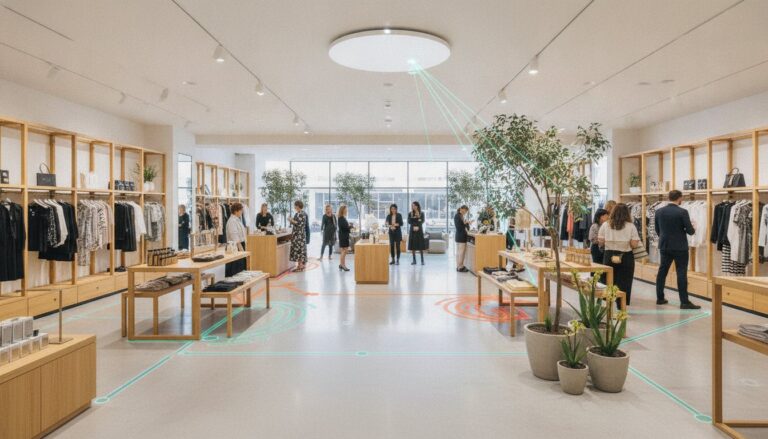
Data only becomes valuable when it’s readable. The V9 Software platform acts as the brain of the operation, converting 3D depth-sensing data into sophisticated, actionable dashboards. It doesn’t just count heads; it tracks spatial analytics, dwell times, and path maps. Business owners can monitor conversion rates in real-time, allowing for immediate adjustments to staffing or floor layouts. This software ensures that every visitor’s journey is decoded into a narrative that helps managers make evidence-based decisions rather than relying on gut feeling.
The FootfallCam Pro2 Advantage
The Pro2 sensor sets the standard with a 99.5% accuracy rate, even in high-traffic zones or areas with complex lighting. It features built-in AI processing that distinguishes between adults, children, and inanimate objects like shopping trolleys. Every device is backed by a 5-year warranty and supported by our local Australian technical team. For a clear breakdown of investment costs and technical specs, we encourage you to view the FootfallCam Pro2 buying guide. Our local presence means you aren’t just buying a sensor; you’re gaining a partner that understands the domestic market.
Taking the Next Step: Consultation and Site Survey
Moving from interest to implementation is a structured process. We begin with a comprehensive site survey to determine the exact number of sensors required for 100% coverage. For businesses currently using 2D or infrared systems, our “Legacy Swap Out Plan” provides a cost-effective pathway to upgrade. Roughly 45% of our recent national deployments involve replacing outdated hardware with modern 3D technology to reclaim data integrity. We manage everything from the initial inquiry to the final national rollout, ensuring your maintenance plans are tailored to your specific operational hours. Contact Footfall Australia for a tailored 3D counting solution and transform your physical space into a source of high-precision intelligence.
Our national support network ensures that any system adjustments or maintenance needs are addressed within 48 hours. This commitment to uptime is why leading Australian brands trust us to maintain their spatial analytics infrastructure. By choosing a professional implementation, you’re ensuring that your investment in a 3D people counter delivers the long-term ROI required in the 2026 business climate.
Mastering the Science of Physical Space
Understanding what is a 3D people counter marks the transition from managing by intuition to leading with evidence. These advanced sensors utilize stereo vision to distinguish between humans and objects, providing a 99.5% accuracy guarantee that 2D alternatives can’t match. By implementing this technology, you secure a granular view of conversion rates and dwell times while maintaining strict compliance through privacy-first AI technology. Every data point becomes a building block for better staffing and optimized floor layouts.
Success in 2026 requires more than just counting heads; it demands a deep dive into the visitor journey. Footfall Australia supports your growth with a national Australian support network, ensuring your hardware and software integrate seamlessly into daily operations. We turn complex spatial analytics into simple, intuitive reports that empower your team to make smarter decisions every day. It’s time to bridge the gap between physical movement and digital precision.
Request a 3D People Counting Consultation
Take the first step toward a more transparent and profitable future for your business.
Frequently Asked Questions
What is the difference between a 2D and a 3D people counter?
A 3D people counter uses stereo vision to create a depth-based map of an entrance, while a 2D counter relies on flat, light-sensitive images. This advanced technology allows the sensor to distinguish between humans and inanimate objects like shopping trolleys or shifting shadows. By mapping the environment in three dimensions, these devices eliminate the common errors found in older 2D systems, delivering data you can actually trust for strategic planning.
How accurate are 3D people counters in high-traffic environments?
Modern 3D sensors maintain a verified accuracy rate of 98% or higher, even during peak shopping hours or major events. These devices use spatial analytics to track multiple individuals simultaneously, even when they walk in close groups or enter side-by-side. This precision ensures that high-density foot traffic doesn’t lead to the undercounting common in basic infrared or thermal systems, providing a reliable foundation for your conversion rate metrics.
Does a 3D people counter record video or compromise privacy?
No, 3D sensors don’t record video or capture identifiable facial features. To understand what is a 3D people counter’s role in privacy, you have to look at how it processes information; it converts human shapes into mathematical coordinates instantly. This approach ensures your business remains 100% compliant with the Australian Privacy Principles while still gaining deep insights into visitor behavior without the risks associated with traditional surveillance.
Can 3D people counters distinguish between adults and children?
Yes, these sensors distinguish between adults and children by applying specific height thresholds to the depth data they capture. Most Australian retailers set a 130cm height filter to exclude children from their primary conversion rate calculations, focusing purely on potential purchasers. This granular data allows management to separate family groups from individual shoppers, providing a much clearer picture of true sales opportunities and staff requirements.
What are the mounting requirements for a 3D people counting sensor?
Standard 3D sensors require a ceiling-mounted position directly above the entrance at a height between 2.2 and 4.5 metres. A single sensor typically covers a 4-metre wide doorway, though wider entrances may require multiple units linked together for seamless coverage. Proper installation ensures the downward-facing lens has a clear line of sight to accurately map the floor area and track visitor movement across the virtual count line.
How much does a 3D people counting system cost in Australia?
A professional 3D people counter in Australia typically costs between A$850 and A$1,600 per unit depending on the hardware brand and specific feature set. Beyond the initial hardware investment, businesses should budget for a one-off installation fee of roughly A$300 and monthly cloud reporting subscriptions starting at A$25 per site. These costs are often recouped within 6 months through improved staff scheduling and data-driven improvements to floor layouts.
Can 3D sensors work in outdoor or semi-outdoor environments?
3D sensors work effectively in semi-outdoor environments like shopping mall entrances or covered walkways when equipped with an IP65 weather-resistance rating. Unlike 2D cameras, 3D technology is unaffected by sunlight glare or shifting shadows, making it ideal for the high-contrast lighting conditions often found in Australia. For fully exposed areas, specialized outdoor housings protect the internal components from dust and moisture while maintaining 98% counting precision.
Do 3D people counters require a constant internet connection?
3D people counters don’t require a constant internet connection to perform their primary task of counting visitors. The sensors process all data on-board and can store it locally for up to 30 days if your network goes offline. An active internet connection is only necessary to push that data to your reporting dashboard, where it’s transformed into the actionable insights your management team needs to optimize operations.