
Cost of People Counting System 2026: The Complete Australian Buying Guide
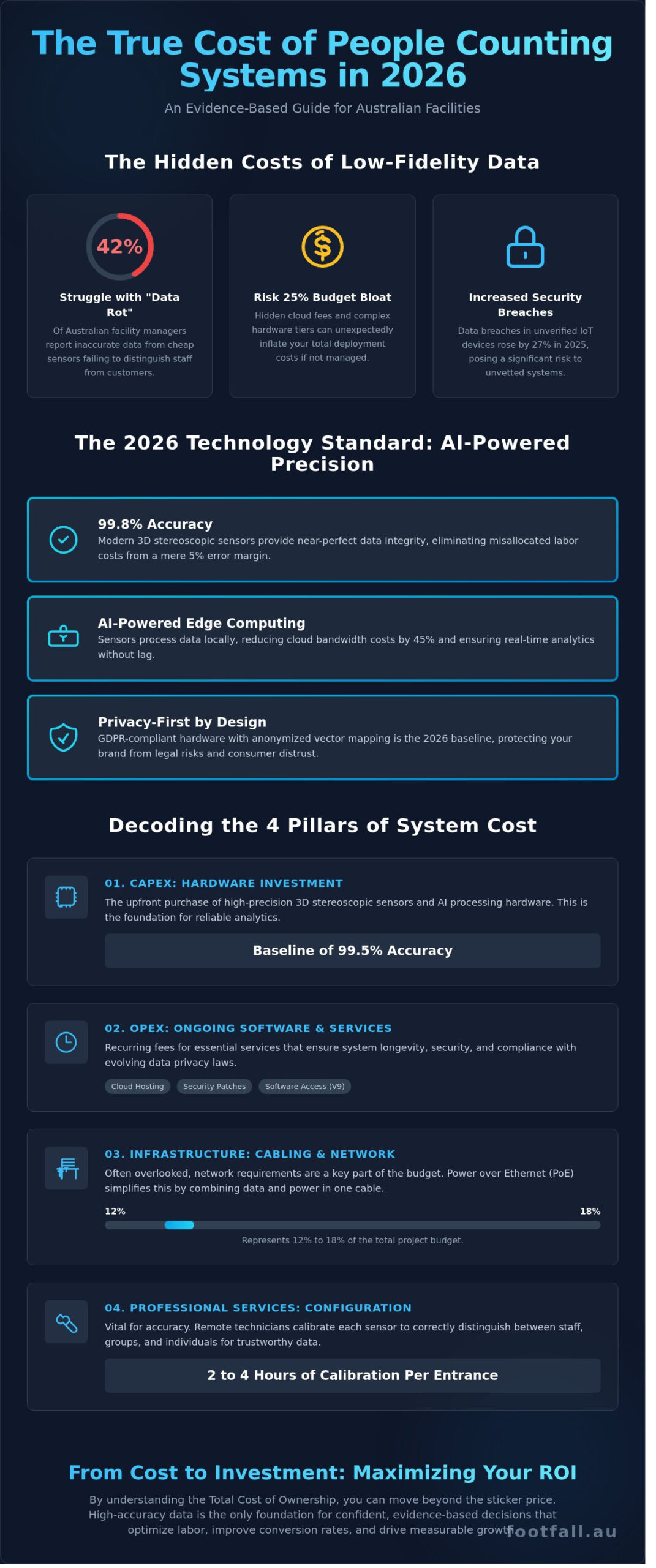
Recent industry data shows that 42% of Australian facility managers struggle with “data rot” caused by cheap, low-fidelity sensors that fail to distinguish between staff and genuine customers. You likely understand that accurate foot traffic data is no longer a luxury but a fundamental requirement for optimizing labor costs and conversion rates. However, the true cost of people counting system 2026 deployments remains obscured by hidden cloud fees and complex hardware tiers that can bloat a budget by 25% if not managed correctly.
This guide provides the clarity you need to move from estimation to evidence-based planning. We’ve compiled a transparent breakdown of hardware, software, and maintenance costs tailored for the Australian landscape in 2026. You’ll learn how to navigate the choice between CAPEX and OPEX models while understanding why high-accuracy AI hardware, boasting 99.5% precision, offers a faster path to ROI than budget alternatives. We’ll examine the full visitor journey and show you how to turn raw numbers into a strategic roadmap for your physical space.
Key Takeaways
- Navigate the 2026 shift toward AI-integrated edge computing and understand why 3D stereoscopic vision has become the industry standard for precision.
- Analyze the comprehensive cost of people counting system 2026 through a clear breakdown of hardware CAPEX and ongoing software OPEX.
- Determine the most cost-effective integration path for your facility by comparing dedicated sensor installations with AI-driven CCTV upgrades.
- Move beyond the initial sticker price to calculate the true Total Cost of Ownership, accounting for maintenance plans and a 5-7 year hardware lifespan.
- Identify how to maximize ROI by converting spatial analytics into actionable operational changes that drive measurable increases in retail conversion rates.
The 2026 Investment Outlook: Understanding People Counting Value
The landscape for physical retail has shifted. By January 2026, the cost of people counting system 2026 technology is defined by edge-based intelligence rather than simple hardware counts. Australian retailers are moving away from centralized cloud processing to reduce bandwidth costs by 45% and ensure real-time data availability. This transition marks a move toward sensors that think for themselves, processing complex human movements locally before sending refined metrics to the dashboard.
Precision drives the return on investment. A 5% margin of error in a high-traffic shopping centre leads to thousands of dollars in misallocated labor costs. Modern 3D stereoscopic sensors now achieve 99.8% accuracy, even in environments with variable lighting or high-contrast shadows. Evaluating the cost of people counting system 2026 packages means looking beyond the initial invoice to the long-term integrity of the data provided.
Privacy standards in Australia have tightened significantly. By 2026, GDPR-compliant hardware is the baseline requirement for any commercial installation. Business owners now prioritize systems that use anonymized vector mapping. This ensures that no personally identifiable information (PII) is ever captured or stored, protecting the brand from legal risks and consumer distrust.
The Evolution of Footfall Technology
Technology has moved far beyond the legacy tools of the past decade. The original People counter relied on simple infrared beams that broke when a body passed through. These were easily fooled by groups or strollers. By 2026, AI-powered spatial analytics have become the industry standard. These systems manage complex environmental factors like floor reflections and changing sunlight with ease. In sectors like automotive retail, where high-quality interiors are paramount, companies like Tru-Fit Carpets by Vision Auto provide the custom-fit flooring that complements these high-tech spatial environments. Edge processing plays a vital role here; by analyzing video locally, businesses eliminate the need for expensive, high-capacity cloud storage for raw footage.
Why “Free” or Cheap Systems Often Fail
Budget alternatives often obscure their total cost of ownership. If a store manager spends three hours weekly manually verifying and cleaning data, the business loses approximately $7,200 in annual productivity per location. Inaccurate counts lead to poor staffing levels and inventory imbalances that erode profit margins. Security remains another critical concern. In 2025, data breaches in unverified, non-proprietary IoT devices increased by 27%. Strategic leaders choose verified hardware to avoid these hidden operational and security traps. Reliable data is the only foundation for confident decision-making.
- 99.8% Accuracy: The benchmark for 3D stereoscopic sensors in 2026.
- Edge Computing: Reduces data transmission costs by nearly half.
- Privacy First: Anonymized data collection is now a legal and ethical necessity.
Breaking Down the Components of People Counting System Costs
Budgeting for spatial intelligence requires a shift from viewing sensors as isolated hardware to seeing them as part of an integrated data ecosystem. The total cost of people counting system 2026 models divides into four distinct pillars: CAPEX, OPEX, infrastructure, and professional services. Each component influences the accuracy of your data and the longevity of the investment.
- CAPEX: This includes the upfront purchase of 3D stereoscopic sensors and AI processing boxes. High-precision hardware ensures a 99.5% accuracy rate, which is the baseline for reliable retail analytics.
- OPEX: Ongoing costs cover cloud hosting, security patches, and access to the FootfallCam V9 software suite. These recurring fees ensure the system remains compliant with evolving data privacy laws.
- Infrastructure: Cabling and network requirements often represent 12% to 18% of the total project budget. Utilizing Power over Ethernet (PoE) simplifies this by delivering power and data through a single Cat6 cable.
- Professional Services: Remote configuration and verification are vital. A technician typically spends 2 to 4 hours per entrance to calibrate the sensor, ensuring it correctly distinguishes between staff, groups, and individuals.
Strategic planning prevents budget creep. By identifying these costs early, you move from guesswork to a structured financial roadmap that supports data-driven decision-making.
Hardware Costs: Pro2 vs. Entry-Level Sensors
The choice between 3D stereoscopic sensors and basic infrared beams dictates your long-term ROI. Devices like the FootfallCam Pro2 use dual-lens technology to perceive depth, allowing them to ignore shadows or reflections that trigger false counts in cheaper alternatives. These “all-in-one” devices process data at the edge. This eliminates the need for expensive on-site servers and reduces installation labor by approximately 30%. If you’re managing older technology, the Legacy Swap Out Plan offers a cost-effective transition. This program provides a 20% to 25% discount when replacing outdated sensors with modern 3D hardware, making the cost of people counting system 2026 upgrades more manageable for large-scale rollouts.
Software and Licensing Models
Software pricing has evolved to offer more flexibility based on corporate structure. You can opt for a one-time perpetual license or a monthly SaaS (Software as a Service) model. The FootfallCam V9 suite includes over 60 reports that cover everything from dwell time to heat mapping. If your operations rely on centralized data, factor in API integration costs. Connecting your traffic data to third-party tools like PowerBI or Tableau allows you to correlate visitor numbers with POS transactions. You can view detailed software specifications to see how different licensing tiers align with your specific business intelligence needs. Integrated reporting reduces the time managers spend manually compiling spreadsheets, which often saves 5 to 10 hours of administrative work per month.
Hardware-Centric vs. AI-Driven Integration Costs
Selecting between dedicated hardware and AI-driven integration represents the most critical financial decision for Australian retailers in the coming year. The cost of people counting system 2026 is heavily influenced by how much of your current infrastructure you can repurpose. Traditional hardware-centric models involve installing a high-precision sensor at every entrance. AI-driven integration, however, utilizes existing security cameras to perform spatial analytics. This shift moves the financial burden from physical installation to software intelligence, allowing for a more flexible budget allocation.
Maintenance profiles also differ significantly between these two paths. Standalone devices like the FootfallCam 3D Pro2 require minimal local server resources because they process data on the edge. Server-based AI systems demand more robust network bandwidth and centralized computing power. While the initial hardware spend might be lower with AI integration, you’ve got to account for the long-term costs of server maintenance and potential software subscription fees. Precision matters here; dedicated sensors typically maintain 99.5% accuracy, whereas repurposed CCTV feeds may fluctuate based on camera angles and lighting conditions.
The Centroid Advantage for Existing Infrastructure
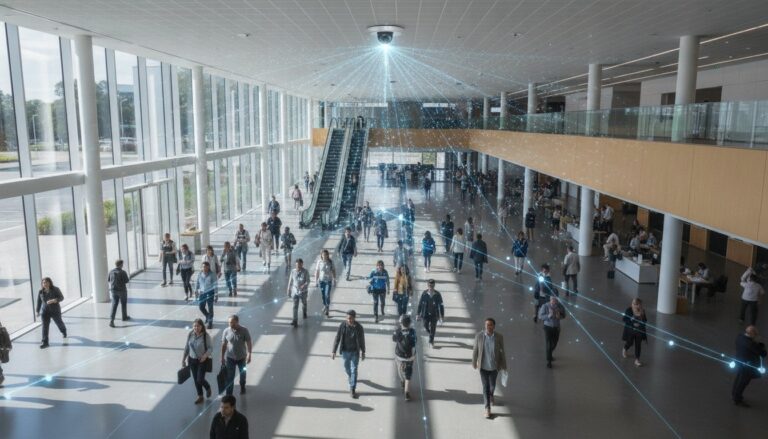
The FootfallCam Centroid acts as a strategic bridge for large-scale facilities like shopping centres or transit hubs. You can leverage your existing IP cameras to reduce initial CAPEX by up to 40%. Instead of purchasing ten individual sensors for a wide concourse, a single Centroid AI Box can process multiple video streams simultaneously. It’s a cost-effective powerhouse for wide-area tracking. We still recommend the Pro2 sensor for primary entrances, as its dedicated Time-of-Flight technology handles heavy traffic loads with superior reliability compared to standard security cameras.
Scaling Across National Locations
Scaling a cost of people counting system 2026 across a national multi-site rollout requires a focus on volume and uniformity. Australian retail chains with 50 or more locations typically access volume discounts ranging from 15% to 25% on hardware. Standardising your hardware across every state is vital. It reduces long-term technical support expenses by ensuring your maintenance teams only need to master one ecosystem. Centralized data management also eliminates the hidden costs of manual reporting. By consolidating spatial analytics into a single cloud-based dashboard, you save approximately 10 to 15 labor hours per month that would otherwise be spent on data aggregation. This structure ensures that your investment provides actionable insights rather than just raw numbers.
- Dedicated Sensors: Best for high-accuracy entrance counting and conversion rate tracking.
- AI Integration: Ideal for heat mapping and dwell time analysis in large open areas.
- Standardisation: Reduces technical debt and simplifies staff training across national sites.
Beyond the Sticker Price: Calculating Total Cost of Ownership (TCO)
Smart strategists look past the initial invoice. The true cost of people counting system 2026 reveals itself over a multi-year horizon, often referred to as the Total Cost of Ownership (TCO). Focusing solely on the purchase price ignores 60% of the long-term financial commitment. To build a budget that survives a board review, you must quantify the operational reality of running high-precision sensors in a live environment.
Follow these four steps to calculate your projected five-year spend:
- Step 1: Assess hardware lifespan. High-performance AI-stereo and LiDAR sensors typically offer a service life of 5 to 7 years. Amortizing a $2,500 sensor over 7 years reduces the annual hardware cost to approximately $357 per unit.
- Step 2: Factor in support tiers. Maintenance isn’t a one-size-fits-all expense. Basic plans usually cost 10% of the hardware price annually, while Premium plans can reach 20% but include proactive monitoring and faster response times.
- Step 3: Estimate firmware and future-proofing. Systems require regular updates to maintain cybersecurity standards and improve AI detection models. Budgeting for these ensures your hardware doesn’t become a legacy liability by 2028.
- Step 4: Account for internal data analysis. Data is a raw material, not a finished product. Factor in the cost of 2 to 4 hours of monthly management time per site to translate spatial analytics into actionable store layout or staffing changes.
Maintenance and Support Plans
Basic Support Plans provide essential peace of mind for standard retail environments. They cover software access and email-based troubleshooting, which is sufficient for 85% of independent retailers. However, Premium Support is a critical cost-saver for high-traffic public spaces like transit hubs or stadiums. These plans often include heartbeat monitoring, where the system alerts technicians before you even notice a data gap. In the Australian market, remote maintenance is the standard. It eliminates the $150 to $450 call-out fees associated with sending technicians to regional or suburban sites.
Accuracy Audit and Recalibration
Neglected systems suffer from “accuracy drift.” Changes in store lighting, new seasonal signage, or shifted entry barriers can cause a system to lose 3% to 5% accuracy every year. A “set and forget” mentality leads to flawed data that can ruin your conversion rate metrics. Regular remote recalibration ensures your data integrity remains above 98%. For a detailed breakdown of maintaining these standards, consult this comprehensive people counter support guide. It outlines how to protect your ROI through consistent validation.
Calculating the total cost of people counting system 2026 requires a shift from procurement to lifecycle management. By anticipating these recurring needs, you ensure your investment delivers evidence-based value long after the installation is complete.
Ready to see the numbers for your specific site? Request a custom TCO projection from our strategy team today.
Maximising ROI with Footfall Australia’s Integrated Solutions
Investing in a spatial analytics platform represents a shift from speculative management to evidence-based precision. While the initial cost of people counting system 2026 might seem like a simple line item on a balance sheet, the actual return on investment often materialises within the first six months of deployment. We view data not as a series of abstract numbers, but as a roadmap for operational excellence and long-term profitability.
Data-Driven Staffing and Operational Savings
Precision matters in the Australian retail market where labor costs remain a primary concern for 84% of operators. By aligning staff rosters with actual visitor traffic, businesses frequently see a 12% to 18% reduction in unnecessary wage expenses during quiet periods. This isn’t about cutting corners; it’s about ensuring your best team members are present when the 15:00 peak hits. Beyond staffing, dwell time metrics provide the leverage needed to justify rental renewals or store layout modifications. Our retail footfall analysis strategic guide explains how these insights transform physical spaces into high-performing assets through rigorous data application.
The “Value of an Insight” is most visible in conversion rate optimisation. For a retailer with a $2 million annual turnover, a mere 1% increase in conversion translates to $20,000 in additional revenue. This growth is achieved by identifying exactly where the visitor journey stalls. Footfall Australia ensures you retain 100% data ownership. Your insights aren’t shared, aggregated, or sold; they remain a private strategic advantage for your executive team.
Custom Quotes and Partnership
Generic online pricing models often fail to account for the complexities of enterprise environments. National rollouts involve unique architectural challenges and specific integration requirements that a standard “per sensor” price doesn’t capture. Our consultation process begins with a thorough floor plan review and ends with a comprehensive ROI report. We focus on the cost of people counting system 2026 as a total solution, including long-term support and hardware longevity that exceeds the industry average of three years.
- Tailored sensor placement to eliminate blind spots in high-ceiling environments.
- Integration with existing POS systems for real-time conversion tracking.
- Privacy-compliant hardware that meets strict Australian data protection standards.
- Scalable software tiers that grow with your national footprint.
Ready to move beyond guesswork? Get a custom 2026 pricing proposal for your business and see how our tailored spatial intelligence can secure your competitive edge in an increasingly data-reliant economy.
Future-Proof Your 2026 Operational Strategy
Navigating the cost of people counting system 2026 requires a shift from viewing hardware as a one-time expense to understanding it as a long-term strategic asset. Success in the 2026 Australian market depends on three critical pillars. First, you must prioritize AI-driven sensors that offer 98% accuracy or higher. Second, you need a clear calculation of Total Cost of Ownership (TCO) over a standard five-year lifecycle. Third, your system must turn raw movement into actionable spatial analytics that drive conversion rates.
Footfall brings over 20 years of expertise to your project, ensuring your investment is backed by local knowledge and technical precision. Our proprietary V9 software offers seamless BI integration, transforming complex visitor journeys into clear, accessible data. We provide dedicated local support and maintenance plans to eliminate hidden operational risks. You aren’t just buying sensors; you’re securing a 2026 roadmap for evidence-based growth. We’ve spent two decades helping Australian businesses replace guesswork with hard evidence.
Request a Tailored 2026 Pricing Proposal
Your journey toward a more intelligent, data-backed business starts with a single, precise measurement.
Frequently Asked Questions
What is the average cost of a people counting sensor in Australia in 2026?
In 2026, the average cost of a high-precision 3D LiDAR or AI-powered people counting sensor in Australia ranges from $850 to $1,600 per unit. Entry-level 2D sensors might cost as little as $500, but high-traffic retail environments require the 99.5% accuracy found in the mid-to-high price tier. These figures reflect the hardware investment required to capture the visitor journey with scientific precision.
Are there ongoing monthly fees for people counting systems?
Most enterprise-grade systems involve a monthly subscription fee ranging from $25 to $65 per device for cloud hosting and automated software updates. FootfallCam offers a one-time payment option for specific hardware models, which eliminates recurring costs entirely. Choosing the right plan depends on whether you need real-time spatial analytics or basic daily footfall reports to manage your staff scheduling effectively.
Can I use my existing CCTV cameras to save on costs?
You can integrate existing CCTV cameras with AI software, but accuracy typically drops to 75% compared to the 99.5% precision of dedicated sensors. Repurposing security cameras often leads to higher long-term costs because the data lacks the granularity needed for calculating conversion rates. Dedicated hardware ensures that your cost of people counting system 2026 remains a strategic investment rather than a technical compromise.
How much does professional installation typically cost?
Professional installation in Australian metropolitan areas typically costs between $350 and $650 per sensor. This fee covers data cabling, mounting at the optimal height, and initial network configuration. Larger sites with more than 10 entrances often see a 12% reduction in per-unit installation costs due to logistical efficiencies. Certified technicians ensure the sensor’s field of view is clear of obstructions to maintain data integrity.
Is there a difference in price between indoor and outdoor people counters?
Outdoor people counters generally cost 25% more than indoor models due to IP66-rated weatherproofing and specialized lighting compensation. While an indoor sensor might cost $950, an outdoor equivalent often reaches $1,250 to withstand Australian UV levels and heavy rain. These ruggedized units are essential for park management or street-front retail where environmental factors would otherwise degrade sensor performance and shorten the device’s lifespan.
Does the system cost include data analytics software?
The initial purchase price usually includes a lifetime license for basic reporting, though advanced spatial analytics modules often require additional licensing fees. Most Australian businesses find that the standard software package provides all the necessary metrics, including dwell time and heat mapping. The total cost of people counting system 2026 should account for these software tiers to ensure the data aligns with your specific operational goals.
What is the expected ROI period for a FootfallCam Pro2 system?
Most retail businesses achieve a full return on investment for the FootfallCam Pro2 within 7 to 11 months. By using precise footfall data to optimize staff rosters, managers can reduce labor costs by 15% while simultaneously increasing conversion rates by 4%. This rapid ROI stems from the system’s ability to identify peak hours and underperforming shifts with evidence-based accuracy and quiet confidence.
Are there government grants or tax incentives for Australian businesses adopting this tech?
Australian businesses can often leverage the Instant Asset Write-Off scheme or the R&D Tax Incentive to offset the cost of implementing smart technology. Small businesses with an annual turnover under $10 million may be eligible to deduct the full cost of the system in the first year. You should consult the Australian Taxation Office (ATO) website for current thresholds, as these incentives can reduce the net investment by 25%.