The Strategic Guide to Office People Counters for Australian Workplaces
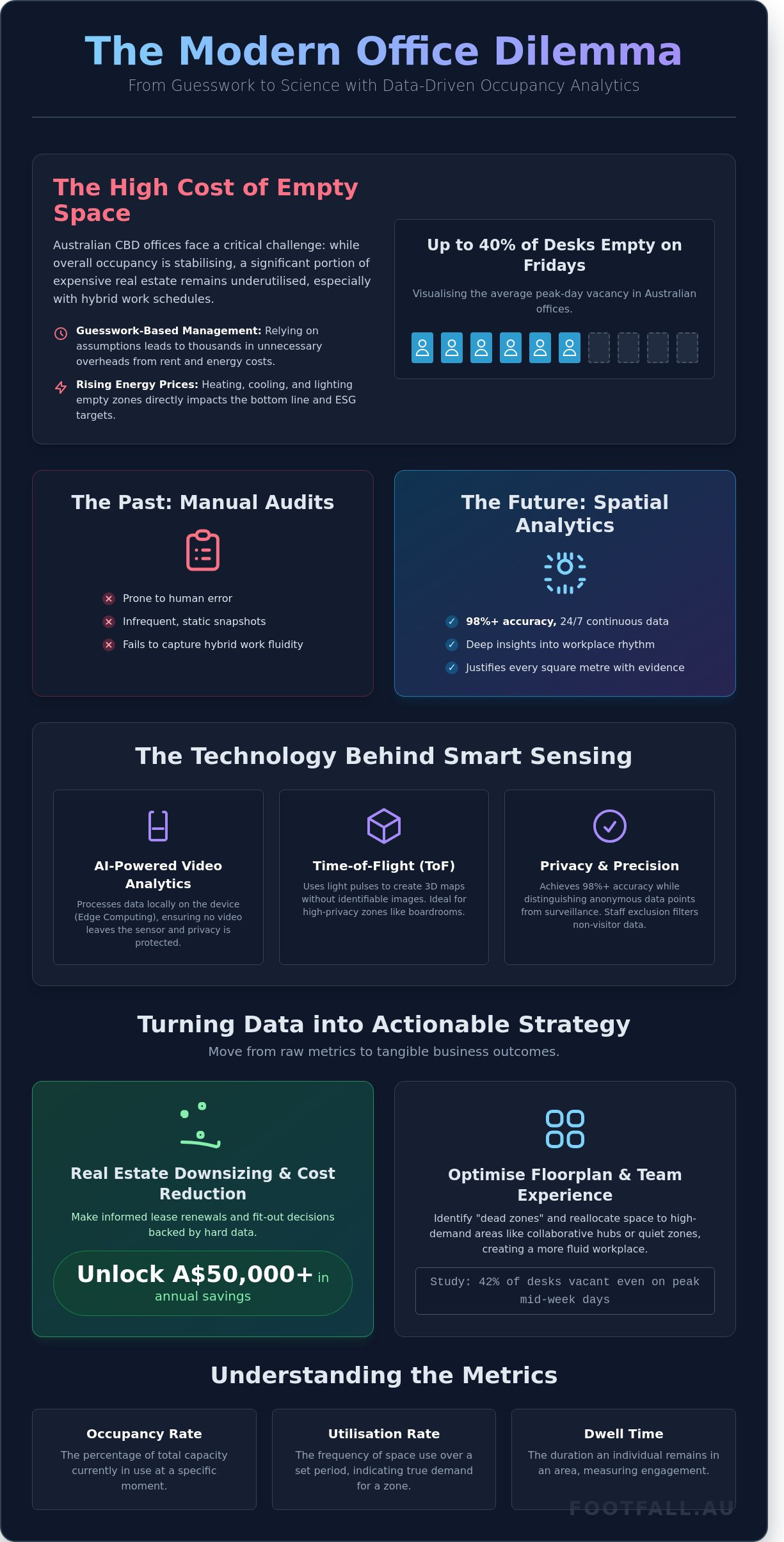
Recent reports from the Property Council of Australia indicate that while CBD occupancy is stabilising, up to 40% of desks in Australian office blocks sit empty on any given Friday. You likely suspect that your current floor plan isn’t working as hard as it should, especially with the complexities of hybrid scheduling and rising energy prices. Managing a modern workplace without precise metrics often feels like a guessing game that costs your business thousands in unnecessary overheads every month.
This guide demonstrates how implementing an office people counter moves your strategy from speculation to science. You’ll discover how to turn anonymous occupancy data into a blueprint for A$50,000 in annual rent savings and a more fluid daily experience for your team. We’ll examine the latest sensor technology, address privacy standards, and outline the path to a fully optimised, data-backed Australian workplace.
Key Takeaways
- Define the shift from simple entry counting to sophisticated spatial analytics using 98%+ accurate AI and Time-of-Flight technology.
- Navigate the critical balance between data collection and staff privacy by distinguishing anonymous data points from traditional surveillance.
- Utilise an office people counter to transform raw occupancy metrics into actionable strategies for real estate downsizing and cost reduction.
- Implement a centralised national strategy using FootfallCam V9 to achieve a unified, evidence-based view of workspace utilisation across all Australian assets.
What is an Office People Counter and Why Does Your Workspace Need One?
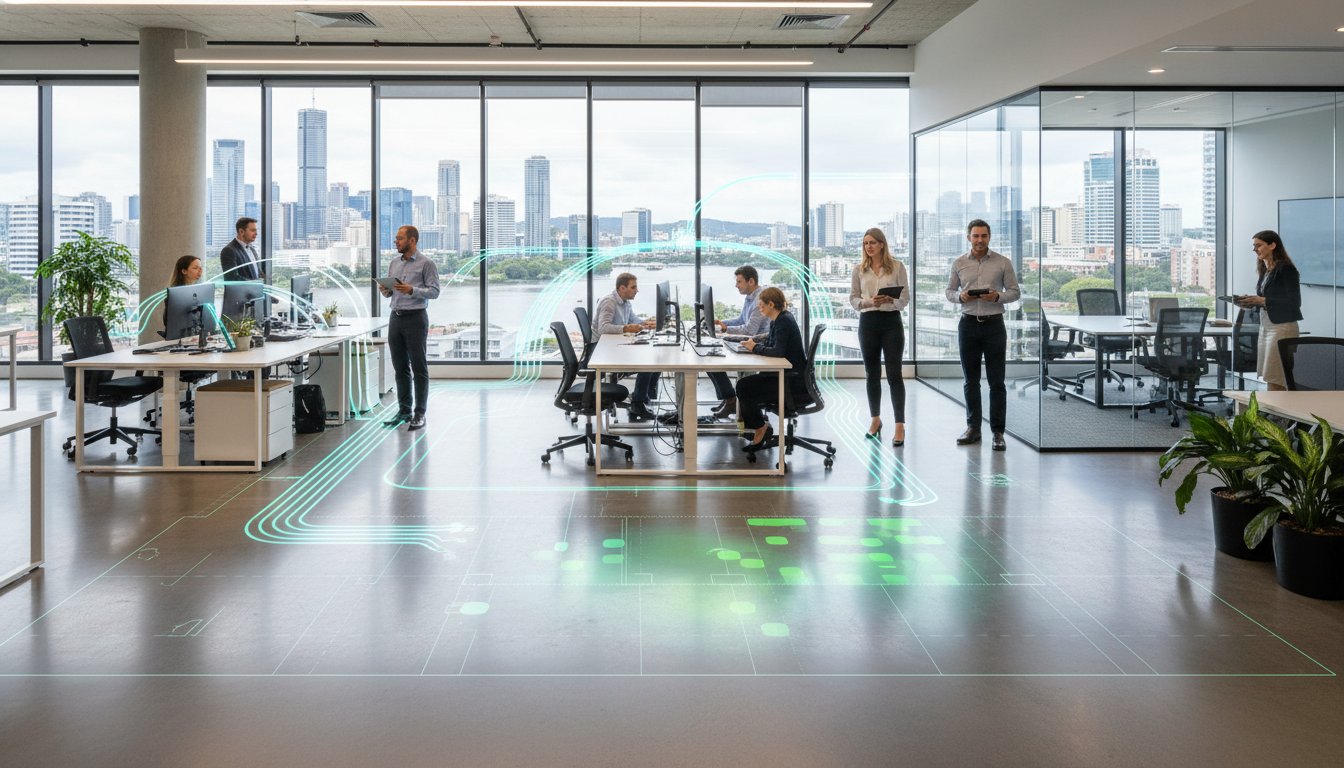
An office people counter is a sophisticated IoT sensor designed to capture real-time occupancy and foot traffic data. These devices represent a significant leap from simple entry counters to tools for deep spatial insight. They don’t just record a person passing a threshold; they map the rhythm of the modern workplace. While basic counters tell you that someone entered the building, advanced spatial sensors reveal exactly which zones they occupy and for how long.
The transition from manual audits to automated data is now a necessity for Australian enterprises. As recently as 2019, many Sydney firms still relied on “clipboard audits” where staff manually recorded desk usage. These snapshots were prone to human error and failed to capture the fluidity of hybrid work. By 2026, continuous data collection has become the baseline. Automated systems provide 24/7 visibility, allowing facility managers to justify every square metre of expensive CBD real estate through hard evidence rather than guesswork.
The Core Purpose: Beyond Just Counting Heads
Effective space management requires moving past the simple question of how many employees are present. It focuses on how they interact with the environment. Identifying “dead zones” is a priority for any lean operation. A 2024 study of Melbourne office layouts found that 42% of dedicated desk areas remained vacant even on peak mid-week days. An office people counter helps validate whether teams actually need more collaborative hubs or if the demand for soundproof quiet zones is higher than current supply allows. This data ensures that floor plan adjustments are driven by actual movement patterns.
Key Terminology for Decision Makers
- Occupancy Rate: The percentage of total capacity currently in use at a specific moment in time.
- Utilisation Rate: The frequency of space use over a set period, indicating the true demand for a specific room or zone.
- Dwell Time: The duration an individual remains in a specific area, which is vital for measuring the effectiveness of breakout zones.
Spatial analytics is the study of how people navigate and interact with physical work environments to improve efficiency. It provides the technological eyes to see hidden patterns in employee behaviour. This intelligence allows business owners to make informed decisions about lease renewals and fit-out investments, ensuring the physical office remains a high-performing asset.
The Technology Behind Smart Office Occupancy Sensing
Modern office management requires precision. An office people counter must deliver 98% accuracy to satisfy Australian corporate reporting standards and ESG requirements. In 2026, the shift toward Power over Ethernet (PoE) ensures seamless national rollouts across Sydney and Melbourne hubs. It eliminates the need for complex battery management or local power points. These hardware units integrate directly with software platforms like FootfallCam V9, turning raw movement into spatial intelligence. It’s the difference between guessing desk availability and knowing exactly how your floor plate performs.
AI-Powered Video Analytics
AI chips now process data locally on the device through Edge Computing. This protects privacy by ensuring no video stream ever leaves the sensor. The technology distinguishes between humans, furniture, and shadows with near-perfect reliability. Advanced algorithms facilitate staff exclusion by using ID tag detection to separate employee movement from visitor traffic. This ensures your occupancy data reflects true space utilisation. You don’t want your cleaners or security patrols skewing the numbers during off-peak hours.
Time of Flight (ToF) and Infrared Options
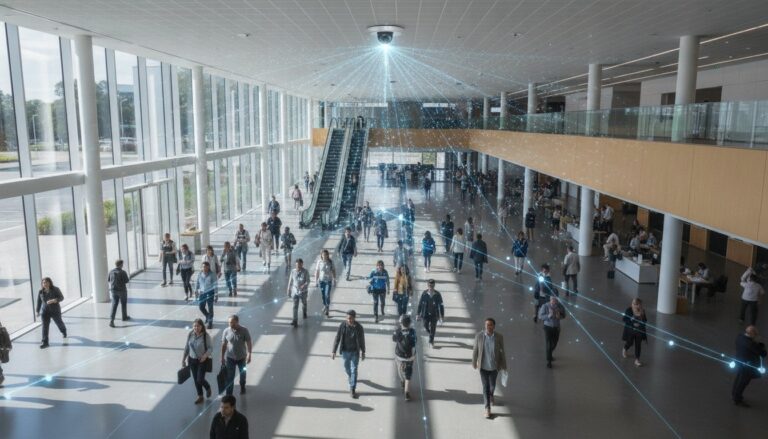
While AI video dominates, ToF sensors provide a specialised solution for high-privacy zones like executive boardrooms or low-light areas. Discreet ceiling-mounted sensors use light pulses to create 3D maps without capturing identifiable images. For high-traffic lobbies, 3D stereo vision remains the gold standard for accuracy. It perceives depth to accurately count dense crowds during peak morning arrivals. If you’re planning a facility upgrade, you can view the latest sensor specifications to match the right technology to your specific floor plan.
- 98% Accuracy: The minimum threshold for reliable corporate occupancy reporting.
- Edge Computing: Processes data on-site to maintain strict Australian privacy compliance.
- PoE Connectivity: Simplifies installation across multi-floor office fit-outs.
- Staff Exclusion: Filters out internal team movements to isolate visitor behavior.
Choosing the right hardware depends on your ceiling height and lighting conditions. High-traffic entrances benefit from 3D stereo vision, while quiet breakout zones might only require ToF sensors. The goal is a unified data set that provides a clear narrative of human movement throughout the building.
Privacy-First Analytics: People Counting vs. CCTV Surveillance
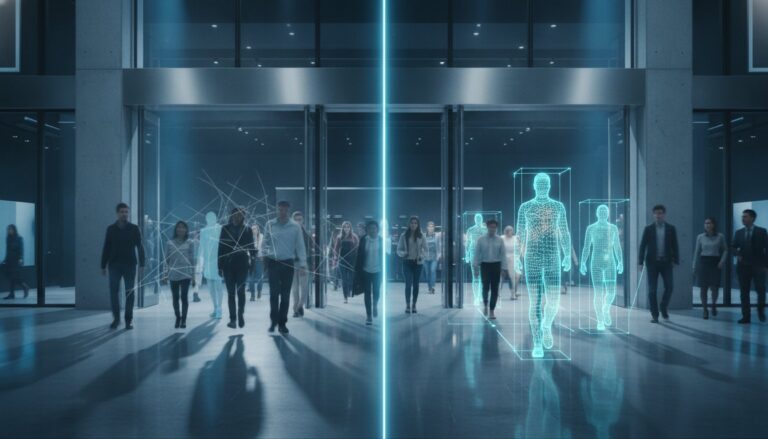
Staff often ask if they’re being watched when they see new hardware installed on the ceiling. It’s a valid concern that requires a clear, evidence-based answer. An office people counter isn’t a camera; it’s a data generator. While traditional CCTV records identifiable video streams for security, modern spatial sensors focus on movement patterns. These devices use Time-of-Flight or AI-driven infrared technology to see humans as anonymous X-Y coordinates. This fundamental shift from surveillance to analytics ensures that your space optimisation project doesn’t come at the cost of employee comfort.
Compliance is a non-negotiable requirement for Australian businesses. The Australian Privacy Principles (APP) and global standards like GDPR mandate strict protections for personal data. Privacy-by-Design hardware meets these standards by ensuring that no human face or identifying feature is ever captured. By choosing sensors that lack the capability to record video, you remove the risk of data breaches involving personal identifiable information (PII). This technical limitation is your strongest argument for internal buy-in.
Anonymisation at the Edge
Modern sensors process data at the edge, meaning the conversion from visual input to numerical data happens on the device itself. No PII is stored or transmitted to the cloud. This 100% anonymisation ensures that the output is purely statistical. Unlike CCTV, which requires manual review and creates a digital paper trail of faces, these sensors only output digits. You can’t identify an individual from a string of coordinates. This eliminates the privacy risks associated with traditional video monitoring, which 43% of employees in a recent 2023 workplace survey cited as a major stressor.
Building Trust with Your Workforce
Transparency is the foundation of a successful smart office rollout. A 2023 study by the Office of the Australian Information Commissioner found that 89% of Australians are concerned about their data privacy. Businesses should lead with the “why” to build trust. Explain that the office people counter aims to improve the daily experience through several key benefits:
- Optimised Climate Control: Adjusting HVAC based on real-time density to ensure comfort.
- Enhanced Safety: Using occupancy data to prevent overcrowding and streamline emergency evacuations.
- Better Facilities: Using data to justify requests for more quiet zones or larger breakout areas.
Focusing on facility performance rather than individual monitoring turns a potential point of friction into a collaborative improvement project. When employees see that data leads to shorter wait times for meeting rooms or better-ventilated desks, the technology becomes a valued tool rather than a perceived threat.
Actionable Insights: How Footfall Data Transforms Facility Management
Raw data lacks value until it informs a strategic decision. In the Australian commercial sector, where prime office rents in Sydney often exceed A$1,300 per square metre, every underutilised desk represents a leak in the budget. An office people counter provides the empirical evidence needed to plug these gaps. Facility managers use this intelligence to negotiate lease renewals based on actual footprint requirements rather than outdated headcount projections. If data reveals that 40% of your floor plate remains vacant on Fridays, downsizing or subletting becomes a viable path to reducing operational expenditure.
- Identify peak occupancy days to consolidate teams and close entire floors.
- Use spatial analytics to prove the need for more collaborative zones over static desks.
- Validate real estate investments with precise dwell time metrics.
Energy Efficiency and Demand-Based Cleaning
Traditional HVAC schedules are rigid and wasteful. Integrating sensors with building management systems allows for climate control that reacts to live occupancy. You stop paying to cool empty boardrooms. This logic extends to hygiene. Instead of cleaning every kitchen every hour, teams respond to actual usage triggers. Demand-based cleaning can reduce facility maintenance costs by up to 20% by directing resources only where they’re needed. It’s a shift from a fixed schedule to a high-intelligence service model.
Meeting Room and Desk Optimisation
Ghost bookings are a silent productivity killer. Internal audits often show that 35% of reserved rooms remain empty because of “no-shows.” By deploying an office people counter, you can automate room release protocols that free up space if no one enters within ten minutes. For hybrid workforces, this data defines the ideal desk-to-employee ratio. Most modern Australian offices now thrive on a 1:1.6 ratio, balancing cost-savings with employee comfort. This evidence-based approach ensures your layout fosters genuine collaboration rather than frustration.
Implementing a National People Counting Strategy with Footfall Australia
Managing a commercial property portfolio across Sydney, Melbourne, and Brisbane requires more than just local observations. A unified office people counter strategy provides the data infrastructure needed to compare occupancy rates across diverse geographical locations. FootfallCam V9 serves as the central intelligence hub; it offers a consolidated dashboard that transforms raw numbers into a clear organizational overview. You can identify which regional hubs are reaching 92% capacity and which metropolitan suites remain underutilized. This allows for evidence-based decisions on lease renewals or expansions rather than relying on anecdotal feedback from site managers. Centralized reporting eliminates the silos that often form between different state branches. When every office uses the same high-precision sensors, the executive team can benchmark performance and space efficiency across the entire continent. It creates a standard metric for success in the hybrid work era.
Seamless Integration and Scalability
The FootfallCam Pro2 hardware integrates directly into your existing IT framework via PoE (Power over Ethernet). For organizations with extensive security infrastructure, the Centroid system adds a layer of intelligence to existing IP cameras. This software-driven approach turns your current surveillance assets into sophisticated counting sensors without requiring additional cabling. It’s a solution that scales effortlessly. You can start with a single 150sqm boutique office in Perth and expand to a 25-storey national headquarters while maintaining a single, consistent reporting interface. This ensures data continuity as your business grows and your spatial needs evolve.
The Footfall Australia Partnership
Footfall Australia brings over 20 years of experience to the local market. We understand the specific operational requirements and building standards of Australian workplaces. We don’t just supply hardware; we provide a closed-loop service that begins with professional installation and extends to ongoing strategic consulting. Our maintenance plans are designed to maintain 98% data accuracy, ensuring your spatial analytics remain reliable for the long term. Local support means your system doesn’t suffer from downtime caused by international time zones. Our technicians are available for on-site calibration and hardware checks, ensuring that environmental factors like changing office lighting don’t compromise your data integrity. This partnership helps you bridge the gap between initial data collection and actionable workplace optimization. Contact Footfall Australia for a comprehensive office space audit to begin your data-driven transformation.
Future-Proof Your Australian Workspace with Data-Driven Precision
Managing a modern Australian office requires more than intuition; it demands precision. By deploying a high-performance office people counter, you transform raw movement into a strategic asset. You’ve seen how smart occupancy sensing balances high-tech spatial analytics with strict Australian privacy standards. This ensures your facility management decisions rest on industry-leading 98%+ counting accuracy rather than guesswork. Your data remains secure while providing the clarity needed to refine floor plans and reduce operational overheads across your entire property portfolio.
Optimising commercial real estate becomes a seamless process when backed by hard evidence. Footfall Australia has provided this level of intelligence through our national support and maintenance network since 2004. We bridge the gap between complex sensor technology and the intuitive reporting your leadership team needs to thrive. It’s time to eliminate the blind spots in your daily operations and embrace a more efficient, evidence-based future.
Optimise your workspace with Footfall Australia’s strategic counting solutions and start making data-driven improvements today. Your workspace is evolving, and with the right insights, your business will stay ahead of the curve.
Frequently Asked Questions
Is an office people counter the same as a security camera?
An office people counter is fundamentally different from a security camera because it’s designed for data collection rather than surveillance. These sensors use Time-of-Flight or infrared technology to detect human shapes as anonymous data points. They don’t capture facial features or record video footage. This design ensures your business remains 100% compliant with the Australian Privacy Principles while providing the spatial insights you need.
How many sensors do I need for a standard open-plan office?
You typically need one sensor for every 30 square metres of open space or one per major entry point. A standard 500 square metre office in a CBD location usually requires 6 to 8 sensors to achieve full coverage. This density ensures 98% accuracy in tracking desk utilisation and breakout area traffic. We determine the final count by analysing your specific floor plan and ceiling heights.
Can these systems track individual employees or their identities?
These systems cannot identify individual staff members or track specific identities. The technology processes movement at the edge, which means it converts physical presence into numerical coordinates instantly. No names, biometric data, or personal identifiers are ever stored in the system. You receive a clear picture of how the office functions without compromising the privacy of your workforce.
What is the typical ROI period for an office people counting system?
Most Australian enterprises achieve a full return on investment within 6 to 18 months. By using an office people counter to identify that 30% of your desks are consistently vacant, you can make informed decisions about sub-leasing or office consolidation. If this data allows you to reduce a lease by 150 square metres in Sydney, the annual savings can easily exceed A$100,000.
Do office people counters work in low-light conditions or at night?
Advanced sensors work with total precision in complete darkness because they don’t rely on visible light. They use active infrared signals to map the environment, maintaining a 98% accuracy rate regardless of the time of day. This is particularly useful for monitoring cleaning schedules or late-night access. You won’t need to leave lights on overnight just to maintain your data integrity.
Can the data be integrated with our existing building management system (BMS)?
You can integrate occupancy data into your existing BMS through standard REST APIs or BACnet protocols. This connection allows your HVAC and lighting systems to respond to real-time human presence. When the sensors detect a room is empty for more than 10 minutes, the BMS can automatically adjust the climate control. This integration typically reduces office energy consumption by up to 25% annually.
How accurate are these counters in a busy office lobby?
High-performance sensors maintain 98.5% accuracy even in high-traffic areas where people move in dense groups. The AI algorithms are trained to distinguish between individuals walking side-by-side or someone standing still near the door. Using an office people counter in your lobby provides a factual foundation for your front-of-house staffing levels. You’ll see exactly when peak arrival times occur without the errors of manual counting.
What happens to the data if the office Wi-Fi goes down?
The sensors store all captured data on internal memory if your network connection is interrupted. Most professional-grade devices hold up to 30 days of timestamped records locally. Once the Wi-Fi or Ethernet connection is restored, the sensor automatically syncs this cached data to your dashboard. This ensures your long-term analytics remain continuous and free from gaps caused by IT outages.