Comprehensive Guide to Queue Management Systems in Australia for 2026
A shorter queue does not always mean customers are waiting less. A queue management system Australia businesses use can organise check-ins and service flow, but queue data alone may not show how many people arrive or move through a site. Looking at both service activity and visitor traffic can help distinguish a staffing or process issue from a surge in arrivals.
Long or unpredictable waits put pressure on customers and staff. Choosing an approach starts with understanding how people arrive, what happens at each service stage and how staff coordinate the work. This guide compares physical, virtual and hybrid queues, explains what to assess before choosing an approach, and covers practical ways to measure waiting, throughput and service performance. It also shows how people-counting data from FootfallCam can add context to queue metrics.
Key Takeaways
- Match a queue management system Australia-wide to how customers arrive, wait and receive service, rather than assuming one queue type suits every site.
- Map service stages, exceptions and communication needs before comparing physical, virtual and hybrid approaches.
- Set a performance baseline and compare similar periods to assess changes in waiting, throughput and service conditions.
- Use people-count data to understand traffic patterns around the queue, adding context to queue metrics without treating it as a measure of waiting time.
What Does a Queue Management System Do for Australian Businesses?
A queue management system combines technology and operating processes to organise how customers arrive, wait and receive service. It can help staff manage service order and tell customers what to do next. In a retail store, for example, the process might direct walk-ins to the right counter. In a clinic, it could coordinate check-in with the next service stage.
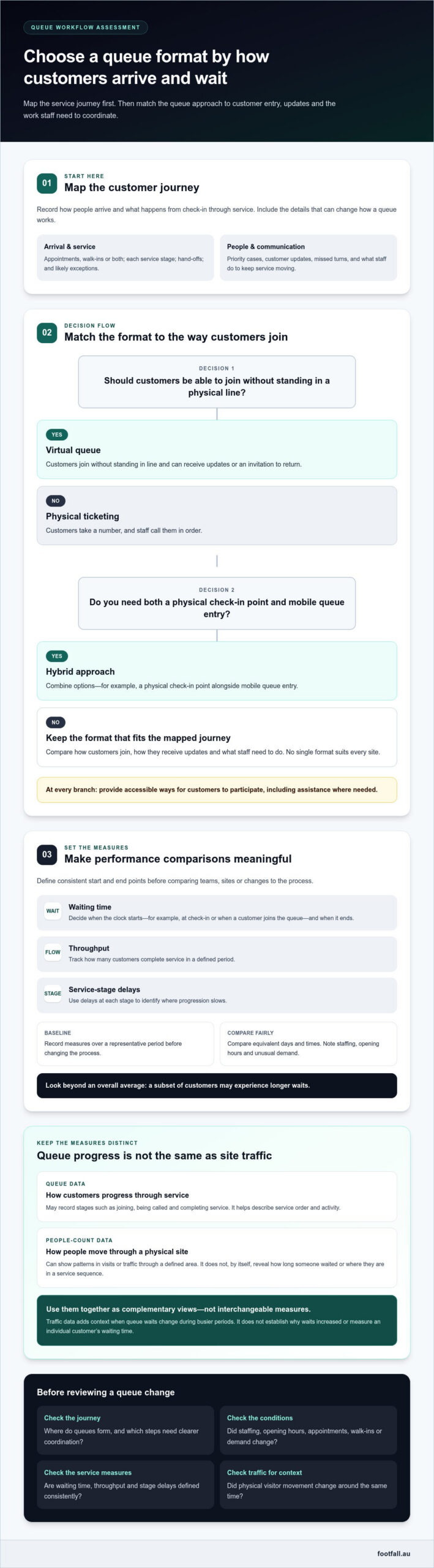
The best fit depends on the workflow. With physical ticketing, customers take a number and staff call them in order. A virtual queue lets customers join without standing in line, then receive updates or an invitation to return. Read more about virtual queueing. A hybrid approach combines options, such as a physical check-in point alongside mobile queue entry. Compare each format by how customers join, how they receive updates and what staff need to do to keep service moving. No single format suits every site.
Queue management system vs. people counting: what is measured?
Queue tools manage service order and may record stages such as joining, being called and completing service. People counters measure physical movement or visits through a defined area. They can show when traffic rises, but do not, by themselves, reveal how long someone waited or where they are in a service sequence.
Queue data describes how customers progress through service; traffic data describes how people move through a physical site. The two are complementary, not interchangeable. FootfallCam Pro2 people counters and FootfallCam V9 analytics software provide a way to measure physical traffic alongside queue processes. For a business assessing a queue management system Australia-wide, considering both views can help put changes in service activity in the context of visitor volume.
How to Assess a Queue Management System for Your Service Workflow
Choose features only after you understand what customers and staff need to do. Use this step-by-step assessment to narrow the options for a queue management system Australia businesses can put into practice.
- Map the customer journey. Record how people arrive, each service stage, likely exceptions and when customers need updates. Include hand-offs, priority cases and what staff do if someone misses their turn. This map helps identify where queues form and which steps need clearer coordination.
- Match the approach to arrivals. Decide whether you handle appointments, walk-ins or both. Then identify workable ways for customers to join and receive updates, such as a ticket, digital notification or display. Consider how staff will manage each route, and provide accessible ways for customers to participate, including assistance where needed.
- Define consistent measures. Set clear start and end points for waiting time, throughput and service-stage delays. For example, decide whether waiting time begins at check-in or when a customer joins the queue. Use the same definitions across teams and sites so comparisons are meaningful.
Which queue features matter most for your customer journey?
Compare ticketing, notifications, appointment booking and display options against the journey you mapped, not against a generic feature checklist. Consider how customers will join, whether updates reach them at the right point, how much staff work each option creates and how the process can stay consistent across multiple locations. A people counting systems guide explains how physical traffic measurement can complement queue reporting without replacing it.
Set a baseline and compare like-for-like periods, taking account of service conditions that affect demand. For example, note staffing levels, opening hours and whether appointments or walk-ins changed. In public services, the Institute of Public Administration Australia’s paper on customer service delivery standards provides context for setting expectations around timeliness. For a separate view of visitor movement, explore people-counting hardware and analytics.
How to Measure Queue Performance and Improve Customer Flow
Establish a baseline before changing the process. Record queue measures over a representative period, then compare equivalent days and times after an adjustment. Note relevant service conditions, such as staffing levels, opening hours or unusual demand, so you do not mistake a change in conditions for an effect of the system.
Choose measures with clear operational meaning. Waiting time shows how long customers spend before service; throughput indicates how many complete service in a defined period; and stage delays can reveal where progression slows. Be consistent about when each measure starts and ends. Looking beyond an overall average can also help reveal whether a subset of customers experiences longer waits. Together, these measures give teams a practical basis for deciding what to adjust.
Can people-counting data help evaluate queue changes?
Yes, as context. Queue reports describe customer progression through service, while people-count data can show patterns in physical traffic entering or moving through a site. If queue waits rise during a period when more people arrive, traffic data helps describe the conditions around the change. It does not establish why waits increased or measure an individual customer’s waiting time.
Footfall Australia supplies people-counting hardware, including FootfallCam Pro2, alongside FootfallCam V9 analytics software to help businesses measure physical traffic patterns. These tools add a traffic measurement layer to queue reporting. For a practical view of how traffic information can support operational decisions, explore this guide to footfall data analysis.
Review queue and traffic information together, then use the patterns to frame the next operational question. For example, if waits rise during busier periods, look at which service stage is slowing down and whether the process changes as arrivals increase. To explore Footfall Australia’s people-counting solutions as a measurement layer for physical sites, visit the footfall data analysis guide.
Make your next service-flow decision with confidence
Choosing a queue management system Australia businesses can use effectively starts with the customer journey, not a feature list. Map how people arrive and move through service, then select physical, virtual or hybrid processes to suit. Set a baseline for waiting time, throughput and service-stage delays before making changes, so you can assess results against comparable conditions.
Queue reports show how customers progress through service. People-count data adds a separate view of physical traffic, helping put shifts in queue activity into context without measuring individual wait times. Footfall Australia combines people-counting hardware with analytics software to help businesses understand visitor movement across physical sites.
Explore Footfall Australia’s people-counting solutions to see how traffic measurement can complement your queue analysis.
Frequently Asked Questions
What does a queue management system do?
A queue management system organises how customers join, wait for and progress through a service. It can manage service order, share updates and help staff see where demand or delays are building. For a queue management system Australia businesses assess, the suitable setup depends on how customers arrive, the service stages involved and how staff need to coordinate each interaction.
How can a queue management system reduce waiting times?
A queue management system can help reduce avoidable delays by directing customers to the right service stage, clarifying who is next and giving staff information to respond to bottlenecks. For example, appointment and walk-in customers may need separate handling. The system can improve coordination, but it cannot guarantee shorter waits if demand exceeds available service capacity.
Can a queue management system work with existing business systems?
Yes, it can work alongside existing systems when the queue platform supports the required connection and information flow. A business might need appointments to inform check-in, or queue updates to reach customers through a chosen communication channel. Map the data and process requirements first, then assess how information will move between systems and how staff will use it.
Is a people counter the same as a queue management system?
No. A queue management system organises service order and customer progression, while a people counter measures physical traffic moving through a site. The information can be complementary: queue reports show service activity, and traffic data provides context about visitor movement. Footfall Australia’s people-counting hardware and analytics software support traffic measurement, not queue ticketing.