How to Improve Retail Store Layout: A Data-Driven Strategy for 2026
Recent industry data suggests that 68% of Australian shoppers will leave a store within three minutes if they cannot intuitively find what they need. You’ve likely experienced the frustration of seeing high foot traffic at your entrance that simply doesn’t translate into transactions at the till. It’s a common challenge to manage ‘dead zones’ where engagement drops significantly, even in premium locations like Sydney’s CBD or Melbourne’s shopping precincts. You know your products have value, but the physical path to purchase often creates unnecessary friction.
This article explains how to improve retail store layout by merging traditional floor planning with modern spatial analytics to maximise your sales floor efficiency. We’ll provide a rigorous framework for choosing a layout that suits your brand identity while identifying the specific bottlenecks that stall customer flow. You’ll gain the tools to measure the ROI of every structural change, allowing you to replace gut feeling with actionable intelligence. We’ll show you how to transform your retail space into a high-performing asset for 2026 and beyond.
Key Takeaways
- Understand the psychology of the ‘Decompression Zone’ to ensure the first few metres of your store effectively set the tone for the customer journey.
- Discover how to improve retail store layout by selecting the optimal framework—Grid, Loop, or Free-Flow—to align with your specific industry and sales objectives.
- Utilise spatial analytics to pinpoint high-traffic hotspots and leverage dwell time as a primary metric for increasing engagement and conversion.
- Master tactical placements, such as the ‘Power Wall’ and strategic checkout locations, to guide visitor movement and capture incremental sales opportunities.
- Learn to validate your design decisions through data-driven A/B testing, linking every layout adjustment directly to improvements in your retail sales conversion rate.
The Psychology of Retail Store Layouts: Why Design Matters
Understanding how to improve retail store layout begins with recognizing that physical space is a silent salesman. A retail store layout is the strategic orchestration of floor space, fixtures, and product placement to influence customer movement and purchasing decisions. It isn’t merely about aesthetics; it’s a calculated application of retail design principles to maximize the value of every square metre. Data from 2024 retail performance benchmarks indicates that stores with optimized flow patterns see a 15% average increase in basket size compared to those with stagnant designs.
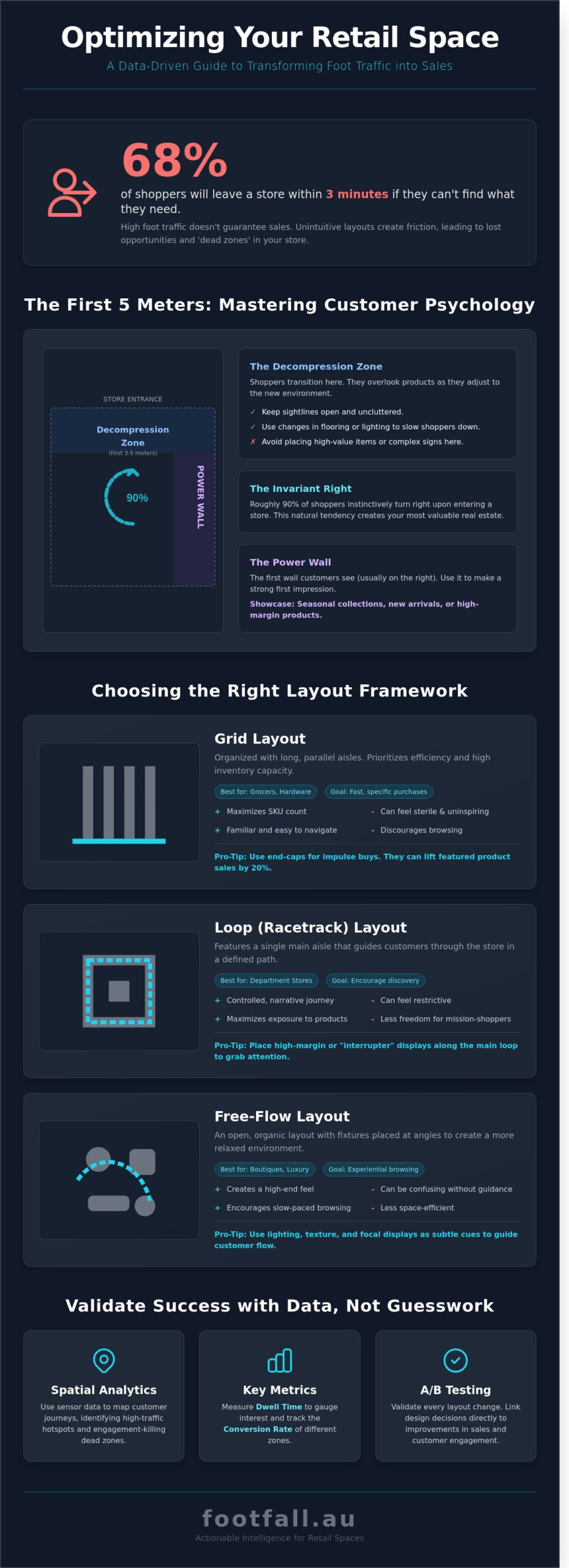
Human biology dictates much of how we navigate commercial environments. Roughly 90% of Australian shoppers instinctively turn to the right after entering a store. This phenomenon, known as the Invariant Right, makes the right-hand wall the most valuable real estate in your building. Successful retailers treat this area as a high-impact “power wall” to showcase seasonal collections or high-margin products. If you’re looking for how to improve retail store layout for 2026, start by ensuring your most compelling brand story begins on the right side of the entrance.
The Decompression Zone: Making the First Impression Count
The first three to five metres of a store constitute the Decompression Zone. Shoppers use this space to transition from the external environment, whether it’s a bustling Sydney street or a busy shopping centre corridor. Placing high-value inventory, security tags, or complex signage here is a tactical error. Customers typically overlook items in this area as their brains process the change in lighting, temperature, and acoustics.
- Visual Transitions: Use distinct lighting levels to signal the shift from the mall to your brand environment.
- Flooring Changes: Transitioning from hard tiles to a softer texture, such as premium wood flooring from Greenhill Timbers, can subconsciously signal the shopper to slow down.
- Open Sightlines: Keep this area clear of bulky displays to allow the customer to scan the entire store and plan their route.
A 2023 study by the Monash Enterprise Centre found that clear, uncluttered entryways reduce initial shopper anxiety, leading to significantly longer browsing sessions.
Understanding the Customer Journey Narrative
Every visitor follows a narrative arc from entry to transaction. This Path to Purchase should feel like a logical progression rather than a confusing maze. Effective design reduces choice paralysis by using clear sightlines and intuitive product grouping that mirrors how people actually live. When shoppers feel lost or overwhelmed by too many options, their cortisol levels rise, often leading to “basket abandonment” in physical spaces. Spatial analytics is the technical process of using sensor data to map these human movements and decode the narrative of the visitor journey. By identifying where shoppers pause and where they accelerate, you can place high-margin “interrupter” displays exactly where they’ll be most effective.
Choosing the Right Framework: Grid, Loop, or Free-Flow?
Selecting a layout framework isn’t just about aesthetics; it’s a strategic decision that dictates how customers interact with your brand. Understanding how to improve retail store layout starts with aligning your floor plan with consumer psychology and operational goals. By 2026, the most successful Australian retailers will move away from “best guesses” and instead use spatial data to determine which framework drives the highest conversion for their specific product mix.
The Grid Layout: Maximising Efficiency and Inventory
The Grid layout is the engine room of high-volume retail. It’s the standard for Australian grocery giants and hardware retailers like Bunnings, where the primary objective is helping customers find specific items quickly. This framework excels at managing a high SKU count while maintaining clear sightlines. However, the risk is creating a sterile “warehouse feel” that discourages browsing. To help differentiate your departments and showcase high-quality items, you can discover TFSE Products Ltd for professional-grade food display and catering solutions that enhance visual appeal.
- Humanise the Aisles: Use varied shelf heights and integrated digital signage to break the visual monotony of long rows.
- Strategic End-Caps: Industry data indicates that end-caps can drive a 20% lift in featured product sales. Use these zones for high-margin impulse buys rather than just clearance items.
- Navigation Logic: Ensure your high-demand “destination” goods are placed at the rear, forcing a journey through the grid that exposes shoppers to more inventory.
The Loop (Racetrack) and Free-Flow Layouts
The Loop layout, often called the racetrack, creates a single, defined path that leads customers through every department. It’s a powerful tool for storytelling and ensuring maximum product exposure, much like the IKEA model. In contrast, the Free-Flow layout is the preferred choice for high-end fashion and luxury boutiques in Melbourne or Sydney. It encourages aimless browsing and creative displays, allowing the customer to set their own pace.
Choosing between these depends on your specific goals for retail footfall analysis Australia. A Loop layout provides predictable traffic patterns that are easy to measure and optimise, while Free-Flow layouts require more sophisticated sensors to understand how visitors move between non-linear displays. If your data shows that customers are rushing to the exit, transitioning a Free-Flow space toward a more structured Loop can help increase dwell time.
Flexibility is the defining requirement for 2026. Retailers are increasingly adopting modular fixtures that allow for rapid reconfiguration. This agility is essential for hosting pop-up events or adjusting to seasonal shifts without a full renovation. If you’re currently optimising your floor plan, consider how easily your chosen framework can adapt to a 30% change in floor stock within a single weekend. Success lies in the balance between a structured customer journey and the freedom to discover something unexpected.
Optimising Customer Flow with Spatial Analytics and Dwell Time
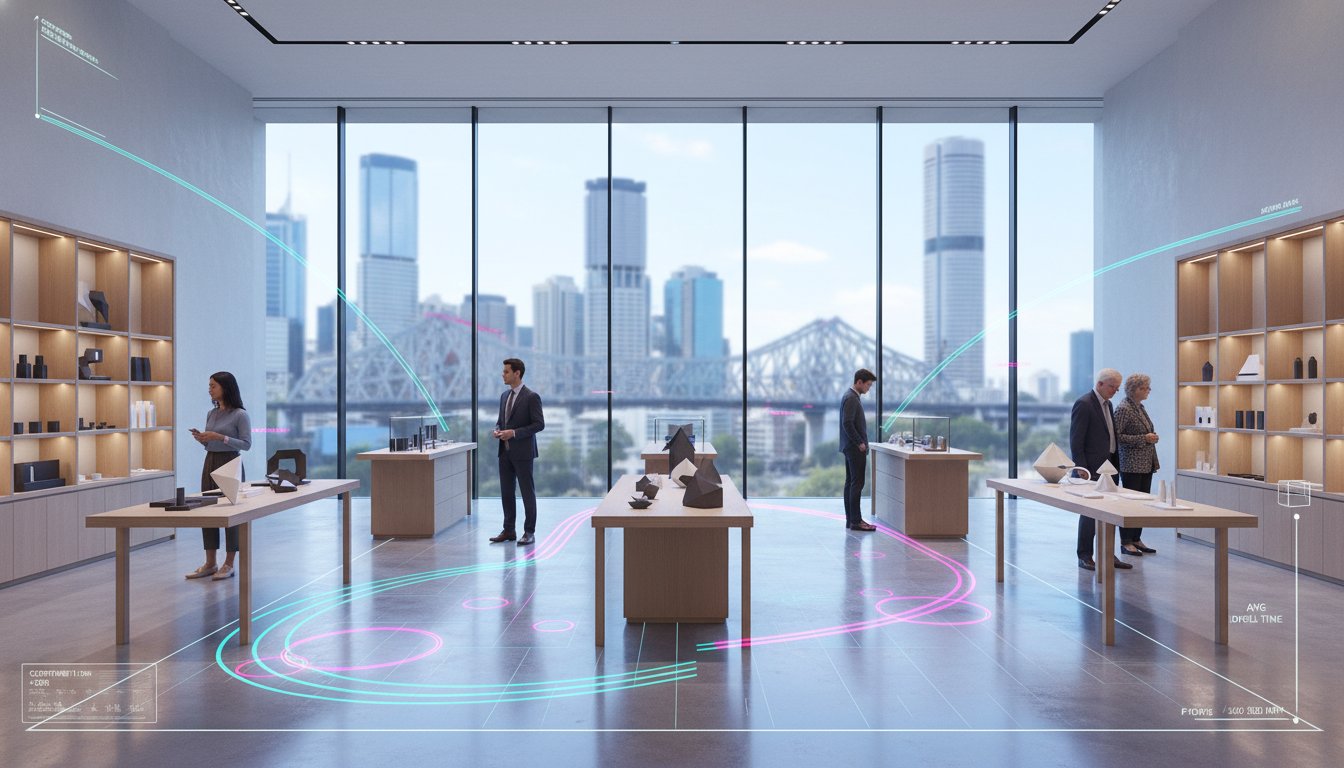
Understanding how to improve retail store layout requires moving beyond aesthetic intuition. Spatial analytics allow you to map the physical journey of every visitor with clinical precision. Through heatmapping, you can distinguish between high-traffic Hotspots and neglected Dead Zones. While a high footfall count in an aisle suggests popularity, heatmaps reveal if customers are merely passing through or actually engaging with the merchandise. This distinction is vital; flow without friction rarely leads to a sale.
Dwell time serves as the ultimate metric for engagement. It measures the exact duration a visitor remains in a specific area. Data shows that a 1% increase in dwell time can lead to a 1.3% increase in total sales. By identifying where customers naturally pause, you can align your highest-value inventory with their natural behaviour. This evidence-based approach removes the guesswork from merchandising, ensuring that your most profitable products occupy your most valuable real estate.
Identifying and Revitalising Dead Zones
Data often reveals that up to 25% of floor space in Australian retail environments goes underutilised. These dead zones are usually found in deep corners or at the end of long, monotonous aisles. You can reactivate these areas by placing destination products, such as essential staples or trending items, at the furthest points of the store. This strategy pulls customers through the entire floor plate. Complement this move with high-contrast LED lighting and clear, eye-level signage. Improving visibility in these cold spots can increase total store yield by 15% without requiring a full renovation.
Leveraging Dwell Time for Increased Basket Size
It’s essential to differentiate between bad dwell, such as waiting in a slow-moving queue, and good dwell, like browsing a curated display. High-margin items should be positioned precisely where good dwell time is highest. Modern people counting technology quantifies these interactions with up to 98% accuracy, providing a clear picture of visitor intent.
When you match dwell data with point-of-sale records, you can determine exactly which displays are converting attention into revenue. If a display has high dwell but low conversion, it’s a sign that the price point or product mix is wrong. This level of granular insight is the most effective way to learn how to improve retail store layout for the 2026 market. Using these metrics allows you to create a seamless journey that encourages deeper exploration and larger basket sizes.
Tactical Layout Improvements to Increase Conversion Rates
Understanding how to improve retail store layout requires a shift from intuition to spatial analytics. Data from 2024 retail studies indicates that 90% of shoppers turn right immediately after entering a store. This makes the right-hand wall, known as the Power Wall, your most valuable real estate for driving high-margin conversions. Beyond the initial entrance, you must manage the pace of the visitor journey. High-velocity shoppers often miss 40% of your inventory because they move too quickly through high-traffic zones.
To counter this, implement the speed bump technique. These are small, low-profile displays positioned just past the transition zone. They break the shopper’s momentum and increase dwell time by up to 20% in key corridors. Integration of digital touchpoints is equally vital for a modern strategy. Positioning click-and-collect stations at the rear of the store forces a full-floor walk-through. Data from the Australian Retailers Association suggests that 35% of click-and-collect users make an additional unplanned purchase when they enter a physical store to pick up an order.
Maximising the Impact of the Power Wall
Your Power Wall should feature your highest-demand or most visually striking inventory to anchor the customer’s attention. Because repeat visitors account for roughly 40% of foot traffic in suburban Australian shopping centres, you’ll need to rotate these displays every 14 to 21 days to maintain engagement. Ensure clear sightlines from the entrance; any obstruction here can lead to a 15% drop in engagement for the items displayed on that primary wall.
Streamlining the Checkout and Exit Journey
Place the checkout at a natural stopping point, typically the front left or the centre of the floor plan. It’s essential to avoid queue anxiety by maintaining a 1.5-metre clearance around all browsing paths. A 2023 industry report found that 73% of shoppers will abandon a purchase if the queue appears to block their exit or creates a bottleneck. Use the final exit path for low-cost, high-frequency impulse items to boost average transaction values by 10% or more.
Validating Layout Success: The Data-Driven Advantage
Modern retail management leaves no room for guesswork. When you consider how to improve retail store layout, the final step isn’t just implementation; it’s validation. You need to prove that moving the footwear section to the back increased dwell time or that a wider entrance boosted foot traffic. Without hard evidence, you’re simply moving furniture. High-performing retailers treat their floor plan as a laboratory where every change is a hypothesis to be tested.
A/B Testing Your Floor Plan
Successful Australian retailers use A/B testing to refine their space. Start by setting a baseline using 30 days of existing footfall data. Change one specific variable, such as the height of a promotional display or the width of a secondary power aisle, and measure the delta over the following four weeks. Comparing week-on-week data helps account for seasonal fluctuations in the Australian market.
Focus on the relationship between Capture Rate and Internal Conversion. Capture Rate measures the percentage of passers-by who enter your store. If this number is high but your retail sales conversion rate remains stagnant, the layout is failing to guide visitors toward a purchase. AI-powered sensors like the FootfallCam Pro2 provide the precision needed to track these micro-movements, giving you real-time feedback on how structural changes influence shopper behavior.
Informing Staffing and Operations through Layout Data
Layout data reveals more than just product performance. It identifies Hotspots where customers naturally congregate. Use spatial analytics to align staff placement with these high-density areas. This ensures assistance is available exactly where it’s needed most, reducing the chance of a lost sale due to lack of service. It’s a strategic way to reduce operational friction by ensuring high-traffic paths remain clear for both staff and customers.
Implementing people counting systems Australia wide allows managers to predict peak periods with high accuracy. When you know a specific aisle becomes a bottleneck every Saturday at 2:00 PM, you can proactively adjust the layout or increase staffing in that zone. This level of insight transforms how to improve retail store layout from a design task into an operational strategy.
The most profitable stores in Sydney and Melbourne don’t view their floor plans as static blueprints. They treat them as living, breathing data sets. By continuously monitoring how people move and interact, you turn your store into a high-performance environment. Data isn’t just a safety net; it’s the engine for consistent growth in a competitive landscape.
Future-Proof Your Retail Strategy Through Precision Analytics
Modern retail in 2026 demands a shift from aesthetic intuition to empirical strategy. Success relies on selecting the right framework, whether it’s a high-efficiency grid or an immersive loop, and then refining that choice through spatial analytics. By monitoring dwell time and heatmaps, you can decode the visitor journey and turn blind spots into high-conversion zones. Understanding how to improve retail store layout is no longer just a creative exercise; it’s a technical requirement for survival in the competitive Australian market. Precise data ensures every fixture and aisle placement serves a measurable purpose.
Leading Australian retailers have relied on our expertise for over 20 years to replace guesswork with evidence-based logic. Our precision AI-driven spatial analytics provide the clarity needed to boost performance across every square metre. With seamless integration into the FootfallCam V9 software, your data becomes an actionable roadmap for long-term growth. It’s time to stop guessing where your customers go and start seeing exactly why they buy.
Optimise your store layout with FootfallCam Pro2 today and build a retail environment that works as hard as you do.
Frequently Asked Questions
What is the best retail store layout for a small shop?
A boutique or free-flow layout is typically the most effective choice for Australian small businesses with less than 150 square metres of floor space. This configuration encourages shoppers to wander and discover items organically, which can increase dwell time by 15% compared to rigid shelf structures. It allows for curated displays that reflect brand identity while maximising every square metre of your footprint without making the space feel cramped.
How often should I change my retail store layout?
You should implement minor visual merchandising updates every 4 weeks and execute a significant strategic layout overhaul every 6 to 12 months. Regular adjustments prevent “store blindness” where repeat customers stop noticing products. Analysis of spatial data often reveals that seasonal shifts in consumer behaviour require a refreshed floor plan to maintain high engagement levels and ensure your stock remains aligned with current demand cycles.
How do I measure the success of a new store layout?
Measure success by tracking changes in your conversion rate and average transaction value alongside spatial analytics like heat maps. If a new layout is effective, you’ll see a direct correlation between increased dwell time in specific zones and a rise in sales per square metre. Use people counters to compare entry traffic against actual purchases to determine if your floor plan is successfully guiding visitors toward the point of sale.
What is a ‘Power Wall’ in retail and where should it be?
A Power Wall is a high-impact display located on the right-hand side of your store, immediately after the decompression zone. Since approximately 90% of Australian shoppers instinctively turn right upon entering a shop, this area serves as your primary real estate for high-margin items or new arrivals. It sets the tone for the entire shopping experience and acts as a critical anchor that draws customers deeper into your retail environment.
Can store layout affect my sales conversion rate?
Your floor plan directly impacts your sales conversion rate by controlling how customers interact with your inventory. Learning how to improve retail store layout through data-driven adjustments can lead to a 20% increase in cross-selling opportunities. By removing physical bottlenecks and placing high-demand items in high-traffic paths, you reduce friction in the buying journey. This strategic placement ensures that more visitors transition from mere browsers to paying customers.
How do people counters help with store layout optimisation?
People counters provide the objective data needed to identify dead zones where customer engagement is low. By monitoring foot traffic patterns, you can see exactly where visitors stop and where they bypass entirely. This intelligence allows you to make evidence-based decisions on where to place promotional displays. It transforms guesswork into a precise strategy, ensuring your most valuable products are positioned in areas with the highest natural visibility.
What are the most common mistakes in retail store design?
Common mistakes include neglecting the decompression zone and creating aisles that are too narrow for comfortable movement. Failing to leave the first 1.5 to 3 metres of the entrance clear forces customers to process too much information too quickly, often leading them to exit prematurely. Additionally, many retailers ignore lighting levels. Inadequate illumination in the back corners of a shop can reduce foot traffic to those areas by as much as 40%.
Is a loop layout better than a grid layout for clothing stores?
A loop layout is generally superior to a grid layout for Australian clothing boutiques because it creates a guided path through the entire collection. While a grid layout works for supermarkets with high SKU counts, a loop encourages a narrative journey that showcases outfits and accessories in a logical sequence. This structure can increase the number of items viewed per visit, directly supporting higher average transaction values and a more cohesive brand experience.