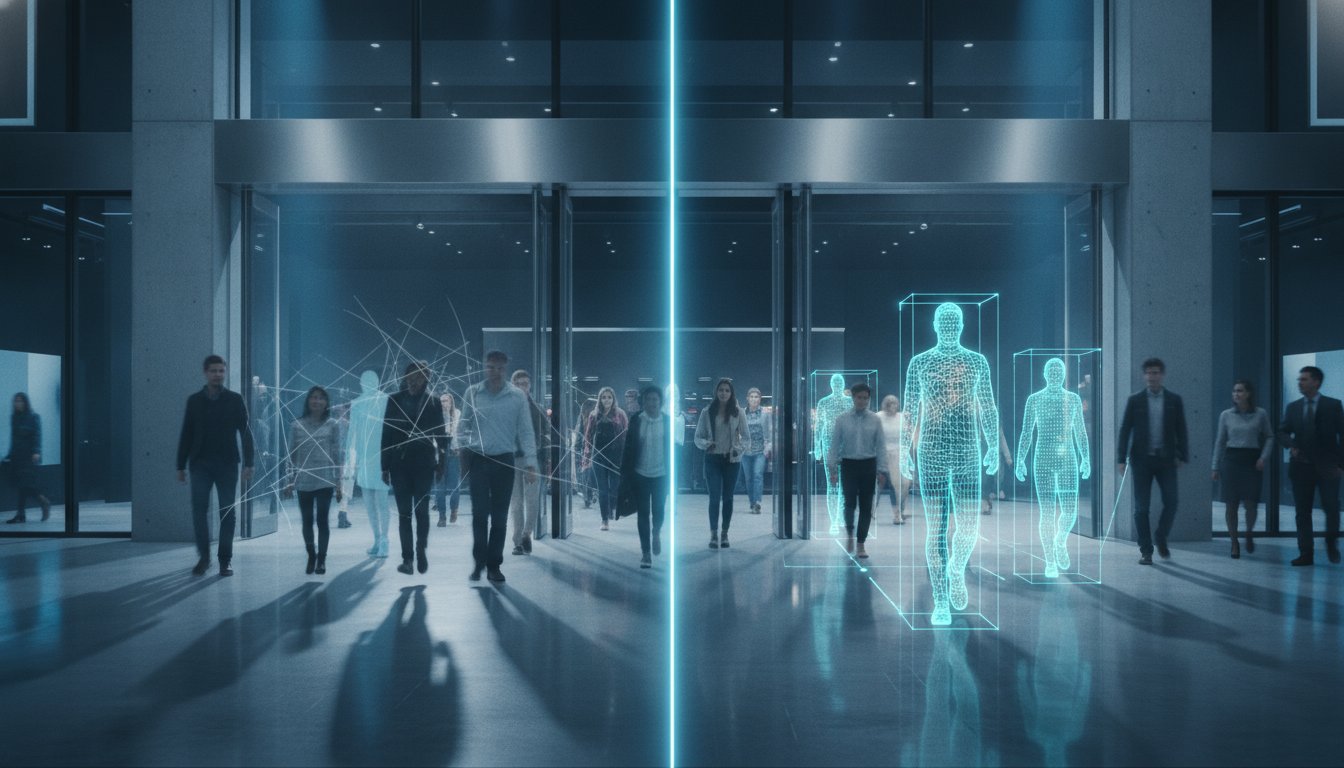
3D People Counter vs 2D: The Definitive 2026 Comparison Guide
If your visitor data is off by even five percent, you aren’t just missing numbers; you’re making strategic decisions based on a fiction. Most retail and facility managers have grown accustomed to a certain margin of error, often accepting that shadows, lighting shifts, or staff movements will inevitably skew their results. You’ve likely felt the frustration of conversion rates that don’t align with reality because your sensors can’t distinguish a human from a reflection. This definitive 2026 comparison of a 3D people counter vs 2D technology clarifies why that gap exists and how to close it for good.
We believe that data is only valuable if it leads to a specific, positive change in your operations. You’ll discover the critical technical and strategic differences that allow 3D depth-sensing systems to reach 98% plus accuracy while automating staff exclusion. We’ll examine the industry shift from simple motion tracking to volumetric intelligence, providing a clear roadmap to ensure your physical environment is measured with the same precision as a digital storefront. This guide provides the empirical evidence you need to move beyond intuition and toward a strategy rooted in high-quality technical solutions.
Key Takeaways
- Understand the fundamental shift from monocular vision to stereo-based volumetric intelligence for superior data precision.
- Identify how 3D sensors eliminate false counts caused by environmental noise like shadows, lighting changes, and side-by-side walking patterns.
- Evaluate the financial impact of a 3D people counter vs 2D when tracking 98% plus accurate conversion rates and automated staff exclusion.
- Discover how to leverage advanced behavioral metrics such as dwell time and heatmapping to optimize physical space utilization.
- Learn about cost-effective transition strategies, including the Legacy Swap Out Plan, to modernize existing infrastructure without total replacement.
What is the Difference Between 3D and 2D People Counting?
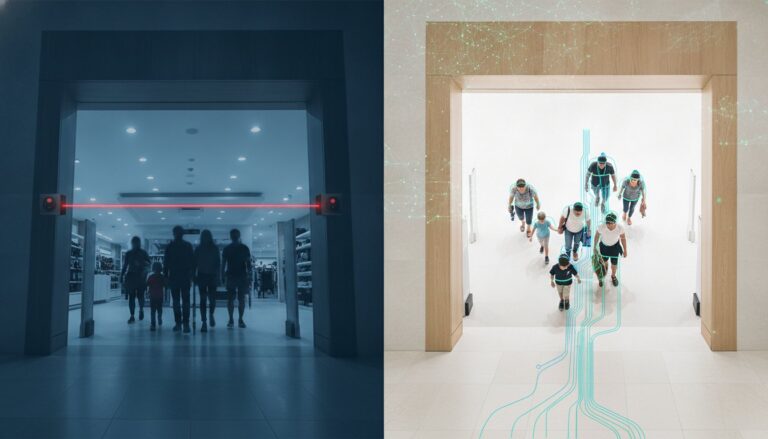
The choice between a 3D people counter vs 2D isn’t merely a matter of hardware cost; it’s a choice between two entirely different ways of perceiving physical space. While older systems viewed your entrance as a sequence of flat, two-dimensional frames, modern sensors interpret the world through volumetric data. This transition from tracking moving “blobs” to measuring specific height and mass is why 3D has become the standard for businesses that require actionable intelligence. The evolution of people counting technologies has moved past simple motion detection toward a sophisticated understanding of human behavior and physical presence.
Understanding 2D Monocular Sensors
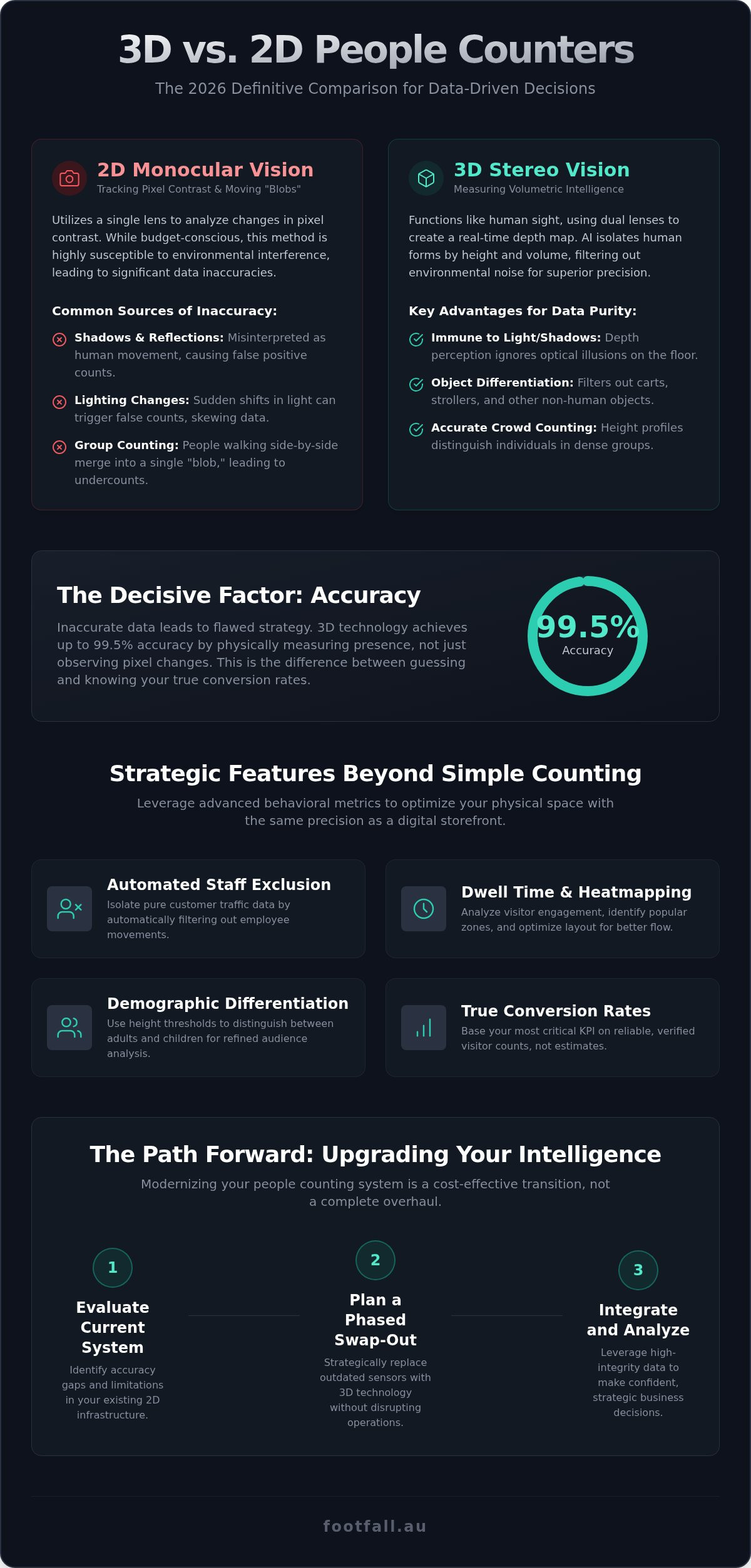
2D monocular sensors, such as the FootfallCam Pro1, utilize a single lens to capture video. The system’s internal algorithms analyze changes in pixel contrast to identify moving shapes against a static background. In controlled environments with consistent lighting and low foot traffic, this technology remains a viable, budget-conscious option for basic occupancy monitoring. However, 2D systems encounter significant hurdles when the environment becomes complex. Because they lack depth perception, they often struggle to distinguish between a human and a shadow on the floor or a reflection in a glass door. This often results in “false counts” that degrade the reliability of your data over time.
The Science of 3D Stereo Vision
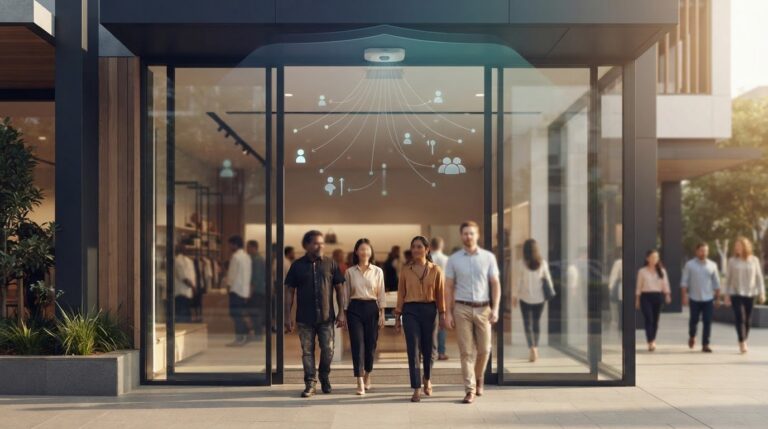
3D stereo vision functions similarly to human sight. By using dual lenses placed a specific distance apart, devices like the FootfallCam Pro2 calculate the distance to every object in their field of view. This binocular perspective allows the sensor to create a 3D depth map in real-time. Advanced AI processing then filters this data to isolate human forms based on their volume and height. This capability is the primary driver behind achieving 99.5% accuracy. It allows the system to ignore non-human objects like shopping carts or strollers and accurately count individuals even in dense crowds where people are walking side-by-side.
In 2026, the demand for precise conversion rate tracking has made 3D the baseline for retail and public sectors. Relying on 2D in high-traffic zones introduces too much environmental noise into your datasets. When your business decisions depend on knowing exactly how many potential customers entered your space, the volumetric intelligence of 3D sensors provides the empirical evidence required for confident management. Moving to 3D ensures that your counts are based on physical presence rather than optical illusions caused by shifting light or floor reflections.
Data integrity depends on a sensor’s ability to reject environmental noise. While the People Counting System Market continues to offer a variety of technologies, the practical gap between a 3D people counter vs 2D becomes undeniable when faced with real-world variables. Most inaccuracies don’t stem from technical failure, but from the inherent limitations of monocular vision when processing complex scenes. For a manager, these errors represent more than just bad stats; they represent missed opportunities and misallocated resources.
Environmental Interference and Lighting
Glass storefronts and polished floors create a landscape of reflections that 2D sensors often misinterpret as movement. Because a 2D camera identifies visitors based on pixel contrast, a shifting shadow or a patch of bright sunlight can trigger a false count. 3D technology bypasses this issue by generating a depth map that ignores light patterns entirely. Volumetric filtering serves as the primary mechanism for isolating physical presence from floor-level optical noise, ensuring the system only records objects with significant height and mass. This allows for reliable data even in environments with floor-to-ceiling windows or high-gloss tiling.
Object and Group Differentiation
One of the most persistent accuracy killers is the crowd effect. In high-traffic environments, individuals walking in close proximity often appear as a single, large “blob” to 2D monocular systems. This leads to an undercount that directly skews your conversion rate metrics. The FootfallCam Pro2 solves this by using stereo vision to draw individual boundaries around each visitor based on their unique height profile. This level of detail allows the system to differentiate between human visitors and non-human traffic with high precision.
- Adults vs. Children: The system applies specific height thresholds to refine demographic data, ensuring children aren’t counted as potential buyers in adult-oriented retail spaces.
- Service Objects: Depth sensing allows the AI to recognize and exclude prams, shopping trolleys, and delivery carts from the final footfall tally.
- Operational Noise: Automated cleaning robots or security drones are easily identified as non-human based on their volumetric signature.
Achieving 99.5% accuracy requires a system that understands the difference between a person and their shadow. If your current reports feel inconsistent during peak hours or sunny days, it’s likely that your 2D sensors are falling victim to these environmental triggers. You can consult with a specialist at Footfall Australia to see how a transition to volumetric counting can stabilize your business intelligence.
Strategic Features: Beyond Simple Counting
The decision between a 3D people counter vs 2D involves more than just selecting a more accurate sensor. It represents a shift from basic volume tracking to sophisticated behavioral analysis. High-level management requires context to turn raw numbers into operational improvements. While 2D systems provide a flat total of movements, 3D technology parses the nuances of human behavior, allowing you to separate meaningful customer interactions from routine operational noise. This layer of “volumetric intelligence” is what transforms a simple counter into a strategic asset for growth and optimization.
Automated Staff Exclusion
Staff movements are perhaps the most common source of data contamination in retail and service environments. Employees entering and exiting for breaks, deliveries, or floor management can inflate footfall figures by 10% to 15% in smaller footprints. This artificial inflation lowers your perceived conversion rate, making your sales team appear less effective than they actually are. Advanced 3D sensors like the FootfallCam Pro2 address this by using precise height thresholds or specialized staff tags to filter out employee movements automatically. By removing these non-buying visits, your conversion rates and KPIs finally reflect the empirical reality of your customer opportunities.
Advanced Analytics: Dwell and Flow
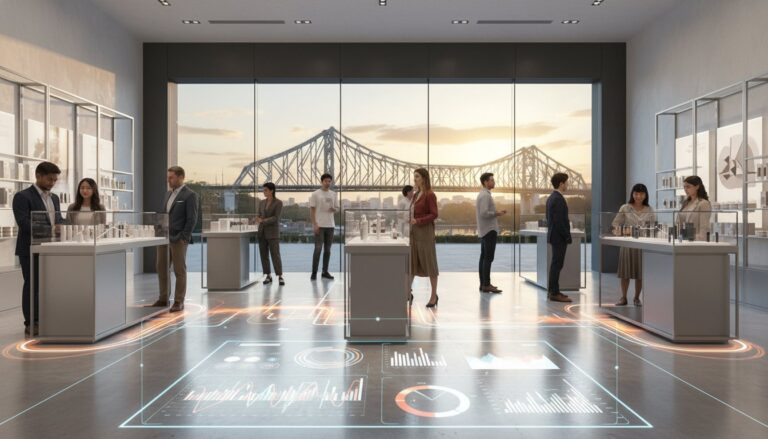
Understanding how people move through a space is as critical as knowing they entered it. 3D spatial data allows for high-fidelity heatmapping and flow analysis that 2D monocular cameras cannot match. Because 3D sensors track individual trajectories in a three-dimensional plane, they can accurately measure engagement time at specific displays or exhibits. This level of detail helps managers identify “dead zones” where traffic stalls or evaluate the effectiveness of a new store layout. Integrating these metrics into the FootfallCam V9 Software dashboard provides a clear narrative of movement, showing you exactly where visitors spend their time and how they interact with your physical environment.
Privacy and compliance also favor 3D depth-sensing technology. Unlike traditional CCTV or 2D cameras that may capture identifiable facial features, 3D sensors generate anonymous depth maps. These maps focus on physical mass and height rather than visual identity, making them inherently more private. This design ensures your business remains compliant with evolving data protection standards while still gaining the deep insights necessary for modern organizational management. By combining this privacy with integrated WiFi tracking to measure “capture rates” (the ratio of passersby to actual visitors), you gain a complete view of your site’s performance without compromising visitor anonymity.
Decision Framework: Which System Does Your Industry Need?
Selecting the right hardware requires a clear alignment between your operational goals and the physical constraints of your environment. While the technical superiority of a 3D people counter vs 2D is evident, the practical application varies significantly across different sectors. Decisions should be rooted in the specific depth of intelligence your organization requires to function efficiently. Whether you are managing a high-volume flagship store or a quiet corporate library, the level of data granularity you choose will dictate the utility of your final reports.
The ROI of Accuracy
In high-traffic retail environments, the financial cost of even a minor margin of error is substantial. If your system is off by just 1%, a store with 10,000 weekly visitors is miscounting 100 potential customers. Over a year, this leads to 5,200 data points of pure fiction. Such discrepancies directly impact staffing schedules, energy management, and marketing evaluation. Relying on 99.5% accurate data from 3D sensors ensures that your labor costs are optimized against real demand. You can explore our detailed breakdown on calculating people counter ROI to understand how these percentages translate into operational savings.
Industry Comparison Table
This table outlines the recommended technology based on the typical requirements of various Australian industries as of 2026.
| Industry | Primary Goal | Recommended Tech | Key Feature Requirement |
|---|---|---|---|
| High-Traffic Retail | Conversion Rate Tracking | 3D (FootfallCam Pro2) | Staff Exclusion & Height Filtering |
| Commercial Office | Desk-Level Optimization | 3D (FootfallCam Pro2) | Fine-Grained Occupancy Sensing |
| Public Libraries | Basic Footfall Totals | 2D (FootfallCam Pro1) | Budget-Friendly Volume Counting |
| Transport Hubs | Mass Transit Flow | 3D (FootfallCam Pro2) | High-Speed Crowd Processing |
Choosing between the FootfallCam Pro1 and Pro2 often comes down to your ceiling height and the complexity of the scene. The Pro1 is an effective solution for standard ceiling heights in low-complexity environments where shadows and reflections are minimal. However, for ceilings exceeding 4 meters or entrances with heavy group traffic, the Pro2’s stereo vision is necessary to maintain data integrity. Transport hubs and museums, which deal with rapid movements and complex group dynamics, require the high-speed processing capabilities of 3D systems to prevent undercounting during peak periods.
If you’re unsure which sensor suits your specific floor plan, our team can provide a tailored assessment of your environment. You can contact Footfall Australia to schedule a technical consultation and ensure your infrastructure is built for long-term accuracy.
The Path Forward: Upgrading Your Intelligence
Modernizing your data infrastructure requires a clear transition strategy rather than a simple hardware replacement. Many organizations currently operate with legacy 2D hardware that, while functional for basic counting, lacks the depth required for 2026 business standards. The decision to shift from a 3D people counter vs 2D is often delayed by concerns over installation complexity or the perceived cost of a total system overhaul. However, the path to volumetric intelligence is more accessible than most managers realize, provided they utilize a structured migration plan designed for scalability.
The Legacy Swap Out Strategy
Identifying the point of diminishing returns for your 2D sensors is the first step toward optimization. When your current system consistently fails to account for the environmental noise or staff movements discussed in previous sections, it has reached its technical limit. We offer a Legacy Swap Out Plan specifically designed to help businesses transition from outdated 2D hardware to FootfallCam Pro2 sensors without the friction of a complete infrastructure rebuild. This plan ensures that your historical data remains relevant while your new counts achieve the 99.5% accuracy required for modern KPIs. Maintaining this level of precision across a national fleet requires a dedicated commitment to People Counter Support to ensure long-term ROI.
Centralized Data with V9 Software
Future-proofing your physical environment involves more than just mounting a sensor; it’s about how that data is processed and presented. The FootfallCam V9 Software serves as a centralized intelligence hub that can manage a hybrid fleet of both 2D and 3D sensors. This allows for a phased rollout where high-traffic flagship stores are upgraded to 3D first, while lower-complexity sites continue using 2D monocular cameras until an upgrade is necessary. For environments where installing new overhead sensors is physically challenging, the FootfallCam Centroid can be integrated to process existing CCTV feeds with AI-driven volumetric logic, breathing new life into your current security infrastructure.
Operating in Australia since 2004, our team understands that data is only valuable if it leads to specific, positive changes in your operations. A national support network ensures that whether you are in a metro hub or a regional center, your hardware remains calibrated and your reporting stays consistent. Moving to a 3D people counter vs 2D isn’t just a technical upgrade; it’s a commitment to empirical evidence and strategic growth. To ensure your organization is prepared for the shifting behavioral trends of the next decade, you should start with a clear understanding of your current system’s limitations. You can contact Footfall Australia for a system audit to begin your transition toward a more accurate and actionable data strategy.
Securing Your Data Integrity for 2026 and Beyond
Accurate data is the foundation of every successful physical environment. The technical gap in a 3D people counter vs 2D directly impacts your ability to track conversion rates and optimize staffing. While 2D systems served an earlier era of basic volume tracking, the complexity of modern retail and public spaces demands the 99.5% accuracy provided by the FootfallCam Pro2. By filtering out environmental noise and automating staff exclusion, you ensure your decisions are backed by empirical evidence rather than intuition.
Transitioning to higher intelligence doesn’t have to be a disruptive process. Our Legacy Swap Out Plans allow you to modernize your infrastructure while maintaining continuity in your reporting. With Australian-based support since 2004, we provide the localized expertise needed to maintain data integrity across your entire network. It’s time to move beyond simple motion tracking and embrace the volumetric intelligence your business deserves. Request a Tailored People Counting Quote for Your Business to begin optimizing your operations with confidence.
Frequently Asked Questions
Is a 3D people counter more accurate than a 2D one?
Yes. 3D counters like the FootfallCam Pro2 reach up to 99.5% accuracy by using stereo vision to perceive depth. Unlike 2D systems that rely on flat images, 3D sensors distinguish between human mass and environmental noise like shadows or reflections. This makes a 3D people counter vs 2D the superior choice for high-traffic zones where precision is non-negotiable for conversion tracking.
Does a 3D people counter use a camera for recording?
No, these devices don’t record or store video footage. While they use dual lenses to perceive the environment, the onboard processor converts visual data into anonymous coordinates or depth maps in real-time. This ensures that your business gains deep behavioral insights without ever capturing or transmitting identifiable personal imagery, maintaining a strict focus on movement statistics rather than surveillance.
Can 3D people counters work in total darkness?
Most stereo-vision 3D sensors require a minimum level of ambient light to function, much like human eyes. However, many modern units include built-in infrared sensors to maintain high accuracy in low-light or variable lighting conditions. If your space operates in complete darkness, specialized Time-of-Flight sensors or thermal technology would be the recommended alternative to standard stereo vision.
What is the typical installation height for a 3D sensor?
Standard 3D sensors are typically installed at heights between 2.1 and 4.5 meters for optimal coverage. For environments with higher ceilings, such as transport hubs or large atriums, specialized lenses can extend this range up to 10 meters. It’s vital to match the lens type to your specific ceiling height to ensure the depth-sensing algorithms remain accurate across the entire entrance width.
Do I need to replace my existing 2D system entirely?
You don’t have to replace every sensor at once. Many organizations use a hybrid approach through a Legacy Swap Out Plan, prioritizing 3D upgrades for high-volume entrances while retaining 2D sensors in low-traffic areas. You can also use the FootfallCam Centroid to apply AI processing to existing 2D CCTV feeds, improving data quality without the immediate need for new hardware installations.
How does 3D technology handle staff exclusion?
3D technology identifies staff members by using height thresholds or specialized wearable tags. Because the sensor measures the physical volume of every individual, it can automatically filter out anyone who doesn’t fit the visitor profile or anyone wearing an exclusion tag. This process ensures that your conversion rates and footfall totals reflect actual customer opportunities rather than internal operational movements.
Is 3D people counting data GDPR and privacy compliant in Australia?
Yes, 3D people counting is inherently privacy-compliant because it generates anonymous depth maps. Since the system doesn’t rely on facial recognition or capture identifiable features, it falls outside the scope of personal data regulations. This allows Australian businesses to gather sophisticated behavioral data while fully adhering to both local privacy laws and international GDPR standards for visitor anonymity.
What is the cost difference between 2D and 3D hardware?
A 3D people counter vs 2D monocular camera typically involves a higher upfront hardware investment due to the dual-lens setup and advanced AI processing. However, the increased accuracy and automated features like staff exclusion often result in a faster ROI. Reliable data prevents the costly mistakes associated with overstaffing or misinterpreting marketing success based on the inaccurate figures often produced by 2D systems.