
Centralised Retail Analytics Platform: The 2026 Guide to Unifying Store Intelligence
Retailers utilizing advanced analytics are currently seeing a 2-3% increase in revenue and a 15-20% reduction in inventory carrying costs compared to those relying on static reports, according to McKinsey & Company. Despite these clear advantages, many operations still lose over 20 hours each week to manual data exports and fragmented spreadsheets. If your team is struggling with inconsistent metrics across departments, it’s time to transition to a centralised retail analytics platform. This shift moves your organization away from reactive guesswork toward a model of empirical certainty where every store movement is accounted for.
You likely recognize that data is only valuable if it leads to a specific, positive change in your daily operations. We understand the frustration of having no real-time visibility into store performance while digital insights remain siloed from physical foot traffic. This guide will show you how to bridge that gap, creating a single source of truth that automates reporting and aligns staff for better sales conversion. We’ll explore the strategic implementation of FootfallCam Analytic Manager V9 and other intelligent systems to transform human behavior into a clear operational advantage.
Whether you are optimizing a high-traffic retail store or a specialized wellness center like Revix Clinic, the ability to translate human behavior into actionable insights is the key to maintaining a competitive edge in 2026.
Key Takeaways
- Unify IoT sensors, POS data, and staff schedules to transition from simple data collection to strategic operational execution.
- Bridge the gap between physical store movements and digital insights using a centralised retail analytics platform that adheres to strict privacy standards.
- Identify the metrics that drive actual ROI, focusing on how store layout effectiveness influences dwell time and bounce rates.
- Determine your organizational maturity stage to decide whether descriptive or predictive analytics will best serve your 2026 growth strategy.
- Discover how integrating hardware like the FootfallCam Pro2 with the V9 Software ecosystem creates a reliable, single source of truth for your business.
What is a Centralised Retail Analytics Platform?
A centralised retail analytics platform is a unified ecosystem that aggregates data from IoT sensors, Point-of-Sale (POS) systems, and staff schedules into a single operational interface. In 2026, the industry has shifted from passive “data collection” to active strategic execution. It’s no longer sufficient to simply count heads at the door. Modern retailers require a system that interprets the “Narrative of Movement,” treating physical presence not as a set of cold statistics, but as a sequence of human actions that reveal intent and preference.
Spreadsheets are the primary enemy of retail growth and scalability. When your management team spends over 20 hours each week manually exporting data and reconciling inconsistent metrics, they’re trapped in a reactive cycle. Centralisation replaces this manual friction with empirical evidence. It allows you to see your customers as people navigating a space, providing the logic needed to back every operational decision with hard evidence rather than intuition.
The Core Components of a Unified System
Building an intelligent environment requires a seamless connection between hardware and software. A robust platform relies on three critical layers to ensure data utility:
- Edge computing hardware: AI-powered sensors like the FootfallCam Pro2 process data locally. This ensures high accuracy while maintaining privacy by only transmitting anonymised metadata to the cloud.
- The Central Hub: FootfallCam V9 Software acts as the brain of the operation. It transforms raw data into intuitive reporting, allowing users to visualise complex behavioral trends across multiple locations.
- Integration layers: Connecting legacy systems is vital for a true “single source of truth.” The FootfallCam Centroid serves as this bridge, allowing older IP cameras and existing infrastructure to feed into the modern centralised retail analytics platform.
Why Australian Retailers are Centralising Now
Managing national store networks across vast distances presents unique geographic challenges. Whether you’re overseeing sites in Perth, Sydney, or Brisbane, centralisation provides real-time visibility without the need for constant travel. It’s about maintaining a consistent standard of intelligence across every square metre of your retail footprint.
Rising labor costs also drive this shift. Retailers can’t afford to overstaff during quiet periods or lose sales due to understaffing during peak footfall. By using data-driven staff optimisation, organisations can align their human resources with actual shopper demand. This creates a more efficient environment where staff are positioned exactly where they can most effectively influence conversion rates and customer satisfaction.
The Architecture of Modern Retail Intelligence
Modern retail success depends on the seamless handshake between physical hardware and cloud-based intelligence. Many software-only solutions fail because they lack a direct connection to the “last mile” of data, which is the actual customer moving through your store. A robust centralised retail analytics platform bridges this gap by ensuring that every sensor and software layer communicates in real-time. This structural integrity is what allows for a truly smarter retail business, where digital insights are backed by physical reality.
Data security remains a primary concern for Australian organisations. Navigating local standards requires a commitment to anonymised counting, ensuring that no personally identifiable information is ever stored or transmitted. By processing data at the edge, your infrastructure can remain compliant while providing the deep behavioral insights needed to scale from a single boutique to a national chain. This architecture also eliminates the 20-hour weekly manual data pull. Automated reporting replaces tedious exports, allowing your team to focus on strategic execution rather than spreadsheet management.
Sensor-to-Cloud Workflow
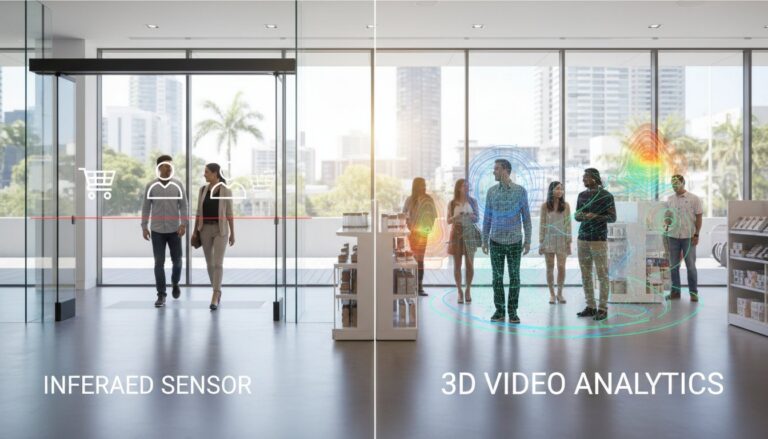
The journey from a customer entering a store to an actionable insight on a dashboard is instantaneous. Hardware like the FootfallCam Pro2 processes video data locally to achieve 99.5% accuracy. This edge computing approach means only metadata is sent to the cloud, reducing bandwidth and enhancing security. Real-time transmission allows managers to make immediate decisions, such as opening a new register during an unexpected surge. The system utilizes advanced AI filtering to exclude staff members and non-human objects like shopping carts from the final count, providing a clean dataset of actual customer visits. Exploring these integrated analytics solutions can help you identify exactly where these operational efficiencies lie.
Unifying Legacy Systems with FootfallCam Centroid
You don’t always need to replace your entire infrastructure to gain advanced insights. The FootfallCam Centroid allows you to upgrade existing CCTV cameras into an AI-driven analytics powerhouse. This significantly reduces the total cost of ownership by leveraging current hardware for sophisticated footfall analysis. By integrating a centralised retail analytics platform with your legacy systems, you create a unified narrative of movement across all locations, regardless of the hardware age. This approach ensures that every department, from marketing to operations, works from the same empirical evidence.
Key Metrics That Drive Retail ROI in 2026
In the current retail environment, descriptive data that merely tells you what happened yesterday is no longer sufficient. Strategic growth now relies on predictive analytics, allowing you to anticipate what will happen tomorrow. A centralised retail analytics platform provides the necessary infrastructure to move beyond basic reporting into high-level operational intelligence. By focusing on specific, evidence-based metrics, you can transform your store from a passive space into a high-performing environment where every square metre is optimised for revenue.
Sales conversion rate remains the ultimate KPI for retail health. It’s the most accurate measure of how effectively your store environment, product mix, and staff performance come together to drive a transaction. However, understanding the why behind your conversion rate requires looking at dwell time versus bounce rate. If customers are entering but leaving within two minutes, your storefront or initial layout may be failing to capture interest. Conversely, high dwell time with low conversion often indicates a friction point in the service model or checkout process. These insights allow for precise, logical adjustments to the store layout that intuition alone cannot provide.
The Power of Integrated Sales Data
Footfall data alone only tells half the story of your store’s performance. To unlock the full narrative, you must merge visitor counts with your transaction data. This integration allows you to calculate true conversion rates across different times of the day, week, or season. By viewing your data through a centralised retail analytics platform, you can identify if a dip in sales is due to a lack of traffic or a failure to convert the visitors already present. For a deeper look at how this applies locally, you can explore this guide on Retail Footfall Analysis in Australia. This empirical approach ensures that marketing spend is directed toward the right problem, whether that’s driving more traffic or improving the in-store experience.
Operational Efficiency and Staffing
Staffing is often a retailer’s most expensive resource, yet it’s frequently managed through guesswork. Using traffic patterns to create smarter rosters ensures that your staff-to-customer ratio is always balanced. You can identify “Power Hours”—those specific windows where footfall peaks and every additional staff member adds maximum value to the conversion rate. Queue analytics further refine this efficiency by highlighting when wait times begin to lead to abandoned purchases. By 2026, as agentic AI begins to power more retail applications, the ability to autonomously adjust staffing or inventory based on these predictive peaks will become a standard competitive advantage. Aligning your human resources with actual human movement creates a more responsive, profitable operation.

How to Choose and Implement Your Platform
Selecting the right centralised retail analytics platform requires a clear understanding of your organizational maturity. You must determine if your team is ready for predictive intelligence or if you’re still establishing a descriptive foundation. A descriptive approach focuses on what happened, while a predictive model uses historical human movement patterns to forecast future needs. Transitioning between these stages shouldn’t require a total system overhaul, so choosing a scalable architecture from the outset is essential for long-term growth.
Data accuracy is the most critical factor in this decision. A system that provides 90% accuracy is often worse than having no system at all. When metrics are off by 10%, your team loses trust in the evidence, reverting to intuition-based decisions that lead to staffing errors and lost revenue. You need empirical certainty to drive operational changes. Ensure any hardware you deploy, such as the FootfallCam Pro2, is verified for 99.5% accuracy across diverse lighting and environmental conditions to maintain the integrity of your single source of truth.
Evaluate the Total Cost of Ownership (TCO) beyond the initial purchase price. This includes hardware, software licenses, and ongoing maintenance. Many retailers are caught off guard by high recurring monthly fees that erode the ROI of their analytics investment. Consider platforms that offer perpetual licenses or flexible support tiers like our Basic and Premium Support Plans. For those with existing infrastructure, a Legacy Swap Out Plan can provide a cost-effective path to modernise your network without discarding previous investments.
Avoiding Common Implementation Failures
Dashboard fatigue is a significant risk when centralising data. If your platform provides too many metrics without clear utility, your management team will eventually ignore the reports. Focus on a “less is more” approach by highlighting actionable insights that lead to specific changes. Team adoption is equally vital. You must train staff to use data for daily decisions, such as adjusting break schedules during unexpected traffic surges. Supporting your team through these shifts in operational culture is essential, and resources like The Health Play Collective can help recharge and align professional teams during such transformative periods. Finally, verify the Service Level Agreements (SLA) for integration maintenance. The hidden cost of a centralised retail analytics platform often lies in the labor required to keep disparate systems talking to each other.
Selecting the Right Hardware-Software Mix
Deciding between dedicated sensors and AI-enhanced CCTV depends on your specific environment and budget. Dedicated hardware like the FootfallCam Pro2 offers the highest precision for entrance counting. However, using the FootfallCam Centroid to add AI layers to your current cameras is a strategic way to gain heatmaps and dwell time data with lower upfront costs. This balance ensures you get the technical implementation you need without unnecessary complexity. For a deeper dive into these options, consult our People Counting Technology guide to understand which sensor mix aligns with your 2026 objectives.
Footfall Australia: Your Partner in Centralised Intelligence
Footfall Australia brings over 20 years of specialized experience to the Australian retail landscape. We don’t rely on intuition or guesswork. Instead, we provide the empirical evidence necessary to manage complex store environments with quiet confidence. Our approach is deeply rooted in data-driven logic, ensuring that every operational decision you make is backed by high-quality technical solutions. By deploying a robust centralised retail analytics platform, we help you transform raw human movement into a strategic advantage.
Our integrated ecosystem starts with industry-leading hardware. The FootfallCam Pro2 People Counters provide the 99.5% accurate data required to understand the narrative of movement within your stores. This information flows seamlessly into the FootfallCam V9 Software, which serves as the central hub for your entire organization. This unified system ensures that your data isn’t just collected, but utilized to drive specific, positive changes in your daily operations across all national locations.
Many retailers are concerned about the technical debt associated with older systems. Our Legacy Swap Out Plan is designed specifically to address this pain point. It allows you to future-proof your existing infrastructure by transitioning fragmented legacy systems into a modern, centralised retail analytics platform. This ensures your investment remains sustainable and scalable, providing a reliable foundation for your 2026 growth strategy without requiring a total “rip and replace” of every existing asset.
Why FootfallCam V9 is the Strategic Choice
The FootfallCam V9 Software ecosystem is designed for organizational clarity. It features customisable dashboards tailored to different roles, ensuring that marketing teams see dwell time while operations managers focus on staff-to-customer ratios. The platform offers seamless integration with third-party POS and ERP systems, creating that essential single source of truth. Automated AI insights work in the background to highlight anomalies and opportunities, such as identifying a store that is consistently underperforming despite high footfall, allowing for immediate corrective action.
Next Steps: From Data to Action
Transitioning from fragmented spreadsheets to unified intelligence begins with a clear map of your current retail data ecosystem. We recommend starting with a comprehensive site audit to evaluate your current data accuracy and identify gaps in your visibility. This objective assessment provides the baseline needed to build a high-performing, data-driven environment. It’s time to move away from intuition and toward a model of empirical certainty.
Consult with our retail analytics experts today to begin your journey toward a more efficient and profitable retail operation.
Master Your Store Intelligence for 2026 and Beyond
Implementing a centralised retail analytics platform is the definitive step toward operational maturity. By consolidating physical footfall with digital performance metrics, you move beyond the limitations of manual spreadsheets and fragmented reporting. This unified approach provides the empirical evidence needed to align staffing levels with actual customer demand, ensuring that every square metre of your retail space is optimized for conversion. You’ve seen how the right architecture and metrics can turn passive data into active strategic execution.
Footfall Australia has remained a trusted partner for Australian retailers since 2004, providing national installation and maintenance support across the country. Our technology, including the FootfallCam Pro2 with its 99.5% accuracy, ensures that your strategic decisions are always backed by reliable data. You now have the roadmap to bridge the gap between human movement and business outcomes with confidence.
Request a Demo of the FootfallCam V9 Platform to discover how a single source of truth can empower your organization. We’re ready to help you transform your data into a sustainable competitive advantage.
Frequently Asked Questions
What is the difference between a retail analytics platform and a POS system?
A POS system records what was sold and when, but a centralised retail analytics platform explains the human behavior leading to that transaction. While the POS captures financial totals, the analytics platform tracks visitor counts, dwell time, and bypass rates. Combining these datasets allows you to understand your true sales conversion rate by comparing the number of people who entered with the number of completed purchases.
How does a centralised platform handle data from multiple store locations?
The platform aggregates real-time metadata from every branch into a unified cloud hub for side-by-side performance analysis. You can filter data by region, store size, or specific time periods to identify high-performing locations and those requiring operational adjustments. This structure ensures that management teams maintain a consistent single source of truth across a national network without needing to visit each site physically.
Can I integrate my existing security cameras into a retail analytics platform?
You can integrate existing CCTV infrastructure by using the FootfallCam Centroid to add AI-driven processing to your current video feeds. This hardware acts as a bridge, transforming legacy cameras into intelligent sensors that track footfall and heatmaps. This approach significantly reduces the total cost of ownership while modernising your retail intelligence capabilities without requiring a full hardware replacement.
Is customer privacy protected in these centralised systems?
Customer privacy is protected through edge computing, where all video processing occurs locally on the device rather than in the cloud. The system only transmits anonymised metadata, such as counts and movement patterns, ensuring that no personally identifiable information is ever stored. This methodology adheres to strict privacy standards, allowing you to gather deep behavioral insights while maintaining complete shopper anonymity.
What is the typical ROI timeframe for a retail analytics implementation?
Most retailers observe a measurable return on investment within 6 to 12 months following a full implementation. This ROI is driven by improved staff alignment during peak hours and a reduction in inventory carrying costs. By using a centralised retail analytics platform to identify and fix conversion friction points, organizations often see immediate gains in sales efficiency that quickly offset the initial hardware costs.
Do I need a dedicated data scientist to use FootfallCam V9 software?
You don’t need a dedicated data scientist because the FootfallCam V9 software is designed with an intuitive, user-friendly interface. The platform automates complex calculations and presents them through clear, actionable dashboards tailored to specific organizational roles. This ensures that store managers and regional directors can interpret traffic trends and make data-driven decisions without specialized technical training.
How accurate is the data in a centralised retail analytics platform?
Data accuracy reaches 99.5% when utilizing high-performance sensors like the FootfallCam Pro2. These devices use 3D stereoscopic vision and AI filtering to distinguish between customers, staff, and non-human objects such as shopping carts. Maintaining this level of precision is essential for building organizational trust in the metrics and ensuring that operational changes are based on empirical facts.
What happens if our internet connection goes down at a store location?
If your internet connection fails, the hardware continues to process and store data locally on its internal memory. Once the connection is restored, the device automatically uploads the cached metadata to the central server without any data loss. This ensures your centralised retail analytics platform reporting remains continuous and accurate, even in locations with unstable network infrastructure or during temporary outages.