
People Counter for Public Libraries: The 2026 Strategic Guide
In 2023, combined physical and digital library visits across Australia surged by 35 percent, yet many facilities still rely on manual clickers or “gut feel” to report these numbers to council stakeholders. Implementing a modern people counter for public libraries is no longer just about tracking foot traffic. It’s about translating physical presence into the empirical evidence needed to secure your next budget cycle. You understand the frustration of trying to justify staffing levels or facility upgrades when your data feels incomplete or anecdotal. Relying on labor-intensive manual counts often leads to inaccuracies that undermine your strategic goals and leave staff stretched thin during unexpected peak periods.
This 2026 guide will show you how to transform basic headcounts into actionable intelligence that optimizes space and proves community impact. We’ll explore the transition from simple entry tracking to sophisticated zone-based analytics and automated reporting designed for the modern Australian landscape. By the end of this article, you’ll know how to leverage high-accuracy visitor data to streamline operations and ensure your library remains a well-funded, vital hub for its patrons.
Key Takeaways
- Moving from simple headcounts to “space-as-a-service” analytics provides the empirical evidence needed for modern library management.
- Different architectural layouts require specific sensors. Learn which technologies excel in grand foyers versus narrow branch entrances.
- Implementing a people counter for public libraries allows for precise zone-based tracking to identify underutilised areas and optimize staff scheduling.
- Data integrity is paramount. We explain how to balance high-accuracy pedestrian analytics with strict patron privacy standards.
- Discover how automated reporting through the FootfallCam Pro2 transforms raw movement into the strategic insights required by council stakeholders.
Why Simple Headcounts are No Longer Enough for Modern Libraries
Public libraries in Australia have transitioned from traditional book-lending repositories into dynamic community hubs. This shift toward a “space-as-a-service” model means that success is no longer measured solely by circulation numbers or the size of a physical collection. Instead, the value of a library is increasingly defined by how its physical environment is utilised for study, digital access, and community connection. Relying on outdated metrics or anecdotal evidence fails to capture this complex narrative. A modern people counter for public libraries provides the empirical foundation required to prove that these spaces are essential infrastructure rather than discretionary services.
Accurate footfall data allows library managers to speak the language of local councils and state government stakeholders. When you can demonstrate precisely how many residents use a facility at 10:00 AM on a Tuesday versus a Saturday afternoon, you move from intuition to evidence-based strategy. This level of transparency is vital for securing operational funding and capital grants in an environment where every dollar is scrutinised.
The Inaccuracy of Manual and Legacy Systems
Many branches still depend on staff-led manual counting or basic infrared beam sensors to track attendance. These methods are fundamentally flawed. Manual counting processes carry a high margin of error, as staff members naturally prioritise patron assistance over clicking a counter during peak periods. Additionally, legacy beam systems often fail to distinguish between a single patron and a group entering together. They can’t differentiate between an adult and a child or filter out staff movements. Different people counting technologies, such as video-based AI sensors, have evolved to solve these specific challenges by providing over 98 percent accuracy. Beyond the data gaps, the hidden labor costs of manual entry and data reconciliation represent a significant drain on limited library budgets that could be better spent on community programming.
Data as the Foundation for Funding Justification
Empirical visitor data creates a compelling “narrative of value” for stakeholders. It isn’t enough to say a library is busy; you must prove it with granular, time-stamped reporting. High-fidelity data allows you to identify trends, such as the growing demand for quiet study zones or the success of a new makerspace. By integrating a people counter for public libraries, you generate the automated reports necessary for council meetings without the administrative burden. This approach aligns with the broader strategic insights found in the ultimate guide to people counting, which emphasises that data is only valuable if it leads to positive operational change. Precise metrics ensure that funding requests for increased staffing or facility upgrades are backed by a clear, undeniable record of community need.
Comparing Counting Technologies for Library Environments
Choosing the right people counter for public libraries depends on your building’s physical architecture and the specific metrics you need to capture. While legacy Passive Infrared (PIR) sensors were once common, they’re largely unsuitable for modern strategic planning. They can’t distinguish between multiple people walking side-by-side or filter out non-human movement. Today, the choice typically lies between AI Stereo Vision and Time-of-Flight (ToF) technologies. Each offers distinct advantages based on the environment.
AI Stereo Vision: The Precision Standard
The FootfallCam Pro2 represents the benchmark for high-traffic library entries. It uses dual-lens technology to create a 3D depth map of the entrance area. This allows the system to accurately filter out inanimate objects like book trolleys, strollers, and automatic doors. These items frequently trigger false counts in simpler systems. For libraries focused on youth engagement, this technology is particularly valuable. It can differentiate between adults and children based on height. This provides clear data on how many families are visiting your children’s wings or attending school holiday programs. It’s a level of detail that simple beam counters simply cannot match.
ToF and Radar: When Privacy or Lighting is a Concern
Time-of-Flight sensors calculate distance by measuring the time it takes for a light pulse to bounce off a person. These systems are excellent for internal zones where lighting might be inconsistent or dimmed for archival protection. Radar-based systems offer a different benefit. They provide total anonymity by tracking movement as “pings” rather than visual shapes. While AI vision is superior for grand foyer entries with high ceilings, ToF or radar might be better suited for sensitive areas. These include quiet study zones or private meeting rooms where patrons expect a higher degree of perceived privacy. If you are managing multiple branches with varying architectural styles, exploring advanced sensor options can help you find a unified software solution.
Installation complexity is another critical factor. This is especially true for Australia’s many heritage-listed library buildings. Most modern systems utilize Power over Ethernet (PoE). This combines power and data into a single cable. It significantly reduces the need for invasive electrical work in older structures. Most devices are low-profile and discreet. They blend into the ceiling to maintain the aesthetic integrity of the space. AI verification is often the deciding factor for administrators. It allows you to visually audit the accuracy of the data without storing personally identifiable information. This balance of transparency and privacy is the foundation of a successful long-term deployment.
Strategic Applications: Optimising Space and Justifying Budgets
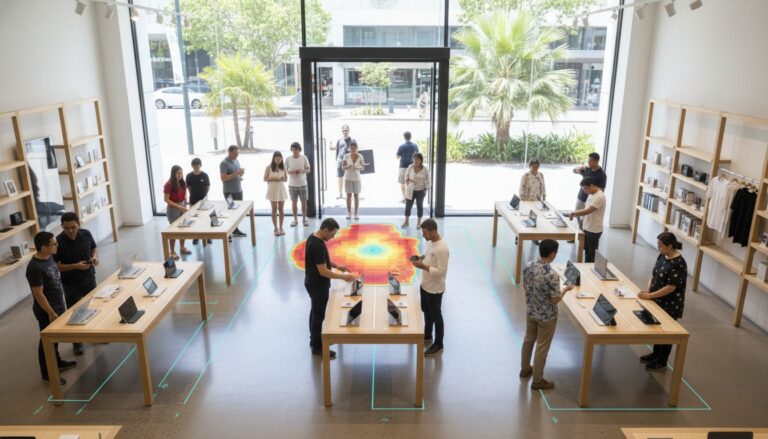
While entrance figures provide a high-level overview, the true strategic power of a people counter for public libraries lies in internal zone analytics. Modern library management requires understanding how patrons interact with specific micro-environments, such as computer labs, quiet study pods, or makerspaces. By shifting focus from the front door to these internal zones, administrators can identify which services are over-capacity and which are underutilised. This granular approach to footfall data analysis ensures that every square metre of the facility is working toward the library’s mission. Similar to the logic used in visitor counting for museums, these insights allow for a sophisticated interpretation of human movement within shared public assets.
Real-time occupancy data also offers a direct benefit to the patron experience. By displaying live capacity levels on digital signage or the library website, you empower students and remote workers to choose the best time for their visit. This level of transparency reduces friction and ensures that quiet study areas don’t become overcrowded, maintaining the high standard of service that Australian communities expect from their local branches.
Managing Peak Hours and Staff Allocation
Data allows you to align staff rosters with actual visitor arrivals rather than relying on traditional, static hours. If the data shows a consistent surge in visitors at 3:30 PM on weekdays, you can adjust shifts to ensure adequate support is available for the after-school rush. Conversely, identifying “dead zones” or low-traffic periods helps you rethink floor plans or the placement of popular collections. You can also use these insights to schedule essential maintenance and cleaning. By performing these tasks during documented low-traffic windows, you minimise disruption to patrons and ensure the facility remains in top condition without compromising service delivery.
Measuring the Success of Library Programs
Public libraries host a diverse range of community workshops, author talks, and seasonal events that require significant resources. A people counter for public libraries provides the hard evidence needed to evaluate these programs. You can track the footfall impact of a specific event and compare the “dwell time” in that section against typical daily averages. If a new children’s display leads to a 20 percent increase in dwell time within the youth wing, you have empirical proof of its effectiveness. This evidence is crucial when reporting to council stakeholders, as it transforms qualitative success into quantitative results that support future program funding and resource allocation.

Ensuring Data Integrity: Accuracy, Privacy, and National Standards
Maintaining patron trust is the cornerstone of any public institution. When implementing a people counter for public libraries, the primary concern is often whether the technology infringes on individual privacy. It’s vital to distinguish between people counting and CCTV surveillance. CCTV is designed for security and records identifiable visual footage for later review. In contrast, professional people counting systems are designed for analytics; they interpret human shapes to generate numerical data without recording or storing images of individuals. This distinction ensures the library remains a safe, anonymous space for all community members.
This technical distinction is crucial for complying with Australian Privacy Principles. By utilizing edge computing, modern sensors process video data locally on the device itself. The visual information is converted into anonymous data points in real-time. The original video is never transmitted to the cloud or stored on a hard drive. This “Privacy by Design” approach ensures that your facility meets the rigorous requirements described in our guide to people counting systems Australia, providing peace of mind for both library boards and the general public.
For Australian library managers, these systems offer a streamlined way to meet reporting standards set by the Australian Library and Information Association (ALIA). Precise, automated data ensures that your annual reports to state bodies and local councils are accurate and defensible. If you’re looking to upgrade your current infrastructure, consulting with a specialist in library analytics can help you navigate these compliance requirements while maximizing data utility.
The Privacy-by-Design Framework
Professional AI counters use sophisticated algorithms to identify human movement patterns. They don’t employ facial recognition technology, meaning they cannot identify specific patrons or track individuals across different visits. To maintain community trust, we recommend placing clear, transparent signage near entrances. This informs visitors that anonymous counting is in place for the purpose of improving library services. This transparency reinforces the library’s role as a trusted public asset while allowing for the collection of high-fidelity data that benefits the entire community.
Connectivity and Data Resilience
Library branches in regional Australia often face challenges with intermittent internet connectivity. To prevent data loss, modern sensors include local data buffering. This allows the device to store information locally during an outage and upload it once the connection is restored. Centralizing this data is made simple through FootfallCam V9 Software, which aggregates metrics from multiple branches into a single, intuitive dashboard. To ensure long-term reliability, these systems perform automatic daily health checks. These checks verify that every sensor is operational and counting accurately, ensuring your dataset remains untainted by technical failures or connectivity drops.
Scaling Your Library Analytics with Footfall Australia
Footfall Australia delivers a cohesive national framework for implementing a people counter for public libraries across diverse branch networks. We recognize that managing a single metropolitan hub requires a different strategy than overseeing a dozen regional outlets. Our approach centers on the FootfallCam Pro2, which serves as the flagship solution for library entries due to its superior 3D depth-sensing and height-filtering capabilities. This technology ensures that your data remains accurate even during high-volume periods, such as school holiday workshops or community festivals.
For libraries that have already invested heavily in security infrastructure, we offer the FootfallCam Centroid. This powerful processing unit allows you to repurpose existing library CCTV cameras for advanced pedestrian analytics. By adding AI intelligence to your current video feeds, you can extract valuable movement data without the need for additional sensor hardware. Maintaining the integrity of this information over time is essential. Our people counter support plans provide proactive health checks and remote calibration, ensuring your ROI is protected and your reports to council stakeholders remain indisputable.
The Legacy Swap Out Plan
Many Australian library branches still struggle with outdated infrared beam counters that provide little more than a rough estimate of attendance. These legacy systems fail to account for group entries or non-human objects, leading to significant data gaps. Our Legacy Swap Out Plan provides a streamlined, cost-effective path to upgrade these inaccurate sensors to modern AI technology. The hardware is designed for plug-and-play installation, which minimizes library downtime and ensures a smooth transition. By modernizing your counting infrastructure, you move from simple tallies to a sophisticated understanding of patron behavior that supports long-term facility planning.
Next Steps for Your Library Branch
Starting your journey toward data-driven management doesn’t require a total system overhaul overnight. We often recommend a pilot program focusing on a single high-traffic zone or a specific branch to demonstrate the immediate value of high-accuracy metrics. This allows your team to become familiar with the automated reporting tools and see firsthand how the data influences staffing and space optimization. We understand that public sector budget cycles require stability; therefore, we offer perpetual software licenses that eliminate the burden of recurring monthly fees. This model aligns perfectly with capital expenditure planning for local governments. To begin your transition to empirical management, consult with our strategic experts for a national solution tailored to your library’s unique requirements.
Advancing the Future of Australian Public Libraries
Modernising library infrastructure requires a transition from manual observation to precise, automated analytics. High-accuracy systems like the FootfallCam Pro2 provide 99.5% AI-driven accuracy, ensuring your data reflects the true community impact of your facility. By implementing a sophisticated people counter for public libraries, you replace guesswork with the empirical evidence needed for successful funding justifications and optimised staff scheduling. This shift doesn’t just count visitors; it measures the value of the community services you provide.
Strategic space management depends on a partner that understands the unique requirements of the Australian public sector. Whether you choose to repurpose existing CCTV networks using the FootfallCam Centroid or require a complete national deployment with dedicated local maintenance, the right technology ensures long-term operational growth. This data-driven approach protects patron privacy while delivering the granular insights necessary to manage modern library environments effectively. It’s about creating a transparent, evidence-based narrative for your stakeholders.
Optimise your library operations with data-driven insights from Footfall Australia. Take the first step toward a more efficient and transparent future for your community today.
Frequently Asked Questions
How accurate are people counters in libraries with wide entrances?
Modern sensors like the FootfallCam Pro2 maintain 99.5 percent accuracy in wide foyers by daisy-chaining multiple units together. These devices work in tandem to create a single, seamless counting line across expansive grand entries. This ensures that patrons walking side-by-side are counted as individuals rather than a single group, providing a precise record of every visitor.
Can people counters distinguish between staff and library patrons?
Systems can exclude staff movements through the use of specialized exclusion tags or AI-based height filtering. While height filtering is excellent for distinguishing children from adults, wearable staff tags provide the most reliable way to ensure that daily operational tasks don’t inflate your visitor metrics. This ensures your reporting reflects genuine community usage rather than internal staff activity.
Do people counters for libraries store any video or facial recognition data?
Professional people counting systems are designed with privacy as a priority and do not store video or use facial recognition. The hardware utilizes edge computing to process visual information locally on the device, instantly converting movement into anonymous numerical data. No images of patrons ever leave the sensor, ensuring total compliance with Australian privacy standards.
What is the best people counter for a heritage library with limited wiring options?
The FootfallCam Centroid is the ideal solution for heritage buildings because it utilizes your existing CCTV infrastructure for analytics. This eliminates the need for invasive new wiring or additional ceiling-mounted hardware in protected spaces. For new installations where wiring is possible, Power over Ethernet (PoE) systems are preferred as they combine power and data into a single, low-profile cable.
Can I integrate footfall data with my library management system (LMS)?
You can integrate data seamlessly through the FootfallCam V9 Software, which supports API data exports to most major library management platforms. This allows administrators to correlate physical traffic with digital loans, circulation numbers, and event registrations. Having all your metrics in one place simplifies the process of creating comprehensive reports for council stakeholders.
How does a people counter handle groups of schoolchildren or families?
An AI-driven people counter for public libraries uses 3D depth mapping to identify individual human shapes within a group. Unlike legacy beam sensors that might count a group of five students as a single block, AI vision identifies each person’s head and shoulders. This technology ensures that school tours and family visits are recorded with high precision, even in crowded entrance areas.
What maintenance is required for a library people counting system?
Maintenance is minimal and largely focused on ensuring the sensor lenses remain free of dust or obstructions. Most technical monitoring is performed remotely through automated daily health checks that verify sensor accuracy and connectivity. Choosing a dedicated support plan provides your branch with regular firmware updates and remote recalibration to maintain data integrity without requiring onsite technical staff.
Can people counters track occupancy in real-time for quiet study rooms?
Real-time occupancy tracking is a core feature that allows you to monitor the live capacity of specific zones like study rooms or computer labs. The system tracks entries and exits to provide an instantaneous count of people currently in the space. You can display this data on digital signage or your library’s website to help patrons find available study spots before they even arrive.