
People Counter Accuracy: The Definitive 2026 Guide to Data Integrity
Did you know there is an average gap of 6.2 percentage points between vendor-claimed performance and real-world people counter accuracy? For a high-traffic retail environment, that discrepancy represents thousands of missed opportunities or overstaffed shifts every month. You likely feel the frustration of seeing inconsistent data across different store locations or struggling to distinguish staff members from genuine customers. It’s difficult to build a conversion strategy on a foundation of “close enough” metrics; especially when shadows or lighting changes trigger false counts that skew your results.
This guide provides the technical clarity you need to ensure your footfall data is 99% accurate and fully actionable for your stakeholders. We move past the marketing jargon to explore how the FootfallCam Pro2 utilizes 3D stereoscopic processing to overcome environmental challenges that often baffle standard sensors. You’ll learn how to navigate the 2026 regulatory landscape, including the EU AI Act, while maintaining a reliable dataset for staffing and conversion analysis. We are going to break down the specific auditing protocols that turn a simple hardware installation into a robust system of data integrity that requires minimal manual intervention.
Key Takeaways
- Quantify the “Data Integrity Gap” to see how a 5% error margin can lead to significant revenue loss and misinformed staffing decisions.
- Discover why transitioning to 3D stereoscopic vision and edge computing is essential for maintaining people counter accuracy above 99% in high-traffic zones.
- Identify how to mitigate environmental challenges, such as glass entries and dramatic lighting changes, that often compromise standard sensing technology.
- Implement a structured validation protocol to provide empirical proof of data integrity for stakeholders without disrupting daily store operations.
- Utilize FootfallCam V9 Software to create a transparent reporting environment that bridges the gap between raw metrics and strategic growth.
Why People Counter Accuracy is the Foundation of Your Business Intelligence
In modern retail and public space management, people counter accuracy is far more than a technical specification. It’s the metric that determines whether your operational decisions are based on empirical truth or expensive guesswork. When we discuss accuracy, we’re measuring how closely your system’s reported footfall aligns with the actual number of human beings crossing a threshold. High-performing systems aim for a 99% threshold, ensuring that the narrative of movement within your space is captured without distortion or false positives from shadows and carts.
The “Data Integrity Gap” represents the hidden cost of settling for mediocre sensors. Even a seemingly minor 5% error margin leads to significant financial leakage. If a flagship store records 20,000 visitors per month with a 5% overcount, the business is effectively chasing 1,000 “ghost” customers who never existed. This skew ruins your sales conversion rate analysis. You might conclude your sales team is underperforming when, in reality, your denominator is simply inflated. Relying on precise but inaccurate data creates a false sense of security that hampers long-term growth and strategic planning.
The Financial Impact of Data Inaccuracy
Miscounting footfall directly compromises your labor model. Inaccurate data leads to overstaffing during perceived peaks that don’t materialize, or worse, understaffing when real crowds arrive. This imbalance results in either wasted payroll or lost revenue from poor customer service. Marketing teams also suffer; inflated visitor numbers suggest a lower ROI for expensive campaigns, leading to the potential cancellation of successful initiatives based on flawed evidence. We define “Data Drift” as the gradual decline in system precision over time, often caused by unmaintained sensors or environmental changes that haven’t been accounted for in the AI model.
Accuracy vs. Precision: What Australian Businesses Need to Know
Understanding the distinction between accuracy and precision is vital for organizational leadership. Precision refers to consistency; a system could be precisely wrong by missing exactly 10% of visitors every single day. Accuracy, however, is the pursuit of truth. For Australian managers, a precise system that lacks accuracy is useless for calculating true conversion rates. The evolution of People counter technologies has moved us from simple infrared beams to sophisticated AI-driven video analytics to solve this very problem. Achieving absolute accuracy ensures that your datasets remain a reliable foundation for investment. For a deeper dive into how these metrics drive organizational success, consult our ultimate guide to people counting. High precision is a technical requirement, but 99% people counter accuracy is the business necessity that empowers confident, data-backed leadership.
The Technology Behind 99%+ Accuracy: AI, 3D Vision, and Edge Computing
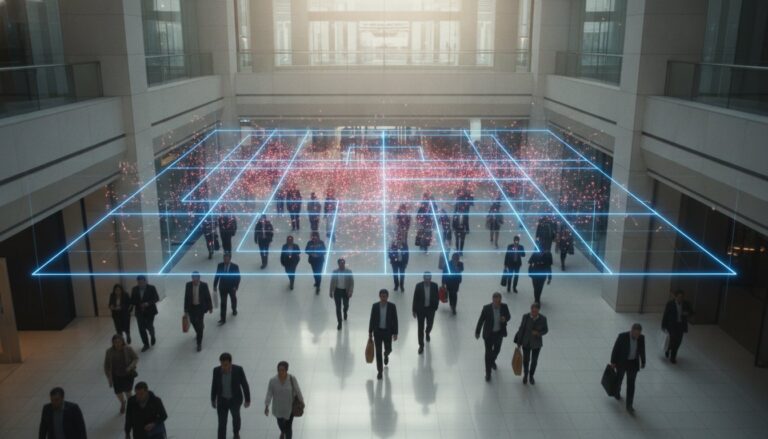
High-performance people counter accuracy relies on the transition from basic infrared sensors to advanced 3D stereoscopic vision. Legacy systems often failed in busy environments because they couldn’t distinguish between a single person and a group walking closely together. Modern solutions, such as the FootfallCam Pro2, utilize dual-lens technology to mimic human depth perception. By capturing two simultaneous images from slightly different angles, the system creates a detailed 3D depth map. This allows the counter to perceive volume and distance, ensuring it identifies individual humans even in high-density crowds.
Data integrity is further protected by Edge Computing. The FootfallCam Pro2 features a powerful 1.2GHz Quad-core processor, allowing it to process every pixel locally on the device. This approach ensures real-time precision while maintaining strict privacy standards, as no raw video ever leaves the unit. Processing at the edge eliminates the latency issues and data loss risks associated with cloud-only processing. It transforms the hardware from a simple sensor into an intelligent analytical node that delivers clean, ready-to-use metrics.
3D Stereoscopic Vision vs. 2D Video Counters
2D counters rely on color and shape contrast, which makes them vulnerable to environmental noise. In Australia’s bright retail environments, harsh sunlight creates deep shadows that 2D systems often mistake for shoppers. 3D vision bypasses this limitation by focusing on physical height and volume. This depth perception enables precise height-filtering, ensuring that children, pets, or low-hanging signage are excluded from adult shopper counts. Research from the Louisiana Transportation Research Center emphasizes that people counter accuracy depends heavily on the degree of agreement between recorded data and the physical reality of the space, a feat only 3D vision consistently achieves.
AI-Driven Object Classification
Modern AI algorithms go beyond simple movement detection to classify objects based on learned behavioral patterns. This intelligence allows the system to filter out non-customer traffic like shopping trolleys, prams, and delivery pallets that would otherwise skew conversion rates. A significant gap in many standard systems is the inability to account for staff movement. By utilizing staff exclusion tags, the system ensures that your team’s frequent entries and exits don’t inflate your footfall numbers. This granular classification is why people counting technology has become a prerequisite for sophisticated retail analytics. If you are looking to upgrade your current infrastructure, the FootfallCam Pro2 offers the most reliable hardware foundation for these AI-driven insights.

Real-World Challenges: Factors That Impact Your People Counting Precision
Theoretical 99.5% accuracy is meaningless if it collapses under the glare of a Sydney summer or the complexity of a busy shopping center entrance. True people counter accuracy is tested when hardware meets the unpredictable nature of physical environments. While many vendors provide lab-tested figures, real-world performance often faces a gap of over 6 percentage points due to local variables. We must account for the specific architectural and behavioral friction that occurs in high-traffic spaces to maintain a reliable dataset.
Environmental and Lighting Factors
Strong Australian sunlight and reflective glass entries are notorious for “blinding” traditional optical sensors. Glare creates visual noise that standard 2D systems cannot filter effectively. To maintain integrity, hardware like the FootfallCam Pro2 utilizes high-grade sensors to ensure performance remains stable even in low-light conditions after hours. Mounting height also plays a critical role; sensors must be calibrated for specific ceiling heights ranging from 2.1m to 4.5m to maintain a clear field of view. Architectural features, particularly wide entrances exceeding 3 meters, can reduce the precision of standard systems by 8-15% if the system isn’t designed to handle expansive coverage areas through multi-sensor stitching.
Behavioural Complexities and Group Logic
Human behavior is rarely linear. Shoppers often perform “U-turns” or loiter near entrances, which leads to significant double-counting in inferior systems. Advanced AI logic is required to track the specific trajectory of an individual. This ensures that a person browsing a window display or waiting for a friend isn’t logged as a new entry. Group Counting logic is also essential for modern retail. Without it, a family of four is recorded as four separate units, skewing your conversion rate data and making your sales team appear less efficient than they truly are.
Professional people counting systems Australia rely on sophisticated dwell-time filtering to distinguish between a customer entering the store and a visitor standing in the doorway. Thermal-only sensors often struggle here; their accuracy can drop to 78% when three or more people enter simultaneously. High-integrity systems solve this by combining 3D vision with behavioral AI to interpret movement as a sequence of human actions rather than just moving pixels. This level of interpretation is what separates a simple counter from a strategic business intelligence tool.
Auditing and Validating Your System: How to Ensure Ongoing Reliability
Validation is the final bridge between a hardware installation and a reliable business intelligence tool. Even the most advanced sensors can fall victim to “Data Drift,” which is the gradual decline in system precision caused by shifting store layouts, new lighting fixtures, or changes in entrance decor. To maintain people counter accuracy, you must move beyond accepting vendor specifications and implement a rigorous auditing protocol. A video audit is the only empirical way to verify that the numbers on your dashboard reflect the physical reality of your space.
We’ve observed an average gap of 6.2 percentage points between vendor-claimed performance and real-world results when systems aren’t properly calibrated. This discrepancy is often the difference between a profitable staffing model and a wasteful one. Professional auditing involves comparing the system’s automated tally against a manual human count of the same video footage. This process ensures that the AI models inside your FootfallCam Pro2 are correctly interpreting the specific nuances of your environment.
The Five-Step Validation Process
Ensuring your data remains actionable requires a structured approach to verification. Follow these five steps to audit your system without disrupting your daily operations:
- Live Stream Access: Access the sensor’s top-down view to ensure the counting lines are positioned correctly relative to the door’s swing.
- Sample Period Selection: Select a high-traffic window, typically 30 to 60 minutes, to capture a diverse range of movement patterns.
- Manual Tally: A human auditor watches the recorded footage and records every entry and exit using a digital counter.
- Comparison: Compare the manual tally against the system’s reported data for that specific time block.
- Calibration: If the variance exceeds 0.5%, perform remote tuning to adjust the AI sensitivity or height filters.
We recommend a minimum sample size of 100-200 people for a statistically significant audit. Accuracy should be checked quarterly to account for seasonal changes, such as different clothing volumes in winter or increased group sizes during holiday periods.
Maintaining Integrity Through Professional Support
Relying on internal teams to manage these technical audits often leads to inconsistent results. Our Premium Support Plan provides proactive health checks where our engineers perform these audits for you. This service includes remote tuning to maintain people counter accuracy as your business evolves. If your current hardware is several generations old, our Legacy Swap Out Plan offers a streamlined path to upgrade to the FootfallCam Pro2, ensuring you benefit from the latest FootfallCam V9 Software updates and improved counting algorithms. Secure your data integrity today by partnering with our experts for a comprehensive system audit.
The FootfallCam Pro2 Advantage: Accuracy You Can Audit
The FootfallCam Pro2 stands as the benchmark for verifiable performance in the Australian market. While many systems operate as “black boxes,” providing data without a clear path to verification, the Pro2 architecture prioritizes transparency. It offers the most auditable hardware solution available, allowing managers to verify people counter accuracy through integrated video proof. This capability ensures that every data point on your dashboard is backed by visual evidence, transforming footfall metrics from a simple estimate into a certified business asset.
For larger environments like shopping centers or transit hubs, the FootfallCam Centroid extends this precision by leveraging your existing CCTV infrastructure. It uses AI video analytics to turn standard security cameras into high-precision counting nodes. This hybrid approach allows for seamless tracking across massive floor plates without the need for redundant hardware installations. It maintains data integrity at scale by centralizing the processing power, ensuring that complex human movements are interpreted with the same logic across every camera in your network.
Transparent Reporting with FootfallCam V9
Data is only as valuable as the interface used to interpret it. FootfallCam V9 Software serves as the central intelligence hub, providing real-time accuracy dashboards and automated health alerts. If a sensor’s performance fluctuates due to an environmental shift, the system notifies you immediately. This prevents long-term data gaps that could otherwise skew your quarterly reports. This level of oversight is particularly critical for multi-site managers who need to compare performance across a national portfolio with total confidence.
Sophisticated footfall data analysis allows you to export raw metrics for external verification, ensuring your stakeholders have clear proof of data integrity. The software automates the reporting of conversion rates and peak hour trends, removing the manual labor typically associated with data consolidation. It empowers your team to focus on strategic optimization rather than troubleshooting hardware discrepancies, leading to more efficient staffing and better customer outcomes.
Future-Proofing Your Analytics
The FootfallCam ecosystem is designed for scalability, growing alongside your business from a single boutique to a national retail chain. Choosing a system that integrates hardware, software, and professional support ensures that your investment remains relevant as behavioral trends shift. We emphasize the value of local Australian support and maintenance to provide rapid response times and site-specific expertise that global-only vendors often lack. This ensures your people counter accuracy remains high regardless of seasonal changes or store renovations.
Securing a reliable dataset is the first step toward evidence-based growth. If you are uncertain about the integrity of your current metrics, it’s time to validate your infrastructure against modern standards. Reliable data is not a luxury; it’s the foundation of a competitive operation. Contact Footfall Australia for a free accuracy assessment to begin building a dataset you can trust for your long-term strategic planning.
Securing the Future of Your Footfall Intelligence
Building a resilient retail or public space strategy requires more than just raw numbers; it requires empirical truth. We’ve explored how people counter accuracy serves as the critical foundation for labor optimization and conversion analysis. By moving from legacy sensors to the FootfallCam Pro2, you leverage 3D stereoscopic vision and proprietary AI to eliminate the “Data Integrity Gap” that often plagues standard systems. These technical innovations ensure your data remains reliable even under the harsh glare of Australian sunlight or within the complexity of high-density crowds.
Maintaining this standard of excellence isn’t a one-time event but a continuous commitment to auditing and professional health checks. Our national support network across Australia is dedicated to ensuring your hardware performs at its peak, providing 99.5% accuracy verified by independent video audits. This proactive approach prevents data drift and ensures your reporting remains transparent for all stakeholders. It’s time to replace intuition with evidence-based decision-making. Request a Professional Accuracy Audit from Footfall Australia to confirm your data integrity and unlock the full potential of your business intelligence. Confident leadership begins with a dataset you can trust.
Frequently Asked Questions
How is people counter accuracy actually measured?
Accuracy is measured by comparing the automated sensor tally against a manual human count of the same video footage over a specific sample period. This verification process requires a sample of 100 to 200 people to be statistically significant. By calculating the variance between these two figures, managers establish a percentage that represents the real-world performance of their hardware rather than relying on theoretical marketing claims.
What is the average accuracy of a FootfallCam Pro2 device?
The FootfallCam Pro2 achieves up to 99.5% accuracy in ideal conditions through its 3D stereoscopic vision and AI analytics. In complex retail environments, it consistently outperforms standard 2D sensors by utilizing depth perception to track individual movements accurately. Maintaining high people counter accuracy requires proper installation at the recommended ceiling height of 2.1m to 4.5m to ensure the AI has a clear field of view.
Can people counters distinguish between adults and children?
Yes, advanced 3D sensors distinguish between adults and children by utilizing precise height-filtering algorithms. The system measures the vertical height of every moving object relative to the floor, allowing it to exclude individuals below a specific threshold, such as 1.3 meters. This ensures your conversion rates aren’t skewed by non-purchasing visitors or families walking together, providing a cleaner dataset for your sales analysis.
Do people counters work in complete darkness?
No tested optical system achieves high accuracy in total darkness without infrared supplementation. Research indicates that accuracy often drops below 92% in low-light conditions without specialized sensors. The FootfallCam Pro2 is designed to maintain high performance in low-light environments common in retail spaces after hours, but for zero-light scenarios, you should consult with a specialist to ensure the hardware is calibrated for those specific conditions.
How often should I audit my people counting system for accuracy?
Audit your system at least quarterly to account for seasonal behavioral shifts and environmental changes. Regular validation is essential because “Data Drift” can occur when store layouts are modified or new lighting is installed. If your business experiences frequent floor plan updates, monthly health checks through a professional support plan are recommended to ensure ongoing people counter accuracy and data integrity.
Can shadows or floor reflections cause false counts?
Shadows and floor reflections often cause false counts in legacy 2D systems, but 3D stereoscopic vision effectively eliminates these errors. Because 3D counters measure physical volume and depth rather than just pixel contrast, they distinguish between a human body and a flat reflection. This technological advantage is vital for Australian stores with glass storefronts or polished flooring that create high-glare conditions during the day.
What happens to accuracy if my store layout changes?
Accuracy can drop significantly if a layout change places shelving or signage within the sensor’s field of view. Obstructions can block counting lines or confuse the AI’s trajectory tracking logic. When you move entrance displays or reconfigure the lobby, you must perform a remote tuning session. This allows engineers to recalibrate the software for the new physical environment and maintain the reliability of your metrics.
Is it possible to exclude staff members from the total count?
You can exclude staff members from your total footfall counts by utilizing specialized staff exclusion tags. These tags allow the AI to identify employees as they enter and exit, automatically subtracting their movements from the customer data. This ensures your conversion rate analysis remains focused exclusively on genuine sales opportunities rather than being inflated by the frequent entries and exits of your internal team.