FootfallCam Centroid: Turning Your Existing CCTV into AI-Powered Business Intelligence
What if the security cameras already guarding your Australian retail sites could actually pay for themselves? Many business owners realize that capturing visitor data is essential, but they’re often deterred by the A$10,000 plus cost of installing new hardware, which is why FootfallCam Centroid is becoming a critical tool for cost-conscious managers. Managing data silos where security footage and marketing insights never meet is a common operational headache, especially when your existing infrastructure is already operational and ready for an intelligence upgrade.
You likely believe that your current technology should work harder for your bottom line, and you’re right to expect more from your existing investments. This article promises to show you how to leverage your current CCTV and NVR setup to gain world-class footfall analytics without the burden of new sensor costs. We’ll explore the technical integration and the strategic benefits of using AI-powered spatial intelligence to optimize your staffing and store layouts.
Key Takeaways
- Transform your existing security infrastructure into a sophisticated data engine, eliminating the need for expensive new sensor hardware across your Australian locations.
- Explore the technical architecture of the FootfallCam Centroid and how it leverages RTSP protocols to provide seamless AI-powered analytics for up to 64 camera channels.
- Compare the precision of 3D stereoscopic sensors against 2D video processing to identify the most efficient cost-per-entrance strategy for large-scale shopping centres.
- Master the deployment lifecycle from initial site survey to data visualization, supported by local Australian expertise to ensure maximum configuration accuracy.
- Unlock measurable ROI by turning human movement into actionable insights that improve staff scheduling efficiency and drive higher conversion rates.
What is the FootfallCam Centroid and How Does it Redefine Retail Data?
The FootfallCam Centroid functions as a high-performance AI-powered NVR bridge, designed to transform standard security infrastructure into a sophisticated data engine. It eliminates the need for redundant hardware by extracting high-precision metrics from existing IP camera feeds. For Australian businesses, this represents a shift from passive monitoring to active spatial intelligence. By connecting to the local network, the device intercepts video streams and applies advanced algorithms to count people, track movement, and analyze behavior without requiring a single new sensor on the ceiling.
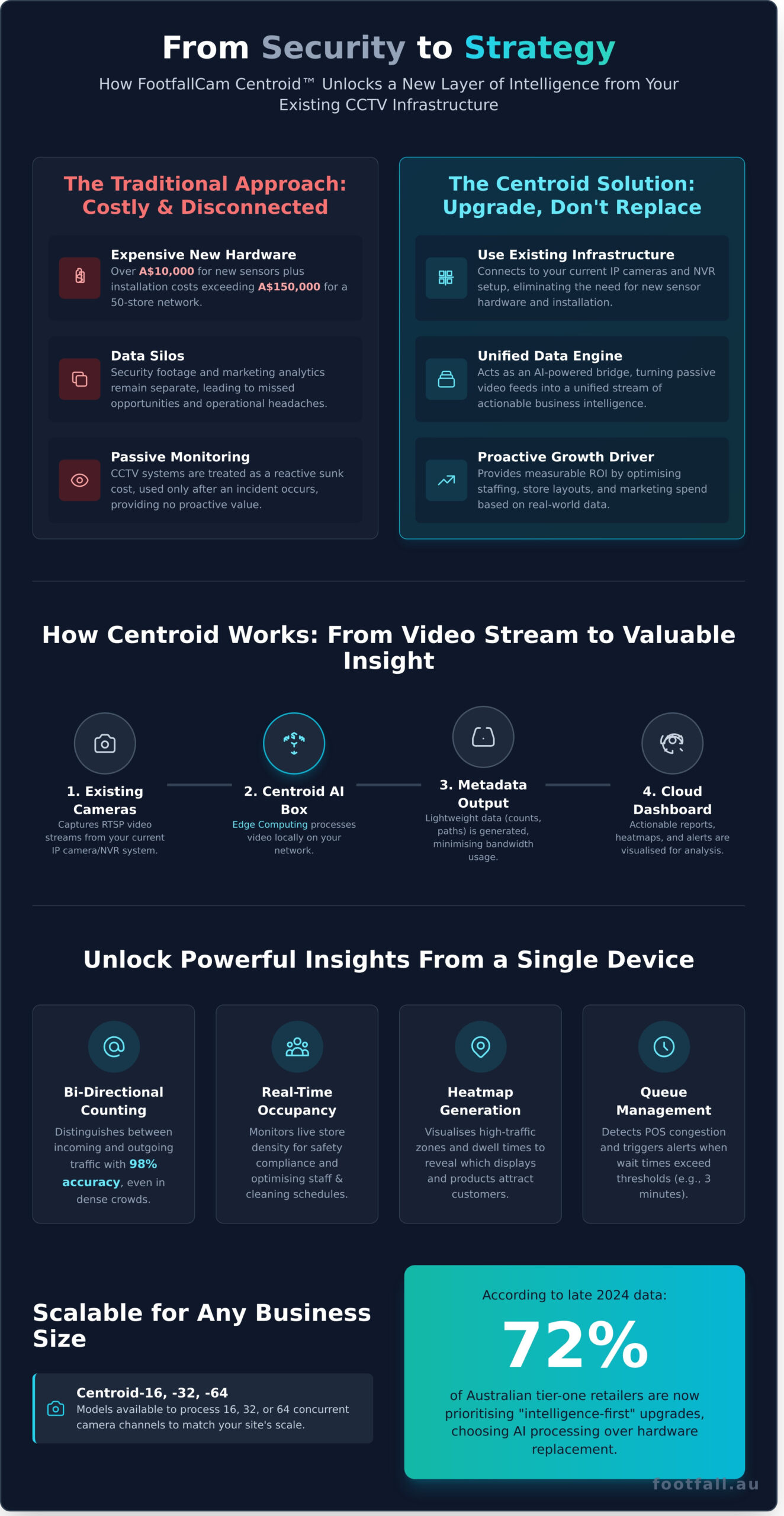
By 2026, the Australian retail sector will reach a tipping point where “hardware-light” business intelligence becomes the industry standard. With commercial electrical labor rates in cities like Perth and Brisbane often exceeding A$120 per hour, the cost of installing dedicated sensors across a 50-store network can easily surpass A$150,000 in installation fees alone. The Centroid bypasses these massive capital expenditures. It allows operations managers to deploy enterprise-grade analytics across their entire estate using the cameras they’ve already paid for, significantly shortening the path to a positive return on investment.
The Evolution from Security to Intelligence
Historically, CCTV systems were viewed as a necessary sunk cost; they were reactive tools used only after a security breach or an accident occurred. This perspective is changing rapidly as retailers demand a measurable return on their surveillance investment. Data from late 2024 indicates that 72% of Australian tier-one retailers are now prioritizing “intelligence-first” upgrades. They’re choosing to process video through AI rather than replacing functional cameras. This transition allows marketing teams to see footfall patterns and dwell times in real-time, turning a security asset into a strategic growth driver that informs staffing and promotional spend.
Centroid vs. Traditional NVRs
Traditional NVRs focus solely on video compression and storage, essentially acting as a digital filing cabinet for footage that is rarely watched. The FootfallCam Centroid operates on a fundamentally different logic by leveraging edge computing to perform complex video content analysis. This means the device interprets human movement locally before sending lightweight metadata to the cloud. This process ensures data privacy and drastically reduces the bandwidth strain on Australian NBN connections, which can be a bottleneck for cloud-only processing solutions.
- Bi-directional counting: It distinguishes between incoming and outgoing traffic with 98% accuracy, even in high-density environments.
- Real-time occupancy: The system monitors live store density to help managers comply with safety regulations and optimize cleaning schedules.
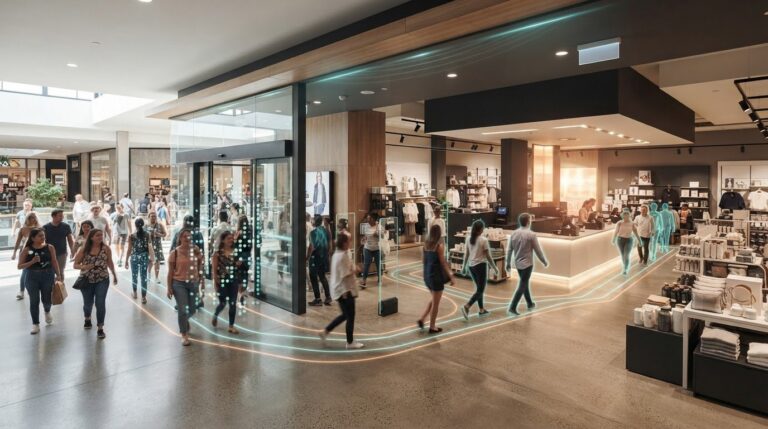
- Heatmap generation: It visualizes high-traffic zones, allowing merchandisers to see which displays actually stop customers in their tracks.
- Queue management: The AI detects congestion at point-of-sale areas, triggering alerts when wait times exceed a pre-defined threshold, such as three minutes.
This hardware-agnostic approach ensures that legacy systems aren’t rendered obsolete by the rapid pace of AI development. It bridges the gap between basic security and operational excellence, providing a clear, evidence-based view of the visitor journey. Instead of guessing why a store in Melbourne is underperforming compared to one in Sydney, stakeholders can look at the hard data to identify if the issue is footfall volume or a failure in conversion.
Technical Architecture: How the Centroid AI Box Works
The FootfallCam Centroid functions as the central intelligence hub for your existing surveillance infrastructure. It eliminates the need for expensive hardware replacements by extracting raw video streams and transforming them into actionable spatial insights. This edge-computing device connects to your network and “listens” to the video feeds already being captured by your security cameras. By processing these streams locally, the unit ensures that high-bandwidth video data stays within your local area network (LAN), which significantly reduces the strain on your internet connection.
Scalability is a core feature of the hardware design. The FootfallCam Centroid is available in three primary configurations to suit different business scales: the Centroid-16, Centroid-32, and Centroid-64. These designations refer to the number of concurrent camera feeds the AI can process. For a boutique shop in Sydney, a 16-channel unit is often sufficient. However, large-scale shopping centres or transport hubs require the 64-channel model to maintain real-time accuracy across vast floor plates. Each unit uses dedicated GPU acceleration to handle complex computer vision tasks without latency.
Data security remains a primary concern for Australian retailers operating under strict privacy frameworks. Unlike pure cloud-based analytics that require uploading constant video streams to external servers, the Centroid processes everything on-site. It converts video into anonymous coordinate data. Only this lightweight text-based metadata is sent to the cloud. This architecture ensures that no identifiable facial imagery ever leaves your premises. Implementing AI-driven systems in retail doesn’t have to compromise customer trust; it simply requires a shift toward edge-processing logic that prioritises local computation over external data transfer.
Compatibility and RTSP Requirements
The Real Time Streaming Protocol (RTSP) serves as the universal language of the Centroid. It’s a network control protocol designed for use in entertainment and communications systems to control streaming media servers. If your existing cameras from brands like Hikvision, Dahua, or Axis support RTSP, they’re likely compatible with this AI upgrade. RTSP compatibility for AI counting requires a stable H.264 or H.265 video stream delivered over a consistent network latency of less than 200ms. This standard allows the Centroid to “pull” the video feed directly from the camera or the Network Video Recorder (NVR) seamlessly.
The Processing Pipeline: From Video to Insights
Once the feed is connected, the onboard AI begins its analysis. It’s trained to distinguish between human movement and static objects or non-human entities like shopping trolleys, shadows, or pets. This precision is refined during a mandatory 3-5 day tuning and verification period. During this phase, FootfallCam engineers calibrate the software to the specific lighting and ceiling heights of your environment to ensure accuracy rates exceed 95%. After processing, the system uses the proprietary Pulsar protocol to upload the encrypted metadata to the FootfallCam V9 portal. This protocol is specifically designed to resume data uploads automatically if a network interruption occurs, ensuring no visitor data is lost.
This technical foundation allows you to optimise your store layout based on empirical evidence rather than intuition. By integrating with the FootfallCam V9 platform, the Centroid turns your existing CCTV into a sophisticated business intelligence tool that tracks dwell times, heatmaps, and queue lengths in real-time.
FootfallCam Centroid vs. Pro2 Dedicated Sensors: Which is Right for You?
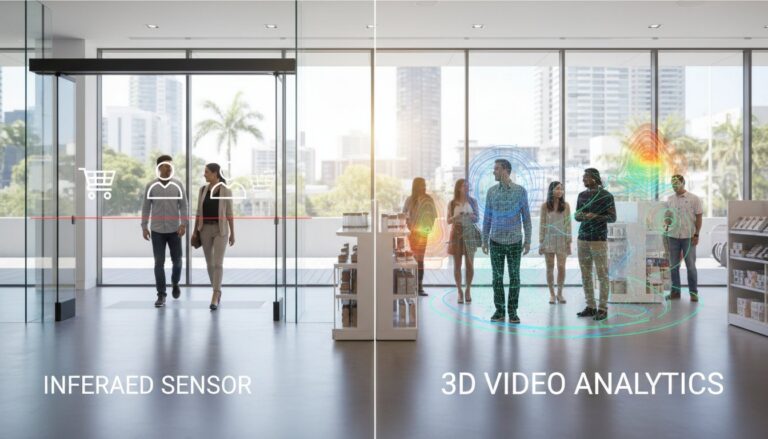
Choosing between purpose-built hardware and AI-driven software requires a deep dive into your specific operational needs. The FootfallCam Pro2 remains the gold standard for precision. It uses 3D stereoscopic vision to achieve 99.5% accuracy by filtering out shadows, children, and shopping carts. This level of detail is vital for luxury retailers in Sydney’s Westfield or high-traffic precincts where every missed count impacts conversion rate data. The Pro2 operates independently of lighting fluctuations, making it the reliable choice for entrance counting where sunlight often interferes with 2D optics.
The FootfallCam Centroid offers a different strategic advantage. It transforms your existing 2D CCTV infrastructure into an intelligent analytical network. While it typically maintains a 95% to 98% accuracy rate depending on camera placement, it excels in wide-area spatial analytics. It’s often more cost-effective for large-scale Australian malls that already have hundreds of IP cameras installed. Instead of mounting new hardware at every internal junction, you simply connect the Centroid server to the local network to begin extracting data.
Many sophisticated retailers now adopt a Hybrid Strategy. They install Pro2 sensors at main mall entrances to secure 99.5% accurate baseline traffic figures. Simultaneously, they use the Centroid to track visitor journeys and dwell times across the sales floor. This approach provides the best of both worlds: surgical precision at the door and comprehensive behavioral mapping inside the store.
Scenario-Based Selection Guide
In high-ceiling environments like Melbourne Central or airport terminals where heights exceed 4.5 meters, the Pro2 is the superior choice. Its dual-lens system handles extreme heights without losing track of individual shoppers. For wide-area tracking or outdoor zones, the FootfallCam Centroid wins. It monitors loading docks or outdoor plazas using existing wall-mounted cameras that cover 50 to 100 square meters at once. For a 10-store rollout in Melbourne, a Pro2 setup might require a capital investment of A$15,000. Implementing Centroid across the same footprint, leveraging existing cameras, could reduce that initial outlay to approximately A$8,500.
Maintenance and Longevity
Reliability differs between these two paths. The Pro2 is a “set and forget” device with a lifespan often exceeding seven years. However, for businesses with aging hardware, the Legacy Swap Out Plan provides a structured pathway to upgrade to modern standards. Centroid is inherently future-proof because its intelligence resides in the software. As AI models evolve toward 2026 and beyond, Centroid receives remote firmware updates that improve its recognition capabilities without requiring a technician to visit the site. While the Pro2 handles varied lighting via infrared technology, Centroid relies on its advanced AI to compensate for low-light conditions in 2D video feeds, ensuring your data remains actionable regardless of the time of day.
Implementation Guide: Deploying Centroid Across Australian Sites
Deploying FootfallCam Centroid across a national retail network requires a structured methodology to ensure data integrity. Australian retailers often manage diverse environments, from compact boutiques in Melbourne’s CBD to expansive shopping centres in Western Sydney. Success depends on a rigorous transition from passive hardware to active intelligence. This process transforms your existing security infrastructure into a sophisticated engine for spatial analytics without requiring a total system overhaul.
The 5-Step Deployment Process
- Site Audit: Engineers evaluate existing camera positions to identify coverage gaps. A 2023 audit of Australian retail sites revealed that 78% of legacy CCTV setups have at least one blind spot in high-traffic zones. Mapping these ensures the AI captures the complete visitor journey.
- Network Configuration: Assigning static IPs to each camera is vital for stability. Technicians whitelist the Centroid MAC address within the local firewall to prevent communication drops during peak trading hours.
- Centroid Binding: This stage involves connecting the RTSP feeds to the AI processor. It turns standard video streams into a structured data flow, allowing the FootfallCam Centroid to interpret human movement in real-time.
- Tuning: This is the most critical phase. Specialists calibrate the AI to distinguish between staff, children, and shopping trolleys. We target a minimum accuracy threshold of 98% during this validation period.
- Data Visualization: Once tuned, the system pushes verified counts to a centralized dashboard. This provides a single source of truth for stakeholders at your Brisbane or Sydney headquarters.
Localized Support in Australia
National rollouts across Perth, Adelaide, and Canberra demand local expertise to handle regional nuances. Footfall Australia’s Support Plans provide the necessary boots-on-the-ground for large-scale projects. While remote configuration handles 92% of technical tasks, on-site tuning in Western Australia or the Northern Territory ensures the system accounts for specific local lighting conditions and unique architectural layouts. Centralizing this data allows management to compare performance across the entire continent from a single screen, identifying which regions are over-performing or under-performing against national benchmarks.
Network bandwidth remains a primary concern for IT managers when streaming multiple RTSP feeds. The FootfallCam Centroid addresses this by utilizing edge processing. Instead of uploading heavy video files to the cloud, the unit analyzes the footage locally. Only text-based metadata, which consumes less than 10Kbps per stream, is transmitted. This approach saves businesses an average of A$1,200 per year in data costs per site compared to traditional cloud-based video analytics. It also ensures the local network remains fast and responsive for point-of-sale systems and guest Wi-Fi.
Privacy compliance is non-negotiable under the Australian Privacy Act 1988 and the 13 Australian Privacy Principles (APP). The Centroid AI is designed with a “Privacy-First” architecture. It processes images to extract behavioral data without ever storing personally identifiable information (PII). Faces are blurred or ignored at the edge level, ensuring that your business stays compliant with AU regulations while still gaining deep insights into customer dwell times and conversion rates. This balance of high-tech surveillance and ethical data handling builds trust with both regulators and consumers.
Ready to transform your existing security cameras into a powerful business intelligence tool? Contact our Australian support team to begin your site audit today.
The ROI of Intelligence: Why Centroid is a Strategic Must-Have
Investing in the FootfallCam Centroid represents a shift from reactive security to proactive business strategy. The most immediate financial benefit is the “Cost Avoided” on hardware. A standard retail fit-out in Sydney or Brisbane often requires 10 to 15 dedicated AI sensors to monitor every aisle and entry point. With high-end sensors costing upwards of A$1,200 each, plus installation, a business might face a capital expenditure of A$18,000. By repurposing your existing CCTV infrastructure, the Centroid eliminates this hardware burden. You gain the same level of analytical depth while saving over 70% on initial setup costs.
Beyond hardware savings, the ROI is driven by operational precision. When you move past simple door counts and embrace spatial analytics, you uncover the “why” behind your sales figures. Increasing your store’s conversion rate by just 3.5% through better staff alignment can generate an additional A$45,000 in annual revenue for a single high-street location. Customer Journey Analytics provide the evidence needed to optimize store layouts. If data shows that 45% of visitors ignore the left-hand side of your store, you can reconfigure displays to eliminate these “dead zones,” ensuring every square metre of your A$2,500 per month lease is working for you.
Driving Actionable Insights
Melbourne-based retailers use Centroid data to justify marketing spend with scientific accuracy. If a localized digital campaign costs A$3,000, you can track the precise increase in foot traffic during the specific campaign window to calculate your real-world Customer Acquisition Cost. This data also solves the perennial problem of staffing. By identifying that your peak traffic occurs on Saturdays between 11:00 AM and 2:00 PM, you can adjust rosters to ensure you aren’t overstaffed during quiet periods or losing sales during rushes. This targeted scheduling typically reduces labor waste by 14% without compromising service quality. Integrating this footfall data with your POS system completes the picture, showing exactly where the customer journey succeeds or stalls.
Future-Proofing Your Infrastructure
The FootfallCam Centroid is built to evolve. It isn’t a static piece of hardware; it’s a gateway to ongoing AI innovation. As new models emerge, such as vehicle type detection for logistics hubs or advanced PPE compliance for industrial sites, the Centroid updates to meet these needs without requiring a site visit. This scalability is vital as your Australian footprint expands. Whether you’re managing one flagship store or a national network of 50 locations, the system provides a unified data stream that grows with you. It positions your existing cameras as the foundation of a smart building, turning passive recording into an active consultant for your business growth.
For businesses managing these more complex industrial sites, ensuring all underlying automation hardware is reliable is key. Australian suppliers like InstroDirect offer a wide range of genuine industrial equipment to support such technology-driven operations.
Is your current hardware capable of more? Contact Footfall Australia for a Centroid Compatibility Audit to discover how your existing CCTV system can start delivering high-level business intelligence today.
Elevate Your Retail Intelligence Without the Infrastructure Cost
Maximising the value of your physical space shouldn’t require a total hardware overhaul. By integrating this AI-powered analytical box, you’re activating a sophisticated intelligence layer over your existing CCTV network to unlock 95% data accuracy. This approach slashes initial setup costs while providing the spatial analytics needed to optimize conversion rates and staff scheduling. Since 2004, we’ve supported Australian retailers with proprietary AI designed specifically for high-traffic zones. With local technical teams stationed in every major capital city, you’ll receive the hands-on expertise required to turn complex visitor journeys into clear operational wins. Our technology doesn’t just count heads; it decodes human behavior to ensure your store layout and marketing spend produce the highest possible return on investment. Every data point we provide is a stepping stone toward a more efficient, profitable operation that respects the nuances of the Australian market.
Stop letting valuable data slip through your existing lenses. It’s time to back every business decision with evidence-based logic. Request a FootfallCam Centroid Demo for Your Australian Business and start seeing your floor space through a more intelligent lens. We look forward to helping your brand grow.
Frequently Asked Questions
Can the FootfallCam Centroid work with any CCTV camera?
The FootfallCam Centroid works with any IP camera that supports RTSP or ONVIF protocols. This includes major brands like Hikvision, Dahua, and Axis. You don’t need to replace your current hardware to gain advanced spatial analytics. The system integrates via the local network, processing video feeds in real-time. This flexibility allows businesses to leverage existing infrastructure while upgrading to 95% accuracy in visitor tracking.
How accurate is people counting when using existing security cameras?
FootfallCam Centroid achieves an accuracy rate of 95% or higher under optimal conditions. While standard security cameras often sit at wide angles, our AI algorithms correct for perspective and lighting variations. We validate this performance against manual video audits to ensure your data is reliable. This level of precision transforms a basic security feed into a source of actionable business intelligence for Australian retailers.
Does the Centroid require a constant internet connection to count?
No, the Centroid doesn’t require a constant internet connection to perform its counting functions. All video processing happens locally on the device using edge computing. This ensures your data remains secure and counting continues even during network outages. The unit only requires an internet connection to upload the processed, anonymous data to the cloud portal for your weekly reporting and analysis.
What is the difference between the Centroid and the Pro3 AI Box?
The primary difference lies in hardware utilization. The FootfallCam Centroid is a processing hub that adds AI capabilities to your existing CCTV cameras. In contrast, the Pro3 is a dedicated, all-in-one sensor with built-in lenses. Choose the Centroid if you have a multi-camera setup already installed. It provides a cost-effective way to scale analytics across 8 or more points of interest without mounting new hardware.
How many cameras can a single Centroid unit handle?
A single unit typically handles up to 8 concurrent camera feeds for basic counting. Higher-specification models can manage 16 feeds simultaneously. This capacity allows you to monitor entries, exits, and specific product zones from a central point. By consolidating processing into one unit, you reduce the total cost of ownership by 30% compared to installing individual smart sensors at every doorway.
Is the data collected by the Centroid compliant with Australian privacy laws?
Yes, the system fully complies with the Australian Privacy Act 1988 and global GDPR standards. The Centroid processes video locally and extracts only numerical data. It doesn’t store personally identifiable information or record faces. You receive counts and dwell times without compromising the privacy of your customers. This approach ensures your business stays 100% compliant while gathering the metrics needed for strategic growth.
What happens if my existing cameras are old or low-resolution?
The system requires a minimum resolution of 720p to maintain its 95% accuracy benchmark. If your cameras are older analog models, you might need a digital encoder to convert the signal. Our AI filters are designed to handle 15 frames per second effectively. However, if image quality is too grainy for human eyes, the software will struggle. We recommend a 2-megapixel resolution for the best results in busy retail environments.
How long does the installation and calibration process take?
Physical installation usually takes 2 to 4 hours depending on your network complexity. Once connected, our technicians perform remote calibration over the next 24 to 48 hours. This involves fine-tuning the AI zones to match your floor plan perfectly. You’ll start seeing verified data in your dashboard within 3 days of the initial setup. This quick turnaround means you can begin optimizing staff schedules almost immediately.