The Definitive Guide to People Counter ROI: Maximising Your Investment in 2026
What if your largest operational expense wasn’t your lease or your inventory, but the A$28,500 you’re losing annually to inefficient staff scheduling? You likely already know that rising labour costs in Australia are squeezing margins thinner than ever. It’s difficult to justify a major tech upgrade when you aren’t certain it will actually move the needle on your bottom line. We understand that every dollar of CAPEX must be backed by a logical, evidence-based outcome rather than a hopeful estimate.
This guide shows you exactly how to calculate a definitive people counter roi by turning raw foot traffic into measurable profit. You’ll learn how to prove the value of your technology through concrete cost savings and accelerated conversion rates. We’ll provide a clear ROI formula tailored for the 2026 retail landscape, share specific examples of operational efficiency, and give you the confidence to choose a high-accuracy system that pays for itself in months rather than years. By decoding the narrative of human movement within your store, you can finally stop guessing and start optimizing for growth.
Key Takeaways
- Master the essential formulas to quantify your people counter roi, moving beyond raw footfall to measure net profit gains and conversion lift.
- Navigate the tightening margins of the 2026 Australian retail landscape by replacing “gut feel” with precise, evidence-based spatial analytics.
- Identify the critical distinctions between CAPEX and OPEX to understand the true Total Cost of Ownership and the financial benefits of upgrading legacy systems.
- Learn to leverage visitor dwell time and zone usage data to justify government funding for public spaces or optimise queue management in retail environments.
- Secure your investment by partnering with local Australian experts to ensure seamless installation and prevent “dead data” from eroding your strategic advantage.
Understanding People Counter ROI: Beyond the Raw Numbers
ROI isn’t a vague aspiration; it’s a precise calculation. In the context of spatial analytics, people counter roi represents the ratio of net profit generated from data-driven operational changes against the total cost of system ownership. This includes the initial hardware investment, installation, and ongoing software subscriptions. For Australian retailers facing a projected 3.8% increase in operating costs by mid-2026, every dollar spent on technology must justify its presence on the balance sheet through measurable efficiency gains.
To establish a baseline, one should first understand what is a people counter and how its sensors translate physical movement into digital datasets. Sophisticated systems move beyond “Vanity Metrics.” While knowing that 5,000 people entered a store is interesting, it’s ultimately a hollow number without context. Actionable insights focus on conversion rates and dwell time. If those 5,000 visitors only resulted in 200 transactions, the data reveals a failure in the sales funnel rather than a lack of traffic.
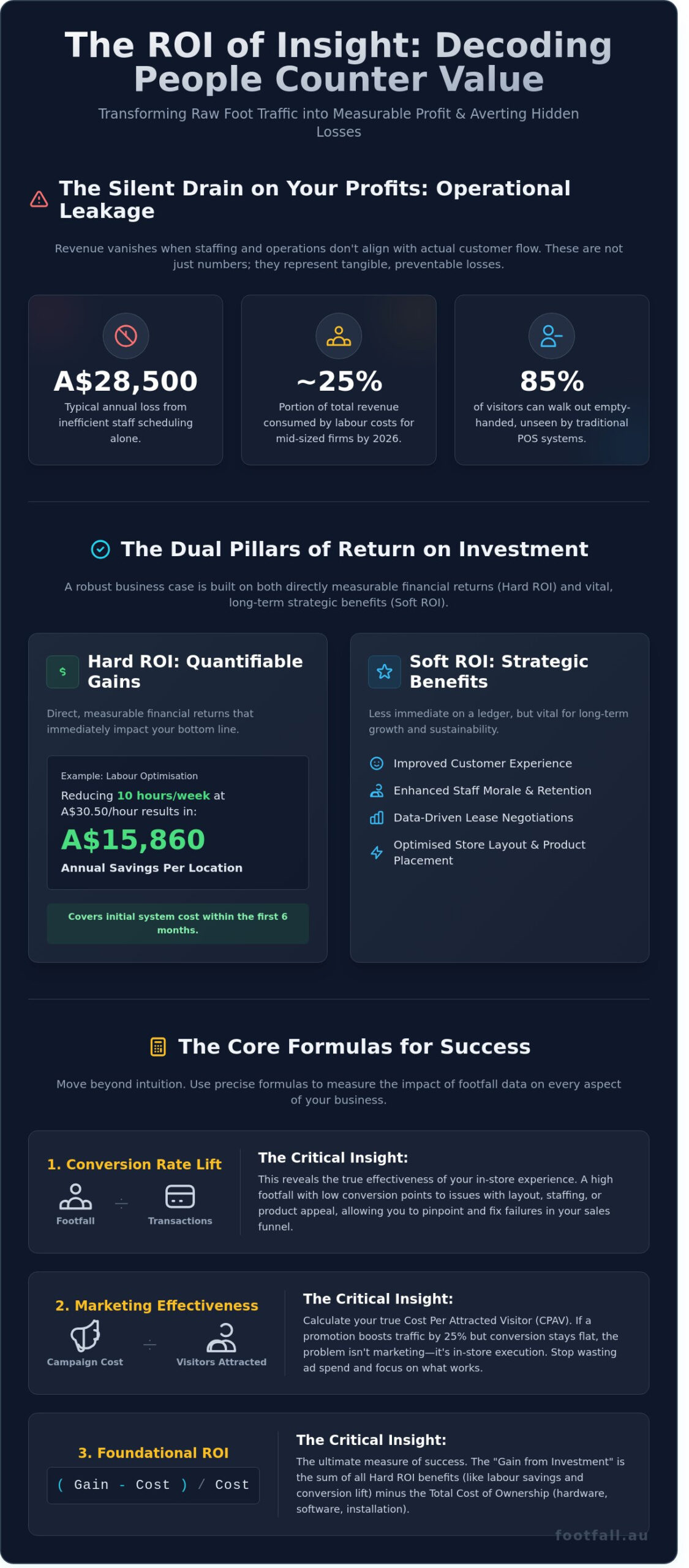
Australian retailers often suffer from “Operational Leakage.” This occurs when revenue vanishes because staffing levels or inventory volumes don’t align with actual visitor flow. By February 2026, data from the Australian Retailers Association suggests that labour costs will account for nearly 25% of total revenue for mid-sized firms. Calculating a true people counter roi requires identifying how much of that leakage can be plugged by synchronising staff rosters with peak traffic hours.
The Shift from Counting to Conversion
Knowing who didn’t buy is often more valuable than knowing who did. Traditional POS systems only record the success stories; they’re blind to the 85% of visitors who might walk out empty-handed. The FootfallCam Pro2 addresses this by capturing high-accuracy “missed opportunities” with 99.5% precision. As commercial rents in Sydney and Melbourne CBDs rose by an average of 12.4% between 2024 and 2026, businesses can’t afford to waste floor space. Traffic data allows managers to identify whether a low conversion rate stems from poor store layout, inadequate staffing, or a mismatch in product offering.
Hard ROI vs. Soft ROI in Footfall Analytics
A robust business case balances Hard ROI with Soft ROI. Hard ROI involves direct, quantifiable financial returns. For instance, reducing redundant labour by 10 hours per week at an average Australian retail wage of A$30.50 results in an annual saving of approximately A$15,860 per location. This often covers the initial system cost within the first six months of implementation. Soft ROI, while less immediate on a ledger, is equally vital for long-term sustainability. It includes:
- Improved Customer Experience: Reducing queue wait times based on predictive traffic data.
- Staff Morale: Preventing employee burnout by ensuring adequate support during high-traffic surges.
- Strategic Planning: Using historical data to negotiate more favourable lease terms based on actual footfall rather than landlord estimates.
Successful Australian enterprises view these metrics as a unified strategy to build a more resilient, evidence-based business model. By replacing “gut feel” with empirical evidence, managers can make confident decisions that protect margins and drive sustainable growth in a competitive 2026 market.
The Mathematics of ROI: 3 Core Formulas for Success
Determining the people counter roi requires moving beyond intuition into the realm of hard financial metrics. Precision data replaces guesswork, allowing you to treat your physical space with the same analytical rigor as an e-commerce platform. The foundational calculation for any capital expenditure remains the standard ROI formula: (Gain from Investment – Cost of Investment) / Cost of Investment. However, for a sophisticated retail environment, this is merely the starting point. You must look at the specific levers that drive profitability: conversion, labour, and marketing spend.
Marketing effectiveness is often the first area where hidden costs are uncovered. By calculating the Cost per Attracted Visitor (CPAV) versus the Cost per Sale, you can see the true performance of your campaigns. If a holiday promotion in Melbourne increases footfall by 25% but conversion remains stagnant, the issue isn’t your marketing; it’s your in-store execution. This distinction is vital for protecting your margins and ensuring every marketing dollar spent actually reaches the checkout counter.
Calculating the Conversion Rate Lift
Optimising Australian Wage Costs
Staffing represents one of the largest overheads for Australian businesses, especially when navigating Fair Work requirements and high penalty rates. Many retailers overstaff during quiet periods, such as Tuesday mornings, while leaving the floor vulnerable during weekend rushes. Data-driven scheduling allows you to match staff-to-customer ratios with surgical precision. By identifying a 15% surplus in labour on low-traffic mornings, a manager can justify shifting those hours to Saturday afternoons or implementing “split shifts” to cover peak periods. This ensures you aren’t paying premium rates for staff to stand idle. It’s about optimising store performance by ensuring your best sellers are on the floor when the most customers are present.
A smart strategist doesn’t just look at the cost of the sensors. They look at the cost of the “blind spots” those sensors eliminate. When you factor in the reduction of unnecessary labour costs and the capture of lost sales, the path to a positive return becomes clear. Australian retailers who adopt this evidence-based approach find that the system doesn’t just pay for itself; it becomes a permanent engine for growth. Every decision, from opening hours to promotional placement, is backed by the quiet confidence of verified human behaviour data.
Analysing the Total Cost of Ownership (TCO)
Calculating a true people counter roi requires looking far beyond the initial purchase price. You must distinguish between Capital Expenditure (CAPEX), which covers the physical hardware and installation, and Operating Expenditure (OPEX), which includes ongoing software subscriptions and maintenance. In the Australian market, many retailers find that a “Legacy Swap Out” strategy yields the fastest returns. By replacing 2018-era thermal or infrared sensors with modern AI units, businesses eliminate the A$300 to A$500 annual maintenance costs per device typically spent on recalibrating failing hardware. Upgrading reduces the ROI drain caused by constant technical intervention.
Accuracy levels are the most significant hidden variable in your financial equation. If a sensor provides 80% accuracy, you aren’t just losing 20% of your data; you’re making 100% of your operational decisions based on flawed premises. This leads to expensive overstaffing during perceived peaks that don’t exist, or missed sales when real traffic surges go undetected. Footfall Australia’s local support plans act as a hedge against this risk. A 48-hour data outage in a high-traffic Sydney storefront can result in the loss of data for over 7,500 visitor movements. This gap makes monthly conversion metrics useless, proving that cheap, unsupported systems are often the most expensive choice over a three-year lifecycle.
Hardware vs. Software: Where to Invest?
High-quality AI sensors like the FootfallCam Pro2 represent a smarter upfront investment because they require zero manual auditing after the initial setup. This precision saves long-term costs by providing reliable data from day one. For the 2023-2024 Australian budget cycle, we’ve seen a shift toward perpetual licenses. These models allow businesses to avoid the compounding costs of monthly subscriptions, which can eat into margins over time. If you’ve already invested in security, the FootfallCam Centroid allows you to run AI analytics on your existing CCTV infrastructure. This turns a sunk security cost into a strategic asset, significantly boosting your people counter roi by leveraging hardware you already own.
The Cost of Inaction: What You Lose by Not Counting
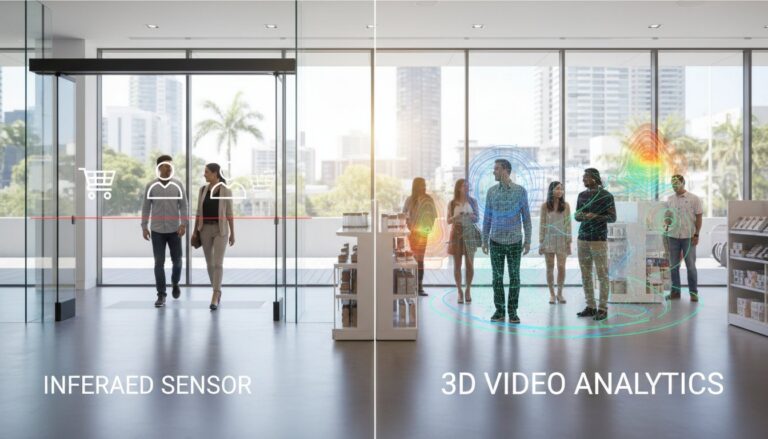
Inaction creates a strategic blind spot that costs more than any technology suite. Consider a major retailer during a 2023 Melbourne CBD event. Their outdated infrared beam counters failed to distinguish between groups and individual shoppers, missing a 15% surge in foot traffic. Because they didn’t see the crowd, they remained understaffed, resulting in an estimated A$14,500 loss in potential weekend revenue. Outdated beam technology often costs a business 40% more in lost opportunities and bad data than the total cost of installing a new AI system. Precise data doesn’t just count people; it identifies the exact moments where your store is failing to convert visitors into customers.
- Infrastructure Efficiency: Using Centroid on existing CCTV reduces installation CAPEX by 60%.
- Data Integrity: AI sensors maintain 98% accuracy even in challenging lighting conditions common in Australian outdoor malls.
- Local Reliability: On-ground support in Australia ensures hardware issues are resolved before they impact monthly reporting cycles.
Industry-Specific ROI Scenarios in Australia
The return on investment for footfall technology isn’t a generic figure; it’s a precise calculation that shifts based on your operational goals. In the Australian market, where labor costs and commercial rents are among the highest globally, the ability to turn raw movement into actionable strategy is a competitive necessity. Whether you’re managing a flagship store in Sydney’s CBD or a regional library in South Australia, the people counter roi is found in the specific inefficiencies you eliminate.
Retailers often see the most immediate impact. By integrating footfall data with Point of Sale (POS) systems, stores can identify their true conversion rate. For instance, a retailer might discover that while footfall is high on Thursday nights, the conversion rate drops by 18% due to inadequate staffing. Adjusting the roster to match these peaks ensures you don’t miss sales opportunities. Additionally, measuring the “capture rate” of window displays allows marketing teams to see exactly how many passersby are enticed to enter, providing a clear A$ value for visual merchandising spend.
- Retail: Aligning staff levels with peak traffic typically reduces wage leakage by 12% while increasing conversion rates by up to 15%.
- Shopping Centres: Proving that a specific corridor receives 25% more traffic than the mall average allows property managers to justify premium lease rates.
- Smart Offices: Companies can reduce their real estate footprint by 20% by identifying zones that remain underutilised throughout the work week.
ROI for Public Sector & Non-Profits
Australian libraries and community centres in cities like Canberra and Adelaide are moving away from manual headcounts toward sophisticated service demand metrics. Accurate data is vital for securing annual government grants, which often exceed A$100,000 for local infrastructure. By proving high dwell times and consistent zone usage, these institutions justify their budget allocations. Using sensors to measure “Cost per Visitor” allows managers to demonstrate the tangible community value of every taxpayer dollar spent, shifting the conversation from simple attendance to deep engagement.
Commercial Real Estate & Property Management
Precision is the foundation of property valuation. Property managers use spatial analytics to transform vague “foot traffic” into hard data that dictates rental yields. Using FootfallCam Pro1 and Pro2 sensors across large-scale precincts provides a granular view of visitor journeys. Heatmapping justifies the ROI of major mall renovations by showing how a new anchor tenant or a redesigned food court redirects flow to previously quiet zones. This evidence-based approach removes the guesswork from lease negotiations, allowing managers to set rates based on verified high-traffic exposure rather than historical estimates.
Data-driven decisions start with the right hardware. Explore our range of Australian-ready sensors to start measuring your facility’s true performance.
In the corporate sector, the ROI is often found in space optimisation. Recent data from 2023 indicates that 35% of commercial office space in Melbourne remains underutilised on any given Tuesday or Wednesday. By identifying these “dead zones” through sensor technology, facilities managers can consolidate floor plans. This doesn’t just save on rent; it slashes utility costs and cleaning fees, providing a payback period on the sensor hardware of less than nine months. It’s a calculated move toward a leaner, more intelligent business model.
Accelerating Your ROI with Footfall Australia
Realising a positive people counter roi requires more than just high-spec hardware. It demands a strategic partner that understands the nuances of the Australian retail and public space environment. Footfall Australia serves as that guide, ensuring your investment translates into measurable financial gains. We eliminate the risk of “dead data” by providing local technical support that keeps sensors online and accurate. If a device goes offline in a Sydney flagship store, our response times are measured in hours, not weeks. This continuity is vital; missing just three days of data during a peak period like the Boxing Day sales can skew your annual conversion metrics by 5% or more.
The Footfall Australia Advantage
Since 2004, we’ve managed the specific challenges of the local market. Our 20 year history means we’ve seen every iteration of spatial analytics and know what works in Australian conditions. We maintain a robust partner network across Perth, Brisbane, and Melbourne, allowing for rapid physical deployment and precise on-site calibration. For businesses struggling with obsolete hardware, our “Legacy Swap Out Plan” provides a streamlined path to modernise. We’ve helped retailers replace failing thermal sensors with 3D LiDAR technology, often resulting in a 12% increase in data accuracy immediately. This plan is a shortcut to ROI, ensuring you don’t waste capital on maintaining systems that no longer serve your strategic goals.
The FootfallCam V9 Software bridges the gap between raw numbers and executive decisions. It’s designed for managers who need answers, not complex spreadsheets. By automating the calculation of conversion rates and dwell times, the software highlights exactly where your floor staff should be positioned to maximise sales. Our clients frequently report a 15% improvement in staff efficiency after implementing these actionable insights. You aren’t just buying a sensor; you’re acquiring a tool that decodes human behaviour into profit.
Building Your Business Case
Securing board approval requires a logical, evidence-based presentation. You need to demonstrate how a 1% increase in conversion rate across ten sites can add A$250,000 to your annual bottom line. We provide the specific data points necessary for these high-level discussions, including:
- Projected payback periods based on current traffic volumes.
- Total cost of ownership (TCO) comparisons against cheaper, less accurate alternatives.
- Staffing optimisations that reduce wage leakage during low-traffic periods.
- Marketing effectiveness metrics that justify promotional spend.
Move from the research phase to a tangible pilot program. Starting with a single site allows you to validate the technology in your specific environment without a massive upfront commitment. Once the data proves the value, scaling becomes a matter of logic rather than luck. Request a free ROI consultation with our Australian team to begin your tailored projection. We’ll help you map out a strategy that ensures your people counter roi is both predictable and sustainable for the long term.
Future-Proof Your Strategy with Data-Driven Precision
Modern retail success in 2026 hinges on your ability to transform raw visitor data into decisive action. You’ve seen how precise conversion metrics and a clear understanding of Total Cost of Ownership define the difference between a simple expense and a high-yield asset. Achieving a sustainable people counter roi depends on the marriage of sophisticated technology and local market expertise. Since 2004, Footfall Australia has helped businesses replace guesswork with evidence-based strategy. We provide local support across all major Australian cities, ensuring your systems deliver the 99.5% accuracy that the FootfallCam Pro2 AI technology is known for. Your investment should yield more than just numbers; it should drive a clear narrative of human movement that leads to higher A$ margins and optimized floor space. It’s time to stop wondering about your store performance and start measuring it with absolute certainty.
Calculate your potential ROI with a Footfall Australia expert today
Your path to a more efficient, profitable business starts with the right data.
Frequently Asked Questions
How long does it typically take to see a positive ROI on a people counter?
Most Australian retailers achieve a positive people counter roi within 3 to 6 months of the initial installation. This rapid return is driven by immediate improvements in labor allocation, often reducing unnecessary staffing costs by 15% during quiet periods. By identifying these specific inefficiencies in the first 90 days, businesses can recoup their A$2,500 investment through smarter operational choices and optimized floor coverage.
Can I calculate ROI if I don’t have an integrated POS system?
You can calculate a clear ROI without POS integration by focusing on labor efficiency and capture rates. Use your manual daily sales records to establish a baseline conversion rate against the total footfall data provided by the sensors. A 5% increase in your capture rate, achieved by refining window displays based on outside traffic counts, provides a measurable financial uplift even without a direct data link.
What is the most important metric for ROI: footfall or conversion rate?
Conversion rate is the most critical metric for measuring financial success because it turns passive visitors into active revenue. While footfall counts quantify your total opportunity, a 1% improvement in conversion typically generates more profit than a 10% increase in raw traffic. Focusing on this metric ensures you’re maximizing the value of every person who enters your space without increasing your marketing budget.
How does people counter accuracy affect the financial return of the system?
High accuracy is essential because it prevents costly staffing errors based on flawed data. A system with 98% accuracy ensures your labor schedules match actual customer demand, avoiding the A$45 per hour cost of overstaffing. If a sensor has a 10% margin of error, you risk missing peak sales periods, which can lead to thousands of dollars in lost annual revenue due to inadequate service levels.
Are there specific Australian tax incentives or depreciation rules for this technology?
Australian businesses can often utilize the instant asset write-off for technology purchases under A$20,000, depending on current ATO thresholds and business turnover. For larger deployments, the hardware is categorized as “Electronic Equipment” for depreciation purposes, usually depreciating at 33.3% per year. For expert guidance on how these Australian Taxation Office rules apply to your specific A$5,000 to A$50,000 investment, you can explore Tax Advisory.
What is the difference in ROI between a basic beam counter and an AI-powered sensor?
AI-powered sensors deliver a 40% higher people counter roi than basic beam counters by providing deeper insights like dwell time and staff exclusion. While beam counters have a lower upfront cost, they can’t distinguish between staff and customers, which skews your conversion data. An AI sensor identifies specific movement patterns, ensuring your strategic decisions are based on genuine customer behavior rather than inflated traffic numbers.
How does the FootfallCam Pro2 reduce the total cost of ownership compared to competitors?
The FootfallCam Pro2 reduces long-term costs by eliminating mandatory monthly software subscriptions, saving your business approximately A$650 per device every year. Its edge-computing design processes data within the unit itself, which removes the need for expensive local servers or high-bandwidth data plans. This streamlined approach lowers installation expenses by 20% and prevents the technical debt often associated with complex, multi-vendor hardware setups.
Is it possible to measure the ROI of marketing campaigns using footfall data?
You can accurately measure marketing ROI by analyzing the specific “lift” in footfall during a promotional window. If a A$3,000 digital campaign results in a 14% increase in store entries compared to the previous month, you can calculate the exact cost per lead. This data-driven approach allows you to stop wasting money on underperforming channels and reallocate your budget to the tactics that drive physical engagement.