The Ultimate Guide to People Counting: Driving Growth with Data in 2026
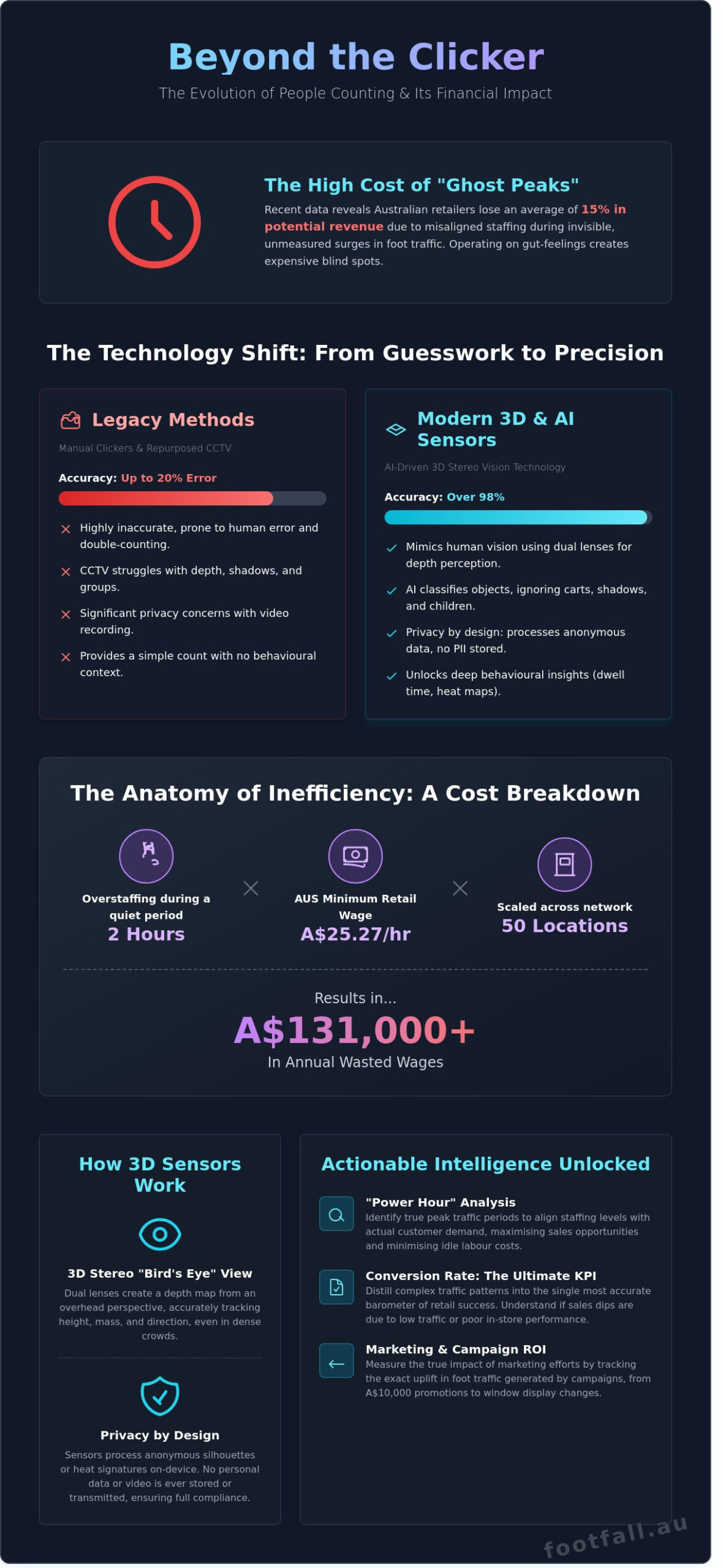
What if your busiest hour isn’t when you think it is, but rather a “ghost” peak that your current reporting simply fails to see? Recent 2024 industry data indicates that Australian retailers lose an average of 15% in potential revenue due to misaligned staffing levels during these invisible surges. You know that managing a physical space requires more than just a gut feeling; it requires the precision that modern people counting technology provides. You’ve likely felt the frustration of a quiet floor during scheduled shifts, only to see conversion rates drop when an unexpected crowd arrives without enough support to close the sale.
In this guide, you’ll discover how to transform raw foot traffic into actionable intelligence to optimise your rosters and drive consistent growth. We’ll show you how to turn anonymous movement into a clear narrative of human behaviour that informs every marketing and operational decision. From measuring the true ROI of your latest A$10,000 campaign to mastering dwell time analytics, we’ll explore the evidence-based strategies that are defining successful Australian businesses in 2026.
Key Takeaways
- Transition from manual tallies to sophisticated AI-driven ecosystems that leverage 3D stereo vision for over 98% accuracy.
- Learn how advanced people counting technology decodes the visitor journey, turning raw foot traffic into actionable data for revenue growth.
- Optimise operational efficiency by using ‘Power Hour’ analysis to align staffing levels with verified peak traffic periods in your Australian venue.
- Master a strategic implementation framework that covers everything from defining business objectives to conducting professional site surveys for optimal sensor placement.
- Future-proof your business with industry-leading hardware and software that transform complex spatial analytics into automated, executive-ready insights.
Beyond the Clicker: Why Modern People Counting is Non-Negotiable
Business leaders often mistake people counting for a simple tally of bodies entering a room. This narrow view ignores the transformative power of modern spatial intelligence. A contemporary People counter functions as a sophisticated business intelligence ecosystem, translating physical movement into structured, actionable data. It marks a definitive shift from the era of manual clickers and subjective “gut feelings” to a period defined by AI-driven precision and automated reporting.
Operating a physical space without this data creates expensive blind spots. In the Australian market, where the Fair Work Commission increased the national minimum wage and award rates by 3.75% on 1 July 2024, labour efficiency is paramount. For a retailer under the General Retail Industry Award 2020, a Level 1 adult earns a minimum of A$25.27 per hour. Overstaffing by just two hours during a quiet Tuesday afternoon costs a business A$50.54 in direct wages alone. Multiply this across 50 locations, and the annual wastage exceeds A$131,000. Automated systems eliminate this guesswork, aligning staff rosters with actual visitor demand to protect narrow margins.
Data serves as the ultimate antidote to business assumptions. High-tech sensors provide the “why” behind your revenue figures, identifying whether a dip in sales stems from low foot traffic or a failure to convert the visitors already inside your doors. This transition from reactive management to proactive strategy allows owners to optimise energy use, cleaning schedules, and security deployments based on verified occupancy levels rather than historical habits.
The ROI of Knowing Your Numbers
Traffic data acts as the essential denominator for every critical retail KPI. You can’t calculate your capture rate or staff-to-customer ratio without an accurate baseline of how many people crossed your threshold. Precision matters here because even a 5% error in traffic data can lead to skewed performance reviews for store managers. Conversion rate represents the single most accurate barometer of retail vitality for 2026, distilling complex foot traffic patterns into a single, actionable percentage of commercial success. By focusing on this metric, Australian businesses can identify high-performing shifts and replicate those winning behaviours across their entire network.
People Counting vs. Traditional CCTV
Repurposing standard security cameras for people counting often results in a significant margin of error, sometimes as high as 15% or 20%. Security systems are designed for wide-angle, horizontal surveillance to identify faces and actions. They struggle with depth perception, frequently double-counting groups or failing to distinguish between a customer and a shadow. Dedicated people counters utilise a “bird’s eye” overhead perspective. These 3D sensors use time-of-flight technology to create a depth map, ensuring 98% accuracy even in crowded entrances where multiple people enter simultaneously.
Privacy remains a cornerstone of the modern sensor approach. Unlike CCTV, which records identifiable facial features and stores sensitive video footage, dedicated counters are built with privacy by design. They process silhouettes or heat signatures locally on the device. No personal data ever leaves the sensor. This allows businesses to gather deep behavioural insights while remaining fully compliant with the Australian Privacy Principles, ensuring customer anonymity is never compromised for the sake of analytics.
The Science of Sight: How 3D and AI Sensors Ensure 98%+ Accuracy
Modern people counting relies on 3D Stereo Vision technology to achieve precision levels that legacy 2D cameras simply cannot reach. These sensors use dual lenses to capture two separate images of the same entrance area. By calculating the minute differences in perspective between these lenses, the device creates a detailed depth map of the environment. This process mimics human binocular vision, allowing the system to determine the exact height, mass, and direction of every object passing through the field of view. Research into scientific methods for pedestrian counting highlights how these multi-view geometries significantly reduce errors caused by overlapping bodies in crowded spaces.
Artificial Intelligence layers on top of this depth data to classify movement with clinical precision. It eliminates the “noise” that historically plagued retail data. Older systems often struggled with environmental shifts, but modern AI algorithms ignore shadows, floor reflections, and dramatic changes in sunlight that occur near glass-fronted Australian storefronts. The sensor doesn’t just see a moving shape; it identifies a human signature. This intelligence ensures that a 98% accuracy rate remains consistent whether it’s a bright summer morning or a rainy afternoon in Melbourne.
3D Stereo Vision vs. Time-of-Flight (ToF)
3D Stereo Vision excels in high-traffic Australian retail environments where ceiling heights often exceed 4 meters. While Time-of-Flight (ToF) sensors measure distance using light pulses, they frequently struggle with reflective surfaces like polished marble or glass partitions found in modern shopping centres. Footfall Australia prioritises 3D Stereo Vision because it maintains high-resolution tracking at mounting heights up to 10 meters. This flexibility is vital for large-scale developments where architectural aesthetics and high clearances are standard.
Filtering Out the Noise with AI
Raw data is only useful if it’s clean. AI-powered sensors use height-based filtering to distinguish between children and adults, ensuring your conversion rates reflect actual potential buyers. Staff wearing specialized AI lanyards are automatically subtracted from the total count in real-time, preventing team movements from inflating footfall figures. Group counting logic identifies clusters of people moving together, such as families or couples, to report on “buying units” rather than just individual bodies. Advanced AI identifies and ignores non-human objects like swinging doors or shifting display banners by analyzing movement patterns and structural volume.
Refining your data at the source prevents the need for manual corrections later. When you remove staff counts and non-human interference, you’re left with a pure stream of customer insight. This level of detail allows managers to trust their metrics when making high-stakes decisions about roster costs or marketing spend. Understanding these technical nuances helps you build a more accurate data strategy for your physical locations. By relying on hardware that perceives the world as humans do, you gain a transparent view of how your space actually functions.
From Traffic to Profit: Decoding the Metrics that Drive ROI
Raw volume tells you the “how many,” but it fails to explain the “why.” Transitioning from basic people counting to a comprehensive visitor journey analysis transforms data into a narrative. This narrative tracks how a customer moves from the sidewalk, through the threshold, and toward the point of sale. Precision matters in this process. Modern sensors leverage deep learning for urban pedestrian counting to ensure that every movement is captured with 98% accuracy. This level of detail allows managers to identify their “Power Hours.” These are the specific 60-minute windows where traffic peaks. If your staff levels remain static while traffic surges, you’re losing money. Aligning schedules with these verified peaks ensures you have your best sellers on the floor when the most wallets are present.
Conversion rate optimisation helps you determine if low sales are a traffic problem or a service problem. If your store in Melbourne’s CBD sees 1,000 visitors but only 50 sales, the issue isn’t marketing; it’s the in-store experience. Dwell time and heatmapping provide the spatial context needed to fix this. You can see exactly which zones drive engagement and which ones act as bottlenecks. If a high-margin display sees 400 passersby but only 10 stops, the visual merchandising requires an immediate update. Data eliminates the guesswork that often leads to expensive floor plan mistakes.
The Conversion Rate Formula for Physical Retail
Integrating FootfallCam data with your POS system is the only way to calculate true conversion. You simply divide total transactions by total visitor count. In the Australian market, benchmarks vary by sector. A high-end fashion retailer in Pitt Street Mall might target a 15% conversion rate, while a pharmacy expects upwards of 50%. Use this data to A/B test your storefront. If a new window display increases street-to-store conversion by 4%, you’ve proven the ROI of your creative spend. You’re no longer relying on “gut feel” to judge a campaign’s success.
Operational Efficiency and Staffing
Understaffing during peak periods creates a “Sales Opportunity Gap.” This is the revenue lost when customers leave because they couldn’t find assistance or the queues were too long. Maintaining an optimal staff-to-visitor ratio, often 1:15 in Australian specialty retail, ensures customers aren’t ignored. A Sydney-based apparel retailer analyzed their 2023 Q4 traffic trends and discovered they were overstaffed on Tuesday mornings but critically understaffed during the Thursday night “late-night shopping” window. By reallocating these hours based on people counting trends, they reduced labour waste by 15% and saw an immediate 9% lift in average transaction value. This strategic shift ensures that A$1 spent on wages generates the maximum possible return.
- Identify Power Hours: Pinpoint the exact times when your store earns the most.
- Calculate Opportunity Gaps: Quantify how much revenue is lost during peak times due to poor staffing.
- Optimise Layouts: Use heatmaps to move slow-moving stock into high-traffic zones.
Implementing People Counting in Australia: A Strategic Framework
Successful implementation of a people counting system requires more than just mounting a sensor to a ceiling. It demands a structured approach that aligns technical capabilities with specific commercial outcomes. Australian businesses that follow a rigorous framework often see a 12% to 18% improvement in operational efficiency within the first six months of deployment. This process transforms raw traffic data into a strategic asset.
- Step 1: Define clear business objectives. Identify the primary driver for the data. A retail chain might focus on increasing conversion rates by 5%, while a public library may require precise visitation numbers to secure A$50,000 in annual government funding. Clear goals dictate which metrics, such as dwell time or path mapping, take priority.
- Step 2: Conduct a site survey. Precision starts with placement. Technicians must evaluate ceiling heights, typically ranging from 2.5 to 4.5 metres, and identify potential obstructions like hanging signage or HVAC ducts. Correct sensor positioning ensures the field of view covers all entry points without blind spots.
- Step 3: Ensure infrastructure readiness. Modern systems rely on Power over Ethernet (PoE) cabling. This simplifies installation by delivering power and data through a single Cat6 cable. Confirming that your local network can support these devices without compromising bandwidth is essential for real-time reporting.
- Step 4: Data integration and dashboard customisation. Raw numbers lack value without context. Integrating people counting data with Point of Sale (POS) systems allows managers to calculate the exact A$ value of every visitor. Custom dashboards should highlight actionable insights, such as peak hour staffing requirements, rather than just total counts.
- Step 5: Continuous monitoring and maintenance. Environmental factors like lighting changes or floor layout shifts can impact accuracy. Regular remote health checks and annual recalibrations maintain the 98% accuracy levels required for high-stakes decision-making.
Privacy and Compliance in the Australian Market
Adhering to the Australian Privacy Principles (APPs) is a legal necessity for any data collection initiative. Modern AI sensors achieve compliance by processing data “at the edge,” meaning they count humans as anonymous moving objects without ever recording or storing personally identifiable information (PII). For public institutions like galleries or council buildings, using anonymous sensing technology protects visitor trust while providing the spatial analytics needed for grant reporting. Transparency is key; clear signage informing visitors that anonymous traffic monitoring is in place helps satisfy both legal requirements and social expectations.
Local Support and the ‘Legacy Swap Out’
Relying on offshore technical support leads to costly downtime. Local Australian technicians provide the hands-on expertise needed for complex installations and rapid troubleshooting across various time zones. Many Australian retailers are currently moving away from outdated infrared beams or thermal sensors, which often suffer from a 15% error margin in high-traffic conditions. Upgrading to AI-driven hardware through a Legacy Swap Out Plan allows businesses to replace inaccurate equipment with precision technology that integrates seamlessly with existing networks. This transition ensures that your historical data remains relevant while your future insights become significantly more reliable.
Ready to move beyond guesswork and start making data-driven decisions? Contact our Australian team today to design a custom framework for your facility.
Future-Proofing Your Space with Footfall Australia
Choosing a people counting provider is a decision that impacts your operational efficiency for the next decade. Footfall Australia acts as a long-term strategic partner, helping you navigate the complexities of physical space management with quiet confidence. We provide more than hardware; we deliver a framework for sustainable growth through evidence-based decision-making. The FootfallCam Pro2 stands as the industry benchmark for precision, capturing data with a verified 99.5% accuracy rate. This ensures your strategic choices rest on a solid foundation of hard evidence rather than inconsistent guesswork.
The FootfallCam V9 Software bridges the gap between raw data and executive action. It generates automated reports that highlight conversion rates and peak traffic periods, allowing regional managers to optimize staffing levels in real-time. This automation saves administrative teams approximately 5 hours of manual data entry per week. For businesses with existing infrastructure, our Centroid solution offers a cost-effective path to intelligence. This AI-powered box connects to your current CCTV network, extracting actionable insights from your existing video streams. This approach reduces electronic waste and lowers initial capital expenditure by up to 40% compared to full system replacements.
The FootfallCam Pro2 Advantage
The FootfallCam Pro2 is engineered for the rigours of the Australian environment. It’s an all-in-one sensor that processes complex human movement patterns locally to protect privacy while delivering high-level spatial analytics. This hardware is built for durability, maintaining peak performance whether it’s facing Perth’s 40°C summer heat or Melbourne’s shifting humidity levels. Key features include:
- Edge Computing: Data is processed on the device, reducing bandwidth usage and enhancing security.
- Seamless Cloud Integration: Access your global or local data from any device, anywhere in Australia.
- Built-in AI: The system distinguishes between adults, children, and staff groups with high-resolution 3D depth sensing.
Comprehensive Support for Peace of Mind
Reliability is non-negotiable in the Australian retail and public sectors. Our support plans ensure your people counting system remains a high-precision instrument throughout its lifecycle. We offer Basic and Premium Support Plans tailored to your operational scale. Premium subscribers benefit from 24/7 remote health checks and proactive firmware updates that keep the AI algorithms sharp. We don’t just sell sensors; we provide the technological eyes required to decode the modern visitor journey. Our team monitors system health to identify potential issues before they impact your data integrity, ensuring your business never flies blind. Book a consultation with our Australian data strategists today.
Master Your Physical Space with Data-Driven Intelligence
The transition from guesswork to evidence-based management defines the next era of Australian retail and public infrastructure. By deploying 3D and AI sensors that guarantee 98%+ accuracy, you’re not just tracking entry; you’re decoding the human narrative within your space. This level of precision allows for the optimization of staff rosters and the refinement of conversion rates based on real-time spatial analytics. Since 2004, Footfall Australia has helped local businesses replace intuition with actionable intelligence. Our local teams in Sydney, Melbourne, Brisbane, and Perth provide the technical foundation to ensure your people counting strategy delivers a measurable return on investment. The future of physical spaces belongs to those who measure them with total clarity. Don’t leave your growth to chance when you can back every decision with hard evidence. It’s time to turn foot traffic into a predictable engine for profit.
Request a Free Data Strategy Consultation for Your Business
Your journey toward operational excellence starts with a single, accurate data point.
Frequently Asked Questions
How accurate are people counting systems compared to manual counting?
People counting systems achieve 98% accuracy, while manual clickers often suffer a 15% margin of error due to fatigue and distraction. High-fidelity 3D sensors eliminate human bias and provide a consistent data stream 24 hours a day. This precision allows Australian managers to trust their conversion rate metrics without second-guessing the input. Hard data replaces the variability of manual tallies, providing a reliable foundation for operational decisions.
Is people counting technology compliant with Australian privacy laws?
Yes, modern people counting technology is fully compliant with the Australian Privacy Principles (APP) and the Privacy Act 1988. Leading sensors use anonymous edge processing, which means they never record personally identifiable information or facial features. Data is converted into numerical coordinates instantly, ensuring your business stays 100% compliant while gathering essential spatial analytics. You gain deep insights into visitor behavior without compromising individual privacy or data security.
Can people counters distinguish between staff members and customers?
Advanced AI sensors distinguish staff from customers by using wearable Bluetooth tags or sophisticated height and shape filtering. These systems filter out 100% of employee movements to ensure your conversion rates reflect true shopper intent. Removing staff noise prevents the inflation of footfall numbers by up to 20% in service-heavy retail environments. This ensures your performance metrics are based solely on potential revenue-generating opportunities.
Do I need to replace my existing CCTV to get accurate footfall data?
You don’t need to replace your CCTV, as people counting sensors operate as a dedicated layer of intelligence above your security infrastructure. While some IP cameras offer basic counting, specialized 3D LiDAR or Time-of-Flight sensors provide 99.5% accuracy that standard security feeds can’t match. Most Australian retailers maintain their existing security while adding dedicated sensors for precise footfall data. This approach ensures maximum data integrity without disrupting your current safety protocols.
What is the typical ROI period for a people counting system in retail?
Most Australian retailers see a full return on investment within 6 to 12 months of implementation. By optimizing staff rosters based on peak traffic, businesses often reduce labor costs by 12% while increasing conversion rates by 5% through better service. A single A$3,000 investment in a high-traffic zone can identify thousands of dollars in missed revenue every month. It’s a self-funding asset that pays for itself through improved operational efficiency.
How does the system handle groups of people or children entering together?
Modern systems use 3D stereoscopic vision to identify individual heads within a group, accurately counting a family of four as four distinct visitors. You can set height thresholds, such as 1.3 meters, to distinguish between adults and children if your strategy requires it. This level of granularity ensures your data reflects the actual volume of people in the space rather than just objects. It provides a clear narrative of how different demographics move through your site.
What infrastructure (like Wi-Fi or power) is required for installation?
Professional sensors typically require a single Power over Ethernet (PoE) cable, which provides both electricity and a secure data connection. This setup eliminates the need for separate power outlets at the ceiling level. If a wired connection isn’t feasible, 4G-enabled gateways provide a plug-and-play solution that operates independently of your internal Wi-Fi network. Installation is usually completed in under two hours per device by a qualified technician, minimizing any disruption to your business.
Can the data be integrated with my existing POS or ERP software?
Yes, people counting data integrates seamlessly with leading POS and ERP platforms through secure API connections. By syncing footfall numbers with your sales data, the system automatically calculates your live conversion rates. This integration transforms raw traffic numbers into actionable insights, showing you exactly how much revenue each visitor represents. It bridges the gap between front-door traffic and final checkout figures for better strategic planning and performance tracking.