How AI People Counting Optimises Business Insights
AI people counting can turn movement through a site into operational data, but that data is useful only when you understand how it was measured. A system’s performance depends on how it is configured and how well its sensing method suits real conditions, such as a busy entrance or an obstructed view.
This guide explains how AI counting detects and records movement, what can affect its results, and how to check whether its metrics and reporting suit your operational needs. It also covers practical privacy questions, including what information a system captures and how it is processed. Use these checks to compare systems and decide whether their insights can support the decisions you need to make.
Key Takeaways
- See how ai people counting can turn movement into measurements that inform business decisions.
- Learn to distinguish metrics such as entries, direction of travel, occupancy and dwell time, and confirm which ones a system actually provides.
- Understand how sensing methods, processing architecture and site conditions affect the data you receive.
- Use practical questions about testing, changing conditions and operational goals to assess whether a system suits your site.
What Is AI People Counting, and What Does It Measure?
AI people counting uses AI-enabled sensors or video analysis to estimate how people move through or occupy a space. The system applies its detection and counting rules to the input it receives. Its output is a set of measurements, not a complete account of individual behaviour, and each result depends on what the system is designed and configured to detect.
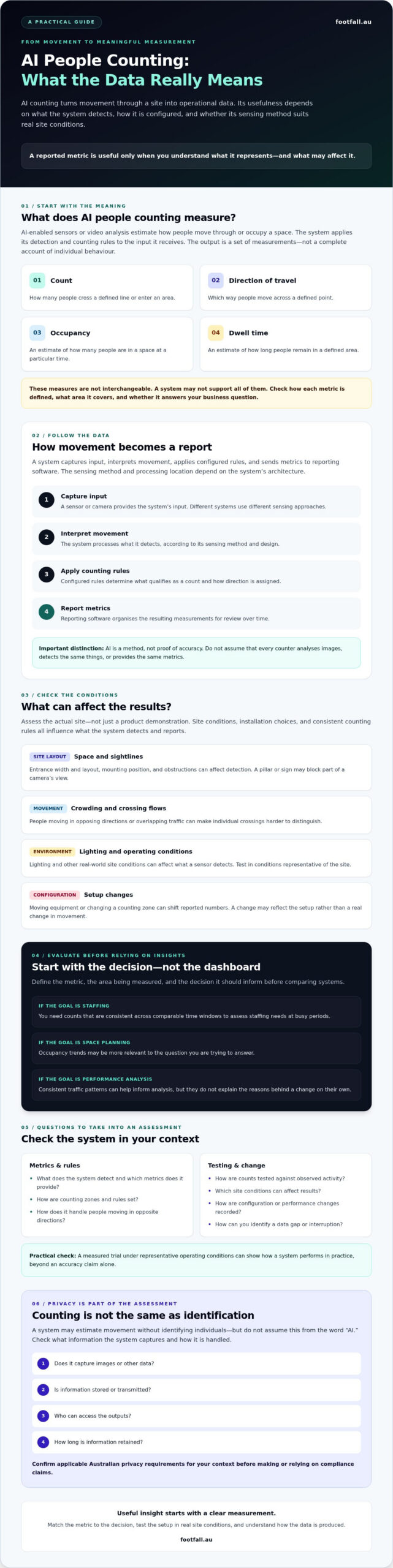
Different metrics answer different operational questions. A count records how many people cross a defined line or enter an area. Direction of travel shows which way they move across that point. Occupancy estimates how many people are in a space at a particular time, while dwell time estimates how long people remain in a defined area. These measures are not interchangeable, and a system may not support all of them. Before comparing options, check how each metric is defined, what area it covers and whether it helps answer your business question. For background on approaches such as density estimation, see Crowd counting.
How Is AI People Counting Different from a Basic Counter?
A basic beam or threshold counter can register when something interrupts a sensor or crosses a detection line. Some AI-enabled systems analyse video or other sensor input to interpret movement, which may help distinguish people and infer direction. Methods vary, so do not assume that every counter analyses images or provides the same metrics.
AI is a method, not proof of accuracy. Results can depend on sensor placement, entrance layout, crowding and system configuration. When comparing options, ask what the system detects, how it handles people moving in opposite directions, and how its measurements are tested in conditions like those at your site. A technical overview of people counting technology can help clarify how sensing methods differ. Check that the metrics reported match the decisions you want to make.
How AI People Counting Turns Movement into Usable Data
AI people counting turns activity in a physical space into reported measurements through a sequence of steps. A system captures input from a sensor or camera, interprets movement, applies configured counting rules, then sends the resulting metrics to reporting software. The sensing method and where processing takes place depend on the system’s architecture. Confirm these details for the specific equipment you are assessing rather than assuming that all products work alike.
For example, a system might register a crossing when someone moves through a defined counting zone. Its rules determine what qualifies as a count and how direction is assigned. Reporting software then organises the results for review over time. Technical designs differ: Texas Instruments’ application note on mmWave radar sensors describes one sensor approach to building people-counting systems. Ask suppliers what input their system uses and how it becomes a reported metric.
A reported metric is useful only when you understand what it represents and what may affect it.
What Conditions Can Affect AI Counting Results?
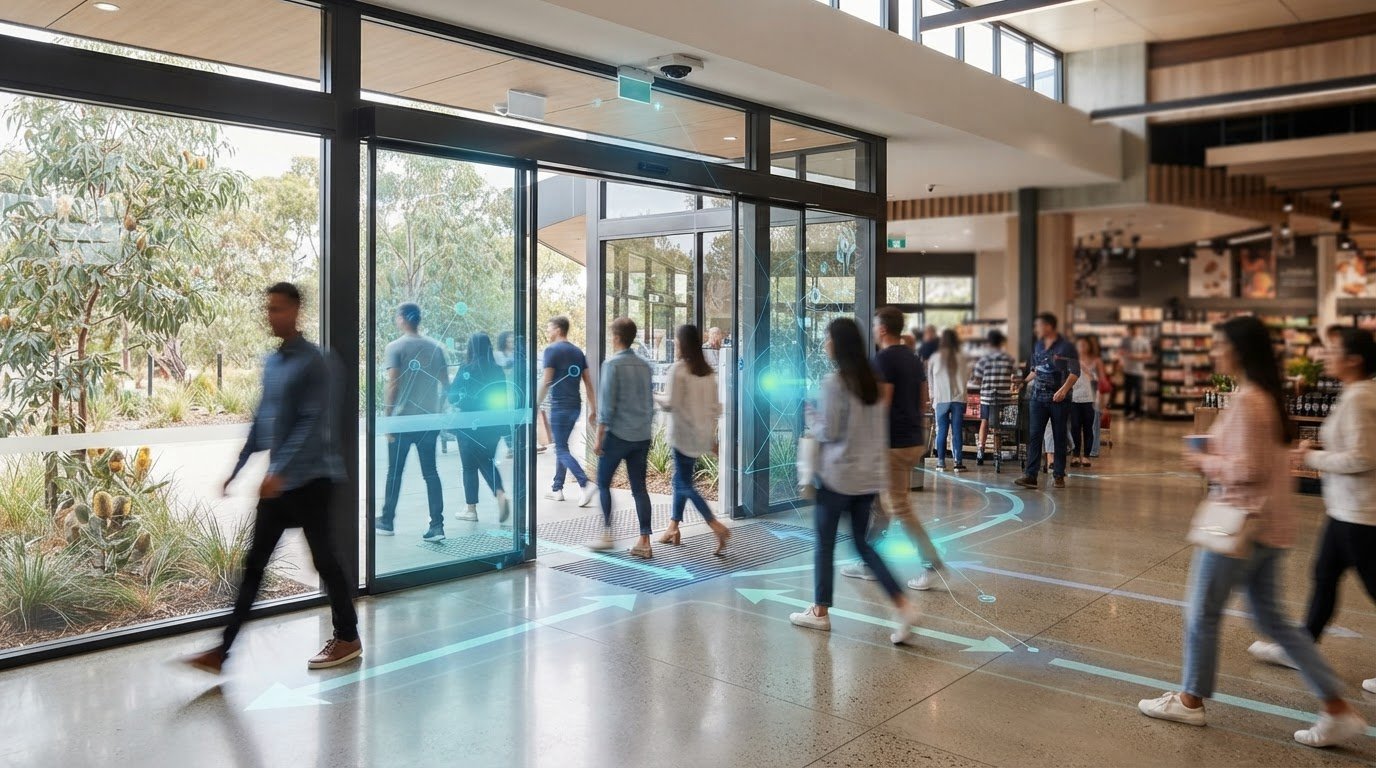
Assess the actual site, not just a product demonstration. Entrance width and layout, people crossing in opposing directions, mounting position, lighting and obstructions can affect what a sensor detects. A pillar or sign may block part of a camera’s view, while overlapping traffic can make individual crossings harder to distinguish.
Installation choices and consistent counting rules also matter when you compare results across days or locations. If equipment is moved or a counting zone is changed, a shift in reported numbers may reflect the setup rather than a real change in movement. Ask how counts are tested under your site’s conditions and how configuration changes are recorded. For further guidance, consult a people counter accuracy guide and review people counting hardware and analytics software as part of your system assessment.
How to Evaluate AI People Counting Before Using Its Insights
Start with a decision, not a dashboard. If you want to assess staffing needs at busy periods, you need counts that are consistent across comparable time windows. For space planning, occupancy trends may be more relevant. Define the metric, the area being measured and the decision it should inform before comparing systems.
Ask suppliers how they test counts against observed activity, which site conditions can affect results, and how they track configuration or performance changes. Find out how counting zones and rules are set, what happens when equipment is adjusted, and how you can identify a gap or interruption in the data. A measured trial under representative operating conditions can show how a system performs in practice, beyond an accuracy claim alone.
Also distinguish counting from identification. A system may estimate movement without identifying individuals, but do not assume this from the word “AI.” Ask what the sensor captures, whether images or other data are stored or transmitted, who can access the outputs and how long information is retained. Confirm applicable Australian privacy requirements for your context before making or relying on compliance claims.
When Can AI People Counting Support Better Decisions?
Consistent traffic patterns can help inform staffing schedules, space planning or performance analysis. They do not explain the reasons behind a change on their own. Interpret the data alongside relevant operational context, and check that the metric supports the decision you are making.
Footfall Australia supplies people counting hardware and analytics software, including FootfallCam Pro2 People Counters, FootfallCam Centroid and FootfallCam V9 Software. The functions, metrics and reporting available depend on the specific products and configuration, so confirm these details when assessing options. Explore Footfall Australia’s people counting solutions to compare them with your site’s requirements.
Turn Site Movement into Better Decisions
AI people counting can make movement easier to measure, but useful insights depend on choosing the right metric and checking how reliably it performs under your site’s conditions. Define the operational decision first, then assess how counts are tested, what might affect the results and what information the system collects. Clear metric definitions and appropriate privacy checks help you interpret reports in context.
Consistent patterns can inform decisions about staffing, space planning and performance. Treat them as evidence to consider alongside other operational context, not as a substitute for understanding why behaviour changes.
Footfall Australia supplies people counting hardware and analytics software as an integrated solution across Australia. To compare its options with your site’s needs and reporting goals, explore Footfall Australia’s people counting solutions.
Frequently Asked Questions
What is AI people counting?
AI people counting uses AI-enabled sensing or video analysis to estimate movement through a defined space. Depending on the system, it may report entries, exits, direction of travel or occupancy. These are not universal features. Ask how each metric is defined and whether it is supported by the hardware and software configuration you are considering.
How does AI people counting work?
A system captures input from a sensor or camera, analyses movement using configured counting rules, then reports the resulting metrics. The process varies by hardware and software. Installation, traffic patterns and site conditions can affect results, so ask how the supplier tests counts and whether validation reflects activity at your site.
Is AI people counting accurate?
AI alone does not guarantee accurate counts. Installation, entrance layout, crowding, obstructions and system configuration can affect performance. Ask suppliers how they test the system, which conditions may limit results and how counts can be checked after installation. Compare accuracy claims only when you understand the test methods and conditions behind them.
Does AI people counting identify individual people?
Not necessarily. People counting is intended to measure movement or occupancy, but capabilities and data handling vary between systems. Do not assume a product identifies people, or rules that out, based only on the term AI. Ask what information is captured, processed, stored and retained, then check which privacy obligations apply to your use case.