How to Ensure Footfall Data Accuracy: The 2026 Strategic Guide
Most footfall data is little more than movement noise that leads to expensive staffing errors and missed conversion opportunities. You’ve likely felt the frustration of looking at reports from different sites and knowing the numbers simply don’t align with reality. This people counter installation guide moves beyond basic hardware mounting to address the core of data integrity at a time when 98% accuracy is the new baseline for AI-driven systems. We understand that you can’t manage what you can’t accurately measure, especially when stakeholder reporting and labor budgets are on the line.
We’ll provide a rigorous framework to help you achieve and maintain 95% or higher data precision across your entire estate. You’ll learn how to navigate the technical transition from legacy infrared sensors to modern 3D analytics while staying compliant with the latest 2026 CCPA and GDPR privacy standards. This guide outlines the specific calibration techniques, AI filtering methods, and maintenance schedules necessary to transform raw counts into a strategic asset that empowers your organizational decisions through empirical evidence rather than intuition.
Key Takeaways
- Establish why 90% data accuracy is the absolute minimum threshold for generating reliable ROI and avoiding flawed conversion metrics.
- Identify the technical limitations of legacy infrared sensors and why 3D stereoscopic vision is required to manage complex group counting.
- Use this people counter installation guide to master environmental calibration, including optimal mounting heights and lighting adjustments for high-contrast areas.
- Implement a rigorous video validation framework to audit system performance and provide transparent evidence for stakeholder reporting.
- Prevent long-term data drift by establishing a structured maintenance lifecycle and utilizing the Legacy Swap Out Plan for aging hardware.
The Strategic Importance of Footfall Data Accuracy for ROI
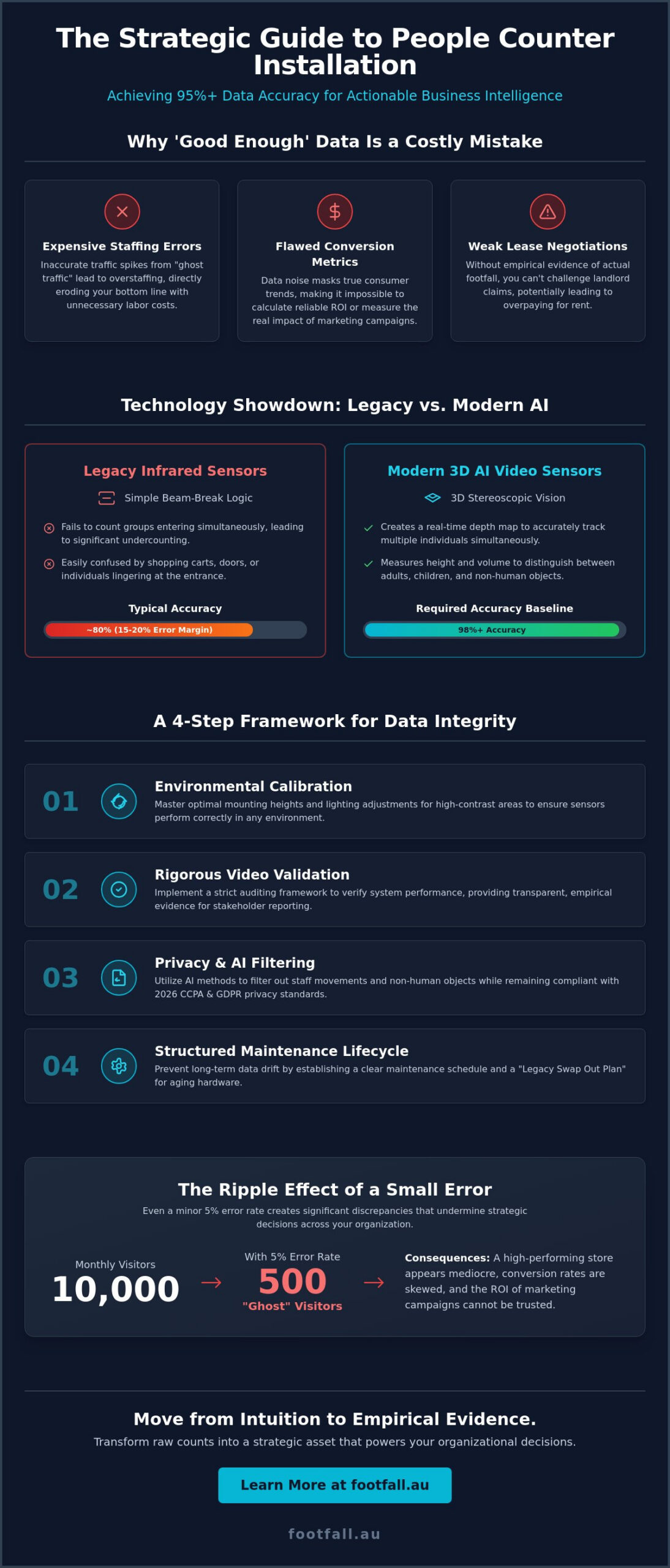
Inaccurate data is often more damaging than no data at all. When organizations rely on flawed metrics, they build their entire commercial strategy on a foundation of “ghost traffic” that doesn’t exist in reality. We’ve found that 90% accuracy is the absolute minimum threshold for actionable business intelligence. Below this mark, the statistical noise in your dataset becomes loud enough to drown out genuine consumer trends, making it impossible to calculate a reliable Return on Investment (ROI) for your physical spaces.
High-precision datasets allow for aggressive labor optimization. If your system incorrectly reports traffic spikes caused by poor sensor placement or environmental interference, you risk overstaffing during quiet periods. This unnecessary labor cost directly erodes your bottom line. Conversely, a robust people counter installation guide helps ensure that your sensors are calibrated to filter out staff movements and non-human objects, allowing you to align your team’s schedule with genuine customer demand. It’s about ensuring every dollar spent on staffing is justified by real-world visitor volume.
Beyond the store floor, precise data serves as powerful leverage in commercial lease negotiations. Landlords frequently cite high foot traffic to justify premium rental rates. When you possess verified, high-accuracy counts, you can challenge these claims with empirical evidence. This transparency protects your organization from overpaying for locations that don’t deliver the promised audience volume. It’s a shift from defensive intuition to offensive, data-backed negotiation.
Quantifying the Cost of Inaccurate Traffic Metrics
The financial impact of a small error is often underestimated. Consider the ripple effect of a 5% error rate on a store with 10,000 monthly visitors. That’s a discrepancy of 500 individuals. When you calculate your conversion rate, that gap can make a high-performing store look mediocre, leading to misguided operational interventions. This error also skews the perceived ROI of national marketing campaigns. If you can’t trust the entry counts, you can’t accurately measure the “pull” of a specific promotion. Building stakeholder trust requires a commitment to people counting technologies that offer verifiable validation and consistent reporting across your entire estate.
Data Integrity as a Competitive Advantage
Moving from intuition to evidence is a hallmark of modern Australian retail management. Organizations that establish a single Source of Truth for their footfall data gain a significant edge over competitors who still rely on anecdotal reports. By following a standardized people counter installation guide, multi-site operators ensure that data is comparable across every location, regardless of ceiling height or entryway width. This consistency is vital for identifying top-performing sites and replicating their success. To understand the broader impact of these metrics on your business strategy, see the ultimate guide to people counting, which explores how to drive growth through data-driven logic in the 2026 market.
Selecting Technology: Why AI Video Surpasses Legacy Sensors
Legacy infrared beam counters served a purpose in the early 2000s, but they’re fundamentally unsuited for the complexities of 2026 retail environments. These devices operate on a simple binary logic: if a beam is broken, a count is recorded. This leads to systemic undercounting when groups enter simultaneously, or overcounting when an individual lingers in the doorway. To move beyond these limitations, a modern people counter installation guide must prioritize sensors that can interpret the physical world in three dimensions. Relying on outdated hardware often results in a 15% to 20% error margin, which is unacceptable for organizations seeking to justify staffing costs based on empirical evidence.
The FootfallCam Pro2 utilizes 3D stereoscopic vision to create a real-time depth map of the entrance area. Unlike standard IP cameras that rely on 2D pixel changes, 3D sensors measure the actual height and volume of objects. This distinction is critical. It allows the system to distinguish between a human being and a shopping cart, or an adult and a child. Much of the academic research on counting accuracy highlights that depth perception is the primary factor in overcoming environmental noise like floor reflections or varying light levels. By filtering out non-human objects, you ensure your data remains a pure reflection of potential customers.
3D Stereoscopic Vision vs. 2D IP Cameras
Depth perception is what allows a sensor to function reliably in high-traffic environments. 2D cameras often struggle with shadows or high-contrast floor patterns, frequently misidentifying a dark shadow as a physical person. 3D sensors are immune to these optical illusions because they calculate the precise distance from the lens to the floor. This technology ensures 95% accuracy even in entryways with wide spans where multiple people might cross the threshold at once. If you’re looking to upgrade your infrastructure, reviewing the specifications of 3D sensors is a vital first step toward data reliability.
Advanced AI Logic and Pattern Recognition
Accurate counting requires more than just seeing; it requires understanding intent. Advanced AI logic filters out “noise” such as U-turns, where a visitor enters and immediately exits, which would otherwise inflate your metrics. Staff exclusion technology is another essential feature. By identifying specific movement patterns, the system ensures employee movements don’t skew customer conversion rates. Integrating these features into a broader people counting systems Australia framework allows for a unified view of performance. This level of sophistication ensures your people counter installation guide leads to a dataset that reflects genuine consumer behavior rather than mechanical errors.
Environmental Calibration: Optimising Installation for Precision
Hardware selection is only the first step in establishing a reliable dataset. The physical environment often presents variables that can degrade accuracy if not properly addressed during setup. A comprehensive people counter installation guide must account for the specific architectural nuances of your space, from ceiling height to the presence of reflective glass facades. Precision relies on how the device interacts with its surroundings; even the most advanced AI sensor will struggle if its field of view is obstructed or if lighting conditions cause significant visual noise.
Mounting height is perhaps the most critical variable in environmental calibration. If a sensor is placed too low, you risk occlusion, where one person blocks the view of another in a crowded entryway. Conversely, mounting a sensor too high can reduce the pixel density required for the AI to accurately distinguish human features. Strategic placement of “counting lines” is equally vital. These virtual thresholds must be drawn to avoid false triggers from passers-by who walk near the entrance but don’t actually enter. For organizations with existing infrastructure, the FootfallCam Centroid allows you to repurpose standard CCTV feeds by applying intelligent video analytics to current streams, effectively turning security assets into high-precision counting tools.
Overcoming Architectural Obstacles
Open-plan foyers and high ceilings require specialized lenses or staggered sensor arrays to ensure full coverage across wide spans. Swinging doors can also create “dead zones” or ghost triggers if the sensor isn’t angled to ignore the door’s mechanical movement. We recommend a people counter installation guide approach that maps the entire entrance width, ensuring that no visitor can bypass the counting zone. This level of planning prevents the data gaps that often plague large-scale retail environments and public spaces.
The Calibration Checklist for Technicians
Technicians should follow a rigorous verification process to stabilize the count. This includes fine-tuning the background subtraction settings, which help the sensor ignore static objects like furniture or display stands. It’s also essential to test the system under varying occupancy levels. A sensor that’s accurate in an empty store might fail during peak Saturday afternoon traffic due to “shadowing” effects. By verifying the sensor angle and testing during both quiet and busy periods, you ensure the system maintains its integrity regardless of visitor density or environmental shifts.
The Verification Process: Auditing Your People Counting Data
Verification is the final, non-negotiable phase of any professional people counter installation guide. While calibration aligns the sensor with its physical environment, auditing proves that the resulting data is actually trustworthy. Many organizations fail at this stage by assuming that a successful hardware mount equates to 95% accuracy. In reality, you must perform Video Validation. This is the process where recorded footage is compared frame-by-frame against the system’s digital count. It provides the empirical evidence needed to reassure stakeholders that your dataset is a precise reflection of human behavior.
Selecting the right sample size is vital for a meaningful audit. Checking a five-minute window isn’t enough to identify systematic errors. We recommend auditing at least 30 to 60 minutes of footage during both peak traffic periods and quiet intervals. This helps you determine if the counter is consistently overcounting or undercounting. If a counter consistently misses 3% of visitors during a crowded Saturday afternoon, it indicates a need for sensitivity adjustments. Using FootfallCam V9 Software simplifies this by generating automated accuracy reports and providing the visual proof required for data integrity standards.
Conducting a Manual Ground-Truth Test
A manual ground-truth test is the gold standard for verification. Technicians record a specific timeframe of entry footage and manually count each individual crossing the threshold. You then compare this manual total to the sensor’s reported count to calculate the variance percentage. If the variance exceeds 5%, you must revisit the sensor angle or counting line placement. Documenting these audits is essential for compliance, especially in sectors where footfall data influences commercial lease costs or government funding. To ensure your hardware meets these rigorous standards, you can request a data integrity audit from our technical team.
Automated Health Checks and Remote Diagnostics
Maintaining accuracy requires constant vigilance beyond the initial setup. Modern systems use automated health checks to flag anomalies, such as sudden data spikes or periods of zero counts that don’t align with store hours. These alerts allow for remote recalibration, often resolving accuracy issues without the need for an expensive on-site visit. Leveraging footfall data analysis helps you spot these anomalies before they impact your monthly reporting. Following a structured people counter installation guide ensures that these remote diagnostics are integrated into your long-term operational strategy, maintaining a high-fidelity dataset as your physical environment evolves.
Sustaining Accuracy: Maintenance and Support Lifecycles
Accuracy isn’t a static achievement; it’s an ongoing commitment to data hygiene. Even the most precise systems can experience “accuracy drift” over time due to subtle environmental changes. A store layout that was optimized during the initial setup might shift as new display units are added or lighting fixtures are replaced. These physical alterations can create blind spots or reflections that challenge the sensor’s AI logic. While a professional people counter installation guide provides the necessary foundation, a structured maintenance lifecycle is what ensures the data remains a reliable asset for years to come.
Hardware obsolescence remains a significant risk for long-term data integrity. Legacy sensors, particularly older thermal or basic 2D units, often lack the processing power required for modern AI filtering and staff exclusion. Our Legacy Swap Out Plan addresses this by allowing organizations to replace aging assets with FootfallCam Pro2 units, instantly restoring precision across the entire estate. Regular firmware updates are equally vital. These updates refine the sensor’s ability to interpret human movement patterns, ensuring your processing logic stays current with shifting consumer behaviors and architectural trends.
Proactive vs. Reactive Support
Waiting for a data gap to appear before taking action is a high-risk strategy that leads to flawed reporting. Proactive monitoring identifies anomalies, such as sudden drops in traffic or sensor connectivity issues, before they skew your monthly conversion metrics. Australian-based partners provide the local expertise needed for regular system health checks, ensuring every device in your network performs at its peak. Our Premium Support Plan offers a safeguard against prolonged outages through priority diagnostics and remote recalibration. Integrating your strategy with comprehensive people counter support transforms your system from a passive observer into a resilient, high-fidelity business intelligence tool.
Future-Proofing Your Data Infrastructure
Scaling a people counting network across national locations requires a centralized approach to maintenance. Consistency is often lost when individual sites manage their own hardware without corporate oversight. By investing in a managed accuracy ecosystem, you ensure that a “visitor” in Sydney is counted using the same rigorous logic as a “visitor” in Perth. Training on-site staff is a simple but effective component of this future-proofing strategy. When employees are trained to recognize and report physical obstructions to sensors, they become active participants in maintaining data quality. This managed approach delivers a superior long-term ROI by protecting the purity of your dataset, allowing you to make high-stakes staffing and marketing decisions with quiet confidence. Adhering to the principles in this people counter installation guide ensures your infrastructure remains a strategic advantage as your organization grows.
Securing Your Data Foundation for 2026
Achieving a high-fidelity dataset requires moving beyond the “set and forget” mentality of legacy hardware. The transition to 3D stereoscopic vision and rigorous video validation is no longer optional for organizations that value empirical evidence over intuition. This people counter installation guide serves as your blueprint for eliminating the “dirty data” that leads to staffing inefficiencies and missed conversion opportunities. By prioritizing environmental calibration and a structured maintenance lifecycle, you ensure that every visitor count reflects a genuine human action rather than mechanical noise.
Maintaining a 95%+ accuracy rate is a continuous process that demands the right technological partners and software infrastructure. With the FootfallCam Pro2 and our proprietary V9 analytics software, you gain real-time monitoring capabilities backed by a national support network across Australia. Don’t let inaccurate metrics undermine your strategic reporting or operational ROI. It’s time to verify your numbers and build a foundation of transparency that empowers your team to act with confidence. Request an Accuracy Audit for Your Current System today and take the first step toward a future of data-driven success.
Frequently Asked Questions
How accurate are modern AI people counters compared to older infrared systems?
Modern AI-based systems like the FootfallCam Pro2 achieve accuracy rates of 98% or higher, significantly outperforming legacy infrared beam counters. Older infrared systems typically average between 85% and 90% because they cannot distinguish between individual visitors in a group. AI technology uses 3D stereoscopic vision to map depth and volume, ensuring that every person is counted as a distinct entity even in dense traffic environments.
Can people counters distinguish between staff members and customers?
Yes, sophisticated systems utilize AI filtering and specific movement pattern recognition to exclude staff from customer metrics. By identifying employees through height thresholds or exclusion tags, the system ensures your conversion rate analysis remains untainted by internal operational movements. This distinction is vital for accurate labor planning and performance benchmarking across multiple sites.
What environmental factors most commonly interfere with footfall data accuracy?
Direct sunlight, high-contrast shadows, and physical obstructions like hanging signs or tall display units are the most frequent causes of data interference. Reflections from glass facades can also create “ghost” counts if the software isn’t properly calibrated. Following a professional people counter installation guide helps mitigate these issues by identifying optimal sensor placement and adjusting sensitivity settings to account for visual noise.
How often should I audit or verify my people counting system?
We recommend conducting a formal video validation audit immediately after installation and at least once every six months thereafter. Regular audits are necessary because environmental shifts or hardware wear can lead to accuracy drift. If your store undergoes a significant layout change or lighting upgrade, an immediate verification check is essential to ensure the counting lines still align with the physical visitor path.
Is it possible to achieve 100% accuracy with a people counter?
While 100% accuracy is technically impossible due to physics and unpredictable human behavior, reaching a 98% precision level is standard for AI-driven 3D sensors. Factors such as extreme crowding or people carrying large objects can create edge cases. However, focusing on a 95% minimum threshold provides a statistically significant dataset that is more than sufficient for making high-stakes commercial and operational decisions.
What happens to data accuracy if my store lighting or layout changes?
Accuracy often degrades when the background environment shifts, as the sensor’s AI logic may still be calibrated to the old layout. Changes in lighting can introduce new shadows that the system might misinterpret as movement. When these changes occur, use the people counter installation guide principles to recalibrate your background subtraction settings and verify that your counting lines remain unobstructed.
How does the mounting height of a sensor affect its counting precision?
Mounting height determines both the field of view and the pixel density available for the AI to process. If a sensor is mounted too low, “occlusion” occurs where taller individuals block the view of those behind them. Conversely, mounting it too high can reduce the system’s ability to distinguish fine details. Adhering to the manufacturer’s specified height range is critical for maintaining the depth perception required for 95%+ accuracy.
Can I use my existing CCTV cameras and still maintain high data accuracy?
You can maintain high accuracy with existing CCTV infrastructure by integrating a FootfallCam Centroid. This device applies advanced AI analytics to your current video streams, effectively upgrading your security assets into precision counting tools. While dedicated 3D sensors offer the highest precision, using the Centroid allows for a cost-effective rollout across large estates while still delivering the sophisticated reporting required for modern retail management.