Optimising Campus Utilisation: A Data-Driven Guide
Did you know that average campus utilization in the US dropped to just 45% in late 2025, even as institutional costs continued to climb? Achieving efficient Campus Utilisation is no longer a matter of guesswork; it’s about translating complex human movement into clear operational intelligence. You likely recognize the frustration of relying on inaccurate manual headcounts in lecture halls or seeing high energy costs drained by underused buildings. It’s a challenge to justify significant capital expenditure when the data to support it feels anecdotal rather than empirical.
This guide will show you how to transform raw occupancy data into strategic campus management decisions that reduce overhead and improve the student experience. We’ll explore how to move beyond intuition by using precise metrics to right-size your facilities and align your physical environment with actual human behavior. By the end of this article, you’ll understand how to bridge the gap between technical innovation and practical application to create a more resilient, evidence-based campus strategy. We’ll examine the specific tools and methodologies required to turn shifting behavioral trends into a sustainable roadmap for your institution’s future.
Key Takeaways
- Shift from static planning to dynamic management by treating campus space as a strategic asset rather than a fixed cost.
- Measure Campus Utilisation with high-precision AI technology to replace the inaccuracies of manual headcounts and traditional sensors.
- Reduce energy and operational costs by synchronising facility maintenance and climate control with real-time occupancy data.
- Improve student satisfaction by implementing live busyness indicators that help students find available study spaces and amenities instantly.
- Ensure complete data privacy and regulatory compliance using anonymous counting methods that align with the Australian Privacy Act.
What is Campus Utilisation and Why Does it Matter in 2026?
Campus Utilisation is the fundamental ratio between actual physical occupancy and the maximum designed capacity of a facility over a specific timeframe. Historically, university administrators viewed space as a fixed asset, managed through rigid timetables and infrequent manual audits. By 2026, this static model has become obsolete. Modern institutions are pivoting toward dynamic, data-driven management to address the “hybrid mismatch” where physical allocations no longer align with actual student behavior. Decisions that once relied on intuition now require empirical evidence to ensure every square metre serves a purpose.
In Australia, the rapid adoption of hybrid learning has fundamentally altered the requirements for what is a learning space. With 90% of universities now maintaining hybrid work and study policies, the traditional “one seat per student” model is financially unsustainable. Space Efficiency has emerged as a critical KPI for leadership, providing a measurable link between facility performance and institutional health. It’s a metric that allows planners to justify existing footprints or reconfigure them to better suit modern pedagogical needs.
The Core Metrics of Campus Utilisation
Precision in measurement requires looking beyond simple headcounts. Effective management relies on three distinct pillars of data:
- Seat Occupancy vs. Room Utilisation: A lecture hall might be “in use” according to the timetable, but if only 20 out of 200 seats are filled, the space is underperforming. Distinguishing between these two metrics prevents the misinterpretation of “busy” rooms that are actually mostly empty.
- Peak Demand Periods: Identifying exactly when capacity is strained helps prevent over-investment in new buildings. Data often reveals that perceived space shortages only occur during narrow windows of time.
- Frequency of Use: This measures how often a space is occupied, identifying rooms that sit empty for days despite being officially booked.
The Cost of Underutilised Space
Underused buildings create a significant financial drain. Every empty lecture theatre represents a “dead cost” in heating, lighting, and maintenance. In the US, the deferred maintenance backlog has exceeded $112 billion, a pressure felt equally across Australian campuses. Relying on inaccurate data often leads to unnecessary capital expenditure on new facilities when existing ones could simply be reconfigured. Beyond the balance sheet, inefficient space management hinders sustainability targets. Heating and cooling underutilised zones increases the carbon footprint, making precise Campus Utilisation data an essential tool for institutional decarbonisation and meeting strict 2026 environmental regulations.
Technology for Measuring Campus Utilisation: From Sensors to Insights
Measuring human movement across a sprawling university environment requires more than simple motion detection. Traditional passive infrared (PIR) sensors, while cost-effective for basic lighting control, often fail to provide the granularity needed for strategic planning. They struggle to distinguish between a single student and a group entering a lecture hall. In contrast, AI-powered video counters like the FootfallCam Pro2 use advanced optics to deliver high-precision data. This technology is central to any modern academic study on classroom efficiency, as it allows administrators to see exactly how many seats are filled in real-time.
For more specialized R&D applications within the university, researchers often utilize high-performance neural interfaces from MindRove to gather deeper data on human-computer interaction and cognitive load in various learning settings.
Integrating Wi-Fi tracking provides a secondary layer of intelligence by monitoring dwell times and movement patterns in open areas like quads or libraries. While video counters provide the “how many,” Wi-Fi analytics offer insights into “how long” and “where to next.” For institutions looking to scale without replacing every camera, the FootfallCam Centroid allows existing CCTV systems to be upgraded with AI capabilities, turning standard security feeds into powerful analytical tools. Effectively managing Campus Utilisation depends on this multi-layered approach to data collection.
AI People Counters: The Gold Standard for Accuracy
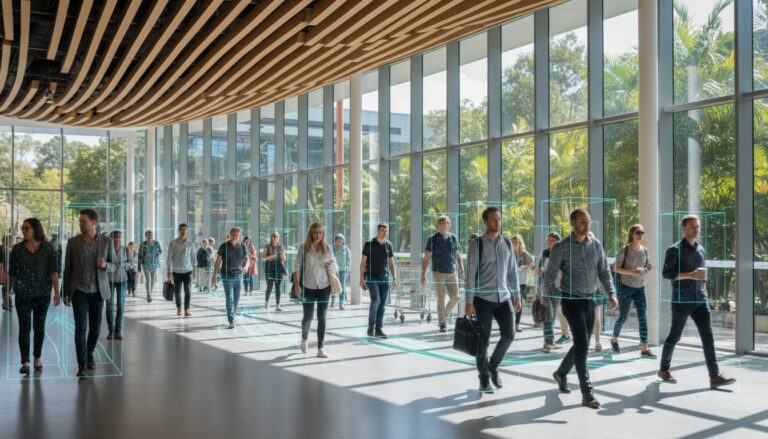
3D binocular vision mimics human depth perception. This allows the FootfallCam Pro2 to filter out inanimate objects like trolleys or shadows, maintaining 98% accuracy even in the dense crowds typical of student unions or main library entrances. You can explore the full capabilities of this people counting technology to understand how these sensors handle complex lighting and high-ceiling environments. To see how these systems fit your specific layout, you might consider reviewing the FootfallCam Pro2 specifications for your next facility upgrade.
Integrating Hardware with Campus Management Software
Raw data only becomes valuable when it’s accessible and actionable. The FootfallCam V9 software aggregates information from across the campus into a single, intuitive dashboard. Facilities managers can use API integrations to sync this live footfall data with room booking systems, automatically releasing “ghost bookings” when a room remains empty. This ensures that Campus Utilisation remains high by making spaces available the moment they’re vacated. The FootfallCam Centroid acts as a digital bridge, enabling legacy CCTV hardware to process modern AI analytics without requiring a full infrastructure overhaul.
Strategic Benefits of Real-Time Occupancy Data
Real-time occupancy data transforms Campus Utilisation from a theoretical metric into a tool for immediate operational savings. Instead of sticking to rigid, time-based cleaning schedules, facilities teams can deploy resources based on actual usage. If a lecture theatre remains empty on a Friday afternoon, there’s no need for a full custodial sweep. This shift toward demand-based maintenance reduces labour costs and ensures high-traffic zones, like student hubs during peak periods, receive the attention they require. It’s about applying logic to physical movement to ensure resources aren’t wasted on empty rooms.
Beyond maintenance, live data significantly improves the student experience. By integrating occupancy sensors with campus apps, universities provide real-time “busyness” indicators for libraries and cafes. This allows students to check seat availability before they walk across campus, reducing frustration and optimising their study time. For university leadership, this empirical evidence is vital for justifying funding requests. When applying for government grants or internal budget increases, having a clear record of facility demand carries significantly more weight than anecdotal reports of overcrowding. This transparency also enhances safety, as automated occupancy alerts ensure areas don’t exceed fire safety capacity limits.
Operational Efficiency and Staffing
Aligning support services with human movement patterns ensures that security and administrative staff are present exactly when and where they’re needed. During peak periods identified by occupancy trends, you can scale security personnel to ensure student safety without overstaffing during quiet hours. Integrating this data with building management systems allows for automated HVAC control. Cooling or heating a 300-seat auditorium for a class of 20 is a common inefficiency that data solves instantly. For more implementation tips, you can explore this strategic guide to footfall data analysis to maximise your operational ROI.
Long-Term Estate Planning
Historical data provides the foundation for predicting facility needs over a 5-10 year horizon. By analysing long-term trends in Campus Utilisation, planners can identify spaces that are consistently underperforming. These areas can be repurposed into high-demand environments, such as collaborative pods or flexible learning labs, rather than committing to expensive new construction projects. This data-driven approach directly aligns with Australian Higher Education standards, ensuring that every capital investment is backed by evidence of actual student need. It turns the physical campus into a responsive environment that evolves alongside shifting pedagogical trends.

Implementing Campus Utilisation Systems: Privacy and Compliance
Implementing a robust strategy for Campus Utilisation often triggers concerns regarding student and faculty privacy. It’s essential to distinguish between security surveillance and anonymous people counting. Modern systems are designed with a “privacy-first” architecture that complies strictly with the Australian Privacy Act and the Australian Privacy Principles (APP). Instead of identifying individuals, these systems use anonymous feature extraction to count silhouettes and movement patterns. This technical distinction is vital; while facial recognition records who a person is, anonymous counters only record that a person is present. This ensures that data remains a tool for optimization rather than an instrument of surveillance.
Transparent communication is the cornerstone of successful implementation. When the student body understands that data collection is used to improve library availability or reduce carbon footprints, the “Big Brother” narrative loses its power. Informing stakeholders about the specific metrics gathered and the anonymity of the process builds trust across the institution. This evidence-based approach ensures the university remains a space of learning and freedom, supported by technology rather than restricted by it. Clear signage and public privacy policies help bridge the gap between technical implementation and community acceptance.
Data Security and Sovereignty
Protecting institutional data requires a focus on where and how information is processed. By utilizing edge computing, sensors process visual information directly on the hardware before any data reaches the cloud. This significantly minimizes risks associated with data transmission and storage. The FootfallCam Pro2 processes data locally at the edge, ensuring that no personally identifiable information (PII) is ever stored or transmitted over the network. This localized approach aligns with the highest Australian standards for data sovereignty and security, providing peace of mind for both IT departments and legal teams.
Installation and Network Integration
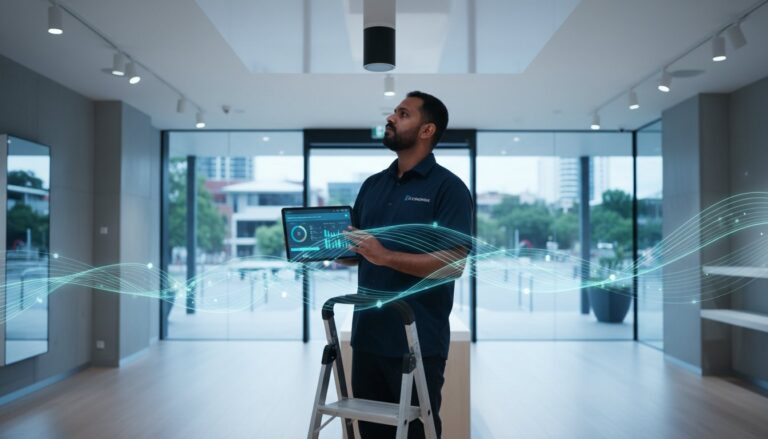
Deployment across a complex campus environment must be efficient and non-intrusive. Using Power over Ethernet (PoE) allows for a single cable to handle both power and data, simplifying the infrastructure requirements for large-scale rollouts. This standard ensures that sensors can be installed in active learning environments with minimal disruption to daily schedules or lecture recordings. For institutions requiring a coordinated national strategy, people counting systems Australia provides the necessary expertise and partner network to manage campus-wide integration. If you’re ready to secure your facility’s future with compliant technology, you can consult with our technical team to plan your deployment.
Why Footfall Australia is the Partner for Campus Excellence
Footfall Australia isn’t just a hardware reseller; we’re a strategic partner with a deep understanding of the Australian higher education landscape. Since 2004, we’ve built a national partner network that provides local expertise and on-ground support for complex institutional deployments. This longevity provides a foundation of reliability that software-only startups cannot match. When managing high-stakes university decision-making, you need a partner that combines technical innovation with two decades of practical application. Our commitment to data accuracy ensures that every decision you make is backed by empirical evidence rather than intuition.
The unique value of our solution lies in the seamless integration of FootfallCam Pro2 hardware and the V9 software suite. This unified ecosystem eliminates the friction often found in fragmented systems where hardware and software from different vendors struggle to communicate. This synergy ensures that the data used to calculate Campus Utilisation is both precise and actionable. We provide the technical means to observe human movement and the intuitive reporting required to turn those observations into a specific, positive change in operations.
Customised Reporting for Educational Institutions
We recognize that facilities managers, registrars, and university executives require different insights from the same data set. Our tailored dashboards speak the language of campus administration, providing automated reporting for TEQSA compliance and internal audits. This level of transparency simplifies the process of justifying space allocation and funding requests. To maintain this precision, our people counter support plans are designed to ensure 24/7 data integrity. This proactive approach identifies and resolves technical issues before they can impact your institutional reporting accuracy.
Getting Started with a Campus Audit
Transitioning to a data-driven model doesn’t require an immediate, campus-wide overhaul. Many institutions find success by starting with a pilot program in a single high-traffic building, such as a main library or student union. This allows you to demonstrate immediate ROI and refine your reporting requirements before scaling. For universities burdened by outdated hardware, our Legacy Swap Out Plan provides a cost-effective path to upgrade to modern AI analytics. If you’re ready to transform your institutional strategy with empirical evidence, contact Footfall Australia for a campus utilisation consultation today.
Securing the Future of the Modern Campus
The transition toward evidence-based management is a vital step for institutions facing rising operational costs and shifting student behaviors. By integrating high-precision technology, you move beyond guesswork and start treating your physical footprint as a dynamic asset. We’ve examined how the 98% accuracy of the FootfallCam Pro2 and local data processing ensure your Campus Utilisation strategy remains both precise and private. These insights don’t just reduce overhead; they fundamentally improve how students interact with your facilities every day.
Footfall Australia has been serving Australian institutions since 2004, providing the reliable data needed for high-stakes decision-making. Our national installation and support network ensures your system remains operational and accurate across your entire estate. It’s time to replace intuition with logic and turn raw occupancy metrics into a sustainable roadmap for growth. Optimise your campus today with Footfall Australia’s expert solutions and build a more responsive, efficient environment for your community.
Frequently Asked Questions
What is the difference between campus utilisation and occupancy?
Occupancy refers to a snapshot of how many people are in a space at a specific moment. In contrast, Campus Utilisation is a broader metric that compares actual occupancy against the total designed capacity of a space over a set period. It helps you understand if a room is being used to its full potential or if it’s consistently underperforming relative to its square footage.
How do people counters handle privacy and GDPR/APP compliance on campus?
Modern sensors ensure compliance by using anonymous feature extraction instead of facial recognition. Hardware like the FootfallCam Pro2 processes visual data at the edge, meaning no personally identifiable information is ever recorded or stored. This approach aligns with the Australian Privacy Principles (APP) and global GDPR standards by focusing on movement patterns rather than individual identities to protect student and faculty anonymity.
Can people counting data be integrated with our existing building management system (BMS)?
Yes, advanced people counting systems offer robust API integrations that allow seamless data sharing with your Building Management System. This connectivity enables you to automate HVAC and lighting based on real-time room usage. By synchronising these systems, you can reduce energy waste in underutilised buildings while maintaining optimal conditions in high-traffic learning environments without manual intervention.
Is it possible to track student flow between different campus buildings?
You can track student flow by deploying sensors at key entry and exit points across multiple facilities. When combined with Wi-Fi analytics, this data provides a clear picture of how students move between lecture halls, libraries, and cafes. Understanding these transition patterns helps you identify physical bottlenecks and optimise the layout of your campus to better support natural human movement throughout the day.
What is the typical accuracy rate for people counters in a crowded lecture hall?
AI-powered 3D sensors achieve an accuracy rate of 98% even in high-density environments like crowded lecture halls. The FootfallCam Pro2 uses binocular vision to distinguish between human silhouettes and inanimate objects, ensuring that shadows or furniture don’t skew your results. This precision is essential for institutional reporting where minor errors could lead to significant miscalculations in strategic space allocation.
How does campus utilisation data help in achieving sustainability goals?
Campus Utilisation data is a primary driver for sustainability because it allows you to identify and decommission or downsize underperforming spaces. By reducing the operational footprint of empty buildings, you directly lower carbon emissions from heating, cooling, and lighting. This data-driven approach ensures that your institution meets environmental targets by only powering the spaces that are actively serving your community.
Can we use our existing CCTV cameras to measure campus footfall?
You can leverage your existing CCTV infrastructure by integrating a FootfallCam Centroid. This device acts as a processing bridge, applying AI counting algorithms to your current video feeds without requiring you to replace your legacy hardware. It’s a cost-effective way to scale your analytics capabilities across the entire campus while maintaining your existing security investments and minimizing new hardware costs.
What are the maintenance requirements for a campus-wide people counting system?
Maintenance is minimal and primarily involves remote software updates and periodic data validation. Systems like the FootfallCam V9 software offer automated health checks to ensure every sensor is online and counting accurately. Institutions can also opt for a Premium Support Plan to receive proactive monitoring and technical assistance, ensuring long-term data integrity without burdening your internal IT or facilities teams.