Visitor Counting for Museums: The Data-Driven Guide to Modern Curation (2026)
Is your museum’s attendance data still reliant on manual clickers and educated guesses? When grant applications worth thousands of AUD depend on hard numbers, ‘close enough’ undermines your mission and leaves valuable funding on the table. The era of anecdotal evidence is over; modern curation demands precision, and the key lies in understanding the true narrative of human movement within your galleries. Effective visitor counting for museums is no longer just about a final tally at the door-it’s about decoding the entire visitor journey with empirical evidence.
This definitive 2026 guide demonstrates how advanced people counting technology transforms museum operations. Discover how to generate automated, 98%+ accurate attendance reports, create compelling heatmaps that reveal your most engaging exhibits, and build irrefutable, data-backed cases for funding acquittals. Prepare to optimise your staffing, secure your financial future, and enhance the visitor experience through actionable spatial intelligence that turns movement into meaning.
Key Takeaways
- Strengthen grant applications to the Australia Council for the Arts with objective, data-driven evidence of your cultural impact and community engagement.
- Move beyond simple entrance counts to measure visitor dwell time, revealing which exhibits truly captivate your audience and which may need rethinking.
- Implement a modern strategy for visitor counting for museums that replaces outdated manual methods with precise, AI-driven technology for institutional transparency.
- Utilise predictive traffic patterns to optimise staff scheduling and resource allocation, ensuring a seamless visitor experience even during peak hours.
The Evolution of Visitor Counting in Australian Museums
The days of staff members standing at the entrance with a mechanical clicker are rapidly becoming a relic of the past. For Australian cultural institutions, the methodology of visitor counting for museums has undergone a profound transformation, moving from manual tallies to sophisticated, AI-driven spatial intelligence. This shift is not merely a technological upgrade; it is a fundamental change in how museums understand their audience, manage their spaces, and justify their public value. As we approach 2026, vague ‘guesstimates’ are no longer sufficient for the level of institutional transparency and operational efficiency that funding bodies and the public expect.
Accurate footfall data is the central nervous system of the modern ‘Smart Museum’ ecosystem. It provides the empirical evidence needed to bridge the gap between artistic vision and operational reality, allowing curators and managers to make informed decisions that enhance the visitor experience while optimising resource allocation.
Why Manual Counting Fails Modern Institutions
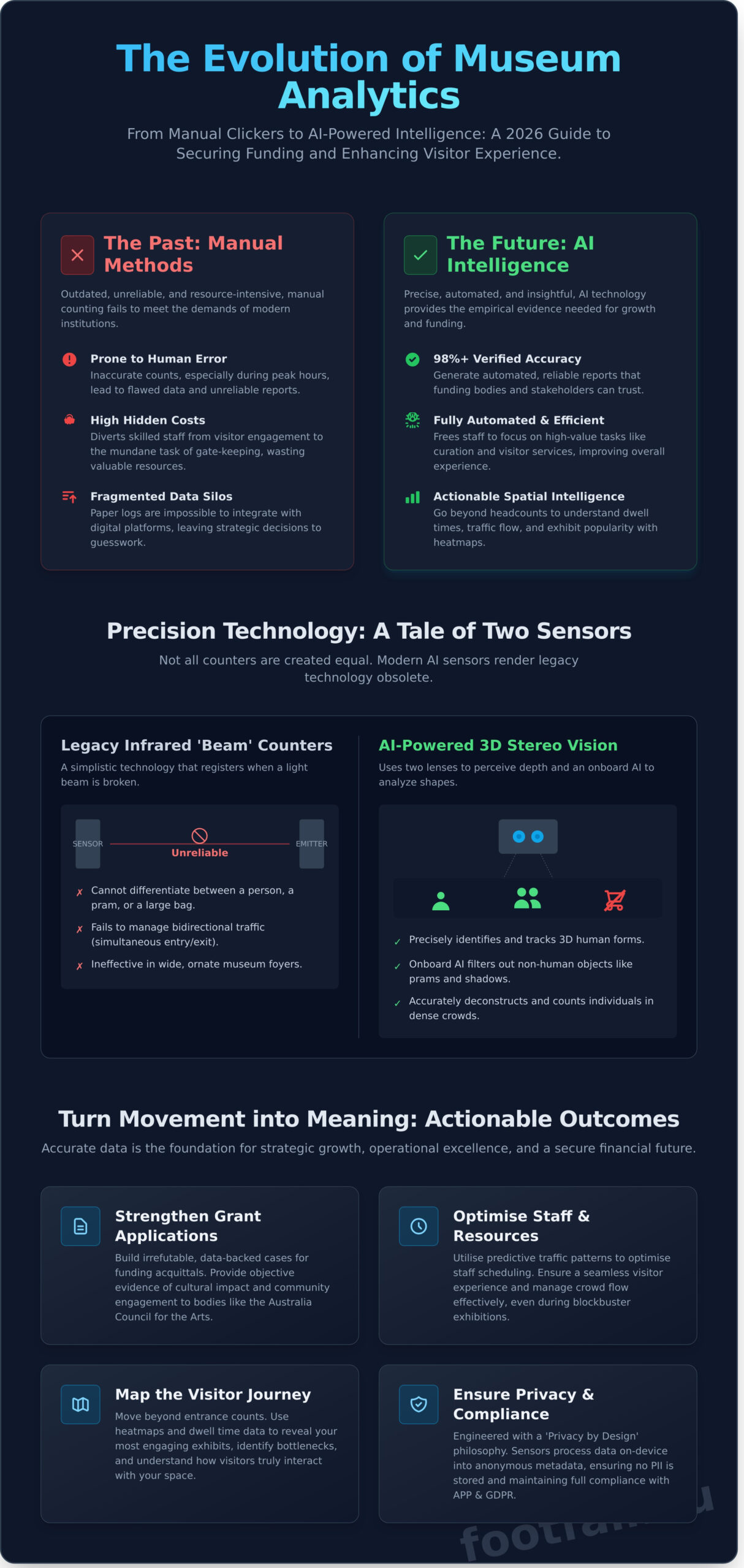
Relying on manual methods introduces significant liabilities. Human error, especially during peak hours or school holidays, leads to inaccurate data, while the hidden cost of diverting skilled staff from visitor engagement to simple gate-keeping is substantial. Furthermore, paper logs create fragmented data silos, impossible to integrate with digital marketing platforms or operational dashboards, leaving strategic decisions to be made in an information vacuum.
The Strategic Value of Footfall Intelligence
True footfall intelligence transcends a simple headcount. It provides a multi-layered understanding of visitor behaviour, including dwell times in specific galleries, popular pathways, and bottleneck areas. This depth of insight is enabled by a range of advanced people counting technologies that deliver precision and reliability. Real-time data enhances situational awareness for safety and crowd management, while building a rich historical dataset becomes the foundation for long-term trend analysis, securing grants, and planning future exhibitions with confidence.
Precision Technology: How AI People Counters Work
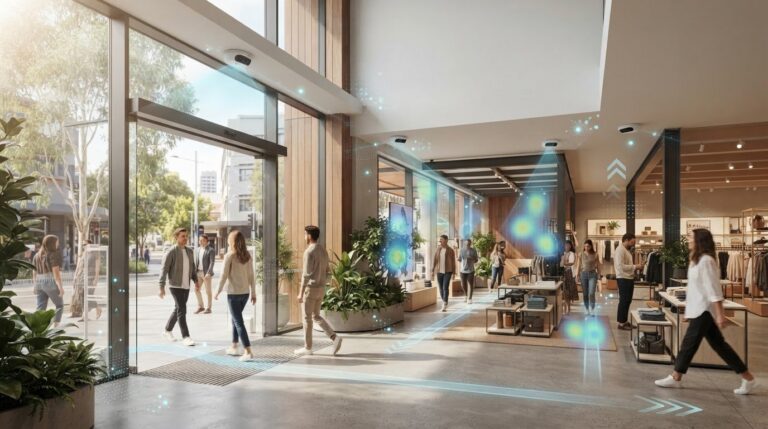
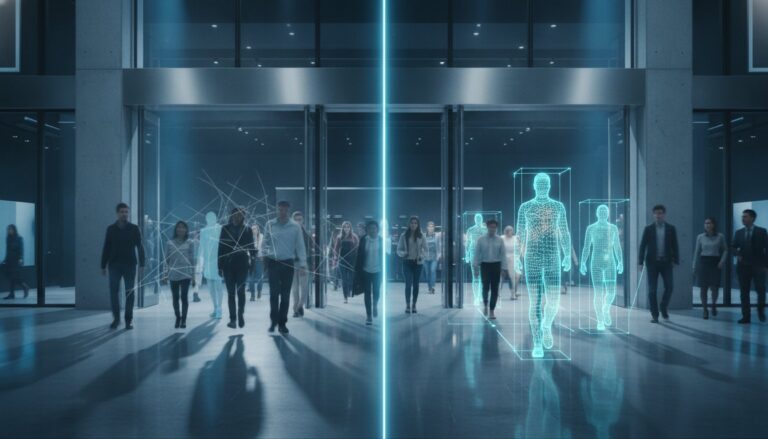
To generate actionable insights, you need precision measurement. The foundation of modern visitor counting for museums is 3D stereo vision technology, powered by sophisticated onboard artificial intelligence. It’s crucial to distinguish this from standard CCTV. While a security camera’s purpose is surveillance and recording identifiable footage, a dedicated people counter is an analytical tool. It uses two lenses to perceive depth-much like human eyes-allowing its AI algorithm to identify and track three-dimensional human forms. This specialised function delivers an independently verified accuracy rate of over 98%, reliably performing in the complex architectural environments of museums with variable lighting, deep shadows, and large, clustered groups.
AI Sensors vs. Legacy Infrared Technology
Legacy infrared ‘beam’ counters, which simply register when a light beam is broken, are fundamentally unreliable in the wide, ornate foyers of museums. A single beam cannot differentiate between a person, a pram, or a large handbag, nor can it accurately manage bidirectional traffic as visitors enter and exit simultaneously. AI-powered sensors render this technology obsolete. By analysing an object’s height, shape, and movement patterns, the onboard intelligence precisely filters out non-human objects and can deconstruct dense crowds during a blockbuster exhibition, ensuring every individual is counted once and only once.
Ensuring Privacy and Compliance in Public Spaces
For any public institution, visitor privacy is non-negotiable. Modern people counters are engineered with a ‘Privacy by Design’ philosophy. The sensors process visual information on the device itself, instantly converting it into anonymous metadata-they track three-dimensional ‘shapes’, not identifiable ‘faces’. No personally identifiable information (PII) is ever stored or transmitted from the sensor. This methodology ensures full compliance with the Australian Privacy Principles (APP) and global standards like GDPR. By focusing on anonymous patterns of movement, institutions can unlock powerful insights into visitor experience and data analytics without compromising ethical obligations. This transparent, privacy-first approach provides the assurance needed to gain confident approval from museum boards, government stakeholders, and the visiting public.
From Entrances to Exhibits: Mapping the Visitor Journey
Effective visitor counting for museums and galleries moves beyond a simple headcount at the door. While total attendance figures are crucial, they only tell the beginning of the story. To truly optimise the cultural experience and operational efficiency, you must map the complete visitor journey, transforming raw numbers into a narrative of movement, engagement, and discovery.
Understanding this narrative allows curators and managers to make evidence-based decisions, ensuring every exhibit resonates and every square metre of floor space serves its purpose. It’s the difference between knowing how many people visited and knowing what they actually did.
Entrance Counting for Compliance and Funding
The foundational layer of data begins at your entrance. High-precision sensors provide automated, reliable attendance figures essential for both safety and strategy. This includes real-time occupancy monitoring to comply with Australian fire safety regulations and manage visitor density. The data seamlessly generates daily, weekly, and seasonal reports, providing the hard evidence needed for grant applications, stakeholder presentations, and strategic planning-distinguishing between weekend tourist peaks and weekday school group surges to optimise staffing and resource allocation.
Interior Analytics and Exhibit Engagement
Once inside, spatial analytics reveal the nuanced behaviours that define the visitor experience. This deeper level of intelligence provides actionable insights that can fundamentally enhance your institution’s layout and impact. By analysing movement patterns, you can refine the physical narrative of an exhibition and ensure your curatorial vision is being realised effectively.
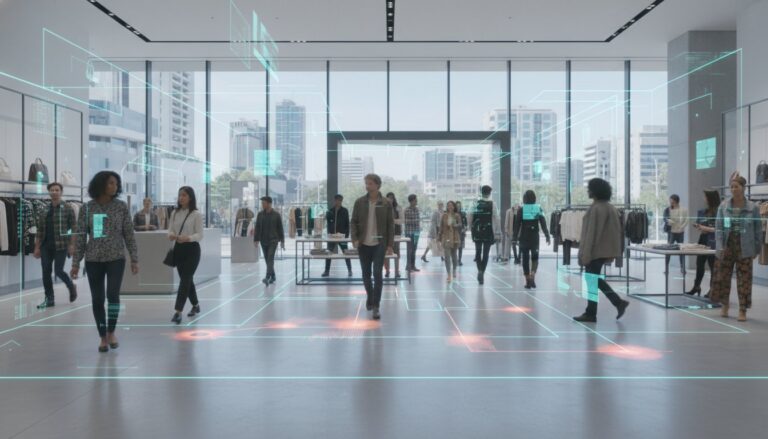
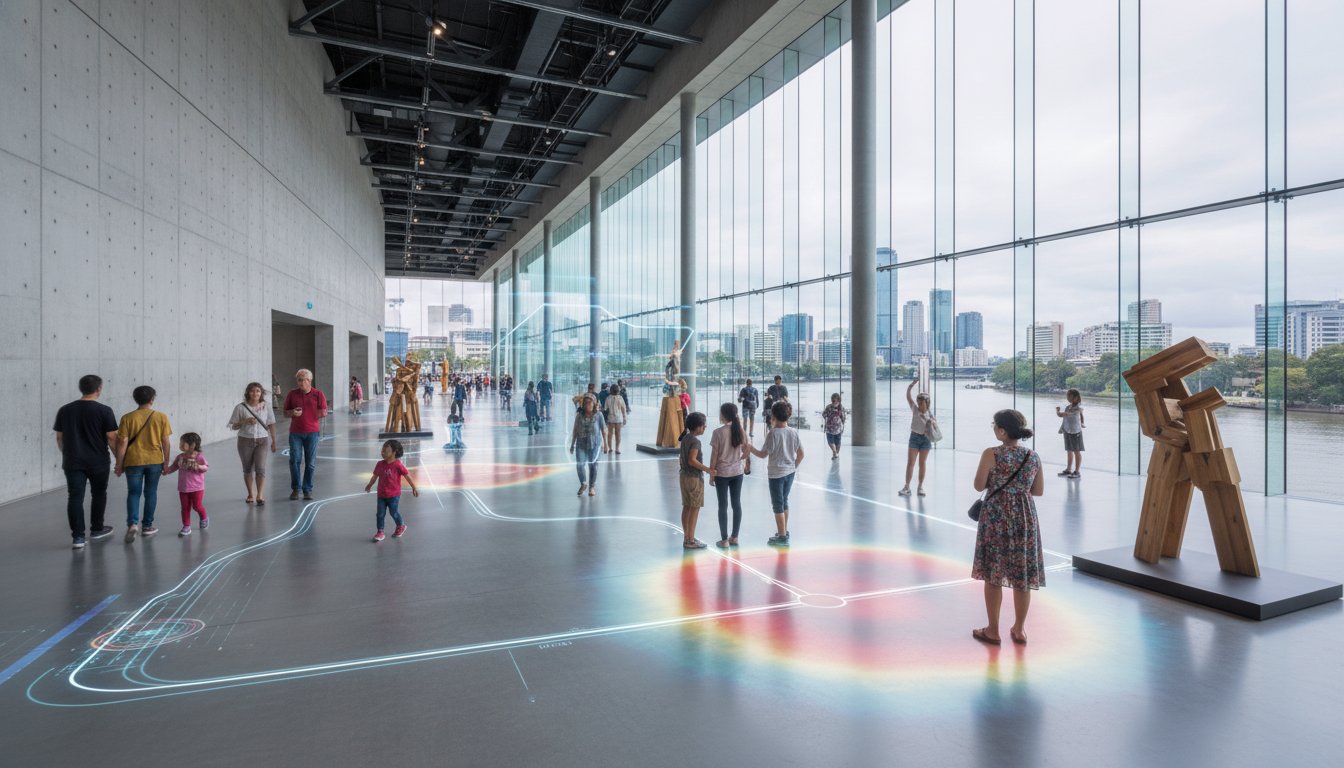
- Heatmapping: Visualise the most popular paths and high-traffic zones within a gallery. This powerful tool instantly identifies which exhibits draw the most attention and, just as importantly, highlights underutilised ‘dead zones’ that may require repositioning or redesign.
- Dwell Time Metrics: Measure precisely how long visitors spend with specific artworks or interactive displays. A longer dwell time often indicates higher engagement and cultural value, providing a clear metric to gauge an exhibit’s success beyond simple footfall.
- Flow Analysis & A/B Testing: Identify and eliminate bottlenecks in your layout that disrupt the visitor journey. You can even A/B test a space-making a minor change, like moving a display case, and measuring the direct impact on visitor flow and interaction over a set period.
Actionable Insights: Using Data for Growth and Funding
Accurate visitor data transcends simple headcounts; it becomes the strategic evidence needed to drive growth, secure funding, and optimise every facet of your operations. For Australian cultural institutions, objective data is the most powerful tool for demonstrating community value and operational intelligence. The true power of modern visitor counting for museums lies in transforming raw numbers into a compelling narrative for stakeholders, from grant bodies to local councils.
A crucial part of this community value is ensuring the museum experience is accessible and welcoming for everyone, including patrons who require disability support. For cultural institutions aiming to strengthen their inclusivity and outreach programs, learning from specialised service providers can be invaluable; to see an example, visit Accessible Care.
Funding Acquittals and Budget Justification
When applying for an Australia Council for the Arts grant or justifying budgets to a local council, objective data is your most persuasive asset. Replace assumptions with evidence by:
- Creating Professional Visualizations: Generate clear, intuitive charts showing peak hours, daily trends, and year-on-year growth for stakeholder reports and grant acquittals.
- Proving Exhibition ROI: Isolate the attendance lift generated by a temporary exhibition to prove its value to sponsors and secure future partnerships.
- Forecasting Future Needs: Use historical traffic data to build accurate attendance forecasts for 5-year strategic plans, justifying facility maintenance or renovation budgets with hard numbers.
Operational Efficiency and Staffing
Move from reactive scheduling to predictive resource allocation. By understanding the precise flow of people through your space, you can align staffing with actual visitor density, not guesswork. This data-driven approach allows you to reduce operational costs during identified low-traffic periods and ensure front-of-house and security staff are exactly where they need to be during peak times. The result is a seamless visitor experience, with reduced queue times at popular exhibits and a more engaged, efficiently managed team.
Ultimately, a robust system for visitor counting for museums and libraries provides the evidence-based foundation for every major decision. It validates your impact, justifies your financial needs, and empowers you to build a more sustainable and engaging institution. Transforming raw numbers into this actionable intelligence is where a dedicated analytics platform from footfall.au delivers exceptional value.
Footfall Australia: Your Partner in Cultural Intelligence
Transitioning from basic headcounts to genuine cultural intelligence requires a partner that understands the unique fabric of Australia’s heritage institutions. At Footfall Australia, we provide more than just technology; we deliver a framework for data-driven decision-making. We combine the high-precision FootfallCam Pro2 sensor with our powerful V9 analytics suite to transform raw visitor data into a clear narrative of engagement, flow, and operational efficiency.
Our commitment is backed by a national support and maintenance network, with dedicated teams ready to assist institutions in Brisbane, Sydney, Melbourne, and across the country. The Footfall Australia difference lies in our approach: we elevate the practice of visitor counting for museums from a simple tally to a strategic tool. We help you decode visitor behaviour to enhance exhibitions, optimise staffing, and build compelling, evidence-based cases for funding and grants.
Hardware Designed for Sensitive Environments
We recognise that the architectural integrity of a museum or gallery is paramount. Our hardware solutions are engineered for discretion and reliability, ensuring the focus remains on your collection, not our technology.
- Discreet Aesthetics: The FootfallCam Pro2 offers versatile and subtle mounting options that respect heritage architecture and blend seamlessly into any environment.
- High Reliability: Our ‘set and forget’ technology provides consistent, high-accuracy data with minimal maintenance, allowing your team to focus on core responsibilities.
- Seamless Integration: Maximise your existing infrastructure by integrating our people counters with current CCTV systems using the FootfallCam Centroid video analytics box.
Advanced Software for Actionable Reporting
Data is only valuable when it leads to informed action. The FootfallCam V9 analytics suite is designed to deliver clear, relevant insights directly to the people who need them, making it the ideal software for visitor counting for museums looking to optimise their operations.
- Customisable Dashboards: Create tailored reports that speak to different roles. Curators can analyse dwell time and exhibit popularity, while operations managers can monitor peak hours and visitor flow.
- Automated Reporting: Schedule daily, weekly, or monthly reports to be delivered directly to key stakeholders, ensuring consistent access to critical performance metrics without manual effort.
Unlock the potential within your visitor data and begin making decisions with quiet confidence. Contact Footfall Australia for a bespoke museum consultation today and discover how we can help you build a more engaging and efficient cultural space.
The Future of Curation is Measured
The era of the simple turnstile is over. As we’ve explored, modern visitor counting for museums has evolved far beyond a simple headcount. The future of Australian cultural institutions lies in understanding the complete visitor journey-from entrance dwell times to exhibit engagement. By leveraging precision AI technology, curators can transform raw footfall data into powerful, actionable insights that justify funding, enhance visitor experiences, and shape the narrative of your space with confidence.
Partnering with an expert is the critical next step. With over 20 years of dedicated Australian expertise, Footfall Australia provides the tools to unlock this cultural intelligence. Our privacy-compliant, non-facial recognition technology delivers a 98% accuracy guarantee, ensuring you have reliable evidence to build a data-driven future for your institution.
Ready to see how precise analytics can redefine your curation strategy? Request a Data-Driven Consultation for Your Museum today and take the first step toward transforming your visitor insights into your greatest asset.
Frequently Asked Questions
How accurate are people counters in museums with high ceilings or low light?
Modern people counters deliver exceptional accuracy, even in challenging museum environments. Our 3D stereo and Time-of-Flight (ToF) sensors are engineered to perform reliably in low light and with high ceilings, achieving over 98% precision. Unlike older technologies, they don’t depend on ambient light. For spaces with significant height, we deploy sensors with specialised lenses to ensure the entire entrance width is captured accurately, providing you with data you can trust for strategic decisions.
Do people counting sensors record video or identifiable faces?
Our systems are designed with privacy as a priority and fully comply with Australian privacy regulations. The sensors do not record video footage or capture personally identifiable information (PII) such as faces. Instead, they detect and track human forms as anonymous data points using technologies like thermal or 3D depth mapping. This ensures visitor privacy is completely protected while providing your museum with precise, actionable footfall analytics without any compliance risks.
Can the system distinguish between museum staff and visitors?
Yes, our intelligent systems can be configured to accurately differentiate between staff and visitors. This is typically achieved by having staff wear a small, discreet tag that allows the sensors to exclude their movements from visitor counts. This ensures your footfall data purely reflects public engagement, providing a more precise understanding of visitor behaviour, peak hours, and exhibit popularity. The result is cleaner data for more effective operational planning and resource allocation.
How does footfall data help in securing government grants in Australia?
Accurate footfall data provides the empirical evidence required for successful grant applications in Australia. Funding bodies like Create NSW or Creative Victoria demand quantifiable proof of community engagement and impact. Our system delivers precise, auditable reports on visitor numbers, peak attendance times, and demographic trends. This hard data substantiates your claims, demonstrating your museum’s value and reach, which significantly strengthens your case for securing vital government and philanthropic funding.
What is the typical ROI for a museum people counting system?
The return on investment extends beyond direct revenue. Museums typically see ROI through significant operational efficiencies, such as optimising staff rosters based on peak traffic, which can save thousands of dollars annually. More importantly, the validated visitor data is instrumental in securing grants, potentially unlocking tens of thousands of dollars in funding. By understanding visitor flow, you can also enhance exhibit layouts to increase engagement and donor potential, making the system a strategic investment in long-term sustainability.
Can the software integrate with our existing ticketing or POS systems?
Absolutely. Our platform is designed for seamless integration with a wide range of third-party systems, including ticketing, Point of Sale (POS), and membership databases. Using a flexible API, we can connect our footfall data with your existing software. This enriches your analytics, allowing you to calculate crucial metrics like gift shop conversion rates, understand ticket sales relative to total visitor traffic, and gain a holistic view of the complete visitor journey from entry to transaction.
Is the hardware difficult to install in heritage-listed buildings?
We understand the unique challenges of installing technology in heritage-listed buildings. Our hardware is compact and designed for discreet, minimally invasive installation. We work closely with your facilities team to utilise existing structures and entryways, often with wireless sensor options to minimise cabling. Our technicians are experienced in complying with the strict regulations governing heritage properties across Australia, ensuring a seamless installation that respects the building’s architectural and historical integrity.
How do people counters handle large groups or school tours?
Our advanced 3D sensors excel at accurately counting individuals within large, dense groups. Unlike basic infrared beams, our overhead sensors view people from above, tracking each person as a distinct object. This technology effectively prevents ‘occlusion’-where one person blocks another from view-ensuring every individual in a school tour is counted precisely. This level of accuracy is fundamental for effective visitor counting for museums, providing reliable data even during your busiest periods.