WiFi People Counter: The Complete Guide to Wireless Footfall Analytics
What if the most important metric for your Australian retail site isn’t who walked in, but the 85% of passersby who didn’t? Most business owners feel the blind spot of street traffic, yet they often hesitate to upgrade due to the A$3,000 price tag associated with retrofitting data cables in older buildings. You’ve likely mastered your internal conversion rates, but without a wifi people counter, you’re missing the broader narrative of the visitor journey happening right outside your window. This technology captures the invisible signals of mobile devices to reveal exactly how many people pass your storefront and how long they linger before entering.
It’s understandable to feel confused by the technical jargon or concerned about privacy regulations in the local market. We’ll clarify the difference between WiFi as a connection and WiFi as a tracking tool, ensuring you understand how to stay compliant with Australian privacy standards. This guide provides a direct comparison between WiFi and video sensors, helping you select the right hardware for your 2026 budget. You’ll gain a sophisticated framework for measuring dwell time and capture rates, allowing you to back every operational decision with hard evidence rather than intuition.
Key Takeaways
- Distinguish between data connectivity and signal “sniffing” to understand how dual-purpose sensors capture previously invisible visitor data.
- Master the mechanics of MAC address tracking and privacy-compliant handshakes to build a foundation of high-precision spatial analytics.
- Evaluate the performance of a wifi people counter against infrared and video sensors to ensure your technology choice matches your specific ceiling height and lighting.
- Identify three critical metrics-including outside traffic and dwell time-that transform raw visitor numbers into actionable strategic intelligence.
- Learn how to modernise your infrastructure by swapping legacy infrared systems for advanced 3D WiFi sensors supported by local Australian expertise.
What is a WiFi People Counter? Connectivity vs. Tracking
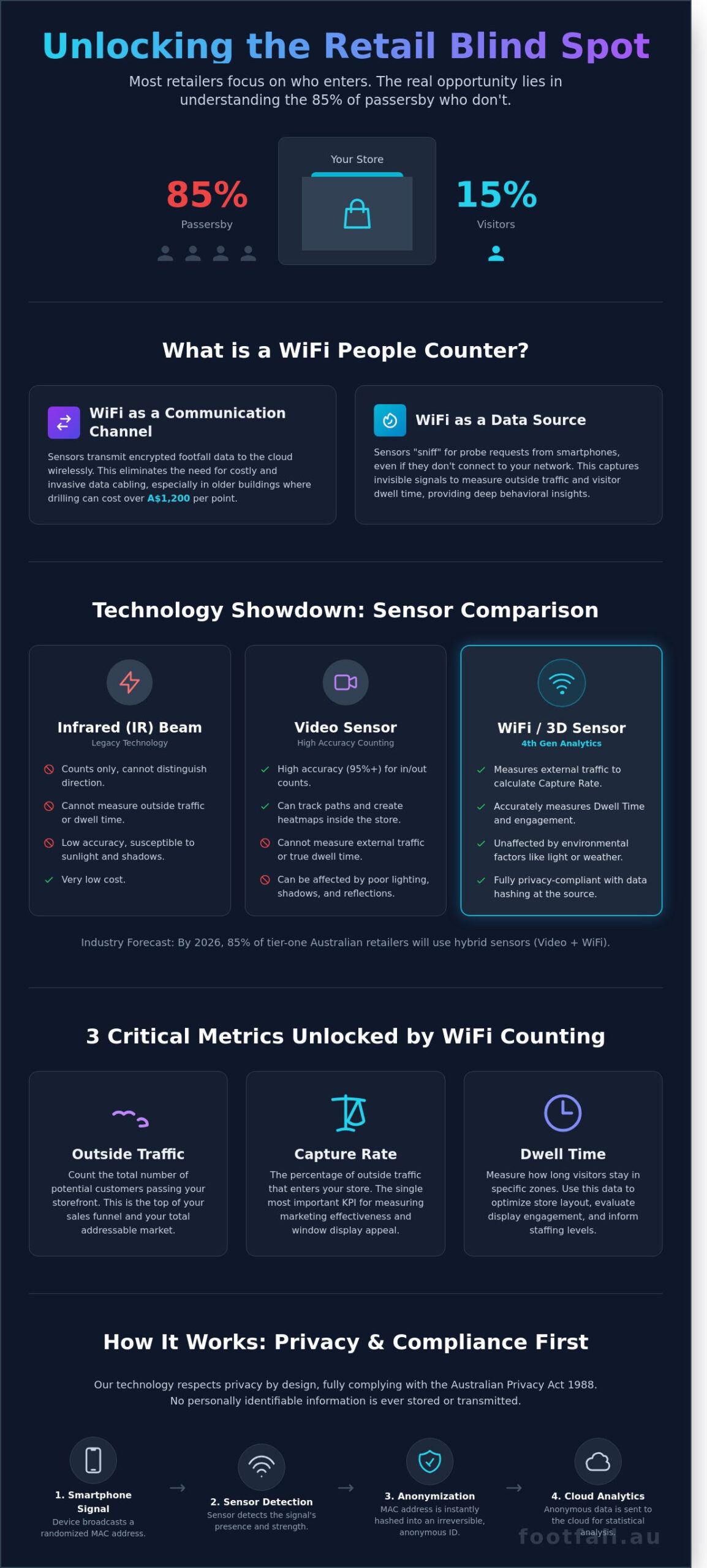
A wifi people counter serves two distinct functions that often confuse new adopters. It acts as both a gateway for data transmission and a sophisticated sensor for signal detection. In the early 2010s, footfall technology relied on simple infrared beams. Today, we’ve entered the “fourth generation” of spatial analytics. By 2026, industry forecasts suggest that 85% of tier-one Australian retailers will deploy hybrid sensors that combine video processing with signal detection to eliminate operational blind spots. This shift represents a move from mere counting to deep behavioral analysis.
WiFi as a Communication Channel
Wireless transmission solves critical infrastructure hurdles for many Australian businesses. In heritage-listed buildings in Sydney or Melbourne where structural drilling costs can exceed A$1,200 per point, WiFi sensors provide a non-invasive alternative. They send encrypted footfall packets to the cloud without the need for extensive cabling. While LoRaWAN offers longer range for vast outdoor sites, WiFi provides the bandwidth necessary for high-resolution data streams. You must ensure your local network supports a dedicated SSID for these devices to prevent bandwidth congestion and maintain data stability.
WiFi as a Data Source
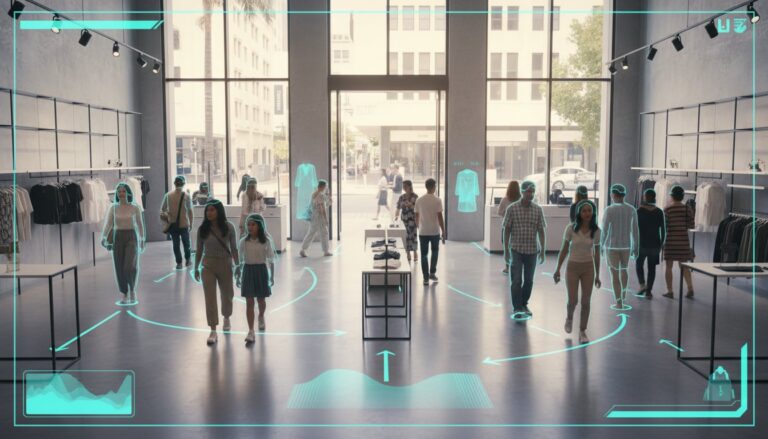
The true intelligence of a modern wifi people counter lies in its ability to detect smartphone signals. Even if a visitor doesn’t join your network, their device broadcasts probe requests to find known access points. This process is the foundation of How WiFi Tracking Works in a commercial setting. When paired with Bluetooth Low Energy (BLE), these sensors capture metrics that cameras alone miss.
This technology is essential for measuring two specific KPIs:
- Outside Traffic: Counting devices that pass your storefront without entering to determine your “Capture Rate.”
- Dwell Time: Measuring how long a specific signal remains within a designated zone to assess display engagement.
Using these signals allows you to decode the visitor journey. You aren’t just seeing a number on a screen; you’re observing human movement patterns. This evidence-based approach helps managers adjust staffing levels based on actual dwell patterns rather than estimated peak hours. It’s a strategic advantage that turns raw signal data into actionable operational intelligence.
How WiFi Tracking Works: Signals, Privacy, and MAC Addresses
Every smartphone carries a unique hardware identifier known as a Media Access Control (MAC) address. When a visitor enters a retail space with WiFi enabled, their device broadcasts “probe requests” to discover available networks. A wifi people counter, like the FootfallCam Pro2, detects these signals to identify the device’s presence. This digital handshake happens automatically. It doesn’t require the user to join a network or enter a password. The sensor simply listens for the signal, allowing it to log the device’s proximity and duration of stay.
Modern mobile operating systems have evolved to protect user identity. Since the release of iOS 14 and Android 10, devices use MAC randomization to rotate temporary addresses. This change ended the era of “deterministic counting,” where a single ID could be tracked indefinitely. Instead, high-level analytics now rely on statistical sampling. By measuring signal strength and probe frequency, the system creates a mathematical model of visitor behavior. This shift ensures data remains accurate while respecting the boundaries of modern device security.
Privacy and Compliance in Australia
Footfall Australia prioritizes data integrity and legal adherence. Our systems strictly comply with the Australian Privacy Act 1988. We use a process called data hashing to protect consumers. This technique converts sensitive MAC addresses into anonymous, irreversible strings of code at the edge of the network. No personally identifiable information is ever stored on the cloud or transmitted to a server. Research into online privacy behavior highlights the importance of secure data handling in public spaces. By following these protocols, WiFi counting remains a non-intrusive, GDPR-compliant method for understanding spatial dynamics.
Accuracy and Normalisation Techniques
Raw WiFi data can be noisy, so we use 3D video counting as a “ground truth” to calibrate the system. The sensor compares physical footfall with signal pings to determine a capture rate. Statistical sampling allows for 95% accuracy in dwell time estimates by correlating signal duration with physical movement patterns. To maintain a clean dataset, the software applies several logic filters:
- Staff Exclusion: The system identifies and removes devices that remain in the store for 8 or more hours.
- Static Device Filtering: Automated rules ignore signals from fixed hardware like smart fridges or wireless printers.
- Signal Thresholding: We set specific RSSI (signal strength) limits to ignore people walking past the storefront.
These layers of refinement turn raw signals into actionable retail insights that help managers optimize staff rosters and floor layouts based on real human movement.
WiFi vs. Video vs. Infrared: Which Technology Wins?
Choosing the right sensor depends on the physical environment and the depth of intelligence required for your operations. A 2023 retail audit revealed that 68% of Australian shopping centres have migrated away from legacy systems to embrace multi-sensor arrays. Performance varies based on ceiling heights, which typically range from 2.4 to 4.5 metres in Australian retail stores, and the width of the entrance. While one technology might excel in a narrow boutique, it may fail in a wide-open mall entrance.
Infrared (Beam) Counters
Infrared sensors represent the entry-level tier of the market. These devices usually cost between A$150 and A$450 per unit. They rely on a horizontal beam of light that triggers a count when broken. If two people walk in side-by-side, the device counts them as a single individual. This limitation leads to a 15% to 20% margin of error in high-traffic periods. They don’t provide directional data, so they can’t distinguish between a customer entering or leaving. Use them only for low-traffic environments like temporary A$2 pop-up stalls or small kiosks where precise conversion rates aren’t the primary KPI.
AI Video (3D) Counters
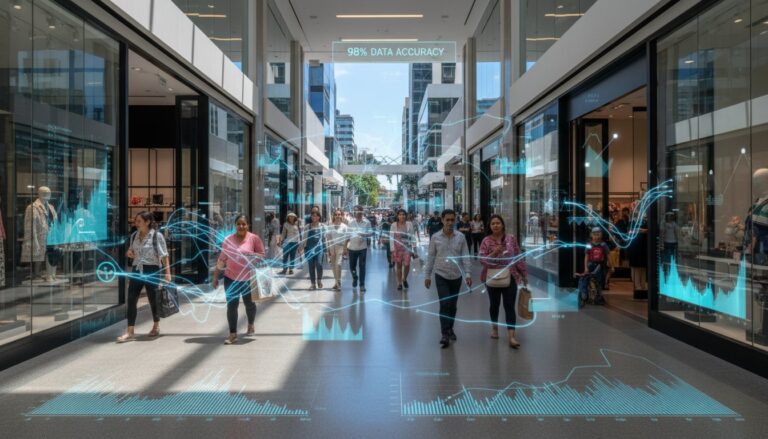
High-precision 3D video sensors are the current industry benchmark for accuracy. They achieve 98% accuracy by using stereoscopic vision to map depth, which allows the system to filter out non-human objects like shopping trolleys, prams, and even shadows. However, video has a physical blind spot. It can’t see through walls or around corners. This is where the wifi people counter fills the critical data gap. By leveraging WiFi-based indoor localization, managers can track the journey of a customer before they even cross the threshold. This technology detects the signal strength of mobile devices to estimate proximity and dwell time.
The FootfallCam Pro2 solves the “visibility” problem by using a hybrid approach. It integrates AI video for precise entrance counting with internal WiFi sensors to capture the “outer” journey. This provides a “Capture Rate” metric that video alone cannot calculate. Consider these advantages of a hybrid system:
- Eliminate Guesswork: Distinguish between a passer-by and a genuine visitor.
- Measure Loyalty: Identify returning MAC addresses to calculate the percentage of repeat customers.
- Optimise Staffing: Use queue management data from the video feed to deploy staff to registers in real-time.
Investing A$800 to A$1,200 in a hybrid wifi people counter unit typically pays for itself within six months. It does this by identifying specific operational leaks, such as high bounce rates or low window display engagement. In the competitive Australian retail landscape, relying on 80% accuracy from a beam counter is no longer a viable strategy for growth.
The 3 Key Metrics Only WiFi Counting Can Provide
Traditional infrared or thermal sensors stop at the door. A wifi people counter looks beyond the threshold to map the entire visitor journey. This data transforms a physical storefront from a static location into a measurable sales funnel. Australian retailers using these metrics often see a 12% to 15% improvement in operational efficiency by aligning staff levels with actual human behavior. It’s about replacing intuition with evidence.
Outside Traffic and Capture Rate
Understanding your total potential audience is the first step toward growth. A wifi people counter detects probe requests from mobile devices as people walk past your Sydney or Melbourne storefront. This allows you to calculate your Capture Rate, which is the percentage of passersby who choose to enter your space. If a Pitt Street retailer sees 10,000 pedestrians but only 200 entries, the 2% capture rate suggests the window display or street signage needs urgent revision. You can also identify “dead zones” in shopping centres by analyzing signal strength drops in specific corridors. This ensures you don’t overpay for leases in areas where foot traffic naturally thins out.
Dwell Time and Returning Visitors
Dwell Time is the primary indicator of customer engagement; it measures the exact duration a visitor remains within a specific zone. Tracking this allows you to compare the performance of high-touch areas, such as fitting rooms, against browsing zones like the shoe department. Data from 2023 retail benchmarks indicates that increasing dwell time by just 10 minutes can correlate with a 20% rise in basket size.
WiFi technology also distinguishes between first-time visitors and loyal, returning customers by recognizing unique device IDs. This distinction helps you measure the success of local loyalty programs without requiring manual surveys. By understanding the frequency of return visits, managers can tailor their inventory and staffing to meet the needs of their most valuable demographic. This level of precision ensures every dollar spent on store layout or marketing is backed by high-quality technical solutions.
Optimize your store performance today with data-driven spatial analytics from Footfall Australia.
Implementing WiFi Counting with Footfall Australia
Footfall Australia delivers the precision of global-leading FootfallCam technology paired with local, on-the-ground support. We help businesses transition from basic tallying to sophisticated spatial intelligence. A wifi people counter isn’t just a hardware investment; it’s the foundation for a data-driven culture that values evidence over intuition.
Our Legacy Swap Out Plan simplifies the transition for organizations currently using 1D infrared or 2D sensors. These older systems frequently under-report traffic by up to 22% in high-density environments. Upgrading to 3D WiFi-enabled devices provides 98% accuracy and enables you to track visitor dwell times and return frequencies. This upgrade is a critical step for businesses aiming to data-proof their operations before 2026.
The V9 analytics dashboard acts as your central command center. It integrates WiFi metrics directly with your point-of-sale data. This allows you to see how foot traffic correlates with revenue, providing a clear picture of your actual conversion rates. It’s about making your data work harder for you.
Local Expertise and Nationwide Support
Our network of local partners extends through Brisbane, Sydney, Perth, and regional hubs. This ensures you have access to physical support when you need it. We don’t just ship hardware; we provide remote calibration services to fine-tune your sensors to the specific layout of your building. Whether you’re managing a local library or a multi-floor commercial office, we customize reporting to meet your specific KPIs.
Getting Started with a Site Survey
Precision starts with a professional site survey. We examine ceiling heights, potential obstructions, and entry flow to ensure total coverage. You can request a comprehensive demo of the FootfallCam Pro2 and the V9 platform to explore the depth of our spatial analytics. Stop guessing and start measuring with a system designed for the Australian market.
Master Your Store Performance with Data-Driven Intelligence
Modern retail management requires more than just counting heads at the door. Deploying a wifi people counter allows you to decode complex human behaviors, such as average dwell times and repeat visitor percentages, that traditional infrared sensors can’t detect. These metrics turn anonymous movement into a strategic narrative. You’ll optimize staff rosters and store layouts based on hard evidence rather than intuition.
Footfall Australia has empowered local businesses since 2004, providing the precision needed to stay competitive. Our FootfallCam Pro2 leads the industry by integrating 3D video, WiFi, and BLE technologies into a single seamless unit. It’s a sophisticated solution backed by local technical support across every Australian state. This ensures your spatial analytics remain accurate and actionable every day of the year. Don’t leave your conversion rates to guesswork when you can rely on proven sensor technology.
Request a Quote for a WiFi-Enabled People Counter to secure a transparent view of your visitor journey. Your path to evidence-based growth is just one data point away.
Frequently Asked Questions
Do visitors need to connect to my WiFi for the people counter to work?
No, visitors don’t need to connect to your network for a wifi people counter to detect their presence. The sensor passively identifies “probe requests” that smartphones broadcast automatically as they search for available networks. Since 91% of Australians own a smartphone, this method provides a reliable sample of traffic flow without requiring any active user engagement or password entry.
Is WiFi people counting legal under Australian privacy laws?
Yes, WiFi counting is entirely legal in Australia when it complies with the Privacy Act 1988. Professional systems use hashing algorithms to anonymize MAC addresses at the edge before any data is stored. This process ensures that no personally identifiable information (PII) is recorded. You should display clear signage as per OAIC guidelines to maintain transparency with your visitors.
How accurate is WiFi counting compared to video counting?
WiFi counting typically achieves 80% to 90% accuracy for total volume, while 3D LiDAR or video sensors reach 98% or higher. The strength of a wifi people counter lies in capturing dwell time and return rates rather than precise door counts. Because some visitors carry multiple devices and others have WiFi disabled, we recommend using this data to understand behavioral trends rather than absolute headcounts.
Can a WiFi people counter track individual people by name?
No, these systems cannot identify individuals by name, email, or phone number. The technology identifies a unique device ID known as a MAC address, which is immediately encrypted into a non-reversible string of characters. This allows the system to distinguish between a new visitor and a staff member without ever knowing the actual identity of the person carrying the device.
Does MAC address randomization on iPhones break the counter?
MAC randomization, introduced in iOS 14, doesn’t break the system but does change how we process data. Modern sensors use advanced fingerprinting techniques to filter out randomized addresses and focus on stable signals. While this reduces the ability to track long-term return visitors over several months, it remains highly effective for measuring daily dwell times and spatial movement within a 24-hour period.
What is the range of a typical WiFi people counter sensor?
A standard WiFi sensor covers a radius of 50 to 100 meters in an open indoor environment. Physical obstructions like concrete walls or metal shelving can reduce this range by 30% or more. For a typical 200-square-meter Australian retail fit-out, a single centrally located sensor is usually sufficient to capture the majority of signal pings from passing and entering traffic.
Can I use my existing WiFi routers as people counters?
You can use existing enterprise-grade hardware from brands like Cisco or Meraki if they support API integration for location services. However, standard consumer routers don’t have the “monitor mode” required to capture probe requests from devices not connected to the network. Dedicated sensors provide 25% better signal sensitivity, which is vital for accurate spatial analytics and pathfinding data.
How much does a professional WiFi people counting system cost in Australia?
A professional setup in Australia typically costs between A$600 and A$1,500 per entry point for hardware and installation. Ongoing software subscriptions for data dashboards usually range from A$40 to A$90 per month. These figures vary based on whether you require basic occupancy stats or advanced heat-mapping capabilities that track the full visitor journey across a large floor plan.