Can I Use My Existing Security Cameras for People Counting? A 2026 Strategic Guide
What if the security infrastructure you’ve already installed across your Australian storefronts could do more than just record footage? With the global people counting market reaching a A$1.3 billion valuation in 2026, the pressure to extract every ounce of value from existing hardware has never been higher. You likely feel the tension between needing precise visitor data and managing the capital expenditure required for new sensors. It’s a common challenge to balance budget constraints with the necessity for evidence-based operational decisions.
This guide provides a clear framework to help you leverage your current CCTV for footfall analytics while maintaining strict compliance with evolving privacy standards. Through a rigorous people counting technology comparison, we’ll examine how tools like AI processors, such as FootfallCam Centroid, can transform standard video feeds into actionable metrics. We’ll also define the tipping point where investing in dedicated hardware like the FootfallCam Pro2 becomes the only logical path for achieving 98% accuracy. You’ll walk away with a strategic roadmap to implement a system that balances cost, performance, and long-term growth.
Key Takeaways
- Learn how to repurpose your existing IP cameras as data collection points by integrating advanced Video Management Software.
- Understand the critical performance differences highlighted in our people counting technology comparison between standard 2D security feeds and 3D stereoscopic sensors.
- Discover how hardware bridges like FootfallCam Centroid allow you to extract sophisticated footfall analytics from legacy CCTV infrastructure.
- Evaluate the operational impact of data accuracy to determine exactly when your Australian business should transition to dedicated hardware.
- Follow a practical two-step framework to audit your current hardware compatibility and select the most efficient analytical software for your site.
Can Security Cameras Perform People Counting? The Short Answer
Yes, your existing security cameras can indeed perform people counting. However, it’s a common misconception that the hardware alone dictates this capability. In reality, the camera functions merely as the “eyes” of the operation, capturing raw visual data. The actual analytical power, or the “brain,” resides in the software layer. For many Australian businesses, repurposing current CCTV infrastructure is a pragmatic first step toward understanding customer behavior without the immediate overhead of a complete hardware overhaul.
When conducting a people counting technology comparison, you’ll find that standard IP cameras, such as the FootfallCam Pro1 IP Cameras, provide a solid foundation for data collection. The challenge arises with legacy systems that lack native intelligence. Unlike modern smart cameras that some competitors claim are sufficient for all needs, older analog or basic digital units require an external processing engine. To bridge this gap, you can integrate a hardware bridge like FootfallCam Centroid or deploy FootfallCam V9 Software to translate standard video streams into structured footfall data. This approach allows for a cost-effective trial of analytics across a national retail network before committing to specialized sensors.
The Evolution of Video Analytics in 2026
By 2026, the industry has shifted decisively toward deep learning object classification. Simple motion detection, which often triggered false counts from shadows or swinging doors, has been replaced by sophisticated AI that recognizes specific human features. Modern systems now distinguish between actual shoppers, staff members, and inanimate objects like trolleys or strollers. This level of detail is essential for maintaining data integrity. While older systems relied on heavy server-based processing, the trend now favors edge computing. This means the analytical work happens closer to the source, reducing bandwidth strain on your local network while ensuring compliance with various people counting technologies and privacy standards.
When Your Existing CCTV is Sufficient
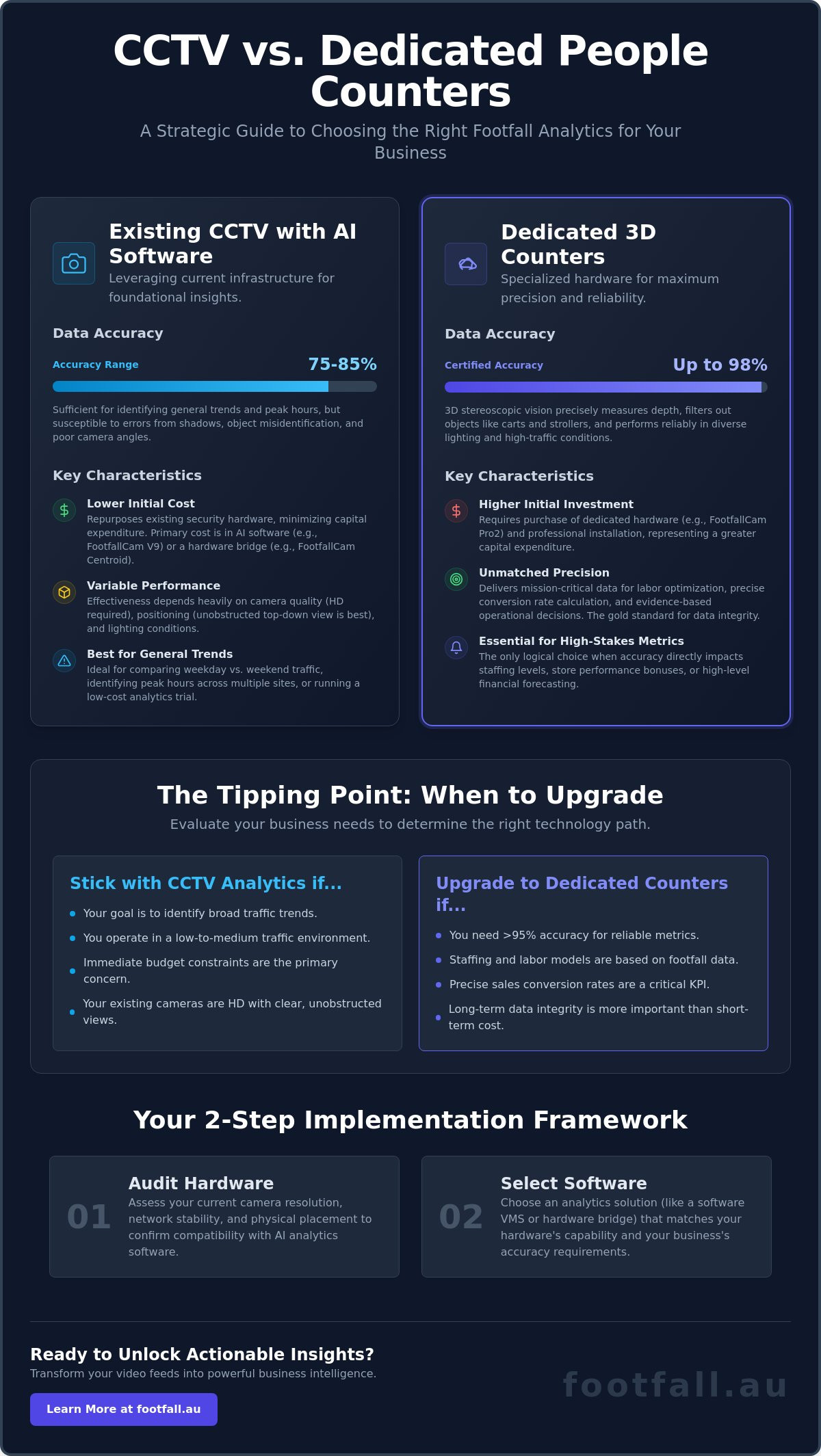
Repurposing your current cameras is often the most logical choice for low-traffic environments where general trends are more valuable than absolute precision. If your goal is to identify peak hours or compare weekday performance across several sites, your existing infrastructure may be “good enough.” However, there are non-negotiable prerequisites. Your cameras must have high-definition resolution and be positioned with a clear, unobstructed view of entry points. Stable network connectivity is also vital; without it, the software cannot receive the consistent stream required for reliable reporting. For businesses that don’t require 99.5% accuracy for labor modeling, this software-driven approach offers a balanced people counting technology comparison against higher-cost alternatives. To ensure your hardware is correctly positioned and integrated for these advanced analytics, you can learn more about Peninsula Smart Care and their expert installation services.
The Technical Mechanism: How CCTV Cameras Count People
Converting a visual feed into a stream of reliable data requires more than simple motion sensing. Modern systems utilize advanced algorithms to identify specific human features, primarily focusing on head and shoulder patterns. This geometric recognition ensures the system doesn’t count shifting shadows or swinging doors as visitors. While some basic systems claim head detection is the only metric needed, a true people counting technology comparison reveals that multi-point feature recognition is far more resilient against errors in crowded Australian retail environments.
Once the system identifies a human shape, it tracks that object across a digital grid. You define virtual lines or detection zones within the camera’s field of view that act as “tripwires.” When the identified object crosses this line in a specific direction, the system registers an entry or exit. This process relies on background subtraction techniques; the software constantly learns the static environment, such as flooring and furniture, to isolate and ignore anything that isn’t a moving human.
The final stage is data transmission. Processing high-resolution video is resource-intensive, so sophisticated systems convert video frames into numerical metadata at the source or via a local bridge. This ensures that only tiny packets of data, rather than heavy video files, are sent to your cloud dashboard. This efficiency is a hallmark of professional dedicated people counters and high-end CCTV integrations alike.
VMS vs. AI Bridge Processing
You have two primary paths for processing these analytics. Software-only Video Management Systems (VMS) run algorithms on a local server, which can strain your existing network if handling multiple high-definition feeds. Alternatively, an AI hardware bridge like FootfallCam Centroid offloads this processing locally. This “edge” approach prevents lag and ensures your security recording remains uninterrupted while providing real-time footfall metrics. Choosing the right processing method is a critical step in building a data-driven retail strategy that remains scalable.
Lighting and Environmental Variables
Standard security cameras often struggle with high-contrast lighting at store entrances. Shadows or bright glare can obscure the head and shoulder patterns the software needs to see. Utilizing cameras with Wide Dynamic Range (WDR) is essential to balance these light levels. While indoor environments are generally controlled, outdoor or semi-outdoor Australian spaces require more robust algorithms to manage wind-blown debris or rapid weather changes that standard CCTV isn’t always equipped to handle. These variables highlight why empirical testing is necessary before a full-scale rollout.
Security Cameras vs. Dedicated People Counters: An Accuracy Comparison
Choosing between repurposed hardware and specialized sensors often comes down to the required level of data precision. A comprehensive people counting technology comparison shows a significant performance gap between these two approaches. While standard IP cameras provide a cost-effective entry point, they typically deliver accuracy rates between 60% and 85%. In contrast, dedicated sensors like the FootfallCam Pro2 achieve up to 99.5% accuracy. This discrepancy stems from the fundamental difference between 2D video processing and 3D stereoscopic vision.
Standard security cameras capture a flat, two-dimensional image. When two people walk closely together, the software often sees them as a single larger mass; this phenomenon is known as occlusion. Dedicated sensors solve this by using dual lenses to perceive depth. This spatial awareness allows the device to distinguish between individuals even in high-density crowds. This technical hurdle is well-documented in Loughborough University research on camera counting accuracy, which highlights how visual-only systems struggle with overlapping subjects.
The Challenge of Oblique Angles
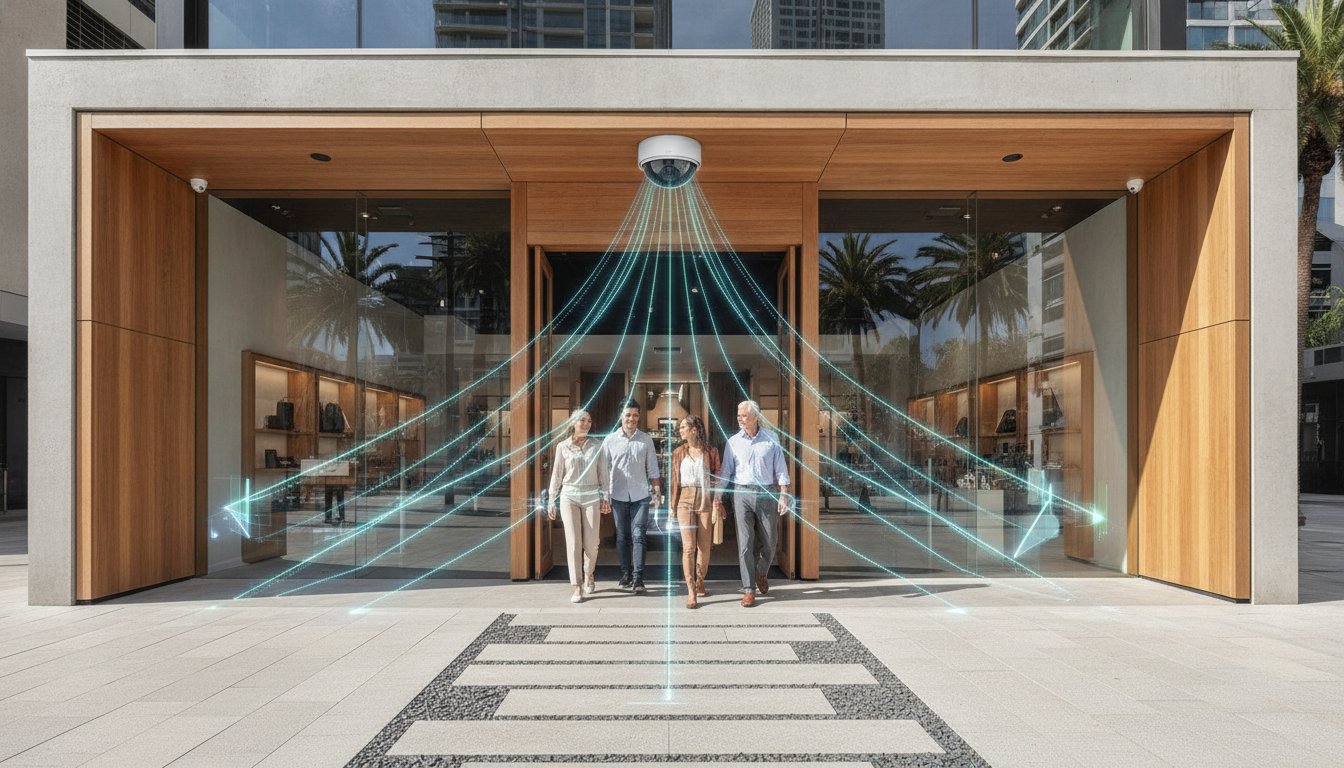
Security cameras are almost always installed at an oblique angle, usually in a corner or high on a wall to maximize surveillance coverage. This perspective creates significant distortion for counting algorithms. Because the camera sees people from the side, it’s difficult for the software to accurately filter by height or differentiate between an adult and a child. For a counting system to be reliable, it requires a top-down, “bird’s eye” view. Repurposing CCTV for this purpose often requires physically moving the camera to a position directly over the entrance, which may compromise its original security function.
Data Granularity and Advanced Metrics
Precision is the foundation of utility. If your data has a 15% error margin, you cannot confidently use it for staff scheduling or calculating conversion rates. Dedicated sensors provide much more than simple entry and exit numbers. They enable advanced metrics such as dwell time, queue management, and heatmaps that reveal how customers move through your space. When defining your people counting technology goals, consider whether you need basic trends or the granular insights required to optimize labor costs and store layouts. Staff exclusion features, which prevent employees from inflating your counts, are also significantly more reliable on 3D hardware.
How to Implement People Counting via Existing CCTV Infrastructure
Implementation begins with a technical audit. First, verify that your current cameras support the Open Network Video Interface Forum (ONVIF) standard and provide at least 1080p resolution. High-definition clarity is non-negotiable for the software to distinguish human features effectively. Second, decide on your processing architecture. While some businesses opt for software-based Video Management Systems (VMS), others prefer a dedicated hardware bridge to offload the analytical burden from their security servers. This choice is a central part of any people counting technology comparison, as it dictates the scalability of your entire network.
Once the hardware is confirmed, you must configure detection zones. This involves drawing virtual boundaries in the video feed to ensure you only count individuals entering the premises, effectively ignoring those merely walking past the storefront. Following configuration, perform manual video audits. Compare the system’s digital count against a physical count of the same footage to calculate your accuracy variance. Finally, link your processed metrics to a footfall data analysis platform to begin generating reports on peak traffic and conversion rates.
The Bridge Approach: Using FootfallCam Centroid
The most efficient way to upgrade your existing CCTV system is through an AI bridge. Unlike traditional VMS setups that require complex manual configuration for every camera, the FootfallCam Centroid acts as a central intelligence hub. It connects to your existing IP cameras via the local network and applies advanced deep-learning algorithms to the raw video streams. This approach allows you to manage multiple feeds through a single device, providing enterprise-grade analytics without the cost of replacing perfectly functional security hardware.
Privacy and Compliance in Australia
Operating a visual counting system in Australia requires strict adherence to the Privacy Act. To maintain compliance, prioritize systems that process data at the “edge.” This means the video is analyzed locally and immediately converted into anonymous numerical data, ensuring no identifiable footage is stored or transmitted to the cloud. This privacy-first architecture is a key factor in a modern people counting technology comparison. Always ensure your premises feature clear signage informing visitors of data collection practices to maintain transparency and public trust. For a tailored assessment of your current infrastructure, consult with our technical specialists to ensure your deployment meets all local regulatory standards.
Strategic Decision: When to Upgrade to Dedicated Sensors
Deciding between repurposed security cameras and specialized sensors is ultimately a financial calculation. While software-based analytics provide a low-cost entry point, the data’s utility depends on its reliability. A people counting technology comparison often highlights that a 15% error rate, common in repurposed CCTV, can lead to significant operational losses. If your staff scheduling is based on inaccurate footfall figures, you’ll likely face either excessive labor costs or lost sales due to understaffing during peak hours.
Precision isn’t just a technical metric; it’s the engine of your ROI. High-accuracy data is non-negotiable for effective retail footfall analysis Australia. By investing in dedicated hardware, you eliminate the guesswork associated with oblique camera angles and lighting variations. Many successful Australian retailers adopt a hybrid strategy: they maintain their existing CCTV for security and loss prevention while deploying dedicated 3D sensors at key entrances for business intelligence. This ensures the best of both worlds without compromising data integrity. To keep these systems running at peak performance, leveraging professional people counter support is essential for ongoing calibration and software updates.
Future-Proofing Your Analytics
The Australian retail landscape in 2026 demands more than just entry counts. Future-proofing your facility involves moving toward 3D stereoscopic technology that can handle complex human behaviors. Integrating these sensors with Wi-Fi tracking allows you to map the entire customer journey, from the storefront to the point of sale. This layered approach prepares your business for AI-driven predictive analytics, allowing you to forecast visitor trends based on historical evidence rather than intuition. A people counting technology comparison shows that only high-end sensors provide the stable data foundation required for these advanced machine learning models.
Next Steps for Your Facility
The path forward starts with an objective evaluation of your current assets. Conduct a thorough site audit to determine if your existing CCTV placement is suitable for a software-driven trial or if an AI bridge like FootfallCam Centroid is the more efficient route. We recommend requesting a live demo of the latest people counting technology to see the accuracy difference firsthand. For a customized national implementation plan, contact a specialist who understands the unique requirements of the Australian market and can help you bridge the gap between security and strategy.
Optimising Your Infrastructure for 2026 and Beyond
Leveraging your current security hardware for footfall analytics is a pragmatic strategy for Australian businesses looking to validate the utility of visitor data. This people counting technology comparison illustrates that while standard CCTV provides a functional foundation, the transition to high-precision 3D sensors is necessary when operational decisions require absolute certainty. You’ve seen how AI bridges can modernize legacy systems and why top-down mounting remains the gold standard for eliminating the accuracy hurdles inherent in oblique angles.
Reliable data is the primary driver of growth in physical spaces. Since 2004, we’ve helped Australian organizations transform raw movement into actionable insights. Whether you choose to repurpose your current IP cameras or deploy dedicated sensors with a 99.5% accuracy guarantee, our national support and maintenance plans ensure your system remains a stable asset. Ready to bridge the gap between surveillance and strategy? Upgrade your existing CCTV with the FootfallCam Centroid today and start making decisions backed by empirical evidence. Your future operational efficiency starts with the right observation today.
Frequently Asked Questions
Can any security camera be used for people counting?
Most modern IP cameras can be repurposed for counting if they support the ONVIF protocol and provide at least 1080p resolution. Analog cameras or older digital units without a network interface are generally incompatible unless they are connected to a digital video recorder that supports third-party analytical integration. You’ll also need a processing “brain,” such as an AI bridge or specialized software, to translate the visual footage into numerical data.
How accurate is people counting using CCTV compared to dedicated sensors?
Repurposed CCTV typically achieves accuracy between 60% and 85% due to the oblique mounting angles and 2D vision limitations. In a people counting technology comparison, dedicated 3D sensors like the FootfallCam Pro2 consistently reach 98% or higher. The dedicated hardware uses stereoscopic vision to perceive depth, which prevents the system from miscounting overlapping shadows or groups of people as a single object.
Do I need special software to start counting people with my cameras?
You must have an analytical engine to translate video streams into actionable metrics. This is usually achieved through Video Management Software (VMS) like FootfallCam V9 or an external hardware processor. Without this software layer, your camera only records footage without generating any statistical insights. The software identifies human shapes and tracks their movement across your defined virtual boundaries in real time.
Is people counting with security cameras legal in Australia?
It’s legal provided your system complies with the Australian Privacy Act 1988 and relevant state regulations. You should prioritize anonymous data collection where the system processes information at the edge and deletes the video stream immediately. This ensures no personally identifiable information is stored. Transparent signage informing visitors that data collection is in progress is a standard requirement for retail and public spaces across Australia.
What is the FootfallCam Centroid and how does it work with CCTV?
The FootfallCam Centroid is a high-performance AI bridge that connects to your existing IP cameras via the local network. It pulls the raw video stream and applies deep-learning algorithms to count people and analyze behavioral patterns. This allows you to gain enterprise-grade analytics from your current infrastructure without the need to install new sensors at every entrance, making it a cost-effective upgrade for large networks.
Can CCTV distinguish between staff and customers?
Standard security cameras struggle with staff exclusion unless they are paired with advanced AI processing hubs. Systems like the Centroid can be trained to recognize staff by their movement patterns or by identifying specific clothing or tags. However, dedicated 3D sensors are generally more reliable for this specific task. Accurate staff exclusion is vital for ensuring your store’s conversion rates aren’t skewed by repeated employee movements.
What is the best mounting height for a camera used for counting?
The ideal mounting height for accurate counting is between 2.5 and 4.5 meters. If the camera is installed too low, the field of view becomes too narrow to capture multiple people; if it’s too high, the resolution of human features decreases significantly. For the best results, the camera should be positioned directly above the entrance looking straight down to minimize the perspective distortion that often occurs with corner-mounted cameras.
Does people counting work in low-light conditions?
Effectiveness in low light depends entirely on your camera’s sensor quality and infrared (IR) capabilities. Standard cameras typically require at least 10 to 20 lux to maintain accuracy without IR assistance. If your entrances are dimly lit, you’ll need cameras with high sensitivity or Wide Dynamic Range (WDR) to ensure the software can still identify head and shoulder patterns accurately against a dark background.