How to Create a Data-Driven Retail Culture: A Strategic Guide for Australian Retailers
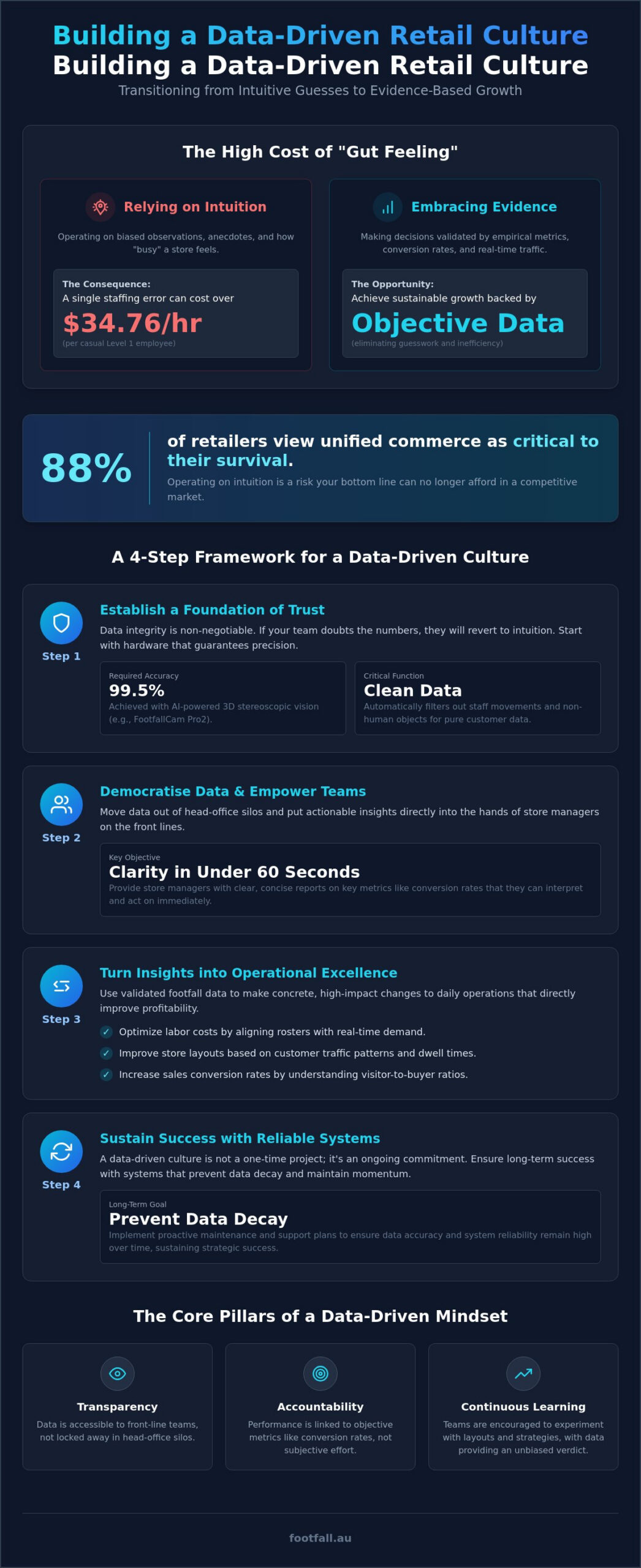
Why do many Australian retailers still rely on “gut feeling” when the cost of a single staffing error can now exceed $34.76 per hour for a casual Level 1 employee? With 88% of retailers now viewing unified commerce as critical to their survival, operating on intuition is a risk your bottom line can no longer afford. Learning how to create a data-driven retail culture is the only way to ensure your store’s growth is backed by empirical evidence rather than historical guesswork. It’s about moving past the coldness of technical jargon to understand the human behavior behind every footfall metric.
You probably recognize the friction that occurs when long-term staff resist new metrics in favor of their own experience, or when siloed data makes it impossible for store managers to see the full picture. This article will show you how to dismantle those barriers. You’ll discover a step-by-step framework to transition your operations toward growth backed by evidence using advanced footfall analytics. We’ll explore how to align your team around shared goals, optimize labor costs through precise staffing, and ultimately improve sales conversion rates by treating every visitor’s movement as a narrative of opportunity.
Key Takeaways
- Learn the essential steps for how to create a data-driven retail culture by transitioning from subjective observations to validated empirical metrics.
- Discover how high-accuracy hardware like the FootfallCam Pro2 builds the necessary trust with store teams to ensure insights are used effectively.
- Master the process of democratising data to empower store managers with clear conversion rate reports they can interpret in under 60 seconds.
- Identify concrete strategies to optimize labor costs and store layouts by aligning staff rosters with real-time customer demand and traffic patterns.
- Understand the critical role of proactive maintenance and support plans in preventing data decay and sustaining long-term strategic success.
Transitioning from Intuition to Evidence-Based Retail Management
A data-driven retail culture is an organizational mindset where every decision, from minor roster adjustments to major window display overhauls, is validated by empirical metrics. Building a robust data culture requires more than just installing sensors; it demands an organizational shift that prioritizes evidence over anecdote. In this environment, success isn’t defined by how “busy” a store felt to a manager, but by the specific conversion rates and dwell times recorded throughout the day. It’s a move toward a more transparent, scientific approach to physical commerce.
The high cost of the “gut feeling” trap has never been more apparent. When managers rely on biased observations, they often fall into patterns of overstaffing during perceived peaks that don’t actually exist, or missing sales opportunities because they didn’t notice a drop in footfall during a specific window. In the current economic climate, where casual wage rates have reached $34.76 per hour, these intuitive guesses are expensive. Understanding how to create a data-driven retail culture helps eliminate these inefficiencies by providing a clear, objective view of store performance. By 2026, leveraging retail footfall analysis Australia has become a strategic necessity for brands looking to protect their margins in a competitive national market.
This transition requires a fundamental psychological shift. It’s the difference between asking “What do I think happened today?” and “What does the data tell us happened today?” This doesn’t mean ignoring the expertise of long-term staff. Instead, it means augmenting their experience with hard numbers. When a veteran floor manager’s intuition is backed by high-accuracy metrics, the resulting strategy is far more potent than either could achieve alone. It creates a sense of quiet confidence across the entire team.
The Core Pillars of a Data-Driven Retail Mindset
Transparency is the first pillar. Data shouldn’t be locked in a head-office silo; it must be accessible to those on the front lines. Accountability follows, where performance reviews are linked to objective conversion metrics rather than subjective “effort.” Finally, continuous learning encourages store teams to run experiments. If a new layout is trialed, the data provides an immediate, unbiased verdict on its success, allowing for rapid iteration and growth.
Why Australian Retailers are Leading the Shift
Rising operational costs have forced Australian retailers to adopt lean operations, making every staff hour and square meter of floor space count. A data-driven culture also helps in attracting high-performing talent who value objective feedback over managerial favoritism. Perhaps most importantly, having a foundation of objective evidence is essential for securing national-level stakeholder buy-in. When you can prove a strategy works with empirical data, scaling it across a national network becomes a logical, low-risk progression.
Establishing the Infrastructure for High-Accuracy Retail Insights
Data integrity serves as the non-negotiable foundation of any analytical framework. If your store managers suspect the numbers are inflated or missed a busy period, they’ll immediately revert to intuition. This erosion of trust is the primary reason why many analytical initiatives fail before they gain momentum. When considering how to create a data-driven retail culture, you must ensure the hardware providing the raw numbers is beyond reproach. Without accurate inputs, even the most sophisticated strategy becomes guesswork.
Modern AI-powered hardware, such as the FootfallCam Pro2, ensures 99.5% accuracy even in the most complex retail environments. These devices use 3D stereoscopic vision to distinguish between human shoppers and non-human objects, such as shopping trolleys or display stands. They also filter out staff movements, providing a clean dataset that reflects actual customer behavior. This level of precision provides the empirical evidence required to back tough operational decisions, such as adjusting rosters or reallocating marketing spend. To build this foundation, you can explore our enterprise-grade hardware designed for the unique demands of the Australian market.
Compliance with Australian privacy standards is equally critical for cultural buy-in. A data-driven culture shouldn’t feel like a surveillance state. Modern systems prioritize privacy by design, using anonymous tracking that doesn’t store personally identifiable information. This approach ensures your operations remain transparent and ethical, positioning data as a tool for optimization rather than a mechanism for monitoring individuals. It’s about understanding the narrative of movement, not the identity of the mover.
Selecting the Right People Counting System for Australia
Legacy infrared sensors often undermine trust because they’re easily fooled by shadows or groups of people entering simultaneously. In high-traffic Australian shopping centers where light levels vary significantly, these older systems provide unreliable data. 3D stereoscopic vision has become the industry standard because it maintains accuracy regardless of environmental changes. Understanding the technical requirements for people counting systems Australia is the first step in ensuring your infrastructure supports your long-term cultural goals.
Centralising Data with Intelligent Software
Moving beyond simple counters requires a transition from manual spreadsheets to automated dashboards. FootfallCam V9 Software provides instant visibility into store performance, allowing for real-time reporting that empowers managers on the floor. For national retail chains, multi-store comparison features are vital for identifying top-performing locations and those that need additional support. By configuring automated alerts, managers receive notifications of peak traffic periods as they happen, allowing them to shift staff from back-of-house tasks to the sales floor exactly when they’re needed most.
Overcoming Cultural Resistance: Democratising Data for Store Teams
Resistance to new technology often stems from a misconception that measurement is a form of “policing.” In many traditional retail environments, staff view footfall sensors as a tool for punishment rather than a mechanism for support. To successfully implement how to create a data-driven retail culture, you must rebrand these insights as a resource that makes the team’s job easier. When store managers see that data can justify a request for more staff during a busy shift or explain why sales were down despite their best efforts, the “stick” becomes a shield. This psychological shift is essential for long-term adoption.
Training for data literacy shouldn’t turn your floor staff into analysts. Instead, focus on teaching store managers how to interpret a conversion rate report in under 60 seconds. High-accuracy systems provide intuitive visuals that highlight performance gaps instantly. Once the team understands the “why” behind the numbers, you can drive engagement through gamification. National store networks often see significant performance lifts by running friendly competitions based on footfall-to-sales ratios. These contests focus on what the team can control, which is the quality of service provided to the customers who actually walk through the door.
Consistency from the top down reinforces this new mindset. Mandating that every regional review or store meeting begins with a look at the FootfallCam V9 dashboard sets a clear standard. When leadership prioritizes evidence-based discussion, it signals that data is the primary language of the business. It moves the conversation away from defensive excuses and toward collaborative problem-solving based on the narrative of movement within the store.
Empowering Store Managers with Actionable KPIs
Simplifying the metrics is the fastest way to build confidence. Focus on “Power Hours,” which are the specific windows of peak traffic where the store’s earning potential is highest. By identifying “Conversion Gaps” during these times, managers can see exactly where they’re losing opportunities. Data Democratisation is the process of giving the person closest to the customer the tools to improve the experience. Armed with this evidence, managers can confidently justify staffing requests to upper management, proving that an extra team member during a Saturday peak will deliver a measurable return on investment.
The Role of Leadership in Cultural Adoption
Senior executives must lead by example by using data-backed justifications for every major strategic shift. This includes celebrating “Smart Failures.” If a marketing campaign doesn’t deliver the expected sales, leadership should use footfall data to determine if the issue was low traffic or a low conversion rate within the store. This objective analysis removes blame and encourages a culture of experimentation. By building a national feedback loop where store-level insights inform corporate strategy, you create a unified team that values accuracy and efficiency above all else.
Turning Footfall Data into Operational Excellence
Operational excellence isn’t a static achievement but a continuous process of refinement based on real-world feedback. When you’ve mastered how to create a data-driven retail culture, your focus shifts from simply collecting numbers to extracting their utility. This stage is where strategic insights translate into improved sales conversion rates and significant cost savings. It requires a commitment to using every data point as a catalyst for specific, positive change in your daily store operations. Evidence replaces guesswork.
Optimising labour costs is often the most immediate benefit of this cultural shift. With casual wage rates for Level 1 retail employees reaching $34.76 per hour in 2026, the cost of staffing errors is high. By using historical traffic patterns, you can align rosters with actual customer demand rather than relying on outdated fixed schedules. This approach prevents overstaffing during quiet periods while ensuring you aren’t caught shorthanded during unexpected peaks. Measuring marketing ROI also becomes more precise; instead of just tracking digital clicks, you can monitor how national campaigns drive physical door swings. This clarity allows you to identify whether low sales figures are due to a lack of traffic or an in-store execution issue. If you’re ready to move beyond intuition and start making evidence-backed decisions, view our range of retail analytics solutions to begin your transformation.
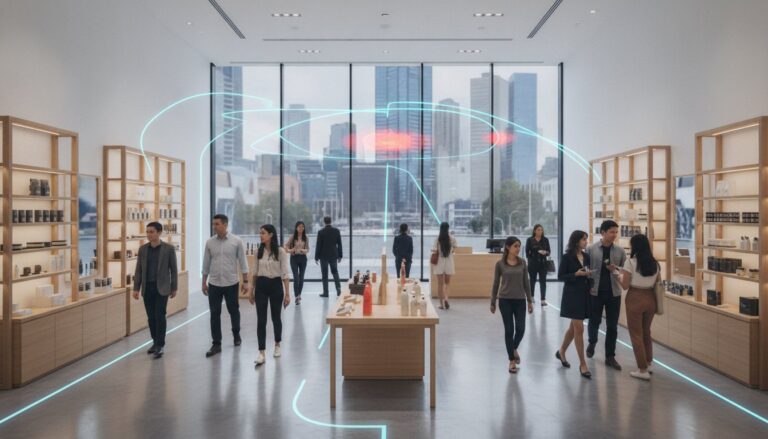
Understanding the narrative of movement through your space reveals how to enhance store layouts effectively. Heatmaps and dwell time data identify “dead zones” where customer engagement drops, allowing you to reposition stock or change signage to revitalise those areas. As in-store purchases are projected to fall to 41% of total retail by late 2026, every visitor who enters your store represents a critical opportunity that must be captured through superior layout and service—a principle of excellence also practiced by specialized providers like Hair Health Australia in their dedicated approach to client care.
Tactical Staffing and the ‘Staff-to-Customer’ Ratio
Calculating your ideal staff-to-customer ratio ensures no visitor is left unserved during peak periods. This metric is far more valuable than simple sales-per-hour targets because it accounts for the missed opportunities that traditional reporting overlooks. By scheduling non-sales tasks, such as restocking or administrative work, during identified low-traffic periods, you significantly reduce “idle time.” Sophisticated people counting technology serves as the primary tool for this labour optimisation, providing the granularity needed to manage costs without compromising the customer experience.
Visual Merchandising and Layout Strategy
Data allows you to treat your physical store like a high-performance website by using “A/B testing” for window displays. By measuring the “Turn-in Rate,” you can determine exactly which creative concepts successfully pull pedestrians from the street into your store. Analysing the customer journey helps you place high-margin items in high-traffic flow paths where they’re most likely to be noticed. Even small adjustments to store entrance design can have a documented impact on overall footfall, turning the entrance from a simple threshold into a strategic asset for growth.
Leading retailers like Miss Runway Boutique apply these principles to ensure their most sought-after pieces are perfectly positioned; learn more about their curated collections and how they use visual appeal to drive engagement.
Sustaining a Data-Driven Culture with Reliable Support Systems
Sustaining the momentum of a new analytical mindset requires more than just initial enthusiasm; it demands technical reliability. The greatest threat to your strategy is “Data Decay.” When a single sensor fails or a network connection drops, the resulting gap in your historical data set can undermine an entire year of strategic planning. If store managers encounter missing or obviously incorrect reports, the trust you’ve carefully built will evaporate. This is why understanding how to create a data-driven retail culture involves viewing hardware maintenance not as a chore, but as a critical pillar of your organizational integrity.
Investing in professional people counter support provides the proactive monitoring necessary to catch these issues before they impact your reporting. A robust support framework ensures that your evidence-backed growth remains continuous. Beyond basic maintenance, a “Legacy Swap Out” strategy is essential for keeping your infrastructure aligned with modern standards. As Australian privacy regulations evolve, specifically the December 10, 2026, deadline for automated decision-making transparency under the Privacy Act, having up-to-date, compliant hardware becomes a legal and cultural necessity. It’s about staying ahead of both behavioral trends and regulatory requirements.
Scalability is the final stage of cultural maturity. What begins as a pilot program in a single high-traffic location must eventually evolve into a national enterprise-wide standard. This expansion allows for true benchmarking across diverse demographics and regions, providing a unified view of the national retail landscape. By standardizing these metrics, you ensure that every level of the business speaks the same language of optimization, from the storefront to the boardroom.
Ensuring Data Integrity through Professional Maintenance
Premium Support Plans offer 24/7 data monitoring and regular health checks, acting as an early warning system for your infrastructure. Remote technical assistance allows for immediate troubleshooting, preventing the costly data gaps that occur when systems are left unmonitored. For Australian retailers with national footprints, local support is critical. It ensures that technical issues in remote locations are addressed with the same urgency as those in metropolitan hubs, maintaining a consistent standard of accuracy across the entire network.
The Long-Term ROI of a Data-Driven Culture
The financial benefits of this cultural shift are cumulative. By projecting sales growth through incremental conversion rate improvements, you can see how a 1% lift across fifty stores translates into significant annual revenue. More importantly, you lower the “Cost of Ignorance” by eliminating the guesswork that often leads to failed expansions or poorly timed store closures. A data-driven culture provides the quiet confidence to move forward with bold strategic changes, knowing every step is supported by empirical proof. Explore our FootfallCam solutions today to build a foundation for measurable, long-term success.
Securing Your Competitive Advantage Through Evidence
Transitioning from intuition to evidence-based management is no longer a luxury; it’s a strategic necessity for survival. By integrating high-accuracy hardware and democratizing insights across your store teams, you eliminate the hidden costs of guesswork. This framework has detailed how to create a data-driven retail culture by aligning labor costs with actual demand and using empirical metrics to optimize store layouts. These steps ensure your operations remain lean, transparent, and focused on measurable growth. It is about turning every visitor’s movement into a strategic advantage.
With over 20 years of experience in the Australian market, we understand the unique challenges of local retail environments. Our FootfallCam Pro2 sensors deliver 99.5% accuracy, providing the reliable foundation your team needs to trust the numbers. Supported by a national network, we ensure your data integrity remains uncompromised across every location. Build your data-driven future with Footfall Australia and transform your physical stores into environments of scientific precision. You have the tools to lead your team toward a future where every decision is backed by the quiet confidence of empirical proof.
Frequently Asked Questions
What is the first step in creating a data-driven retail culture?
The first step is establishing a reliable foundation of high-accuracy hardware to ensure data integrity. Without empirical evidence that staff can trust, any attempt at cultural change will fail immediately. You must ensure your initial data inputs are beyond reproach before asking store managers to shift their decision-making processes. This initial investment in integrity prevents the skepticism that often derails analytical initiatives across national retail networks.
How do I deal with staff who are resistant to being monitored by data?
Rebranding data as a tool for support rather than punishment is the most effective way to manage resistance from long-term staff. Explain to your team that footfall metrics justify additional staffing during busy periods and provide an objective shield during quiet ones. When staff see that data actually makes their jobs easier and fairer, the perception of “policing” naturally fades. It creates a unified culture that celebrates measurable success.
Can people counting data be integrated with our existing POS system?
Yes, people counting data seamlessly integrates with most modern sales systems to calculate your conversion rate in real time. This integration is essential for understanding how to create a data-driven retail culture that focuses on the utility of information. Combining movement data with transaction records allows you to see exactly where sales opportunities are being missed during peak traffic periods, providing a scientific basis for operational changes.
How accurate does my footfall data need to be for cultural change?
Your data requires an accuracy level of at least 95% to maintain organizational trust, though 99.5% is the preferred benchmark for high-performance environments. If the numbers feel “off” to experienced managers, they’ll quickly revert to intuition-based guesses. High-accuracy sensors like the FootfallCam Pro2 ensure that every strategic adjustment is backed by undeniable evidence rather than statistical noise, which is vital for long-term cultural adoption.
Is it expensive to implement a data-driven culture across a national retail chain?
Implementation should be viewed as a strategic investment in efficiency rather than a simple overhead expense. While national rollouts involve hardware and software costs, the return on investment is realized through optimized labor costs and improved conversion rates. Eliminating even a few hours of overstaffing per week across a national network quickly offsets the initial capital expenditure, making the shift toward a data-driven culture financially sustainable.
What are the most important retail KPIs to track in 2026?
The most critical KPIs for 2026 include conversion rate, power hours, and the staff-to-customer ratio. These metrics move beyond simple sales figures to reveal the narrative of movement and human behavior within your space. Tracking these specific data points allows you to identify operational gaps that traditional reporting often overlooks, providing a clearer path to evidence-backed growth and more efficient resource allocation across your entire network.
How often should store managers review their footfall reports?
Store managers should review tactical reports daily to make immediate adjustments to floor coverage and task scheduling based on recent traffic. On a broader level, weekly and monthly reviews are necessary to identify long-term traffic trends and seasonal shifts. This consistent rhythm ensures that data remains a central part of the store’s operational language and a daily habit for all levels of management.
Does a data-driven culture require hiring specialized data analysts?
No, a data-driven culture doesn’t require a dedicated team of analysts if you use intuitive reporting systems designed for retail. Modern platforms like FootfallCam V9 Software translate complex movement patterns into simple, actionable insights that any store manager can understand in seconds. The goal is to empower your existing team with the tools to make better decisions independently, rather than creating a new technical silo.