Smart Building Technology in Australia: A Strategic Guide to 2026 Trends
By 2026, the Australian smart building market is projected to reach a valuation of A$8.731 billion, yet many facilities still rely on manual headcounts to manage their most expensive asset: physical space. You’ve likely felt the frustration of seeing entire floors sitting vacant while energy costs climb and ESG targets feel increasingly out of reach. It’s a common challenge for facility managers who know that intuition isn’t enough to satisfy rigorous NABERS requirements or new NCC 2025 lighting mandates. Integrating high-precision building occupancy sensors Australia wide can transform this raw movement into a strategic asset, driving significant ROI through advanced analytical layers.
This article reveals how occupancy data is redefining building efficiency and operational success across the country. You’ll learn exactly how to move beyond simple automation toward a system that anticipates human needs. We’ll explore the shift toward occupant-centric design and how real-time analytics allow you to seamlessly integrate with existing security and HVAC systems to reduce overheads. By the end, you’ll have a clear roadmap for using empirical evidence and intuitive reporting to optimize your space and meet the 2026 standards for intelligent infrastructure.
Key Takeaways
- Understand how smart buildings in 2026 shift from simple automation to predictive, AI-driven ecosystems that optimize performance through integrated digital layers.
- Discover how deploying advanced building occupancy sensors Australia wide eliminates the high financial cost of underutilized office space by providing granular, actionable data.
- Learn to leverage the three pillars of intelligent infrastructure to automate environmental controls and implement predictive maintenance for significant energy reduction.
- Align your technological investments with Australian ESG and NABERS targets by using precise metrics to meet mandatory NCC 2025 energy efficiency standards.
- Explore how FootfallCam Centroid and FootfallCam Pro2 turn existing infrastructure into high-precision analytical tools for seamless operational integration.
Defining Smart Building Technology in Australia (2026)
The 2026 definition of a smart building has moved beyond simple automated scheduling. It’s now an ecosystem of integrated digital layers that work in unison to optimize performance across every square metre. In previous years, automation was a series of “if this, then that” commands. Today, we’ve transitioned into predictive, AI-driven environments that understand human intent. For Australian commercial real estate, this shift is critical. Management teams are no longer satisfied with static systems. They’re prioritizing intelligence because it offers a way to manage national portfolios through empirical evidence rather than gut feeling.
This evolution is driven by the need for data-driven asset management. Asset managers across the country are facing higher operational costs and stricter environmental regulations. Using high-precision building occupancy sensors Australia wide allows these professionals to quantify exactly how their spaces are used. This data isn’t just a metric; it’s the foundation for strategic decisions that impact the bottom line. Modern Occupancy sensor technology has evolved from basic motion detection to sophisticated analytical tools that differentiate between human movement and environmental changes, ensuring that every kilowatt of energy spent is justified by actual presence.
The Core Components of an Intelligent Asset
A truly intelligent asset relies on three functional layers. First, IoT sensor networks provide real-time environmental monitoring, capturing data on everything from desk occupancy to CO2 levels. Second, edge computing is used for localized data processing. Solutions like FootfallCam Centroid allow for this processing to happen on-site, which enhances data security and reduces latency. Finally, cloud-based analytics platforms, such as FootfallCam V9 Software, aggregate this information for long-term strategic planning. This structure ensures that data is captured accurately and translated into actionable insights for facility managers.
Why Connectivity is the Foundation
Connectivity is the glue that prevents a building from becoming a collection of expensive, isolated gadgets. Historically, security, HVAC, and occupancy systems operated in silos. This fragmentation led to inefficiencies, such as cooling a room that the security system knew was empty. By breaking down these silos, building occupancy sensors Australia can feed data directly into a building’s central nervous system. This requires a high-speed data architecture that supports interoperability. Whether you’re integrating with legacy hardware or installing new FootfallCam Pro2 People Counters, the goal is a seamless flow of information. This unified approach is what allows Australian buildings to meet the rigorous energy efficiency standards of the NCC 2025 while maintaining occupant comfort.
Beyond Automation: The Three Pillars of Intelligent Infrastructure
True intelligence in a modern facility isn’t a single feature. It’s the interplay between three functional pillars: environmental control, operational efficiency, and behavioural intelligence. While basic automation might turn off lights at 6:00 PM, an intelligent ecosystem understands that a team is working late in Zone B and maintains optimal conditions only in that specific area. By deploying building occupancy sensors Australia based facility managers can bridge the gap between static scheduling and dynamic, demand-driven response. These pillars don’t just exist side-by-side; they communicate to create a self-optimising environment that prioritises both performance and occupant well-being.
Environmental Control and Sustainability
The first pillar focuses on HVAC, lighting, and air quality. Instead of running systems on fixed timers, intelligent buildings use real-time demand data to adjust settings. This approach is critical for compliance with the Commercial Building Disclosure (CBD) Program, which mandates transparency in energy performance for large commercial spaces. Meeting rigorous NABERS and Green Star requirements becomes a data-driven exercise rather than a series of guesses. By cooling or lighting only occupied zones, you can drastically reduce the carbon footprint of your commercial assets while ensuring air quality remains high where people are actually working.
Operational Efficiency and Maintenance
The second pillar moves your strategy from reactive to proactive. Traditional maintenance often follows a calendar, which leads to over-servicing low-use areas while high-traffic zones suffer. Precise usage monitoring allows you to extend the lifecycle of building assets by servicing them based on actual wear and tear. Automated reporting streamlines facility management workflows, providing a clear audit trail for operational decisions. Implementing a strategic analytical layer ensures that your maintenance budget is spent where it’s needed most, reducing wasted labour and material costs across the portfolio.
Behavioural Intelligence: The Occupancy Layer
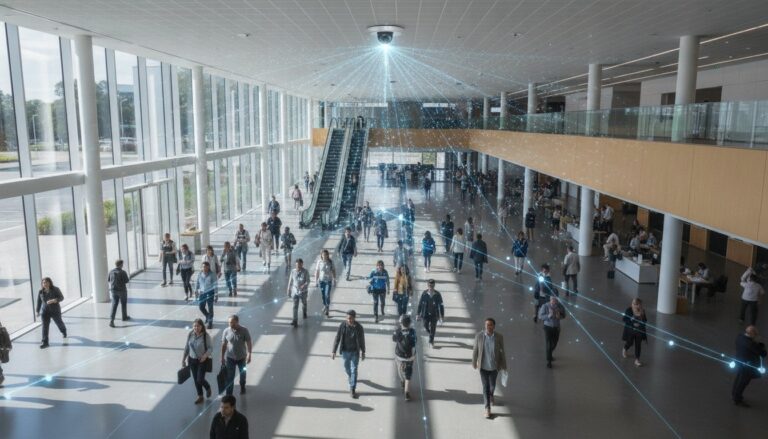
The final, and perhaps most critical, pillar is behavioural intelligence. Behavioural intelligence is the quantification of human movement within a space. This layer allows you to understand how occupants actually interact with their physical environment, identifying dead zones that are costing you rent and high-traffic areas that require layout reconfiguration. You can explore the latest people counting technology to see how this data is captured with high precision. When you combine this movement narrative with building occupancy sensors Australia wide, you gain the ability to justify every square metre of your floor plate through empirical evidence.
Space Optimisation: Solving the Occupancy Data Gap
Underutilised office space represents one of the largest avoidable expenses in Australian commercial markets. With prime office rents in cities like Sydney and Melbourne reaching significant heights, every square metre of vacant floor plate is a drain on capital. Traditional management often relies on manual observations or outdated PIR (Passive Infrared) technology, but these methods leave a dangerous data gap. PIR sensors are designed for simple lighting control; they often fail to detect stationary occupants, leading to inaccurate reporting and missed opportunities for consolidation. Transitioning to advanced building occupancy sensors Australia wide allows firms to identify exactly where their real estate spend is being wasted.
The hybrid work model has complicated space management further. Tuesday to Thursday peaks followed by Friday troughs create a volatile environment that static leases can’t accommodate. Empirical usage metrics provide the evidence needed to right-size portfolios. By leveraging AI-powered people counting technology, such as the FootfallCam Pro2, facility managers can achieve accuracy levels exceeding 99.5%. This precision is the catalyst for real change. It allows you to move from guessing how many desks are needed to knowing exactly how many are used at any given hour.
Inaccurate Data vs. AI-Driven Accuracy
Accuracy is the primary driver of ROI in footfall analysis. Manual tallies and beam counters are notoriously unreliable, often missing individuals in groups or failing during high-traffic periods. Modern 3D LiDAR and AI video sensors solve this by creating a precise digital narrative of movement. These AI-driven sensors are sophisticated enough to distinguish between human beings and inanimate objects like cleaning trolleys or delivery crates. This distinction ensures your data remains clean and actionable, providing a foundation of truth for your strategic planning. Decisions backed by 99.5% accuracy carry a level of confidence that manual reporting simply can’t match.
Real-Time Occupancy for Safety and Comfort
Beyond long-term planning, real-time data serves immediate operational needs. Managing live capacity limits ensures occupant safety and maintains compliance with local health and safety regulations. You can also implement dynamic cleaning schedules. Instead of cleaning every room on a fixed loop, teams are dispatched based on actual usage. This efficiency improves the user experience by ensuring high-traffic zones remain pristine while reducing unnecessary labour in vacant areas. Providing live availability of desks or meeting rooms through intuitive dashboards empowers employees to find workspaces quickly, reducing friction in the hybrid office. Integrating these building occupancy sensors Australia wide turns a static building into a responsive, human-centric environment.
To ensure your newly optimized meeting rooms are equipped with high-quality production technology, learn more about how NextGen AV provides end-to-end audio-visual solutions for corporate environments.

Strategic Integration: Aligning Tech with ESG and Operational Goals
Aligning technology with corporate strategy requires a shift from anecdotal evidence to empirical truth. For Australian asset managers, smart building technology is no longer a discretionary upgrade; it is a fundamental requirement for maintaining competitive ESG (Environmental, Social, Governance) rankings. By implementing building occupancy sensors Australia based portfolios can move beyond surface-level sustainability claims to provide transparent, auditable data. This granular information serves as the primary currency for institutional investors who demand evidence of operational efficiency and risk mitigation before committing capital to commercial assets.
The relationship between data and government compliance has tightened significantly with the introduction of the NCC 2025. These regulations mandate improved lighting controls, requiring that 95% of light fittings in large commercial storeys be managed by time switches or occupant sensing devices. Meeting these standards while simultaneously chasing high NABERS ratings requires a unified data strategy. When you quantify human movement, you gain the ability to justify every kilowatt-hour consumed, turning compliance from a regulatory burden into a documented competitive advantage. To effectively share these sustainability wins with stakeholders, Digital Content Studios offers professional video production specializing in corporate and government communications.
The Role of Data in ESG Reporting
Data-driven reporting strengthens all three branches of ESG. Environmentally, it provides the proof of reduced energy waste through demand-based utility management. Socially, it enhances occupant wellbeing by preventing overcrowding and ensuring that environmental conditions, such as air quality and temperature, are optimized for the actual number of people in a room. From a Governance perspective, high-precision occupancy data facilitates better risk management. It allows boards to make informed decisions about lease renewals and space divestment based on actual usage patterns rather than optimistic projections.
Integrating Footfall with Building Management Systems (BMS)
The most significant operational gains occur when occupancy data is fed directly into your Building Management System (BMS). This integration allows HVAC systems to dynamically adjust based on live presence, eliminating the expense of cooling or heating empty zones. Lighting systems can similarly be automated to respond to actual human presence, far exceeding the capabilities of basic motion sensors that often fail when occupants are stationary. For a deeper look at how to translate these metrics into strategy, consult our guide on footfall data analysis to understand the nuances of integration.
Justifying capital expenditure (CAPEX) to stakeholders becomes a logical exercise when backed by these metrics. If the data shows that 30% of a floor plate is consistently underutilised, the ROI of consolidating space or sub-leasing becomes undeniable. This evidence-based approach removes the friction from the approval process, allowing facility managers to secure funding for technology that pays for itself through energy savings and rent optimization. To begin quantifying your building’s performance, explore our integrated sensor solutions designed for the Australian commercial market.
Future-Proofing Assets with Footfall Australia’s Analytical Layer
Future-proofing a commercial portfolio doesn’t require a complete structural overhaul. While new developments benefit from built-in intelligence, the majority of Australian assets are legacy buildings that need a cost-effective path to modernisation. Footfall Australia provides this path by transforming existing infrastructure into a sophisticated network of building occupancy sensors Australia wide. This approach allows asset managers to achieve smart building status without the prohibitive costs of a total system replacement. It’s a pragmatic strategy that values existing capital while layering on the intelligence required for 2026 standards.
Where high-precision data is required at primary entrances or specific high-traffic zones, the FootfallCam Pro2 People Counters provide the industry standard for accuracy. These devices work in tandem with a broader analytical layer to create a holistic view of the building. This combination ensures that every human movement is quantified, providing the empirical evidence needed to manage HVAC and lighting systems efficiently as discussed in previous sections. By deploying these building occupancy sensors Australia based managers can justify every operational decision through hard data.
Upgrading Legacy Buildings with AI
FootfallCam Centroid serves as the analytical engine for transforming older assets. By connecting to your existing CCTV network, Centroid uses AI to extract occupancy data from video feeds that are already in place. This eliminates the need for invasive cabling or structural changes, making it an ideal solution for upgrading older assets in Sydney or Melbourne. It’s a cost-effective path to smart building status that leverages your current security investment. For a comprehensive look at hardware options beyond legacy upgrades, you can review the people counting systems Australia overview for specific hardware configurations.
Actionable Insights through V9 Software
Data only creates value when it’s accessible and interpretable. FootfallCam V9 Software centralises information from across your national portfolio into a single, intuitive interface. Facility managers can use customisable dashboards to monitor live occupancy, dwell times, and flow patterns across different states. These automated reports remove the burden of manual data collection, allowing executive teams to focus on strategic growth rather than administrative tasks. To maintain the reliability of these insights, it’s essential to ensure data integrity with a dedicated people counter support plan. This ensures your systems remain calibrated and your ROI remains protected.
Managing a national portfolio requires more than just software; it requires a partner on the ground. Footfall Australia offers localized support and maintenance to ensure your infrastructure remains functional from Perth to Brisbane. Having a consistent support framework ensures that your data remains a reliable foundation for long-term ROI. This commitment to accuracy and local expertise positions Footfall Australia as an essential guide for the future of the built environment, helping you stay ahead of shifting behavioural trends with quiet confidence.
Strategic Resilience through Data-Driven Assets
Transitioning to an intelligent infrastructure is a strategic necessity for the 2026 commercial landscape. You’ve seen how precise data solves the occupancy gap and aligns your assets with mandatory Australian regulations. By quantifying human movement, you transform underutilised space into a high-performing environment that meets both ESG and NABERS targets. This shift moves your management style from reactive to predictive, ensuring every square metre of your floor plate is validated by actual usage patterns.
Implementing advanced building occupancy sensors Australia wide ensures your portfolio remains resilient against shifting work patterns. Footfall Australia has been serving local businesses since 2004, providing the technical expertise needed to integrate complex analytical layers into existing assets. With 99.5% accuracy from the FootfallCam Pro2 and comprehensive local maintenance plans, you can base your future growth on reliable metrics rather than intuition. It’s a structured approach that provides the stability required for long-term asset appreciation.
Request a strategic consultation for your national asset portfolio to begin optimising your operational ROI. The future of your physical environment is built on the clarity of your data.
Frequently Asked Questions
What is the primary benefit of smart building technology in Australia?
The primary benefit is the ability to reduce operational overheads by aligning building performance with actual occupant behaviour. Instead of relying on static schedules, facility managers use real-time data to justify utility spend and space allocation. This empirical approach eliminates the financial drain of maintaining empty zones, ensuring that every Australian dollar spent on energy or rent directly supports human productivity. It transforms a building from a passive expense into a responsive, strategic asset.
How does smart building technology help with NABERS ratings?
Smart technology improves NABERS ratings by providing the precise environmental data required for formal energy efficiency assessments. Automated systems ensure that HVAC and lighting operate only in occupied areas, directly lowering the building’s carbon footprint. This granular reporting allows managers to identify and rectify energy leaks quickly, helping assets maintain a competitive edge in the Australian commercial market. It provides the documented evidence needed to prove sustained energy reduction over time.
Can I turn an existing building into a smart building without a full renovation?
You can upgrade legacy assets without a full renovation by implementing an analytical layer like FootfallCam Centroid. This technology connects to existing CCTV infrastructure to extract occupancy metrics without invasive structural work. It’s a cost-effective path to modernising older floor plates while meeting new NCC 2025 lighting control requirements that mandate occupancy sensing in large commercial storeys. This approach allows you to layer intelligence over your current capital investment.
Is AI people counting compliant with Australian privacy laws?
AI people counting is compliant with the Australian Privacy Act 1988 when the system processes data anonymously. Modern sensors like the FootfallCam Pro2 use edge computing to count individuals without storing personally identifiable information or facial images. This approach ensures that your building occupancy sensors Australia installations provide high-accuracy metrics while respecting the privacy rights of all occupants. The focus remains on the movement of people as a metric rather than the identity of individuals.
What is the difference between a BMS and smart building technology?
A Building Management System (BMS) acts as the central nervous system for hardware control, while smart building technology provides the analytical brain. While a BMS might execute a command to cool a room, smart technology uses real-time occupancy data to determine if that cooling is necessary. Integrating these layers turns a reactive facility into a predictive ecosystem. This synergy ensures that building functions are driven by human intent rather than simple mechanical timers.
How much energy can a smart building realistically save?
Automated systems that integrate occupancy sensors and daylight harvesting can deliver energy savings of up to 50-70% compared to conventional systems. These results are achieved by eliminating energy waste in vacant zones and optimising environmental settings based on actual presence. For Australian commercial buildings, this reduction is a vital component in meeting mandatory energy efficiency targets. It represents a significant decrease in long-term operational costs and a faster path to achieving net-zero goals.
What hardware is required for accurate occupancy tracking?
High-accuracy tracking requires 3D people counters, such as the FootfallCam Pro2, and a centralised software platform like FootfallCam V9. These devices use stereoscopic vision to distinguish between humans and objects, ensuring 99.5% accuracy. For larger zones, an AI-driven processing unit can be added to existing security cameras to expand coverage without requiring additional sensor hardware at every desk. This combination provides a holistic view of human movement across the entire facility.
How does footfall data improve office space optimisation?
Footfall data improves office space optimisation by identifying exactly which areas of a floor plate remain underutilised throughout the week. This information allows facility managers to reconfigure layouts, consolidate departments, or even sub-lease vacant sections to maximise ROI. By deploying building occupancy sensors Australia wide, organisations can base their real estate strategies on hard evidence rather than anecdotal reports. It ensures that your physical footprint is always aligned with your actual operational needs.