
Calculating Retail Conversion Rate: The Definitive Formula and Guide for 2026
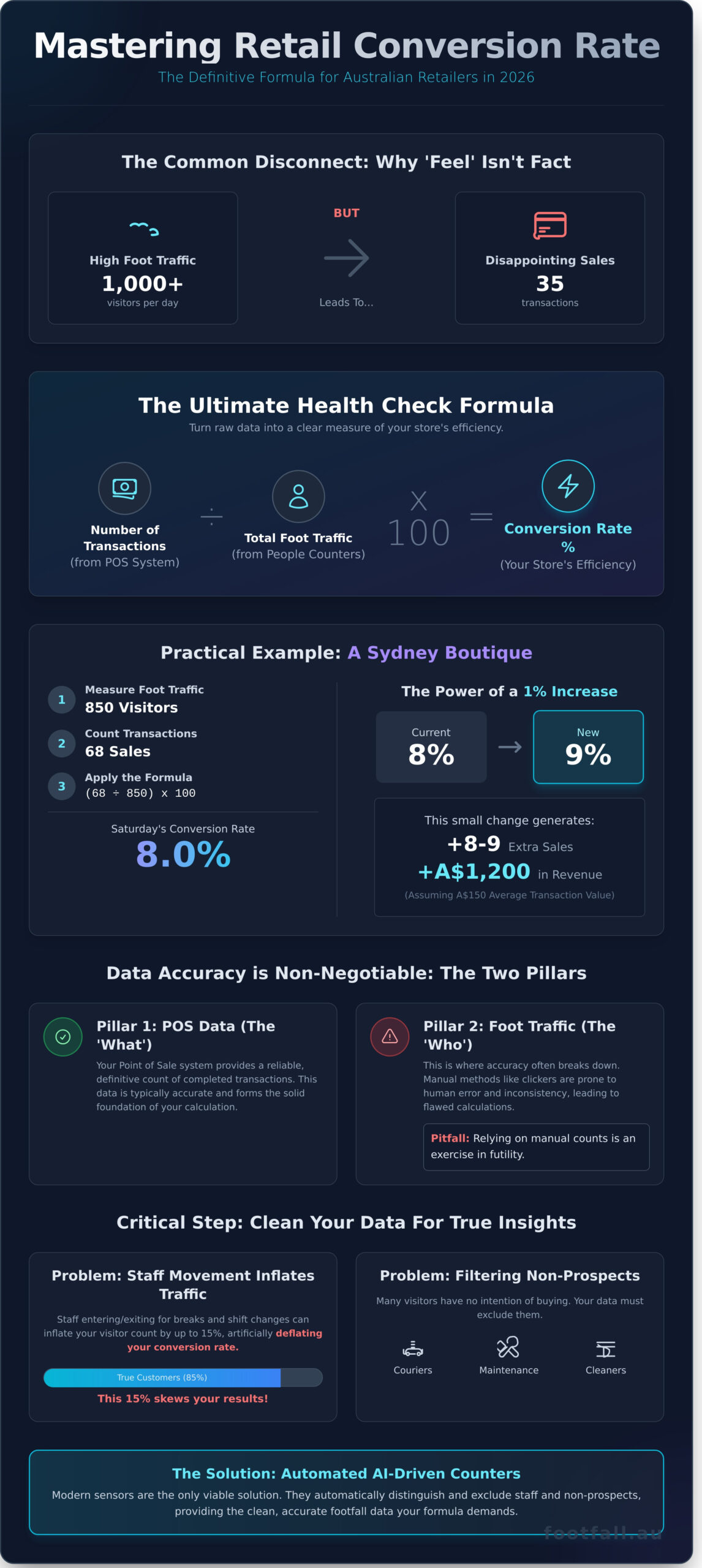
Your store is bustling with activity, yet the final sales figures don’t reflect the foot traffic. This common disconnect, where performance is judged on ‘feel’ rather than fact, leaves many Australian retailers guessing. Inconsistent data from manual door counts and POS systems only deepens the uncertainty. The key to unlocking genuine growth lies in moving beyond raw visitor numbers to understand true engagement. Mastering the calculating retail conversion rate formula is the most critical step in transforming your physical space into a high-performance sales environment.
This definitive guide for 2026 is designed to provide that clarity. We will equip you with the exact, repeatable formula to turn visitor data into a clear measure of success. You’ll learn not only how to calculate your conversion rate with precision but also how to benchmark it against key Australian retail sectors. We then move from measurement to action, providing a clear strategy to optimise your visitor journey, improve your rate, and drive measurable sales growth. It’s time to replace guesswork with data-driven confidence.
Key Takeaways
- Master the calculating retail conversion rate formula by combining two critical data points: your total transactions and your precise visitor foot traffic.
- Understand why conversion rate is the single most important metric for diagnosing your store’s performance and identifying hidden growth opportunities.
- Discover how your store’s performance compares to Australian industry benchmarks, from high-traffic Sydney CBD locations to specialty boutiques in Perth.
- Translate conversion rate data into a powerful staffing strategy, ensuring you have the right team on the floor during your most critical sales hours.
What is the Retail Conversion Rate Formula?
The retail conversion rate is the fundamental measure of a physical store’s performance. It represents the percentage of visitors who enter your store and complete a purchase. More than just a number, it is the ultimate health check for your business, providing a clear, actionable insight into how effectively your space, staff, and products are turning foot traffic into revenue. While high sales volume might seem impressive, it can be a vanity metric; conversion rate, by contrast, is a measure of pure efficiency.
Understanding the process of calculating retail conversion rate formula is the first step toward optimising your store’s operational intelligence. The formula itself is direct and powerful:
(Number of Transactions ÷ Total Foot Traffic) x 100 = Conversion Rate (%)
This calculation transforms raw data into a strategic tool, allowing you to decode the narrative of human movement within your store and pinpoint precisely where opportunities are being won or lost.
Why 2026 Retailers Prioritise Conversion Over Footfall
In high-cost environments like Sydney and Melbourne CBDs, where commercial rent demands maximum return, every visitor represents a significant investment. A high footfall count with a low conversion rate signals missed opportunities-shoppers who were interested enough to enter but left without buying. Measuring conversion is the only way to identify these gaps and calculate the true ROI of marketing campaigns that drive people to your door.
The Mathematical Breakdown: A Practical Example
Imagine a boutique in Paddington, Sydney, uses people counting sensors to track its performance. Here’s a step-by-step guide to calculating retail conversion rate formula for a typical Saturday:
- Step 1: Measure Foot Traffic. The sensors record that 850 people entered the store.
- Step 2: Count Transactions. The Point of Sale (POS) system shows 68 completed sales.
- Step 3: Apply the Formula. (68 Transactions ÷ 850 Visitors) x 100 = 8% Conversion Rate.
A mere 1% increase to 9% would mean an extra 8 to 9 sales. If the average transaction value is A$150, that’s over A$1,200 in additional revenue from a single day. A common error to avoid is failing to filter out staff movement from foot traffic data, which can artificially lower your conversion rate and mask your true performance.
The Two Pillars of the Formula: POS vs. Foot Traffic Data
To calculate a meaningful retail conversion rate, you must build your formula on two pillars of precise data: the number of transactions and the total number of unique visitors. The first pillar is your sales data, the definitive ‘what’ that is accurately logged by your Point of Sale (POS) system. The second, more elusive pillar is your foot traffic-the ‘who’ that represents your total sales opportunity. As detailed in Forbes’ guide to Retail Conversion Rate Secrets, mastering this metric requires moving beyond simple sales figures to understand operational efficiency.
While POS data is typically reliable, footfall data is often where accuracy breaks down. Relying on a staff member with a manual clicker is an exercise in futility, especially in high-volume locations like Brisbane’s Queen St Mall, where thousands of people pass by hourly. Such methods are prone to human error, distraction, and inconsistency. The accuracy of calculating retail conversion rate formula depends entirely on the quality of these two data streams, making automated people counters the only viable solution for capturing a precise visitor count.
The Staff Exclusion Factor: Cleaning Your Data
One of the most significant distortions in raw traffic data comes from your own team. Staff entering and exiting for breaks, shift changes, or daily duties can inflate your visitor count by up to 15%, artificially deflating your conversion rate. Modern, AI-driven counters solve this by distinguishing employees from genuine shoppers based on movement patterns or even staff tags. Achieving this ‘clean data’ is fundamental to ensuring your conversion formula reflects true customer behaviour, not internal logistics.
Filtering Out Non-Prospects (Delivery and Service Staff)
Your store receives visitors who have no intention of making a purchase. Mail couriers, maintenance technicians, and cleaning crews all contribute to foot traffic but are not potential customers. Advanced sensors use technical methods to filter out these non-prospects, including:
- Height-filtering: To exclude children or differentiate adults based on typical profiles.
- Path-tracking: To identify individuals who follow non-shopping paths, such as moving directly to a service desk and immediately exiting.
Clean traffic data is the removal of all non-buying personnel from the visitor count. By integrating your POS system with a smart footfall analytics platform, you can automate this entire process, transforming a complex calculation into a seamless, real-time performance indicator.
Analysing the Results: What is a ‘Good’ Retail Conversion Rate in Australia?
Once you have a precise figure, the immediate question becomes: is it good? The answer is nuanced. A ‘good’ conversion rate is not a universal number; it is a benchmark entirely dependent on your specific retail context. Factors like your industry, store location, and even the time of year fundamentally alter what constitutes success. The true power of calculating retail conversion rate formula lies not in a single result, but in tracking its movement over time against relevant benchmarks.
A pharmacy in a suburban shopping centre, for example, will naturally have a much higher conversion rate than a luxury jewellery store on a high-traffic city street. The former serves needs-based, high-frequency purchases, while the latter involves high-consideration decisions and attracts significant ‘window shopper’ footfall. Similarly, conversion trends in Sydney’s bustling CBD will differ from those in Melbourne’s laneway boutiques or Perth’s destination retail parks. Your store’s location directly impacts your baseline rate by defining the purchase intent of your average visitor.
Sector-Specific Benchmarks for 2026
To set realistic KPIs, you must compare your performance to industry-specific standards. While these figures evolve, current data provides a strong directional guide:
- Apparel and Fashion: Typically ranges from 15-25%. This sector sees high footfall but also significant browsing behaviour, as customers try on items or compare styles before committing.
- Big Box Retail and Supermarkets: Expect high conversion rates, often exceeding 50%. Most visitors enter with a clear shopping list and high purchase intent.
- Specialty Stores: These businesses (e.g., hobby shops, high-end electronics) often see a strong correlation between high dwell time and high conversion, with rates of 30-50% being common for engaged visitors.
The Impact of Seasonality on Your Formula
A static annual conversion target is an ineffective measure in the dynamic Australian retail landscape. Your expectations must adapt to seasonal fluctuations to generate actionable insights. Consider how seasonality affects your visitor journey and purchase behaviour.
During major sales events like the End of Financial Year (EOFY), conversion rates should spike as promotions create urgency. Conversely, during the peak pre-Christmas holiday period, foot traffic may soar, but the conversion rate can actually decrease. This is due to a higher volume of casual browsers and gift-seekers who are earlier in their purchasing journey. By using historical data from your own store, you can move beyond a fixed KPI and set ‘floating’ conversion targets that accurately reflect seasonal realities, turning the process of calculating retail conversion rate formula into a truly strategic tool.
Beyond the Formula: Using Conversion to Optimise Staffing
Your retail conversion rate is more than a simple performance metric; it is a direct reflection of your in-store customer experience. A consistently low sales-to-traffic ratio often points to a critical operational issue: a misalignment between staffing levels and customer demand. By analysing conversion data on an hourly basis, you can transform your staffing strategy from reactive guesswork into a precise, data-driven science.
Identifying Service Gaps with Conversion Data
A period of high foot traffic paired with a low conversion rate is a clear indicator that your team is overwhelmed. This is when potential sales are lost due to customers being unable to find assistance or facing long queues. This ‘Queue Abandonment’ factor is a silent killer of revenue, as frustrated shoppers leave just before the final transaction. Conversely, low-traffic periods are opportunities. Training staff to proactively engage the few customers present can significantly lift conversion, turning quiet hours into profitable ones. By optimising staffing in your Sydney store with traffic data, for instance, you can ensure every hour is managed for maximum potential.
The Staff-to-Customer Ratio: The Hidden Variable
The effectiveness of your team is a hidden variable in your conversion rate. While there’s no universal magic number, analysing your data can reveal an optimal staff-to-customer ratio for your specific environment. For many retailers, proactive engagement from a well-placed team member can double the likelihood of a sale. This is where the process of calculating retail conversion rate formula evolves into a powerful management tool. Systems like FootfallCam V9 can analyse historical traffic and conversion trends to predict staffing needs, ensuring you have the right number of staff on the floor during your ‘Power Hours’ to capture every sales opportunity.
Ultimately, linking your conversion rate to your staffing schedule provides actionable insights that directly impact your bottom line. It empowers managers to build rosters that are not just based on availability, but on proven customer demand and sales potential.
Automating Your Insights with Footfall Australia
Understanding the retail conversion rate formula is the first step. The next is implementing a system that delivers this data with precision and without manual effort. Manually tracking entries and sales leaves room for error and provides only a retrospective view of performance. To make agile, data-driven decisions, Australian retailers are turning to automated intelligence. This is where manual methods end and strategic growth begins.
By integrating advanced people counting technology with your existing Point of Sale (POS) system, you move beyond simply knowing your conversion rate to understanding the behaviours that drive it. The process of calculating retail conversion rate formula becomes a seamless, real-time function of your daily operations, providing hourly insights that empower you to optimise staffing, marketing, and store layout instantly.
The FootfallCam Pro2 Advantage
The FootfallCam Pro2 is the gold standard for visitor analytics, engineered for the demands of the modern Australian retail environment. It delivers unparalleled accuracy and operational peace of mind through a combination of sophisticated technology and dedicated local support.
- Guaranteed 99.5% Accuracy: Utilising advanced AI and 3D stereoscopic vision, the Pro2 precisely distinguishes between individuals, groups, and even staff, ensuring your footfall data is clean and reliable.
- Local Australian Support: With easy installation and dedicated support teams in every capital city, from Perth to Canberra, you receive expert assistance tailored to your specific location.
- Privacy and Compliance: The system is fully GDPR compliant and designed to meet Australian privacy principles, processing data anonymously to protect your customers and your business.
Getting Started with Data-Driven Growth
Transitioning to an automated system is a straightforward, high-impact investment in your business’s future. Our process begins with a complimentary site survey to design a solution perfectly matched to your store’s layout and objectives. For businesses with outdated sensors, our Legacy Swap Out Plan provides a cost-effective pathway to upgrade to superior accuracy. Stop guessing and start measuring what matters. Let us show you how automating the process of calculating retail conversion rate formula can unlock new levels of profitability.
Ready to transform your visitor data into your most valuable asset? Contact Footfall Australia for a custom conversion analysis and discover the opportunities hidden in your foot traffic.
Beyond the Formula: Activating Your Conversion Rate Intelligence
Mastering the calculating retail conversion rate formula is the first step, but true strategic advantage comes from the precision of your data. As we’ve explored, understanding the interplay between your POS transactions and accurate foot traffic is what separates passive measurement from active optimisation. This single metric holds the key to refining everything from staffing schedules to marketing effectiveness, turning insights into tangible growth for your Australian business.
The challenge lies in capturing that foot traffic data with unwavering accuracy. Since 2004, Footfall Australia has been the trusted partner for Australian retailers, providing the technology to unlock these critical insights. With local support in Sydney, Melbourne, Brisbane, and Perth, our AI-powered systems deliver 99.5% counting accuracy, giving you the confidence to make evidence-based decisions.
Stop guessing and start knowing. Maximise your store’s ROI with a FootfallCam Pro2 system and take command of your retail performance. The future of your store is not a matter of chance, but a matter of choice-and data.
Frequently Asked Questions
Is a 20% conversion rate good for a retail store?
A 20% conversion rate can be considered a strong starting benchmark for many Australian retail sectors, but its value is highly contextual. For a high-volume apparel store, it may be average, whereas for a luxury jeweller, it could be exceptional. The most effective approach is to benchmark against your own historical data and industry-specific figures. True performance measurement comes from consistent tracking and striving for incremental improvement based on actionable data, not just a single number.
How do I calculate conversion if I don’t have a people counter?
Without an automated people counter, you can use manual methods, though they lack precision. Staff can use a handheld clicker to count visitors during specific, representative hours. Another less accurate proxy is to use the number of sales receipts as your visitor count, but this method fundamentally misunderstands the formula. For reliable, data-driven decisions, investing in an automated footfall solution is essential to capture the accurate traffic data needed for strategic analysis.
Does the conversion rate formula change for multi-level stores?
The fundamental formula-(Transactions ÷ Visitors) x 100-remains the same. The challenge in a multi-level store is accurate data collection. To calculate an overall store conversion rate, you must measure total visitors at all main entrances. For deeper insights, advanced spatial analytics can be deployed to measure traffic and conversion rates for each individual floor or key department. This allows you to identify which levels are driving sales and which require optimisation.
How often should I calculate my retail conversion rate?
The optimal frequency depends on your objective. For tactical decisions like adjusting staff rosters or evaluating a weekend promotion, calculating daily or weekly provides immediate, actionable feedback. For strategic analysis, such as assessing seasonal trends or the impact of a new store layout, a monthly or quarterly calculation offers a more stable overview. Consistency is paramount; regular measurement transforms raw data into a powerful tool for forecasting and growth.
Can I use CCTV cameras to calculate my store’s conversion rate?
Yes, but only with the right technology. Standard security CCTV is not designed for counting, but modern video-analytic systems can leverage camera feeds to provide highly accurate footfall data. These intelligent platforms use AI to distinguish individuals, track paths, and deliver the precise visitor numbers required for conversion analysis. It is crucial to ensure any system complies with Australian privacy laws while turning your existing infrastructure into a source of business intelligence.
What is the difference between eCommerce and retail conversion rates?
While both measure the percentage of visitors who purchase, the context is entirely different. An eCommerce conversion is a completed checkout out of total website sessions, while a retail conversion is a sales transaction out of total physical visitors. Physical retail conversion rates are naturally much higher (often 20-40%) because the act of visiting a store signifies a stronger purchase intent than simply browsing a website. The process of calculating retail conversion rate formula reflects this high-intent environment.
How do I exclude children or groups from my conversion calculation?
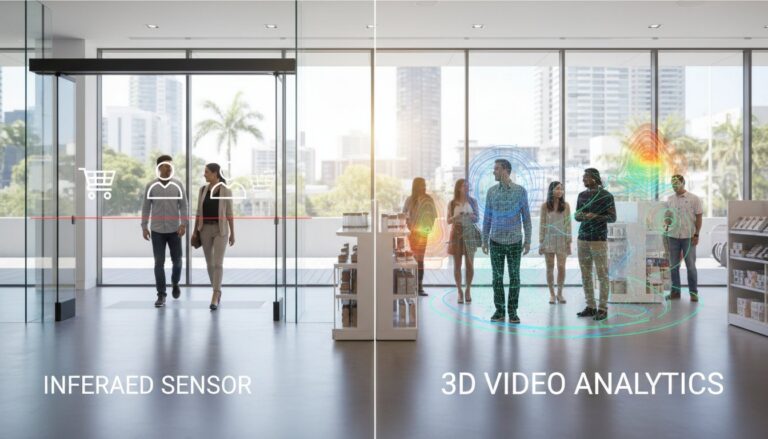
Excluding non-purchasing individuals like children requires advanced sensor technology. Basic infrared beam counters cannot differentiate between adults and children. However, sophisticated AI-powered video analytics can be configured to filter out visitors below a certain height. These systems can also identify groups (e.g., a family) and count them as a single buying unit, not multiple individuals. This provides a more accurate traffic count of genuine potential customers for your calculations.
What happens to the formula if a customer makes multiple purchases in one visit?
The standard conversion rate formula typically counts the number of sales transactions, not the number of unique customers. Therefore, if one person makes two separate payments during a single store visit, it will be counted as two conversions. This can slightly inflate your rate. To get a complete picture of purchasing behaviour, you should analyse conversion data alongside other key metrics like average transaction value (ATV) and units per transaction (UPT).