Event Attendance Tracking Technology: The 2026 Guide to Spatial Intelligence
Measuring your event’s success with manual clickers and constant badge scans often creates more friction than insight. These outdated methods leave you with inaccurate headcounts and glaring blind spots across your venue, making it nearly impossible to prove sponsorship value or manage crowd flow with confidence. The landscape of event management is evolving, demanding a more intelligent approach to measurement. This is where advanced event attendance tracking technology transforms the entire attendee experience from a series of disjointed checkpoints into a single, seamless narrative of movement.
Absolutely. We deploy specialised, weather-resistant sensors with appropriate IP ratings designed to perform reliably in outdoor environments. These robust units are engineered to handle variable lighting conditions, from bright sunlight to low light, as well as precipitation. This ensures you can gather continuous, accurate data on foot traffic and visitor behaviour for festivals like Frequency Forest, open-air markets, and other outdoor activations, allowing for effective crowd management and layout optimisation.
Absolutely. We deploy specialised, weather-resistant sensors with appropriate IP ratings designed to perform reliably in outdoor environments. These robust units are engineered to handle variable lighting conditions, from bright sunlight to low light, as well as precipitation. This ensures you can gather continuous, accurate data on foot traffic and visitor behaviour for festivals, open-air markets, and other outdoor activations, allowing for effective crowd management and layout optimisation. For broader site security in these temporary settings, companies like Jobcam provide specialised solar-powered surveillance solutions.
This guide prepares you for 2026 and beyond, revealing how to move past simple gate counts and embrace the power of spatial intelligence. We will demonstrate how passive sensing and AI-driven analytics can unlock the full visitor journey, providing actionable insights without interrupting it. Discover how to generate real-time heatmaps of your most popular exhibits, ensure venue safety with precise occupancy data, and deliver automated, evidence-backed reports that prove undeniable ROI to your stakeholders. It’s time to replace guesswork with evidence-based strategy.
Key Takeaways
- Learn why badge scans reveal less than half of the attendee journey and how spatial intelligence provides the complete picture of on-site engagement.
- Understand the critical difference between active systems and passive event attendance tracking technology that captures authentic attendee behaviour without friction.
- Convert raw footfall data into actionable spatial intelligence, allowing you to measure booth performance and optimise floorplan layouts with precision.
- Enhance operational safety by using real-time occupancy data to manage crowd density and ensure compliance with Australian fire and safety standards.
Beyond the Badge: The Evolution of Event Attendance Tracking Technology
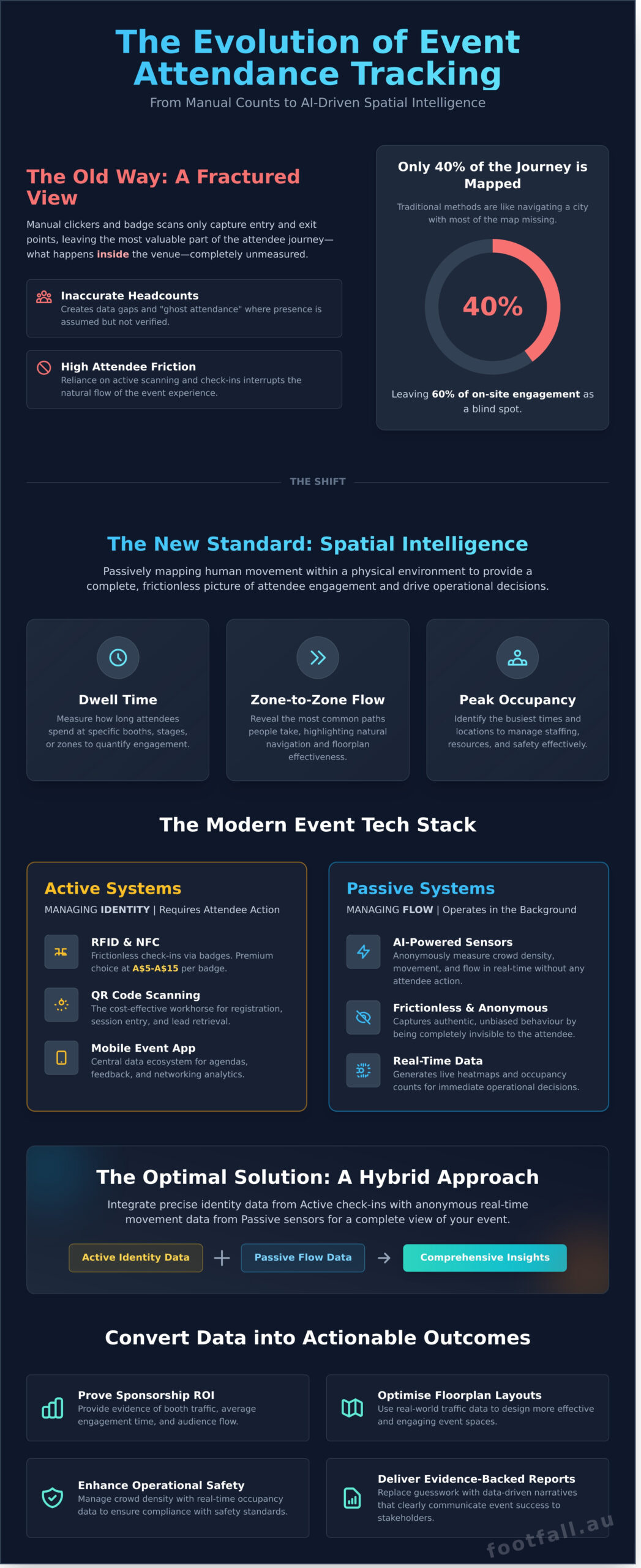
For decades, event attendance was a simple headcount. Manual clickers and spreadsheet check-ins gave way to barcode and RFID badge scanning, which felt like a technological leap. Yet, in 2026, relying solely on these methods is like navigating a city with only 40% of the map. This traditional approach only captures entry and exit points, leaving the most valuable part of the attendee journey-what happens inside the venue-completely unmeasured. The industry is now moving towards a frictionless model, where data is collected passively and precisely, providing a complete picture of engagement without interrupting the attendee experience.
This shift in event attendance tracking technology moves the focus from basic headcounts to high-value behavioural metrics. The data that truly matters for optimising ROI now includes:
- Dwell Time: How long attendees spend at specific booths, stages, or zones.
- Zone-to-Zone Flow: The most common paths people take through the venue, revealing natural navigation patterns.
- Peak Occupancy: Identifying the busiest times and locations to manage staffing and resources effectively.
The Limitations of Active-Only Tracking
Active tracking methods require a deliberate action from the attendee, like scanning a badge or checking in via an app. This creates significant data gaps. Attendees often bypass non-mandatory scans, leading to incomplete session data and “ghost attendance” in large exhibition halls where presence is assumed but not verified. While early Time and attendance systems provided a basic framework, they cannot answer the critical question: what happens between the scan points?
Why Spatial Intelligence is the New Event Standard
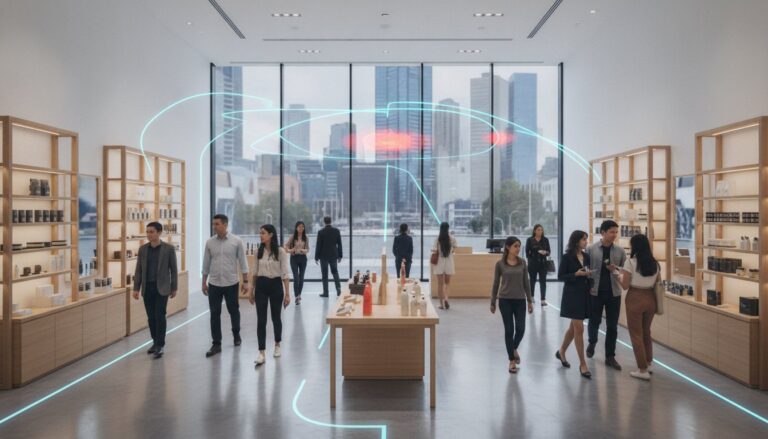
Modern event analytics move beyond counting who attended to understanding how they engaged with the space. This is the core of spatial intelligence. Spatial intelligence is the mapping of human movement within a physical environment to drive operational decisions. For event sponsors, this high-fidelity data is transformative. Instead of just a lead list, you can provide them with evidence of booth traffic, average engagement time, and audience flow, directly proving the value of their investment.
The Tech Stack: Active vs. Passive Tracking Systems
Selecting the right event attendance tracking technology begins with a fundamental choice: do you require active attendee participation, or do you need to observe natural movement passively? Active systems identify who is where, while passive systems measure how many people are moving through a space. Understanding this distinction is the first step toward building a data-driven event strategy.
The optimal solution often lies in a hybrid model, integrating precise identity data from active check-ins with anonymous real-time movement data from passive sensors. This creates a comprehensive view of both individual engagement and overall crowd behaviour, unlocking a deeper level of analysis to maximise your return on investment.
Active Technologies: Managing Identity
Active tracking requires attendees to perform an action, like scanning a badge or checking in on an app. These systems are ideal for managing access, tracking session attendance, and capturing leads.
- RFID and NFC: For high-budget conferences, RFID (Radio-Frequency Identification) badges offer seamless, frictionless tracking as attendees move past sensors. The cost, often A$5-A$15 per badge, makes it a premium choice. NFC (Near Field Communication) provides a more affordable “tap-and-go” alternative for smaller events or specific interaction points.
- QR Code Scanning: As the most accessible and cost-effective method, QR codes are the workhorse for registration, session entry, and exhibitor lead retrieval. Best practices demand well-placed scanners and clear instructions to minimise queues and ensure a smooth attendee experience.
- The Mobile Event App: By 2026, the mobile app will be a central data ecosystem. It will integrate personalised agendas with real-time feedback and networking analytics, mirroring the sophisticated data capture seen in virtual conference attendance tracking, where digital engagement is the primary metric for success.
Passive Technologies: Managing Flow
Passive systems operate in the background to measure crowd density and movement patterns without any attendee action. This provides unbiased data on how people naturally interact with your event space.
- AI Video Analytics: To achieve unparalleled accuracy in crowd analysis, AI-powered 3D sensors like the FootfallCam Pro2 can deliver accuracy rates of up to 99.5%. This technology anonymously maps visitor journeys, identifying high-traffic zones, measuring dwell time, and optimising layouts based on real-world behaviour.
- LiDAR Sensors: In complex venues or low-light environments like evening functions, LiDAR (Light Detection and Ranging) excels. It uses laser pulses to create a precise 3D map of movement, ensuring data continuity where traditional cameras may be less effective.
- Wi-Fi/Bluetooth Tracking: By detecting anonymous signals from mobile devices, this technology provides a high-level estimate of total venue occupancy and peak traffic times. While less granular than video or LiDAR, it is a valuable tool for understanding overall attendance flow.
Spatial Intelligence: Using AI Sensors to Map the Attendee Journey
Effective event management moves beyond simple entry and exit counts. True optimisation lies in understanding the complete attendee journey-the paths they take, the content they engage with, and the areas they ignore. Modern event attendance tracking technology leverages AI-powered sensors to convert raw footfall data into a rich narrative of spatial intelligence, providing a clear, evidence-based view of how your event space is truly performing.
By analysing movement patterns from the moment an attendee enters to the moment they leave, you can decode behaviour, anticipate needs, and make strategic decisions that directly enhance both the attendee experience and your return on investment.
Heatmapping and Zone Analysis
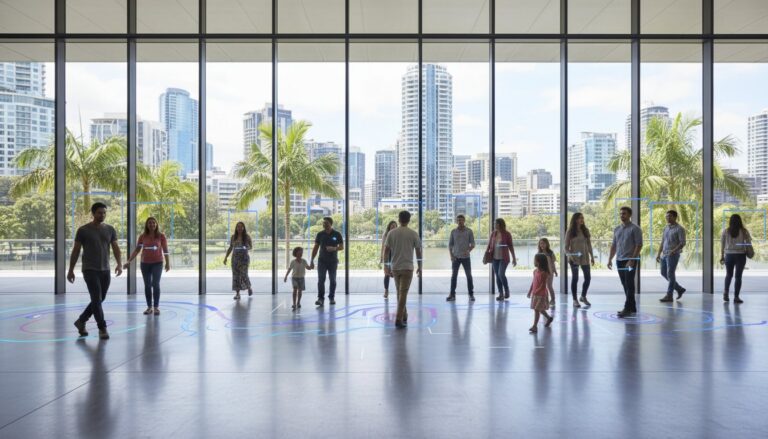
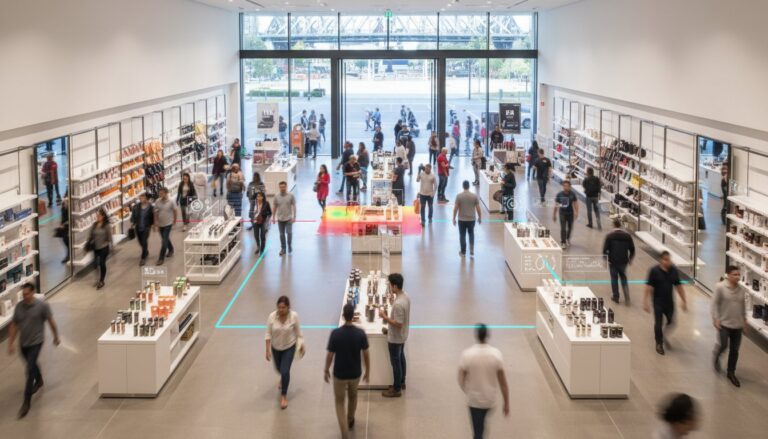
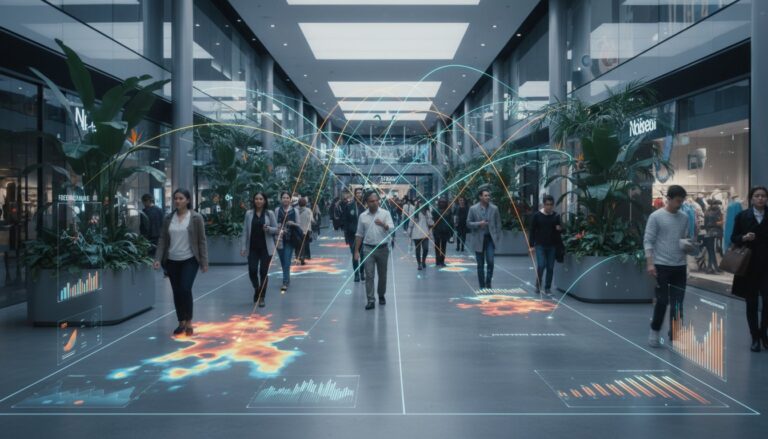
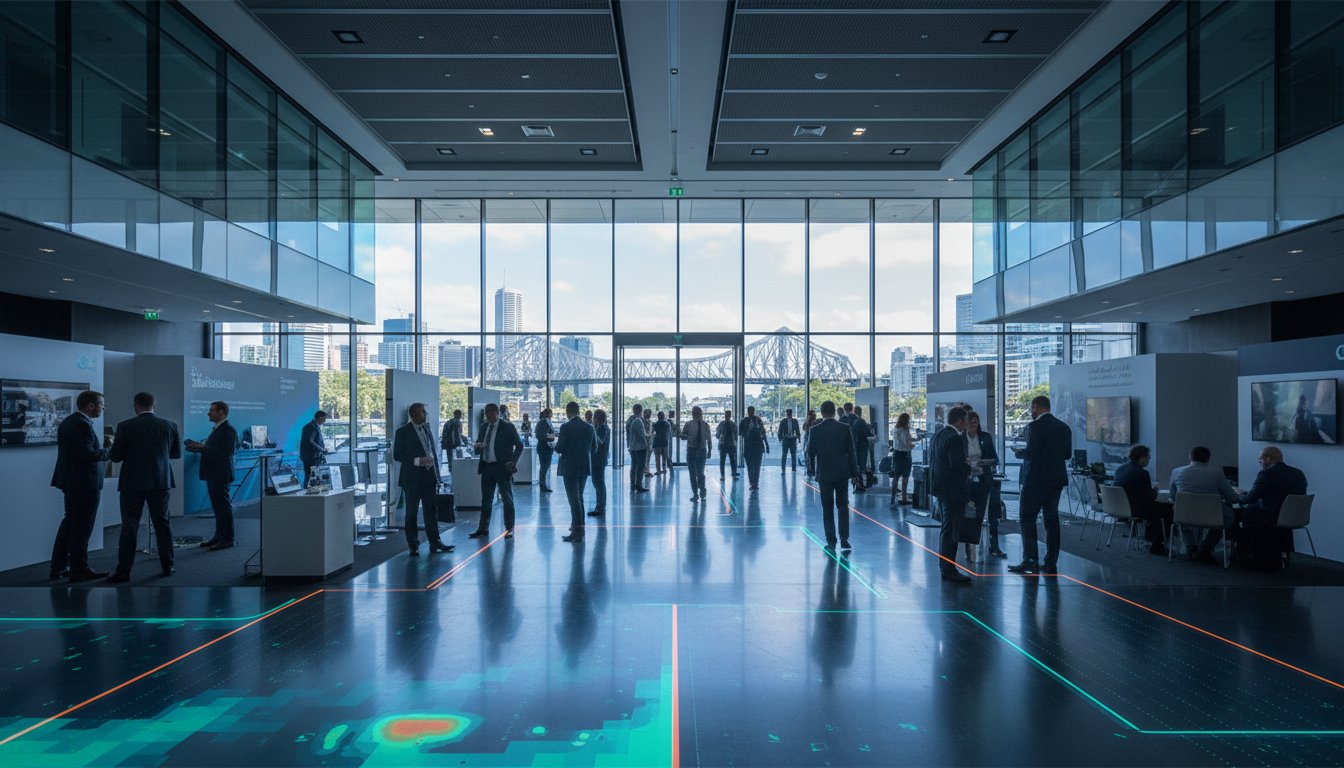
Translate raw visitor numbers into intuitive, actionable heatmaps of your exhibition floorplan. This visual data instantly reveals high-traffic “hot zones” and underperforming “dead zones,” allowing you to refine layouts for future events. Optimise sponsor placement by positioning premium partners in historically high-traffic corridors, justifying higher fees with concrete data. For live floor management, real-time density visualisations empower your team to manage crowd flow, improve safety, and enhance overall event security and attendance tracking protocols on the fly.
Measuring Engagement Beyond the Scan
A badge scan at a keynote tells you who arrived, but not who stayed. Spatial analytics measures dwell time with precision, differentiating between attendees merely “passing through” a zone and those demonstrating “meaningful engagement.” This allows you to answer critical questions:
- Which breakout sessions truly captivated the audience from start to finish?
- What was the real-world ROI of the networking lounge or coffee station?
- How long did attendees interact with a sponsor’s interactive display?
This level of insight is more accessible than ever. Advanced solutions like Centroid technology can even transform your existing CCTV infrastructure into a network of smart event sensors, seamlessly integrating powerful spatial analytics without the need for extensive new hardware installation. This is the future of intelligent, data-driven event management.
Operational Excellence: Safety, Staffing, and Real-Time Occupancy
Beyond simple attendance figures, operational excellence is achieved through real-time spatial intelligence. Modern event attendance tracking technology transforms raw footfall data into actionable decisions that enhance safety, optimise resource allocation, and ensure rigorous compliance. This data-driven approach moves event management from reactive problem-solving to proactive, strategic control.
Crowd Safety and Compliance in Australia
Meeting the stringent safety standards of venues like the ICC Sydney or Melbourne Convention and Exhibition Centre is non-negotiable. Real-time occupancy monitoring provides the hard data needed to manage crowd density and adhere to Australian fire codes with precision. When a specific zone approaches its capacity, automated alerts are sent to event staff, allowing for proactive crowd management. For high-demand breakout sessions, this technology can power automated “One-In, One-Out” systems, ensuring a safe and comfortable experience for every attendee.
Optimising Onsite Resources
Data-driven staffing eliminates guesswork. By analysing live attendee flow, you can deploy security personnel to emerging hotspots and direct catering staff to busy food courts, optimising labour costs and improving service. This intelligence extends to every corner of your event’s operations:
- Reduce Wait Times: Predictive flow analysis helps anticipate peak registration times, ensuring desks are adequately staffed to prevent queues.
- Efficient Maintenance: Cleaning schedules can be dynamically adjusted based on actual restroom and common area usage, not a fixed timetable.
- Enhance Attendee Experience: Live “busyness” maps displayed on digital signage can guide attendees to less congested areas, improving their overall journey.
The value of this data extends far beyond the event floor. Post-event, this granular information becomes a powerful reporting tool. Providing verified attendance figures to government bodies for grant acquittals or to corporate sponsors to prove ROI is simplified and substantiated. Effective event attendance tracking technology provides the verifiable proof of presence required by key stakeholders. By decoding the narrative of human movement, you gain the strategic advantage to run safer, more efficient events. Discover how to implement these solutions at footfall.au.
Implementing Event Analytics with Footfall Australia
Transitioning from theory to practice requires a partner that understands the unique demands of the Australian events landscape. Footfall Australia provides a complete solution designed to translate attendee movement into strategic intelligence. We support national event organisers with rapid-deployment kits, ensuring that your event attendance tracking technology is operational when and where you need it, without complex infrastructure overhauls.
The foundation of our system is the FootfallCam Pro2, a high-precision 3D sensor engineered for both temporary event setups and permanent venue installations. This hardware captures anonymous spatial data with unparalleled accuracy. This data feeds directly into our V9 Analytics Manager, a powerful software platform featuring intuitive dashboards. Event managers can instantly visualise visitor journeys, measure dwell times in sponsor zones, identify traffic bottlenecks, and access actionable reports to optimise operational flow and enhance the attendee experience.
Critically, our entire solution is engineered for privacy by design. The technology processes data anonymously, ensuring full compliance with the Australian Privacy Act and GDPR, giving you and your attendees complete peace of mind.
The FootfallCam Advantage for Events
Our system is built to deliver immediate value and integrate smoothly into your existing operational framework. Major Australian venues leverage our data to prove event success to sponsors, leading to significantly higher re-booking rates. Key advantages include:
- Rapid Setup: Deploy a complete tracking system in hours, not days, perfect for conferences, trade shows, and festivals.
- Seamless Integration: Our API allows for effortless connection with your current event management software, enriching your existing datasets.
- Actionable Insights: Move beyond simple headcounts to understand attendee behaviour, justify sponsorship value, and optimise floor layouts for future events.
Getting Started with Spatial Intelligence
Activating spatial intelligence for your event is a straightforward, consultative process. We begin by offering a comprehensive site survey to map out the optimal sensor placement for your next major Australian event, ensuring maximum data integrity. To guarantee operational continuity, you can select from our Basic and Premium Support plans, providing everything from remote assistance to dedicated onsite technical support. Take the first step towards data-driven event management.
Consult with a Footfall Australia strategist for your next event and discover how precise analytics can elevate your return on investment.
Transform Your Event Strategy with Spatial Intelligence
The landscape of event management is shifting. Modern event attendance tracking technology has evolved far beyond simple headcounts, offering a deep, data-driven understanding of attendee behaviour. This transition to spatial intelligence allows organisers to map the complete attendee journey, optimise venue layouts, and enhance safety in real time, turning reactive processes into proactive, evidence-based strategies.
Making this strategic leap requires a partner with proven expertise and precision. Trusted by Australian retailers and venues since 2004, Footfall Australia delivers actionable insights with our FootfallCam Pro2 AI hardware, which boasts an industry-leading 99.5% accuracy. With dedicated local support teams in Sydney, Melbourne, and Brisbane, we provide the tools and expertise to turn your event data into a powerful strategic asset.
Optimise your next event with Footfall Australia’s spatial intelligence solutions and discover the true potential of your attendee data. The future of events is intelligent, and your journey toward data-driven success starts here.
Frequently Asked Questions
Is event attendance tracking technology compliant with Australian privacy laws?
Yes, when implemented correctly. Our systems are designed for compliance with Australia’s Privacy Act 1988 by collecting anonymous, aggregated data. The technology tracks movement patterns and counts people without capturing personally identifiable information (PII) like faces or names. To ensure full transparency and compliance, we recommend clear signage at the event informing attendees that anonymous crowd-monitoring is in progress for operational improvement and safety.
Can I use existing CCTV cameras for attendance tracking?
While technically possible, it is not recommended for achieving precise, actionable data. Standard security CCTV is designed for surveillance, not for the sophisticated spatial analytics required for accurate people counting and flow analysis. Dedicated AI-powered sensors provide over 98% accuracy by design, operate in various lighting conditions, and are built specifically to process anonymous data, which better aligns with privacy best practices and delivers more reliable business intelligence.
What is the difference between active and passive attendee tracking?
Active tracking requires direct attendee participation, such as scanning a QR code, tapping an NFC-enabled badge, or using a mobile app. This method is excellent for identifying specific individuals and tracking their session attendance. Passive tracking, in contrast, is anonymous and requires no action from attendees. It uses overhead sensors or Wi-Fi analytics to monitor crowd density, dwell times, and movement flow throughout a space, providing a macroscopic view of the visitor journey.
How accurate are AI people counters for high-density events?
Modern AI-powered 3D sensors deliver exceptional accuracy, typically exceeding 98%, even in high-density environments like sold-out concerts or bustling exhibition halls. These systems use advanced algorithms to distinguish individuals in tightly packed crowds, accurately measure bidirectional traffic through entrances, and filter out static objects. This level of precision ensures the data you collect is reliable and forms a solid foundation for strategic decision-making and operational adjustments.
Do attendees need to download an app for the tracking to work?
No, our primary event attendance tracking technology operates without requiring any action from your guests. We utilise passive, overhead sensors that anonymously analyse movement from above, ensuring a seamless and non-intrusive experience for every attendee. This approach gathers comprehensive data on crowd flow and engagement without the friction of app downloads, maximising both data collection rates and visitor convenience. App-based tracking is a separate, active technology you can choose to integrate.
How much does it cost to implement attendance tracking for a 3-day conference?
The cost is tailored to your event’s specific scale and objectives. Key factors include the venue size, the number of entry and exit points, and the number of distinct zones you wish to monitor (e.g., keynote hall, specific exhibitor booths). For a typical 3-day conference in Australia, a comprehensive implementation can range from A$4,000 to over A$15,000, depending on hardware requirements and the desired depth of analytics. We provide a detailed quote based on a thorough assessment of your needs.
Can this technology track movement in outdoor event spaces?
Absolutely. We deploy specialised, weather-resistant sensors with appropriate IP ratings designed to perform reliably in outdoor environments. These robust units are engineered to handle variable lighting conditions, from bright sunlight to low light, as well as precipitation. This ensures you can gather continuous, accurate data on foot traffic and visitor behaviour for festivals, open-air markets, and other outdoor activations, allowing for effective crowd management and layout optimisation.
How do I export the data for my event sponsors?
Our intuitive analytics dashboard provides robust reporting tools designed for clarity and impact. You can easily generate and export customised reports in standard formats like PDF or CSV. These reports can highlight key metrics crucial for sponsors, such as total footfall to their zone, average dwell time at their booth, and peak traffic hours. This provides them with tangible, data-driven evidence of their sponsorship ROI, strengthening your relationship for future events.