People Counter Features: The 2026 Guide to Choosing the Right Technology
Recent data from Australian retail environments shows that legacy sensors compromise foot traffic accuracy by as much as 18% because they can’t distinguish between a staff member and a high-value customer. Deploying the wrong people counter features means your A$50,000 seasonal marketing campaign could be measured against ghost data rather than actual human intent. You already know that guessing your peak hours is a recipe for inefficient staffing or lost revenue. It’s frustrating when your current sensors provide a total count but fail to explain why visitors left without making a purchase.
This guide details the essential and advanced people counter features that transform raw movement into actionable business intelligence. We’ll help you find a future-proof system that integrates seamlessly with your existing POS infrastructure. You’ll gain a clear checklist of must-have capabilities versus secondary options, ensuring your strategy for 2026 is built on a foundation of precision rather than guesswork.
Key Takeaways
- Understand how modern 3D stereo vision and AI-driven people counter features evolve your data from simple tallies into high-definition business intelligence.
- Master the art of conversion accuracy by isolating staff movements and measuring specific engagement through advanced dwell time and zone analytics.
- Navigate the complexities of Australian data regulations by prioritising Privacy by Design and seamless cloud-based reporting for multi-site management.
- Future-proof your retail operations by identifying the hardware benchmarks and upgrade pathways required to maintain a competitive edge in the 2026 landscape.
Beyond the Click: Why People Counter Features Define Your ROI
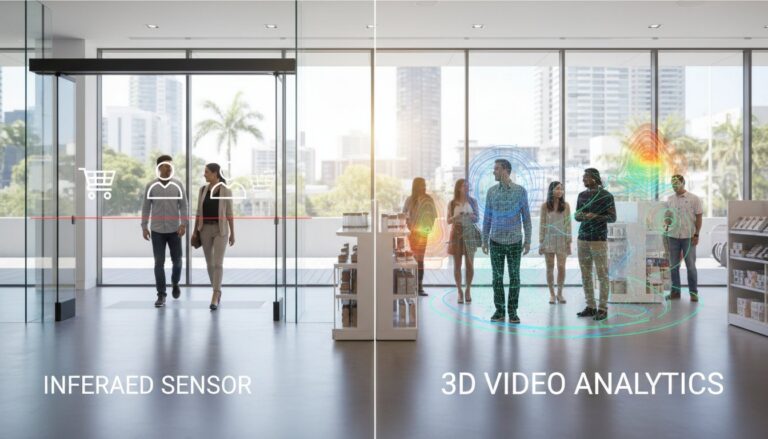
Unlock the full potential of your physical space by looking past the hardware. A modern people counter functions as a sophisticated business intelligence engine rather than a simple tally device. It serves as the primary lens through which you view visitor behavior, transforming raw movement into strategic assets. Since 2021, the shift from basic infrared beams to 3D AI-powered vision has redefined how Australian retailers and facility managers measure success. This evolution ensures that the people counter features you prioritize directly influence your bottom line.
High-performance sensors now target a 98% accuracy threshold as the industry standard. Falling below this mark renders your data unreliable for high-stakes decisions. When you invest in advanced features, you aren’t just buying a sensor; you’re securing a foundation for actionable insights. These insights allow you to move from guessing how many people entered your store to knowing exactly how to optimize your operations for maximum profit.
The Cost of Inaccurate Data
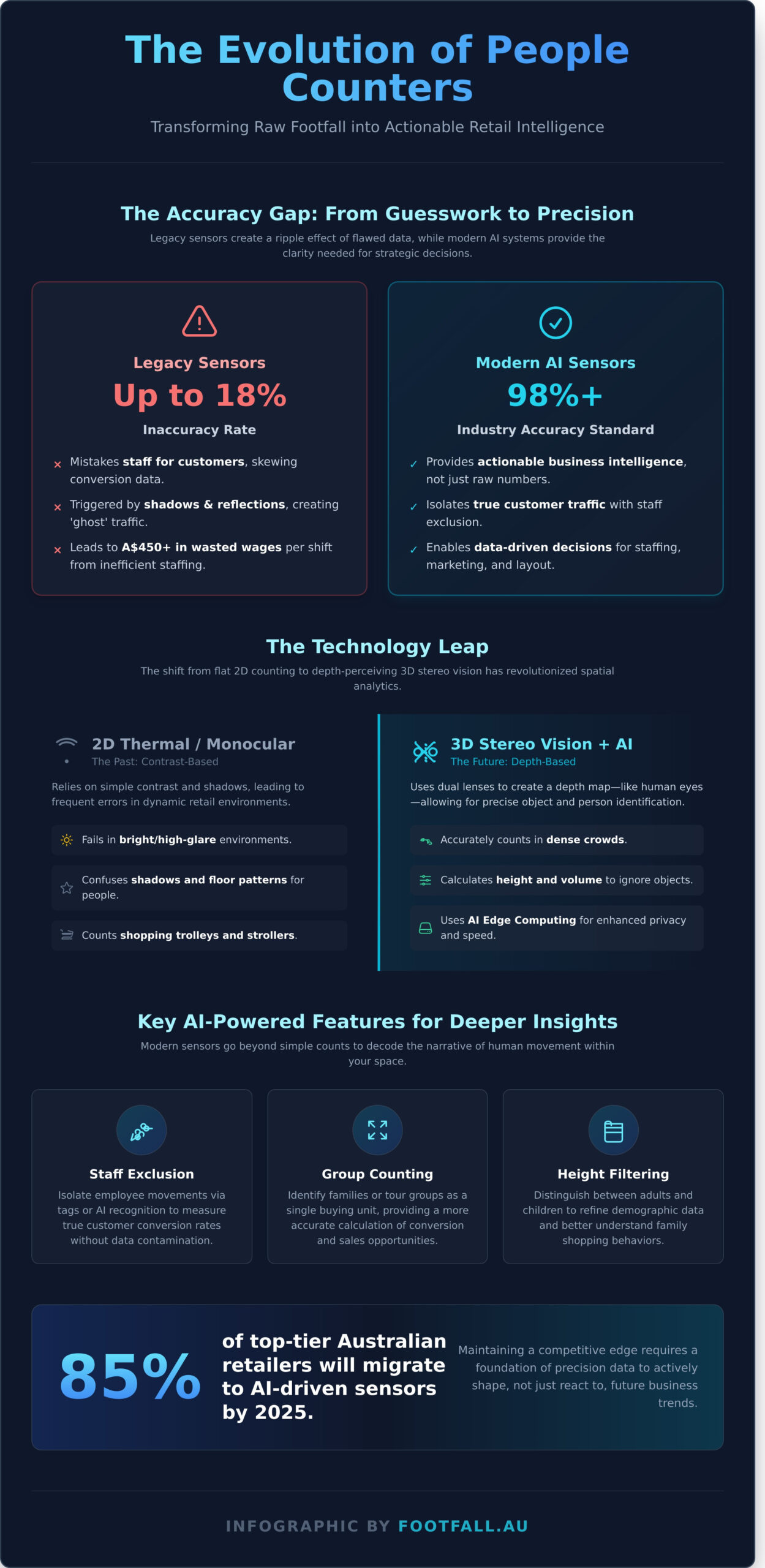
Relying on data with a 5-10% error margin creates a ripple effect of flawed logic across your entire organization. In a high-volume retail environment, such as a Sydney CBD flagship store, a 10% overcount can lead to inflated conversion targets that your team can never realistically meet. Data integrity in retail is the precise alignment between physical footfall and digital transaction records to produce a true conversion rate. Inaccurate sensors often struggle with shadow traffic, where sunlight or internal reflections trigger false counts. Sophisticated systems distinguish between actual human movement and inanimate objects like shopping trolleys or strollers, ensuring your staff levels match real demand. If a manager misallocates three staff members during a “ghost” peak, it could cost a business upwards of A$450 in wasted wages per shift.
The Evolution of Counting Technology
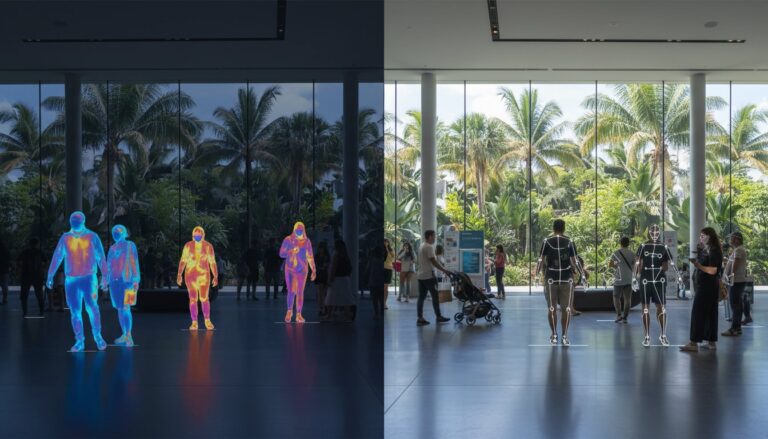
The technological leap from 2D to 3D sensors has fundamentally changed spatial analytics. Older 2D sensors rely on contrast and shadows, which often fail in the bright, high-glare environments typical of Australian shopping centres. In contrast, 3D stereo vision uses two lenses to create a depth map, much like the human eye. This allows the system to accurately count individuals even in dense crowds where people walk side-by-side. Modern people counter features now incorporate AI-driven edge computing, which processes data locally on the device. This shift reduces latency and enhances privacy by ensuring no video streams leave the sensor. Key advantages of this evolution include:
- Height Filtering: Distinguish between adults and children to refine demographic data.
- Staff Exclusion: Use wearable tags or AI shape recognition to remove employees from total counts.
- Group Counting: Identify families or groups as a single buying unit to calculate more accurate conversion rates.
By 2025, it’s estimated that 85% of top-tier Australian retailers will have migrated to AI-driven sensors to maintain a competitive edge. These tools don’t just count heads; they decode the narrative of human movement within your space. Choosing the right features means you’re no longer reacting to past trends but actively shaping the future of your business through evidence-based strategy.
Essential Hardware Features: Precision in Every Environment
Precision isn’t a luxury in footfall analytics; it’s the foundation of every strategic decision you’ll make. High-performance people counter features begin with 3D stereo vision technology. Unlike 2D sensors that often struggle with depth, 3D sensors use dual lenses to mimic human sight. This allows the device to calculate the exact height and volume of objects moving through the entrance. By identifying the physical depth of a person, these systems eliminate the 15% error margin common in older thermal or monocular systems that often mistake shadows or floor patterns for actual visitors.
Reliability extends to how the device maintains its connection and power. Power over Ethernet (PoE) has become the standard for Australian commercial installations, providing a stable data connection and power supply through a single Cat6 cable. This setup reduces installation costs by up to 30% compared to traditional electrical wiring. Research into Automated people-counting systems confirms that hardware robustness is critical for maintaining high-resolution data streams in varied environments. Without a stable PoE connection, businesses risk data gaps that can lead to flawed staffing models during peak hours.
Wide-angle lenses are a necessity for retailers in Sydney or Melbourne operating in boutique spaces with ceilings below 2.5 metres. These lenses capture a massive field of view without distorting data at the periphery. To safeguard your insights, ensure the hardware includes “Edge storage.” If your local network goes offline, the sensor stores up to 30 days of data internally. This prevents the loss of critical visitor metrics during internet outages, ensuring your historical records remain unbroken. Investing in this level of hardware durability can save a business upwards of A$4,200 annually in recovered data and avoided maintenance visits.
AI-Powered Object Differentiation
Modern sensors do more than count; they categorise. Advanced AI algorithms distinguish between adults, children, and shopping trolleys with 99.5% precision. This allows managers to filter out non-prospect traffic, such as delivery personnel or children, who can artificially inflate your footfall numbers. Height-based filtering ensures that only individuals over a specific threshold, typically 1.3 metres, are counted as potential customers. This level of detail is vital for optimising staff rosters based on actual buying groups rather than raw headcounts.
Environmental Adaptability
Australian retail conditions demand hardware that handles extreme light fluctuations. Sensors in CBD storefronts must feature high dynamic range (HDR) imaging to compensate for harsh afternoon sunlight and deep shadows. For semi-outdoor locations like arcade entries, look for IP65-rated housing. These units resist dust and moisture, ensuring the internal optics remain clear. Anti-glare technology is equally vital; it prevents light bouncing off polished tiles from triggering false counts, an issue that can skew data by as much as 12% in brightly lit showrooms.
Advanced Analytics Features: Turning Traffic into Strategy
Raw numbers provide a baseline, but sophisticated people counter features transform those figures into a roadmap for growth. Data is only valuable if it leads to a specific, positive change in your operations. Without advanced analytics, you’re looking at a flat headcount rather than a dynamic narrative of human behaviour. High-performance sensors now go beyond the “ping” of a crossing line to decode intent and engagement.
The Power of Staff Exclusion
Employees often cross the store threshold 15 to 25 times per shift. These movements inflate your traffic counts and suppress your true Sales Conversion Rate (SCR). If you don’t filter this data, your performance metrics remain fundamentally flawed. Modern systems use AI-powered lanyards or Wi-Fi signal tracking to identify and remove staff movements from the final dataset automatically. This ensures you’re only measuring genuine potential customers.
A flagship fashion retailer in Sydney’s CBD implemented AI-based staff filtering in November 2023. Before the update, their SCR appeared to be stagnating. After removing staff “noise” from the data, they discovered their actual conversion rate was 12% higher than previously reported. This correction proved that their sales team was performing exceptionally well, shifted management’s focus from staff training to inventory depth, and provided a clearer picture of their return on investment.
Deep Engagement and Spatial Intelligence
Understanding what happens between the entrance and the point of sale is vital for optimising floor productivity. Several people counter features allow you to measure this middle-of-the-funnel activity with precision:
- Dwell Time and Zone Analytics: These tools measure how long a visitor remains in a specific 2-square-metre zone. If a new promotional display has a high dwell time but low associated sales, it indicates that the visual merchandising is effective, but the price point or product mix isn’t resonating.
- Heatmapping: This visualises the path-to-purchase by highlighting the most travelled routes. It identifies “dead zones” where 35% of your floor space might receive less than 5% of total foot traffic. You can then use this evidence to redesign the layout and pull traffic into underutilised corners.
- Group Counting: A family of four entering a home appliance store represents one buying unit, not four. Group counting logic identifies clusters of people moving together and counts them as a single entity. This prevents your conversion data from plummeting during weekend family shopping peaks.
Live Occupancy and Flow Control
Managing the visitor journey requires real-time awareness. Live occupancy features provide a digital heartbeat of the venue, which is critical for safety compliance and maintaining service standards. Modern sensors trigger automated alerts to floor managers via mobile apps when occupancy reaches 85% of a pre-set limit. This allows for proactive queue management before customer frustration peaks at the registers.
Visualising the journey from entry to exit helps you spot bottlenecks that cost you revenue. By monitoring flow in real-time, you can deploy staff to the fitting rooms or service desks exactly when the data shows a surge in zone occupancy. It’s a shift from reactive scheduling to evidence-based floor management that respects the visitor’s time and enhances their experience.
Compliance and Connectivity: The Australian Checklist
Australian retail environments demand more than just raw data; they require a framework that respects local regulations and integrates with existing business logic. Choosing hardware based solely on price ignores the operational costs of poor connectivity or legal non-compliance. High-performance people counter features prioritize a “Privacy by Design” philosophy, ensuring your data collection aligns with the Australian Privacy Act 1988 and global GDPR standards. This compliance protects your brand reputation while providing the evidence needed for strategic investment.
Modern systems move beyond local software silos. A cloud-based dashboard, such as the V9 interface, offers a centralized view of your entire estate. While local software limits data access to a single back-office PC, cloud systems enable managers in Sydney to compare real-time performance against branches in Perth or Brisbane. This accessibility ensures that decision-makers have a unified source of truth, regardless of their physical location.
Privacy and Data Security
Privacy is a non-negotiable asset in the Australian market. AI-driven counters utilize edge processing to maintain anonymity; the sensor analyzes the video feed internally and transmits only numerical data to the cloud. No personal images or identifiable features are ever stored or transmitted. This creates a clear distinction between “counting people” and “facial recognition,” the latter of which often triggers significant public pushback and regulatory scrutiny. According to the 2023 OAIC Australian Community Attitudes to Privacy survey, 87% of Australians want more control over their personal information. Using sensors that encrypt data in transit via AES-256 protocols ensures you meet these expectations while maintaining total operational transparency.
Integration and Scalability
Data loses its value if it remains isolated. Your hardware must talk to your Point of Sale (POS) system to calculate conversion rates automatically. If a flagship store sees 2,500 visitors but only 300 transactions, the 12% conversion rate highlights a specific floor management issue rather than a lack of marketing reach. Systems like the FootfallCam Centroid further enhance this by repurposing existing CCTV feeds for analytics, which can reduce infrastructure costs by up to 35% for large-scale deployments.
- API Connectivity: Ensure the system supports RESTful APIs for seamless data flow into BI tools like PowerBI or Tableau.
- Automated ROI: Link footfall to sales data to identify which staff shifts generate the highest A$ return per visitor.
- Franchise Ready: Select a system that scales from a single boutique to a national network of 500+ locations without losing data integrity.
Support and maintenance should be viewed as a core feature of the system ecosystem. A counter that is offline is a blind spot in your business intelligence. Professional systems include health check monitoring that alerts your IT team the moment a sensor loses connectivity. This proactive approach ensures a data uptime of 99.5%, providing the consistent history required for year-on-year growth analysis. Investing in a robust support plan transforms a simple sensor into a long-term strategic partner.
Ready to upgrade your business intelligence with compliant, high-precision technology? Explore our range of Australian-compliant people counters here.
Future-Proofing with Footfall Australia: The FootfallCam Advantage
Selecting the right people counter features is about more than just checking boxes; it’s about investing in a system that evolves with your business. The FootfallCam Pro2 stands as the definitive synthesis of these requirements. It integrates 3D stereoscopic vision with AI-driven processing to deliver 99.5% accuracy even in high-traffic environments. This hardware doesn’t just count heads. It decodes the complex narrative of human movement within your space, providing a level of precision that basic sensors simply can’t match. By 2025, businesses relying on outdated technology will find themselves at a severe disadvantage as competitors leverage deeper spatial intelligence to refine their operations.
The Legacy Swap Out Plan
By the start of 2026, the gap between basic infrared beams and AI-driven analytics will become a critical operational risk for Australian retailers. Older 2D systems often miss up to 20% of traffic during peak periods, leading to skewed conversion data and poor staffing decisions. Footfall Australia simplifies the transition through our Legacy Swap Out Plan. We help businesses replace obsolete hardware with Pro2 sensors, reducing the Total Cost of Ownership (TCO) by approximately 25% over a five-year lifecycle. High-quality hardware ensures you aren’t replacing sensors every 24 months. This strategic upgrade path allows you to move from simple counting to advanced metrics like dwell time and heat mapping without the traditional headache of a full system overhaul.
Partnering for Actionable Insights
Data only creates value when it informs a specific, positive change in your daily operations. Footfall Australia operates as a High-Tech Consultant, moving beyond the role of a simple hardware vendor to become an objective partner in your growth. Our team provides national support across Brisbane, Sydney, Melbourne, and Perth, ensuring your system remains calibrated for specific Australian light conditions and floor layouts. We leverage the FootfallCam V9 software to track long-term data trends, allowing you to compare performance across different seasons or specific marketing campaigns.
The V9 platform transforms raw numbers into a narrative. It allows managers to see exactly how footfall correlates with weather patterns or local events. This evidence-based approach has helped our clients achieve a 14% increase in average transaction value by optimizing staff schedules to match peak visitor flows. We don’t just hand you a login; we help you interpret the visitor journey to uncover hidden opportunities in your physical space.
Success in the Australian retail and public sector requires a partner who understands the nuances of the local market. Whether you’re managing a single boutique in Adelaide or a national network of shopping centres, the right intelligence is your most valuable asset. Precision in measurement leads to confidence in management. It’s time to stop guessing how your space is used and start knowing.
Book a consultation with Footfall Australia to find your ideal feature set and secure the data you need to stay ahead of shifting consumer trends.
Secure Your Competitive Edge with Data-Driven Intelligence
Choosing the right people counter features isn’t just a technical purchase; it’s a strategic investment in your brand’s future. By 2026, the distinction between market leaders and those falling behind will rest on a 98% accuracy guarantee that turns simple foot traffic into actionable intelligence. You need more than just numbers. You require a system that maps the visitor journey while staying 100% compliant with Australian privacy regulations. Footfall Australia supports this transition with a local installation and support network designed specifically for our unique market conditions. We replace guesswork with evidence-based logic, allowing you to optimize staff rosters and conversion rates with total confidence. The FootfallCam Pro2 delivers this precision through high-tech sensors and intuitive reporting, ensuring your management decisions are backed by hard data. It’s time to gain a transparent view of your physical space and drive sustainable growth. Optimise your business with the FootfallCam Pro2 today and start leading with data-driven certainty.
Frequently Asked Questions
What is the most important feature in a people counter for retail?
Precision is the most critical feature for any retail environment. Look for sensors that maintain 98% accuracy even during peak traffic periods. Without this level of reliability, your conversion rate calculations can fluctuate by 15%, which leads to poor staffing decisions and wasted labor costs. Modern systems must also offer cloud-based reporting to turn these raw numbers into a clear business strategy.
How does staff exclusion work in modern people counting systems?
Staff exclusion uses AI-driven skeletal tracking or specialized wearable tags to filter employees from your visitor counts. This prevents your team’s movements from inflating foot traffic data by an average of 12% per shift. By removing this noise, you gain a true reflection of customer intent and more accurate labor-to-traffic ratios. It ensures your performance metrics aren’t skewed by internal operations.
Can people counters distinguish between adults and children?
Advanced sensors use 3D depth perception to distinguish between adults and children based on height thresholds. You can set a specific height limit, such as 1.3 meters, to ensure that families are counted as a single buying unit or to exclude toddlers from your primary data. This distinction is vital for Australian retailers aiming to calculate precise sales conversion rates and understand demographic trends.
Do people counters store images of customers?
Professional people counters don’t store identifiable images of your customers. They operate on a privacy-by-design principle where the sensor processes visual data into anonymous metadata locally on the device. All video streams are discarded within milliseconds. This ensures your business complies with the Australian Privacy Act 1988 while still capturing the critical spatial analytics needed for growth.
How accurate are AI-powered people counters compared to infrared?
AI-powered sensors deliver 98.5% accuracy, whereas traditional infrared beams often struggle with 20% error rates in busy environments. Infrared systems can’t distinguish between a single person and a group entering simultaneously. Key people counter features in AI models include the ability to track individual paths, ensuring your data remains robust even during peak Saturday afternoon rushes in Melbourne or Sydney.
What is the difference between 2D and 3D people counting technology?
3D technology uses dual-lens stereoscopic vision to perceive depth, while 2D sensors rely on flat image analysis. This allows 3D counters to ignore shadows or floor reflections that typically cause 15% false positives in 2D systems. The 3D approach provides the spatial intelligence required for complex tasks like dwell time measurement and queue management in large-scale Australian shopping centres.
Can I integrate people counter data with my POS system?
You can integrate traffic data with your Point of Sale (POS) system via secure API connections. This marriage of datasets allows you to calculate your exact conversion rate automatically. If your store sees 500 visitors but only 50 transactions, you’ll identify a 10% conversion rate immediately. This insight helps managers adjust staffing levels to capture the A$2,500 in potential revenue often lost during peak hours.
What happens to the data if my internet goes down?
Modern sensors include internal memory that stores up to 30 days of data during an internet outage. Once the connection is restored, the device automatically syncs the cached information to your cloud dashboard. This ensures your historical records remain continuous. Your long-term trend analysis won’t be compromised by a temporary network failure at your retail site.