

Wi-Fi vs Wired People Counters: Which Connectivity is Best for Your Business?
Would you trust a strategic expansion plan to a system that loses 15% of its data every time the store’s network fluctuates? Most Australian retailers recognise that precision is the only currency that matters when measuring conversion rates. However, the debate over Wi-Fi vs wired people counters often leaves business owners caught between the high cost of physical cabling and the fear of signal dropouts. It’s a common dilemma where the desire for a seamless installation conflicts with the need for absolute data integrity.
Discover a clear path to choosing infrastructure that supports your specific retail environment without unexpected maintenance headaches. This article breaks down the technical and financial realities of both connectivity types to ensure your business intelligence is built on stable, high-precision evidence. We will explore how different hardware configurations impact your ROI reporting and clarify the common confusion between Wi-Fi as a connection method versus its use as a tracking technology.
Key Takeaways
- Understand how your choice of connectivity serves as the invisible infrastructure that dictates the precision and reliability of your footfall analytics.
- Evaluate the security and stability benefits of wired systems as the gold standard for high-traffic commercial environments requiring uninterrupted data transmission.
- Identify scenarios where Wi-Fi offers the necessary flexibility for rapid deployment in historic Australian landmarks or dynamic pop-up retail spaces.
- Analyze the total cost of ownership and potential for data loss when comparing Wi-Fi vs wired people counters to optimize your long-term ROI in A$.
- Learn how hybrid technology like the FootfallCam Pro2 future-proofs your data through intelligent caching, ensuring no visitor journey is lost during network downtime.
The Connectivity Dilemma: Why Your Choice of People Counter Matters
Modern retail strategy relies on the precision of spatial analytics to drive growth. Choosing between Wi-Fi vs wired people counters is not merely a technical checkbox; it is a strategic decision that dictates the reliability of your entire data pipeline. The “invisible” infrastructure supporting your sensors determines whether your insights arrive in real-time or suffer from lag that renders them useless for immediate operational adjustments. When a People counter loses its connection, the resulting data gaps can skew conversion rates and lead to poor staffing decisions that impact your bottom line.
In the Australian retail landscape, where labour costs are a significant overhead, the relationship between connectivity and latency is critical. A 10-minute delay in data transmission might seem minor, but for a high-volume store in Melbourne’s CBD, it means missing the window to deploy additional staff during a sudden footfall surge. Connectivity choice directly impacts the long-term ROI of your system by influencing maintenance costs and the lifespan of the hardware. Strategic managers prioritise systems that offer 99.9% uptime to ensure every visitor journey is captured with absolute certainty.
This requirement for high availability is a common theme in modern business infrastructure; as you optimize your network for data accuracy, it may also be the right time to explore Hosted Cloud PBX to ensure your communication channels remain equally resilient.
Wired (PoE) Connectivity Explained
Wired systems utilise Power over Ethernet (PoE) to deliver a stable, high-bandwidth connection. This method uses a single Category 6 cable to transmit both power and data simultaneously from your network switch to the sensor. High-traffic environments, such as major shopping centres or transport hubs, treat wired connections as the gold standard because they are immune to the signal interference that often plagues crowded wireless frequencies. Power over Ethernet (PoE) is a technology that ensures constant uptime without battery dependency. By eliminating the need for local power outlets at every sensor point, businesses reduce electrical installation complexities while ensuring the device remains online 24/7 for consistent data harvesting.
Wi-Fi and Wireless Connectivity Explained
Wi-Fi counters transmit footfall data to the cloud by connecting to local wireless access points. These units are often preferred for heritage buildings or temporary “pop-up” activations across Australia where invasive cabling is restricted. You’ll find two main types: plug-in units that require a standard power point and battery-powered sensors that offer total placement freedom. It’s a common misconception that “wireless” means “maintenance-free.” Even the most efficient battery-powered Wi-Fi vs wired people counters require periodic battery replacements or re-charging cycles, which can lead to data “blackouts” if not managed proactively. While Wi-Fi offers rapid deployment, its performance depends entirely on the strength and stability of the local network environment.
Wired People Counters: The Gold Standard for Data Stability and Security
Wired systems represent the pinnacle of reliability for businesses that cannot afford data dropouts. While wireless solutions offer flexibility, the physical connection of a wired sensor provides a level of consistency that radio waves simply cannot match. In high-traffic Australian retail environments, such as major shopping centres in Sydney or Melbourne, the sheer volume of mobile devices can create significant signal noise. Wired sensors bypass this congestion entirely. They deliver a clean, constant stream of information directly to your local network or cloud server without the risk of packet loss or interference from nearby electronics.
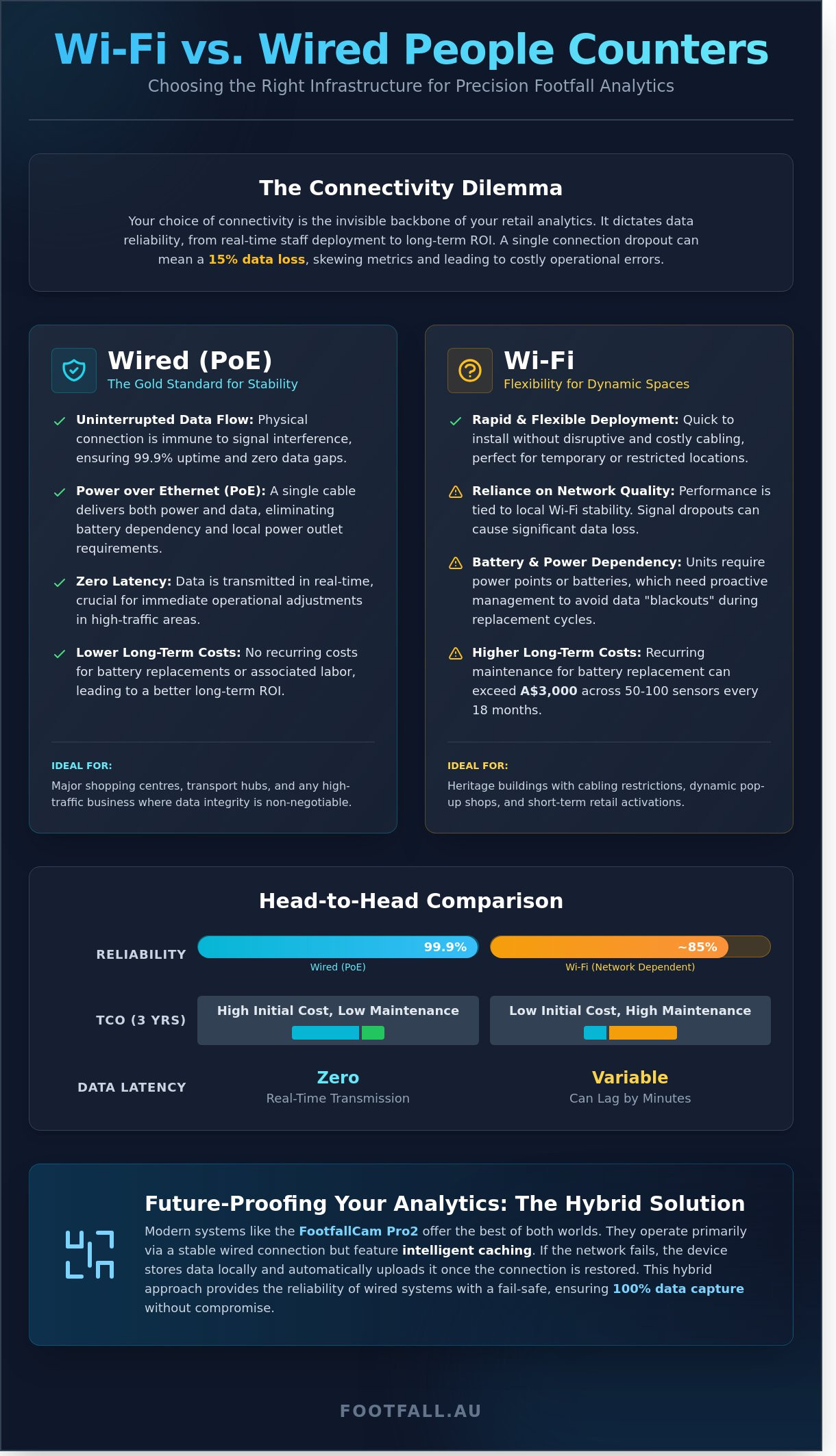
The primary advantage of these systems lies in Power over Ethernet (PoE) technology. By utilizing PoE, a single Category 6 cable provides both the electrical power and the high-speed data connection required for the sensor to operate. This architecture removes the logistical headache of battery management. For a large-scale retail chain, the cost of replacing lithium batteries across 50 or 100 sensors every 18 months can exceed A$3,000 when factoring in both parts and specialist labour. Wired systems eliminate these recurring operational expenses while ensuring the device is always online.
Uninterrupted Data Flow and Zero Latency
Wired devices ensure that your occupancy metrics remain accurate every second of the day. They prevent the “data gaps” that frequently occur when a Wi-Fi router restarts or during local firmware updates. In a 2023 review of network infrastructure, industry experts highlighted that wired connections provide unmatched reliability and stability compared to their wireless counterparts. This is vital for real-time occupancy monitoring, where a 30-second delay could lead to a breach of safety protocols in a crowded venue.
- Consistent Pings: Wired sensors maintain a heartbeat connection, allowing IT teams to monitor device health instantly.
- Network Management: IT departments across Australia prefer wired devices because they don’t compete for limited wireless bandwidth.
- Zero Latency: Data reaches the analytics dashboard in milliseconds, providing an immediate view of visitor flow.
Enhanced Cyber Security for Corporate Networks
When evaluating Wi-Fi vs wired people counters, security is often the deciding factor for enterprise clients. Every wireless device on a network represents a potential entry point for unauthorized access. By opting for a wired system, you eliminate the broadcasting of an SSID and the vulnerabilities associated with wireless encryption protocols. This significantly reduces the digital “attack surface” of your business. Wired sensors integrate seamlessly with enterprise-level firewalls and support local server hosting, ensuring that sensitive footfall data never leaves your internal environment if privacy is a top priority.
This focus on secure data handling is a core component of the importance of people counting technology in the modern corporate landscape. Large-scale retail hubs, permanent office complexes, and government buildings rely on this hardware to maintain strict compliance with data protection standards. For organisations looking to build a future-proof analytics foundation, choosing professional wired installations ensures that your data remains both accurate and protected from external threats.
Wi-Fi People Counters: Flexibility and Speed for Dynamic Environments
Wi-Fi people counters offer a streamlined path to data acquisition by removing the need for extensive structural cabling. This connectivity method suits businesses operating in agile environments where speed of deployment is a priority. Installation often takes less than 30 minutes per device, as it leverages existing wireless infrastructure. For Australian retailers managing multiple locations, this reduces the reliance on specialised electrical contractors, potentially saving hundreds of A$ in labor costs per site during the initial rollout.
The primary trade-off involves signal stability. Wireless environments are susceptible to interference from other electronic devices or physical barriers. To maintain data integrity, professional sensors like those from FootfallCam incorporate edge counting. This technology allows the device to process and store visitor counts locally on internal memory during a network dropout. Once the connection restores, the sensor automatically syncs the cached data to the cloud. When evaluating Wi-Fi vs wired people counters, businesses must weigh the security, scalability, cost, and performance of their current wireless network against the mission-critical nature of their data.
Connectivity vs. Sensing: Clearing the Confusion
There is a frequent misunderstanding regarding how Wi-Fi functions within a sensor. In this context, Wi-Fi serves as the data transport layer; it’s the “pipe” that sends numbers to your dashboard. This is distinct from Wi-Fi MAC address tracking, which follows signal pings from smartphones to estimate dwell time. The FootfallCam Pro2 utilizes Wi-Fi to transmit data while relying on high-precision video analytics for the actual counting process. A Wi-Fi connection does not inherently mean a device is using Wi-Fi sensing for accuracy.
When to Choose Wi-Fi Connectivity
Wireless connectivity is the strategic choice for specific Australian business scenarios where physical modifications are restricted or impractical:
- Historic Buildings: Sites protected under the Heritage Act 1977, such as those in Sydney’s The Rocks or Melbourne’s CBD, often prohibit drilling or new conduit installation. Wi-Fi sensors provide a non-invasive solution that respects architectural integrity.
- Temporary Installations: Pop-up shops and trade exhibitions require hardware that can be set up and dismantled within hours. Wireless sensors allow for rapid relocation as floor plans evolve.
- Small Retail Footprints: Boutique stores with a single entrance and a robust, existing Wi-Fi router can avoid the complexity of a Power-over-Ethernet (PoE) setup.
Choosing between Wi-Fi vs wired people counters ultimately depends on your site’s physical constraints and your long-term infrastructure strategy. While Wi-Fi offers unparalleled agility, it requires a stable network environment to ensure seamless reporting. For businesses with 99.9% network uptime, the flexibility of wireless sensors provides a sophisticated, low-friction entry point into spatial analytics.
Head-to-Head Comparison: Power, Latency, and Total Cost of Ownership
Choosing between Wi-Fi vs wired people counters requires a cold look at long-term operational stability. While Wi-Fi offers a lower barrier to entry, wired systems provide a foundation of reliability that pays dividends as your data needs grow. The decision rests on whether you value immediate convenience or sustained data integrity.
Total Cost of Ownership (TCO) Breakdown
Professional cabling in Australia typically costs between A$150 and A$400 per point depending on ceiling height and site complexity. This initial capital expenditure often deters smaller retailers, yet it eliminates the recurring “hidden” costs of Wi-Fi management. Wireless systems frequently suffer from signal dead zones in dense retail environments. Troubleshooting these interruptions can lead to technician call-out fees exceeding A$120 per hour. For a granular look at budget planning, consult this comprehensive guide to people counting systems in Australia.
Data Integrity and Accuracy Metrics
Signal congestion in busy Australian shopping centres is a documented challenge, particularly on the crowded 2.4GHz band. Wired systems consistently achieve uptime percentages of 99.9%. In contrast, Wi-Fi devices may experience packet loss during peak trading hours when hundreds of customer smartphones compete for the same bandwidth. This latency directly hinders your ability to perform strategic footfall data analysis. If a sensor only uploads data every 15 minutes because of a weak signal, you lose the real-time pulse of your store.
- PoE Efficiency: Power over Ethernet delivers both electricity and data through one cable, removing the need for local power points or battery maintenance.
- Scalability: Adding 100 wired devices is a matter of switch capacity. Adding 100 Wi-Fi devices often requires a total overhaul of wireless access point architecture to prevent network crashes.
- Interference: Wired connections remain immune to the physical obstructions like concrete pillars or metal shelving that degrade Wi-Fi signals.
Battery-powered Wi-Fi sensors might seem simple, but the labour cost of replacing batteries across a national fleet of 50 stores can reach thousands of dollars annually. Wired systems represent a “set and forget” investment. They ensure that your visitor journey data remains uninterrupted by low batteries or router resets.
Ready to build a data foundation that lasts? View our high-performance hardware options.
Future-Proofing Your Analytics: Why the FootfallCam Pro2 Offers the Best of Both Worlds
Evaluating the Wi-Fi vs wired people counters debate often leads to a trade-off between installation ease and network stability. The FootfallCam Pro2 removes this friction by offering both connectivity paths in a single device. This flexibility allows Australian retailers to deploy sensors in complex heritage buildings where cabling is restricted, while still utilizing Power over Ethernet (PoE) in modern storefronts. You don’t have to choose between a quick setup and long-term reliability; you can have both.
Data integrity remains the cornerstone of spatial analytics. When a network outage occurs, the Pro2 doesn’t stop working. It caches up to 25 days of footfall data locally on the device. Once the connection restores, the sensor automatically synchronizes with the cloud. This failsafe ensures your conversion rates and peak hour reports remain accurate, even during local ISP disruptions or router reboots. It’s a level of resilience that protects your investment from the unpredictable nature of digital infrastructure.
The Hybrid Advantage of FootfallCam Pro2
The Pro2 supports both PoE and Wi-Fi to adapt to any Australian business environment, from high-ceilinged transit hubs to boutique kiosks. Its AI-driven counting engine operates independently of the connection type, maintaining over 98% accuracy regardless of how data reaches the server. This means your business intelligence stays consistent across multiple sites with varying infrastructure. For a deep dive into the hardware specifications and power requirements, read the FootfallCam Pro2 buying guide to see how it fits your specific technical needs.
Ensuring Long-Term Success with Professional Support
Connectivity is only as strong as the infrastructure supporting it. Footfall Australia provides dedicated support plans that monitor device health and connectivity stability in real-time. If your current hardware feels sluggish or inaccurate, our “Legacy Swap Out” program helps you replace outdated, unreliable wireless systems with modern, dual-connectivity units. This upgrade path minimizes downtime and secures your data pipeline for years to come. Consult with a Footfall Australia strategist to design your ideal connectivity map and resolve the Wi-Fi vs wired people counters dilemma for your specific site.
Selecting the right connectivity depends on balancing your physical site constraints with your long-term data goals. While wired connections offer unparalleled stability for permanent flagship locations, the flexibility of Wi-Fi allows for rapid deployment in temporary or restricted spaces. The FootfallCam Pro2 ensures that no matter which path you choose, your business intelligence remains uninterrupted, actionable, and ready to scale.
Future-Proofing Your Retail Analytics Strategy
Choosing between Wi-Fi vs wired people counters shouldn’t mean sacrificing long-term reliability for short-term convenience. Wired connections provide the essential foundation for high-security environments, while Wi-Fi delivers the agility required for rapid deployment in dynamic Australian retail spaces. The FootfallCam Pro2 eliminates this connectivity dilemma by supporting both Power over Ethernet (PoE) and Wi-Fi in a single device, ensuring your hardware remains functional as your store infrastructure evolves.
Data integrity is paramount for accurate spatial analytics. Our proprietary data caching technology safeguards your insights by storing information locally to prevent data loss during temporary signal drops. We provide a national support network for professional wired installations across Australia, ensuring your system is optimized for precision from day one. It’s time to replace guesswork with high-precision intelligence that reflects the true narrative of your visitor journey.
Request a data-driven consultation for your site connectivity
You’re ready to transform your foot traffic into a strategic roadmap for measurable business growth.
Frequently Asked Questions
Do Wi-Fi people counters lose data if the internet goes down?
Most professional Wi-Fi sensors don’t lose data because they include internal flash memory to cache information during outages. These devices can typically store up to 30 days of visitor data locally. Once the network connection is restored, the sensor automatically syncs the stored records with your analytics dashboard, ensuring your historical trends remain accurate and complete.
Is it more expensive to install a wired people counting system?
Wired systems usually require a higher initial investment due to the cost of professional cabling. In Australia, a licensed data cabler often charges between A$80 and A$120 per hour for installation services. While the upfront price is higher than a plug-and-play Wi-Fi unit, the long-term reliability often results in lower troubleshooting costs over a five year lifecycle.
Can Wi-Fi signals from customers interfere with a Wi-Fi people counter?
Signal interference can occur in crowded environments, but it’s manageable by using the 5GHz frequency band rather than the common 2.4GHz band. When evaluating Wi-Fi vs wired people counters, it’s vital to remember that wired connections are immune to the radio frequency noise found in busy shopping centres. Professional Wi-Fi sensors use advanced hopping techniques to maintain data integrity despite heavy local traffic.
What is PoE, and why is it recommended for people counters?
PoE stands for Power over Ethernet, which is a system that sends both power and data through a single Cat6 cable. It’s the gold standard for people counters because it removes the need for a dedicated power point near the ceiling. This technology provides a consistent power supply and a secure data link, resulting in 99.9% uptime for your spatial analytics sensors.
Can I switch from Wi-Fi to a wired connection later?
Many high-end sensors feature dual-mode connectivity, allowing you to switch from Wi-Fi to a wired Ethernet port if your infrastructure changes. This flexibility is ideal for businesses that need immediate data but plan to renovate their premises in the future. You can deploy the hardware quickly using existing Wi-Fi and hardwire the units later to improve network stability and security.
Are wired people counters more secure against hacking than Wi-Fi models?
Wired counters offer superior security because they don’t broadcast a signal that can be intercepted from outside the building. While Wi-Fi models use WPA3 encryption to protect data, they still present a larger potential attack surface than a physical cable. For high-security environments like banks or government offices, a wired connection ensures that visitor movement data stays within the physical network.
How much bandwidth does a Wi-Fi people counter use?
A standard people counter is extremely efficient, typically consuming less than 500KB of data over a 24 hour period. The devices transmit small text-based packets containing timestamps and counts rather than high-resolution video files. This negligible bandwidth usage means you can run dozens of sensors on a standard commercial internet plan without affecting your point-of-sale systems or guest networks.
Do battery-powered wireless counters have the same accuracy as wired ones?
Battery-powered sensors generally offer lower accuracy, often hovering around 80% to 85% compared to the 98% accuracy of wired 3D sensors. The power constraints of batteries usually limit the device to simple infrared beams that can’t distinguish between groups or strollers. Wired units have the constant power needed for complex 3D stereoscopic vision, which is essential for precise conversion rate tracking.