How to Gain Confidence in Your Retail Data: A 2026 Strategy for Australian Retailers
What if the discrepancy between your store traffic and your daily revenue isn’t a failure of your sales team, but a failure of your reporting tools? Many Australian retailers find themselves caught in a cycle of second-guessing automated reports that don’t seem to reflect the reality of their physical floor operations. It’s frustrating to manage inconsistent data across different locations, especially when you’re trying to justify marketing spend or adjust rosters against a national minimum wage that rose to A$26.44 per hour in July 2026.
We agree that data is only valuable if it leads to a specific, positive change in your operations. By integrating footfall data with POS systems, you move beyond intuition and toward a single source of truth for every store in your network. This article will show you how to transform unreliable metrics into a foundation of trust using AI-driven accuracy and integrated analytics. You’ll learn how to calculate true conversion rates and gain the confidence to make staffing adjustments based on empirical evidence, ensuring your strategy is prepared for the shifting behavioral trends of the 2026 retail market.
Key Takeaways
- Identify the root causes of “dirty data” to bridge the gap between reported foot traffic and actual sales transactions.
- Discover the strategic advantage of integrating footfall data with POS systems to calculate precise conversion rates and justify marketing ROI.
- Understand how AI-powered stereoscopic vision achieves a 98% accuracy rate by filtering out false positives like shopping trolleys and shadows.
- Learn a practical two-step framework for auditing your current sensors to establish a verifiable baseline for your national store network.
- Explore how the Legacy Swap Out Plan provides a structured path to modernize aging hardware and maintain data integrity through 2026.
The Crisis of Confidence: Why Retailers Doubt Their In-Store Metrics
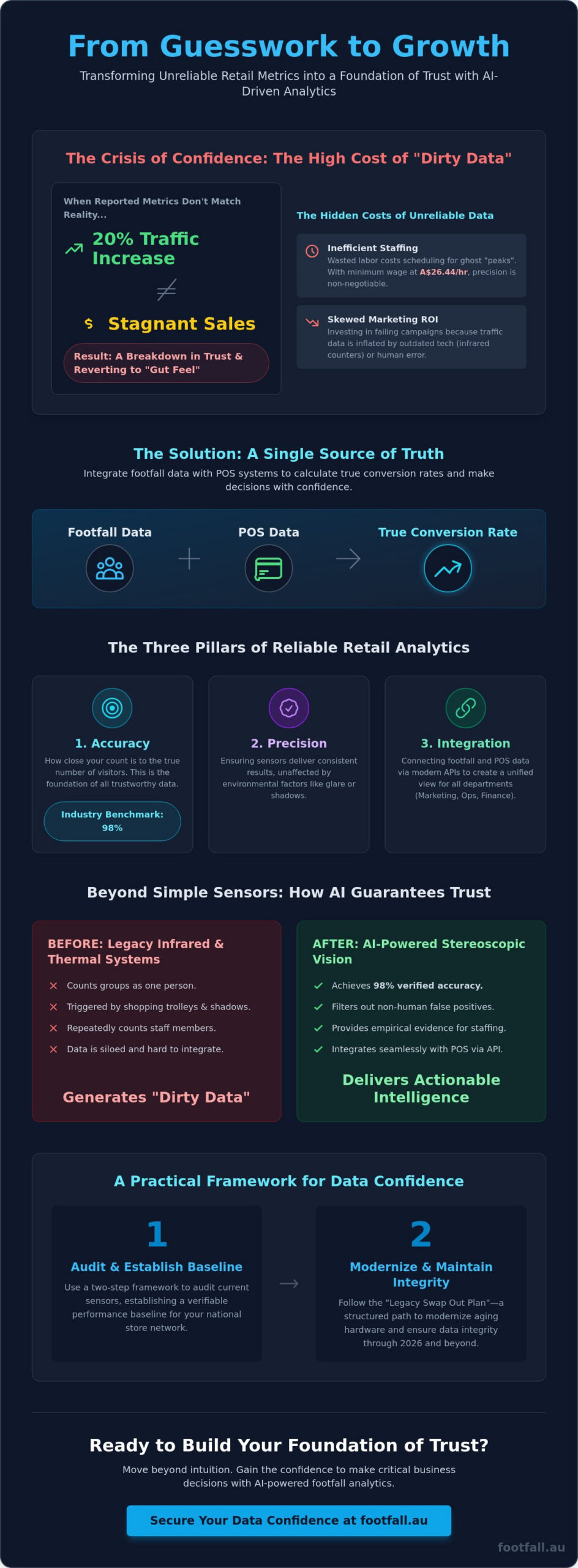
Many Australian retailers operate under a cloud of skepticism regarding their in-store metrics. It’s a common scenario: a store manager looks at a dashboard showing a 20% increase in traffic, yet the daily settlement from their Point of Sale (POS) system reflects stagnant sales. This discrepancy creates “dirty data,” a set of metrics that look professional on a screen but fail to withstand the scrutiny of a physical floor audit. When your traffic counts don’t align with your revenue, the result is a breakdown in trust between the head office and store-level management.
Within the 2026 retail climate, “roughly accurate” is no longer a viable baseline. With the ACCC increasing its oversight on retail pricing and operational transparency, and the national minimum wage rising to A$26.44 per hour, every operational decision must be precise. Relying on flawed data leads to a psychological fatigue where leadership reverts to intuition or “gut feeling.” This regression into guesswork is dangerous. Decisions regarding store hours, marketing spend, and inventory levels become gambles rather than strategic moves. By integrating footfall data with POS, retailers can finally bridge this gap, turning speculative numbers into actionable intelligence.
The Hidden Costs of Unreliable Retail Data
Operational inefficiency carries a high price tag. When footfall data is inflated or undercounted, labour costs spiral. Scheduling too many staff members during a ghost “peak” hour wastes capital, while understaffing during a genuine surge leads to lost conversions. Poor data also skews the perceived ROI of marketing campaigns. If a weekend promotion appears to drive traffic that doesn’t actually exist, you might continue investing in failing strategies while ignoring channels that truly perform.
Common Sources of Data Friction
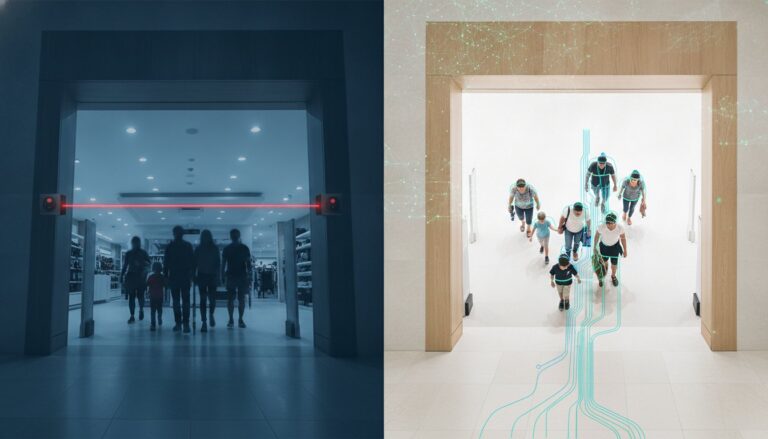
Most data friction stems from outdated technology or organizational silos. Legacy infrared counters often fail to distinguish between a single customer and a group, or they count a staff member multiple times as they cross the threshold. Manual counting or staff observations are equally flawed, as they’re subject to human error and bias. These inaccuracies are compounded when marketing, operations, and finance departments work in silos. Without integrating footfall data with POS systems, these departments speak different languages, making it impossible to achieve a unified view of the customer journey.
Defining Data Confidence: The Three Pillars of Reliable Retail Analytics
Reliable analytics don’t happen by accident. They require a structured approach to how information is captured, processed, and presented. For Australian retailers managing diverse portfolios across the nation, data confidence is the result of three specific pillars: accuracy, consistency, and integration. Without these, even the most sophisticated dashboard becomes a liability rather than a tool for growth.
Accuracy vs Precision in Footfall Counting
While often used interchangeably, accuracy and precision play different roles in your analytics. Accuracy measures how close your count is to the actual number of visitors, while precision ensures that your sensors deliver the same result under identical conditions. High precision is essential for calculating a reliable retail sales conversion rate. If your counts fluctuate due to environmental factors like harsh midday glare or shifting shadows near store entrances, your conversion metrics will be inherently flawed. A 98% verifiable count rate serves as the definitive industry benchmark for establishing data confidence.
Integrating Footfall Data with POS
The third pillar involves breaking down technical barriers between departments. By integrating footfall data with POS systems, you create a holistic view of the customer journey that links entrance traffic directly to transaction volume. This process allows you to integrate footfall and sales data into a single, cohesive narrative. Modern API-first platforms facilitate this connection, ensuring that marketing, operations, and finance teams all work from the same dataset. When store managers can see local conversion trends in real-time, they gain the autonomy to make immediate, evidence-based decisions on the floor.
Consistency across a national network is equally vital. If one flagship store uses a different counting methodology than another outlet within your network, you can’t perform a meaningful comparative analysis. Standardizing your hardware and software ensures that a “visitor” is defined identically across every location. Finally, the shift toward real-time reporting is no longer optional. In the fast-paced 2026 retail environment, delayed data is historical data. Real-time insights allow for intra-day staffing adjustments and immediate response to marketing triggers. If you’re ready to stabilize your metrics, consider exploring how advanced analytics solutions can provide the clarity your strategy requires.
Beyond Simple Sensors: How AI-Powered Hardware Guarantees Trust
Establishing a foundation of trust in your retail strategy requires moving beyond the limitations of basic motion detection. Traditional infrared beams or repurposed security cameras often fail because they lack the intelligence to differentiate between a human shopper and a shopping trolley. High-fidelity data requires a transition to AI-based human behaviour analysis. By using hardware specifically designed for counting, retailers avoid the noise generated by shadows or light fluctuations that typically plague standard CCTV systems. This level of physical accuracy is the prerequisite for integrating footfall data with POS; if the initial count is flawed, the resulting conversion metrics become a liability.
Deploying purpose-built hardware eliminates the ambiguity of repurposed security feeds. These sensors process information at the “edge,” meaning the data is analysed directly on the device before being transmitted. This increases processing speed and ensures that integrating footfall data with POS happens with minimal latency, providing a near-instantaneous view of store performance across your national network. This technical distinction allows management to treat physical presence as a sequence of human actions rather than just a set of isolated statistics.
The Anatomy of a High-Confidence Sensor
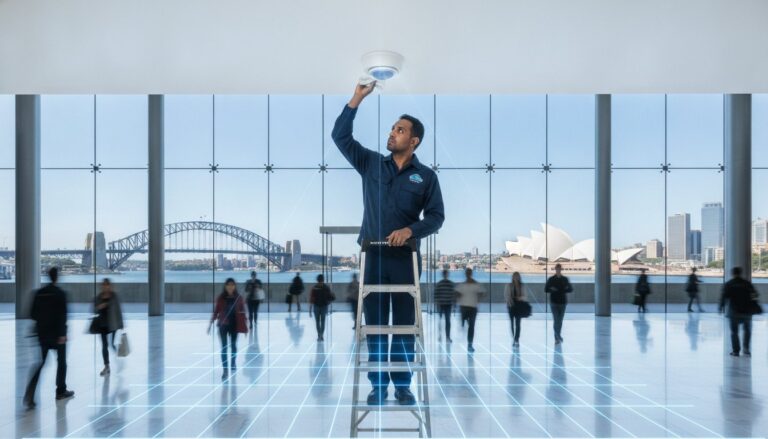
The FootfallCam Pro2 People Counters utilize a dual-lens system to create a 3D map of the store entrance. This stereoscopic vision allows the sensor to calculate the height and mass of objects, effectively ignoring strollers or inanimate objects that would trigger a false count in legacy systems. AI filtering further refines this data by distinguishing between store staff and genuine customers. This ensures that your conversion rates remain untainted by internal movements or staff shift changes. Wide-angle coverage provides a comprehensive view of complex entrances, capturing movement across the entire threshold without the blind spots common in narrow-field sensors.
Privacy by Design
Privacy remains a non-negotiable priority for Australian consumers and regulators. With the removal of the small business exemption for the Privacy Act in 2026, nearly all Australian businesses must now comply with the Australian Privacy Principles (APPs). AI-powered sensors provide a solution by using anonymous counting rather than facial recognition. These systems convert human shapes into anonymous data points in real-time on the device itself. This approach ensures that no video footage is ever recorded or stored, protecting the brand from the statutory tort for serious invasions of privacy that came into effect in June 2025. This commitment to privacy builds customer trust while still providing the deep operational insights necessary for modern retail management.
A Practical Framework for Auditing and Validating Your Retail Metrics
Establishing a culture of data confidence requires more than just high-quality hardware. It demands a rigorous, repeatable framework for auditing and validating the information you collect. For Australian retailers, this process ensures that every strategic decision, from adjusting rosters to meet the A$26.44 per hour minimum wage to optimizing floor layouts, is backed by empirical evidence. A structured audit identifies where data friction exists and provides the technological means to observe and correct it.
Step 1 involves conducting a physical versus digital count audit to establish a verifiable baseline. This is typically done by comparing manual counts from a 15-minute peak period against the sensor’s reported data. Step 2 requires evaluating the health and calibration of existing sensors, ensuring that environmental changes like new display units haven’t obstructed the field of view. Step 3 focuses on centralizing your data streams. By integrating footfall data with POS systems, you eliminate the disconnect between traffic trends and transaction reality, creating a single source of truth for the entire organization.
Step 4 moves toward proactive management by implementing automated alerts for data anomalies or device downtime. If a sensor in a Perth outlet stops reporting, the head office should know immediately rather than discovering the gap during a monthly review. Finally, Step 5 centers on the human element. You must train staff to interpret and act on these verified metrics. When a store manager understands that a dip in conversion isn’t just a “slow day” but a specific operational challenge, they can take immediate corrective action. If you’re ready to verify your store’s performance, Footfall Australia provides the auditing tools necessary to stabilize your retail strategy.
Conducting a Video Validation Audit
High-confidence reporting relies on the ability to prove that your numbers are correct. Using recorded footage from the sensor allows you to perform a frame-by-frame comparison to verify its accuracy. Validation is an ongoing process, not a one-time event. For high-traffic national retail chains, these audits should occur at least biannually to account for seasonal changes in shopper behavior and store entrance configurations. This persistent focus on utility ensures that your data remains a reliable foundation for long-term planning.
Leveraging the FootfallCam V9 Software for Insights
The FootfallCam V9 Software acts as the analytical engine for your retail network. It allows you to spot trends across multiple locations by customizing dashboards for different stakeholder levels. A C-suite executive might require a high-level overview of national ROI, while a store manager needs granular, hour-by-hour traffic patterns. By automating reports, you ensure that these insights reach decision-makers without manual intervention. This seamless combination of complex technical systems and intuitive reporting empowers your team to move from observation to optimization with total confidence.
Building a Foundation of Trust with Footfall Australia
Trust in retail data isn’t a static achievement but a continuous operational state. Footfall Australia positions itself as a strategic partner rather than a mere equipment provider, recognizing that the utility of information depends entirely on its accuracy and application. By providing a unified ecosystem of AI-powered hardware and intuitive software, we help retailers move beyond the limitations of isolated datasets. The process of integrating footfall data with POS becomes a streamlined pathway to understanding human behavior on the shop floor, allowing for decisions that are scientifically sound and operationally efficient.
Many Australian organizations struggle with “technical debt” from aging sensors that no longer meet modern standards for precision. The Legacy Swap Out Plan addresses this directly by offering a structured way to upgrade outdated infrared or thermal systems. This plan ensures that your transition to a data-driven strategy is both cost-effective and technically seamless. When your foundation consists of high-fidelity sensors like the FootfallCam Pro2, the subsequent steps of integrating footfall data with POS yield metrics you can actually trust to guide your national growth.
A unified hardware and software solution eliminates the friction often found when trying to stitch together disparate systems. When your people counters and analytics software are designed to work in harmony, data integrity is maintained throughout the entire pipeline. This synergy allows for the seamless combination of complex technical systems with simple, intuitive reporting that empowers the end user. It’s about creating a narrative of movement that is both scientific and empathetic to the daily challenges of store management.
Strategic Support for Australian Retailers
Local expertise is vital for navigating the specific regulatory and market conditions of the region. Our deep understanding of people counting systems Australia wide allows us to provide support that is both technical and strategic. We offer Premium and Basic Support Plans that proactively monitor your data health, identifying anomalies or device downtime before they impact your reporting. With a 20-year industry track record, we provide the stability and reliability that national retail chains require to manage shifting behavioral trends with quiet confidence.
Future-Proofing Your Data Strategy
A future-proof strategy must be scalable and adaptable to new technological benchmarks. Whether you’re managing a single boutique in Melbourne or a national footprint across every state, our solutions grow with your ambitions. We stay ahead of the curve in people counting technology, ensuring your organization is prepared for the next wave of analytical innovation. This long-term thinking protects your investment and ensures that your retail strategy remains rooted in empirical evidence rather than intuition. Gain confidence in your retail data with a Footfall Australia consultation to begin transforming your in-store observations into a strategic advantage.
Optimising Your Retail Strategy for 2026 and Beyond
Data confidence is the result of intentional technical choices. You’ve seen how moving beyond legacy sensors to AI-driven hardware like the FootfallCam Pro2 ensures that your physical metrics are as reliable as your digital ones. By integrating footfall data with POS, you eliminate the guesswork that often plagues national store networks. This unified approach provides a single source of truth, allowing you to manage staffing and marketing with empirical precision. Decisions are no longer based on intuition; they’re backed by the science of human movement.
Maintaining this level of accuracy requires a partner that understands the Australian retail landscape. Since 2004, we’ve provided Australian-based support and maintenance to ensure long-term data integrity. With a proven 98% plus accuracy across national networks, our systems turn physical presence into a strategic advantage. It’s time to stop reacting to the market and start leading with evidence. A more confident, data-driven future for your brand begins with a single, verified baseline.
Book a Data Integrity Audit for Your Retail Store
Frequently Asked Questions
How accurate are modern people counting systems in 2026?
Modern AI-driven sensors like the FootfallCam Pro2 achieve a verifiable accuracy rate of over 98%. This high level of precision is made possible by stereoscopic vision and edge computing, which allow the device to distinguish between human shoppers and inanimate objects like shopping trolleys. In the 2026 retail environment, this benchmark is essential for making reliable decisions regarding labour allocation and marketing spend across your national network.
What is the difference between a people counter and a CCTV camera for data?
Purpose-built people counters use 3D stereoscopic lenses and AI to process movement data locally, whereas standard CCTV cameras rely on 2D video feeds that are prone to errors from shadows and overlapping figures. People counters are designed specifically for data integrity and privacy, converting human shapes into anonymous coordinates without recording video. This technical specialisation ensures a level of accuracy that repurposed security hardware simply cannot match.
Can I integrate my footfall data with my existing POS system?
Yes, integrating footfall data with POS is achievable through API-first platforms that connect traffic metrics directly to sales transaction logs. This integration allows you to calculate real-time conversion rates and identify specific periods where sales don’t match store traffic. By centralising these data streams, you create a unified analytics environment that empowers store managers to take immediate, evidence-based corrective action on the shop floor.
How does people counting comply with Australian privacy laws?
Modern systems comply with the Australian Privacy Principles (APPs) by using anonymous human counting technology that never records or stores personally identifiable information. With the removal of the small business exemption for the Privacy Act in 2026, this “privacy by design” approach is critical. The sensors process human shapes into data points at the edge, ensuring no video footage is captured, which protects your brand from privacy breach liabilities.
What happens to my data if the internet connection in my store goes down?
High-quality people counters feature internal storage and “offline mode” capabilities to prevent data loss during connectivity outages. The sensors continue to count and store visitor data locally on the device. Once the internet connection is restored, the hardware automatically syncs the cached information with your central analytics dashboard. This ensures your reporting remains continuous and reliable, providing a stable narrative of movement even during technical disruptions.
Is it worth upgrading my old infrared counting system?
Upgrading is a strategic necessity because legacy infrared systems often suffer from high error rates due to their inability to distinguish between groups or ignore staff. The Legacy Swap Out Plan provides a structured pathway to replace these outdated sensors with AI-powered hardware. High-fidelity data is the only way to justify operational costs, especially as the national minimum wage rose to A$26.44 per hour in July 2026.
How much does it cost to implement a high-confidence data system in Australia?
Implementation costs vary based on the number of store entrances, the complexity of the layout, and the level of software integration required. While basic cloud-based software subscriptions are common, complete hardware packages involve an upfront investment followed by optional support plans for maintenance. Retailers should evaluate these costs against the potential ROI gained from optimised staffing and improved conversion rates across their specific store locations.
How long does it take to see a return on investment from footfall data?
Many retailers observe a return on investment within the first three to six months by integrating footfall data with POS to identify staffing inefficiencies. Once you have a verifiable baseline of store traffic, you can adjust rosters and marketing strategies to capture missed sales opportunities. This immediate visibility into conversion trends allows for rapid operational adjustments that directly impact your bottom line and overall store performance.