Tracking Customer Paths In-Store: The 2026 Guide to Behavioral Analytics
With Australian consumer confidence sitting at a low 68.5 in early 2026, can your retail floor afford to rely on intuition? While footfall remains steady, the gap between browsing and buying is widening for many retailers. Tracking customer paths in-store has evolved from a simple curiosity into a vital strategic requirement for survival. You likely feel the pressure of justifying product placement fees to suppliers without the data to back your claims, or you’re frustrated by high traffic that never reaches the checkout. It’s a common challenge, but one that empirical evidence can solve.
This guide provides the roadmap to master the science of in-store movement, helping you eliminate dead zones and drive higher conversion rates. You’ll learn how to utilize tools like the FootfallCam Pro2, which offers 98% accuracy, to create a clear map of your customer’s journey. We will examine how to identify high-engagement hot spots and implement a data-driven framework for layout redesigns. By the end, you’ll understand how to integrate FootfallCam V9 analytics while maintaining full compliance with the latest Australian Privacy Principles and automated decision-making disclosure laws. It’s time to transform your store into a measurable, high-performing conversion funnel.
Key Takeaways
- Move beyond vanity footfall counts by understanding the strategic value of tracking customer paths in-store to reveal why visitors aren’t converting.
- Identify why AI-powered video analytics have superseded Wi-Fi and Bluetooth as the state-of-the-art method for capturing precise movement data.
- Master the interpretation of heatmaps and flow diagrams to distinguish between high-engagement “Hot Zones” and neglected areas of your floor plan.
- Implement a structured four-week baseline measurement to systematically identify “Dead Zones” and justify product placement fees with empirical evidence.
- Leverage the FootfallCam Pro2 and V9 Software to integrate high-accuracy behavioral metrics into your existing operational framework.
Understanding the Strategic Value of Tracking Customer Paths In-Store
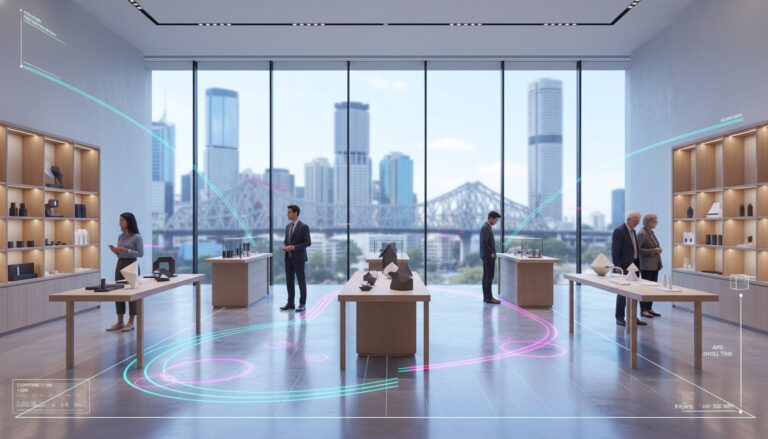
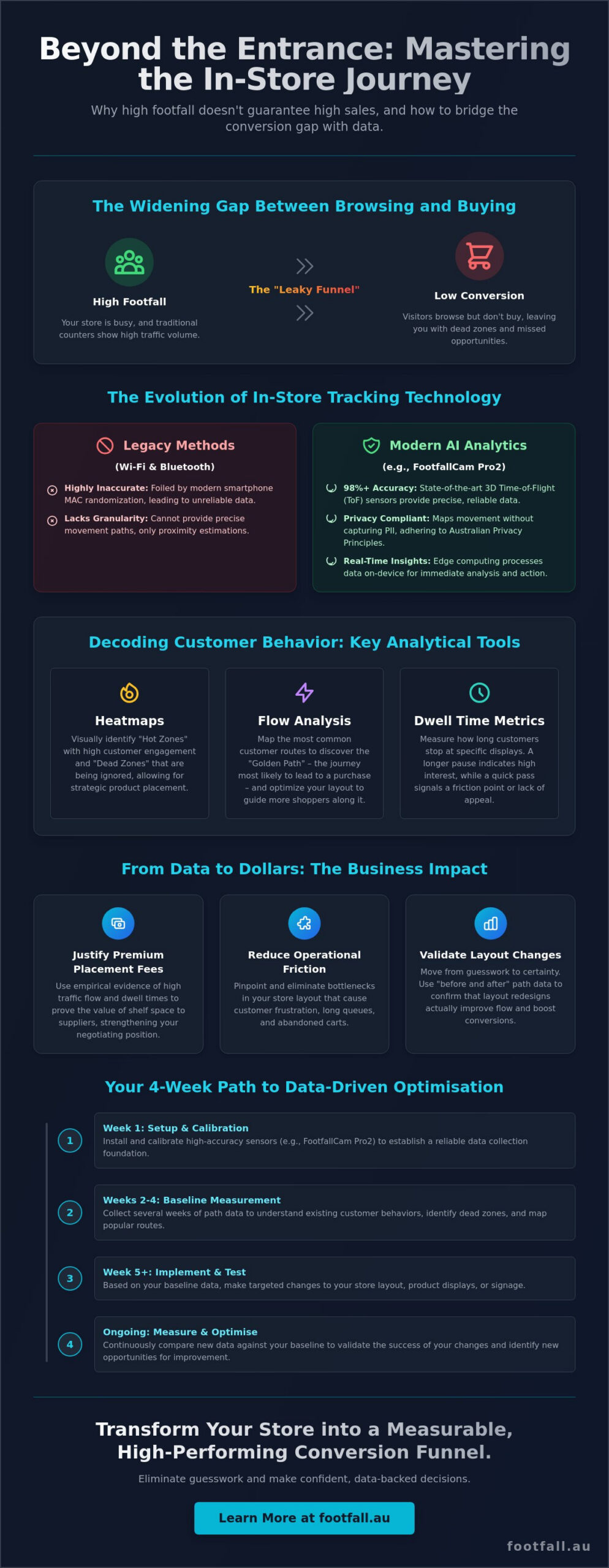
Path tracking is the systematic mapping of individual visitor movements throughout a physical space. While traditional metrics focus almost exclusively on the entrance, this methodology observes the entire journey from the threshold to the point of exit. Traditional footfall data provides the “who” and the “when,” but it remains a vanity metric if it fails to explain the “how.” Without journey data, a store manager sees high traffic but cannot explain why sales don’t correlate. Tracking customer paths in-store bridges this gap by providing a granular view of every aisle, display, and interaction.
Think of your physical store as a three-dimensional conversion funnel. In the digital world, marketers obsess over click-through rates and bounce points; physical retail requires the same level of scrutiny. Path tracking identifies “leaks” where customers lose interest or hit a physical barrier. By applying principles of customer analytics, businesses can transform a chaotic floor plan into a streamlined path to purchase. This objective approach ensures that layout decisions are rooted in human behavior rather than aesthetic preference.
From Footfall Counts to Behavioral Narratives
Distinguishing between volume and behavior is critical for operational growth. Volume tells you your store is busy; behavior tells you why. By analyzing movement, you can identify the “Golden Path,” which is the specific route most frequently taken by your highest-spending demographic. Decoding intent becomes possible when you measure movement speed and stopping points. A customer who stops for 30 seconds at a display is showing engagement, whereas one who rushes past is likely experiencing a friction point or lacks interest in that specific product range. These sequences of actions form a narrative that reveals what your customers truly value.
The Business Case: Why Path Tracking is Non-Negotiable in 2026
Maximizing the utility of every square meter is essential as commercial pressures increase. Data-driven logic allows you to optimize your environment with quiet confidence. Implementing an advanced tracking system enables you to:
- Justify premium shelf placement fees to suppliers with empirical evidence of high traffic flow and dwell times.
- Reduce operational friction by identifying bottlenecks that cause customer frustration and abandoned carts.
- Validate layout changes by comparing “before and after” movement data to ensure the new design actually improves flow.
Relying on intuition leads to costly layout errors that can take months to rectify. Modern retail demands evidence-based strategy. Using specialized systems like the FootfallCam Pro2 ensures that these decisions are backed by over 98% accuracy. This transition from guesswork to precision is the hallmark of a forward-thinking retail organization that treats physical presence as a sequence of interpretable human actions.
Modern Technologies for Precise In-Store Path Mapping
Legacy methods like Wi-Fi and Bluetooth tracking have reached their functional limit. MAC randomization, a security feature standard in modern smartphones, renders device-based tracking highly inaccurate as a single visitor often appears as multiple unique signals. This technological shift has forced a move toward more sophisticated hardware. Tracking customer paths in-store now relies on AI-powered video analytics, which currently represents the state-of-the-art with accuracy levels reaching 99.5% in optimal conditions. These high-precision systems provide the empirical evidence required for modern retail management.
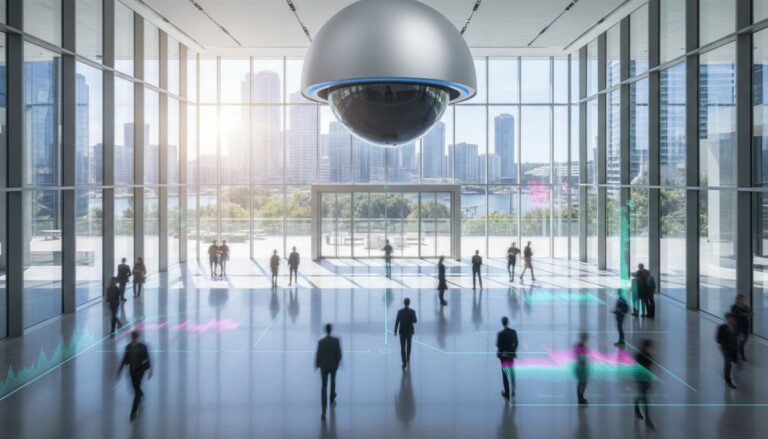
These systems utilize 3D Time-of-Flight (ToF) sensors to map physical depth and movement. By calculating the time it takes for light to bounce off objects, sensors create a high-resolution map of the environment. This allows for precise movement monitoring without capturing high-definition facial imagery or personally identifiable information (PII). To ensure low latency, these devices employ edge computing, processing data locally on the hardware before aggregating it in the cloud. This architecture ensures that path data is available for real-time analysis while minimizing bandwidth requirements and enhancing data security.
AI Video Analytics vs. Legacy Tracking Methods
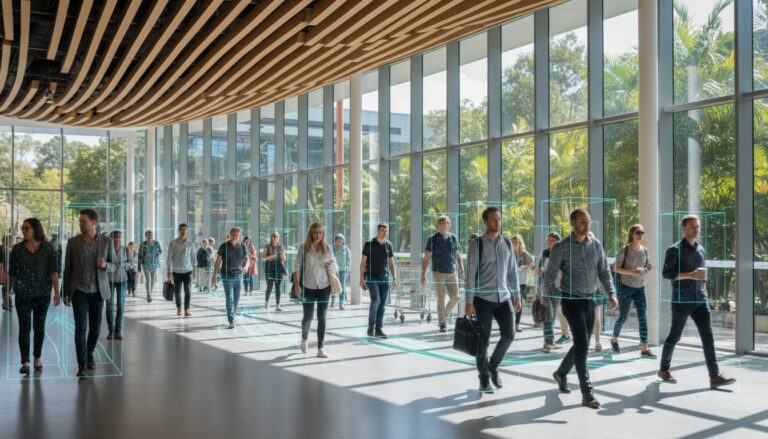
The transition to modern people counting technology offers a leap in data quality. AI algorithms distinguish between shoppers, staff, children, and trolleys, ensuring metrics aren’t inflated by non-customer movement. For existing infrastructure, FootfallCam Centroid applies these AI capabilities to your current camera network. If you are looking to upgrade visibility, consider exploring FootfallCam hardware to see how these systems integrate.
Privacy-First Design: Anonymous Tracking and Compliance
In 2026, privacy is a strategic asset. Following the 2024 Privacy Amendment Act, the OAIC is conducting targeted compliance sweeps. Legal precedents now confirm even temporary processing constitutes “collection.” Consequently, tracking customer paths in-store must prioritize anonymity. Modern systems utilize privacy masking to track coordinates rather than faces. This ensures identities are never recorded, adhering to Australian Privacy Principles while gaining deep strategic insights without legal risks.
Interpreting Path Data: Heatmaps, Dwell Times, and Flow Analysis
Data is only as valuable as the strategic changes it inspires. While high-precision hardware captures movement, the true advantage lies in how you interpret the resulting visualisations. Tracking customer paths in-store transforms abstract statistics into a visible narrative of human behavior. By mapping these journeys, you can identify the “traffic rivers” where most shoppers flow naturally and the stagnant pools where engagement drops. This objective clarity allows management to move past anecdotal observations and make decisions based on empirical evidence.
Flow analysis reveals the directionality of movement, which is often overlooked in basic footfall counts. Understanding whether customers turn left or right upon entry, or which aisles they bypass entirely, helps you position high-margin items in the path of maximum visibility. When you observe these natural patterns, you can align your store’s physical architecture with the customer’s instinctive habits. This alignment reduces cognitive load for the shopper and increases the likelihood of unplanned purchases.
Visualising the Journey: Path Tracks vs. Heatmaps
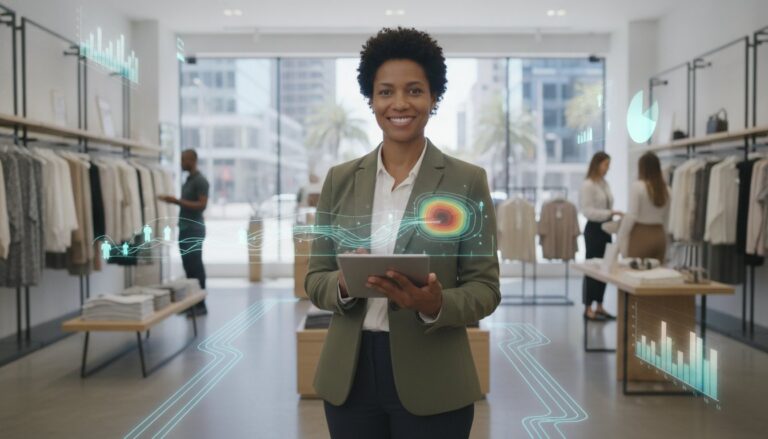
Choosing the right visualisation tool depends on the specific operational question you need to answer. Path tracks are essential for analysing the sequence of a shopping trip. They show the exact chronological order of aisles visited, helping you understand how one product category influences the next. In contrast, heatmaps provide a cumulative view of floor-space performance. They highlight “Hot Zones” where customers congregate and “Cold Zones” that remain neglected. Combining these views is a cornerstone of effective retail footfall analysis Australia, as it offers a 360-degree understanding of both individual intent and aggregate trends.
The Power of Dwell Time: Identifying Engagement and Friction Points
Dwell time is the critical bridge between initial interest and final purchase. However, not all dwell time is beneficial. Productive Dwell occurs when a customer is actively browsing or comparing products, indicating high engagement with your inventory. Unproductive Dwell, such as time spent in a slow-moving queue or navigating a congested bottleneck, often leads to frustration and cart abandonment.
Identifying these “Friction Points” is vital for maintaining a seamless experience. If tracking customer paths in-store reveals high dwell times in areas with low sales, you’ve likely found a navigation issue or a confusing display. Conversely, you can use dwell data to optimise staffing. By deploying team members to high-engagement kiosks exactly when dwell times peak, you provide support at the precise moment a customer is most likely to convert. This data-driven approach ensures your labor costs are always mapped to actual customer needs.
Data-Driven Store Optimisation: Implementing Changes Based on Path Insights
Turning movement data into measurable ROI requires a disciplined, four-step framework. While many retailers acknowledge the importance of layout, few apply a rigorous scientific method to the process. Tracking customer paths in-store provides the empirical foundation for this transition. By following a structured optimization cycle, you can move from speculative adjustments to evidence-based refinements that directly impact your bottom line.
- Step 1: Baseline Measurement. Capture at least four weeks of existing path data. This duration is essential to filter out seasonal anomalies and establish a reliable control group for future comparisons.
- Step 2: Identifying “Dead Zones.” Locate aisles with high entry rates but near-zero dwell times. These areas represent wasted real estate where customers are passing through without engaging with the inventory.
- Step 3: Hypothesis Testing. Develop a specific change, such as rearranging fixtures or moving “Anchor Products” to the rear of a dead zone, to encourage the “Golden Path.”
- Step 4: Post-Implementation Review. Measure the change in dwell time and conversion over a subsequent four-week period to validate the success of the intervention.
This logical progression ensures that every change to your physical environment is a calculated move toward efficiency. If you’re ready to begin your baseline measurement, view our FootfallCam solutions to find the right hardware for your space.
Eliminating “Dead Zones” and Optimising High-Traffic Aisles
Strategic placement is the primary tool for reviving cold areas of the store. By placing essential “Anchor Products” at the end of neglected aisles, you force a deeper penetration into the floor plan. However, traffic volume alone isn’t the goal; comfort is equally vital. Data often reveals bottlenecks where the “Butt-Brush Effect” occurs. This phenomenon happens when a customer abandons a display because they’ve been bumped by a passerby. Widening these specific bottlenecks, as identified by flow analysis, prevents premature exits and protects the browsing experience. High-margin items should then be positioned precisely along these newly optimized, most frequent path tracks to maximize their exposure to engaged shoppers.
A/B Testing Store Layouts with Empirical Evidence
Modern retail management treats the store floor like a live experiment. Using footfall data analysis, you can run controlled layout experiments with quiet confidence. For instance, you might test two different end-cap displays in identical zones to see which drives higher aisle penetration. Similarly, path analysis can validate the effectiveness of marketing signage. If a new promotional banner doesn’t result in a diverted path toward the featured product, the data suggests the creative or the placement has failed. This level of transparency allows you to justify every operational decision to stakeholders and suppliers alike, backed by a lexicon of measurement rather than intuition.
Implementing a Comprehensive Tracking Solution with Footfall Australia
Selecting the right technology partner is the final step in moving from theoretical planning to operational execution. Footfall Australia provides the specialized tools necessary for tracking customer paths in-store with high-fidelity precision. While basic sensors might offer entry counts, a comprehensive solution requires a synergy between edge-based hardware and sophisticated analytical software. This integration ensures that every human action is captured as a reliable data point, allowing for long-term strategic planning and layout refinement.
For retailers with existing infrastructure, FootfallCam Centroid offers a seamless path to modernization. This device connects to your current IP camera network, utilizing AI to extract behavioral metrics from legacy video streams. It transforms standard cameras into intelligent sensors capable of tracking customer paths in-store without requiring a full hardware overhaul. This approach prioritizes utility and cost-efficiency, ensuring that data-driven logic is accessible regardless of your current technological baseline.
The FootfallCam Pro2: Precision Hardware for Path Analytics
The FootfallCam Pro2 serves as the industry standard for path tracking in 2026. Its ultra-wide-angle lenses provide complete floor coverage, which reduces the number of devices required to map a complex environment. Equipped with built-in AI processors, the unit handles path generation in real-time at the edge, eliminating the latency often associated with cloud-only processing. This hardware is a foundational component of modern people counting systems Australia, offering the 98% accuracy required to justify high-level management decisions.
FootfallCam V9 Software: Turning Raw Coordinates into Strategy
Hardware captures the movement, but the FootfallCam V9 software interprets the narrative. This analytics engine provides automated reporting on critical metrics such as aisle penetration and cross-shopping rates. Instead of wading through raw coordinates, managers access customizable dashboards that focus on specific KPIs. The software allows you to visualize the “Golden Path” and identify friction points through intuitive reporting. It also supports the integration of movement data with your existing records to provide a true conversion metric, bridging the gap between browsing and buying.
Maintaining data integrity across multiple Australian locations requires more than just software; it demands reliable support. Footfall Australia offers Basic and Premium Support Plans to ensure your systems remain calibrated and compliant with evolving privacy standards. Whether you are implementing a new fleet of Pro2 counters or utilizing the Legacy Swap Out Plan for older hardware, the focus remains on accuracy and long-term utility. This partnership empowers you to stop relying on intuition and start leading with evidence.
Transitioning to a Data-Driven Retail Future
The physical retail environment is no longer an opaque space governed by guesswork. By moving beyond simple entry counts, you’ve gained the ability to interpret the complex narrative of human movement within your store. We’ve explored how identifying the “Golden Path” and systematically eliminating “Dead Zones” through baseline measurements can directly influence your conversion rates. This methodical approach ensures that every square meter of your floor plan is optimized for maximum utility and customer engagement.
Adopting a structured framework for tracking customer paths in-store is the most effective way to stay ahead of shifting behavioral trends in 2026. With AI-driven 99.5% accuracy and full compliance with Australian Privacy Principles, our technology is ready to support your strategic goals. Footfall Australia provides the national installation and support network required to ensure your data remains a high-quality asset for years to come. Discover how FootfallCam Pro2 can map your customer journeys today to begin transforming your physical space with quiet confidence. The shift from intuition to empirical evidence is the definitive path to long-term success.
Frequently Asked Questions
Is tracking customer paths in-store legal under Australian privacy laws?
Yes, path tracking is legal provided the system adheres to the Australian Privacy Principles. The Privacy and Other Legislation Amendment Act 2024 requires businesses to disclose the use of automated decision-making systems. By utilizing privacy-masking technology that tracks anonymous coordinates rather than facial features, you ensure full compliance while maintaining data utility.
What is the difference between a heatmap and a customer path track?
A heatmap visualizes aggregate density, showing which areas of the store receive the most cumulative dwell time. A path track illustrates the specific chronological sequence of an individual’s journey. While heatmaps identify “Hot Zones,” path tracks reveal the exact narrative of how a shopper moves from one department to the next.
Can I use my existing CCTV cameras to track customer paths?
You can leverage your current infrastructure by integrating the FootfallCam Centroid. This device applies advanced AI processing to your existing IP camera streams, extracting behavioral data without the need for a full hardware overhaul. It’s an efficient way to begin tracking customer paths in-store using your established network.
How accurate is AI-based path tracking compared to Wi-Fi tracking?
AI-based tracking is significantly more reliable than legacy Wi-Fi methods. The FootfallCam Pro2 achieves over 98% accuracy by using 3D Time-of-Flight sensors. Wi-Fi tracking has become increasingly inaccurate due to MAC randomization and device security features, which often lead to fragmented or misleading data points.
Does path tracking require customers to opt-in or download an app?
No, modern path tracking is a passive and anonymous process. It doesn’t require customers to download software or connect to a network. The sensors observe physical movement patterns through video analytics, ensuring you capture a 100% sample rate of all visitors without requiring active participation or collecting personal identifiers.
How long does it take to see ROI from an in-store tracking system?
Most retailers begin to see a return on investment within the first three to six months. The process starts with a four-week baseline measurement to identify “Dead Zones” and bottlenecks. Once you implement layout changes based on these insights, you can immediately measure the resulting improvements in dwell time and conversion rates.
What is the ‘Golden Path’ in retail analytics?
The “Golden Path” refers to the specific route most frequently taken by your highest-converting customers. By tracking customer paths in-store, you can identify this high-value journey. This allow you to place high-margin products or promotional displays exactly where they’ll receive the most natural engagement from motivated shoppers.
Can path tracking distinguish between staff and customers?
Yes, the AI processors in the FootfallCam Pro2 can distinguish between staff and visitors. This is achieved through behavioral exclusion or the use of specialized staff tags. Removing staff movement from your dataset is essential for maintaining the integrity of your conversion metrics and ensuring your analysis reflects genuine customer behavior.