Integrating People Counters with POS Data: A Strategic Guide to Retail Conversion
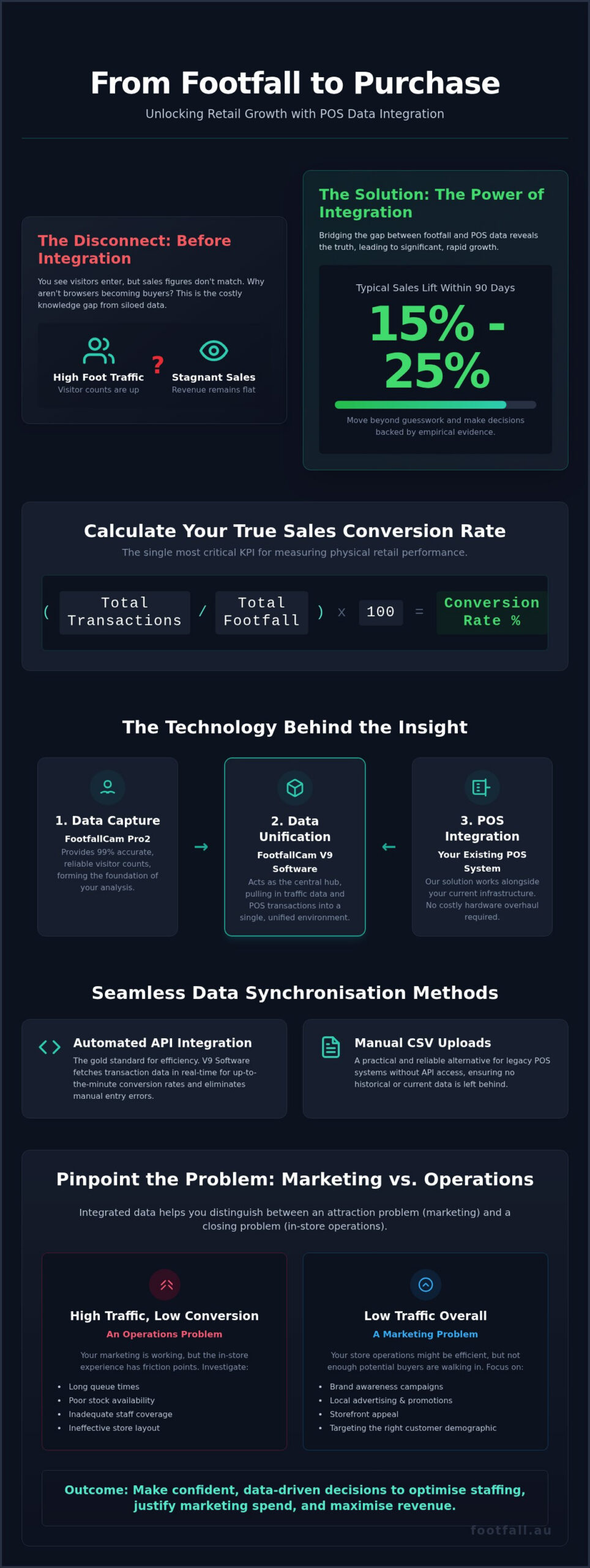
Did you know that retailers who bridge the gap between their storefront and their registers often see sales lifts between 15% and 25% within just ninety days? It’s frustrating to watch a steady stream of foot traffic enter your store only to see stagnant figures at the end of the day. You’re likely dealing with data silos where your visitor numbers and sales transactions never meet, leaving you unable to justify staffing costs or identify why browsers aren’t becoming buyers.
This guide will show you how integrating people counters with POS data transforms these isolated metrics into a clear narrative of human behaviour and operational efficiency. We’ll explore the technical implementation of unified analytics and how this evidence-based approach allows you to calculate your true conversion rate and stay ahead of shifting Australian retail trends. By aligning your traffic patterns with transaction timing, you can move beyond intuition and make decisions backed by empirical evidence.
Key Takeaways
- Identify your true sales conversion rate to see exactly what percentage of visitors make a purchase, moving beyond simple footfall counts.
- Learn the strategic benefits of integrating people counters with POS data to eliminate silos and create a unified view of your store’s performance.
- Understand how FootfallCam Pro2 sensors and V9 Software work together to automate reporting and ensure high-accuracy data for your business.
- Determine if stagnant sales are caused by low traffic or poor service, allowing you to optimise staffing and marketing strategies with confidence.
Unlocking Retail Conversion Rates: The Strategic Value of POS Integration
Raw footfall numbers tell you how many people walked through the door, but they don’t explain why. Without sales context, traffic is a vanity metric that can mask underlying operational issues. By integrating people counters with POS data, you bridge the gap between physical presence and financial outcome. This transition from intuition-based management to empirical strategy ensures every decision rests on a foundation of objective measurement rather than guesswork. It allows managers to see the store as a living laboratory where every variable can be tested and refined.
Modern people counting technology allows you to look beyond the total headcount to see the narrative of human movement. When you align these counts with transaction records, the “missed opportunity” cost becomes visible. If a store has high traffic but low sales, it signals a friction point in the customer journey. This might include long queues, poor stock availability, or inadequate floor coverage. Identifying these gaps is the first step toward reclaiming lost revenue.
Calculating Your True Sales Efficiency
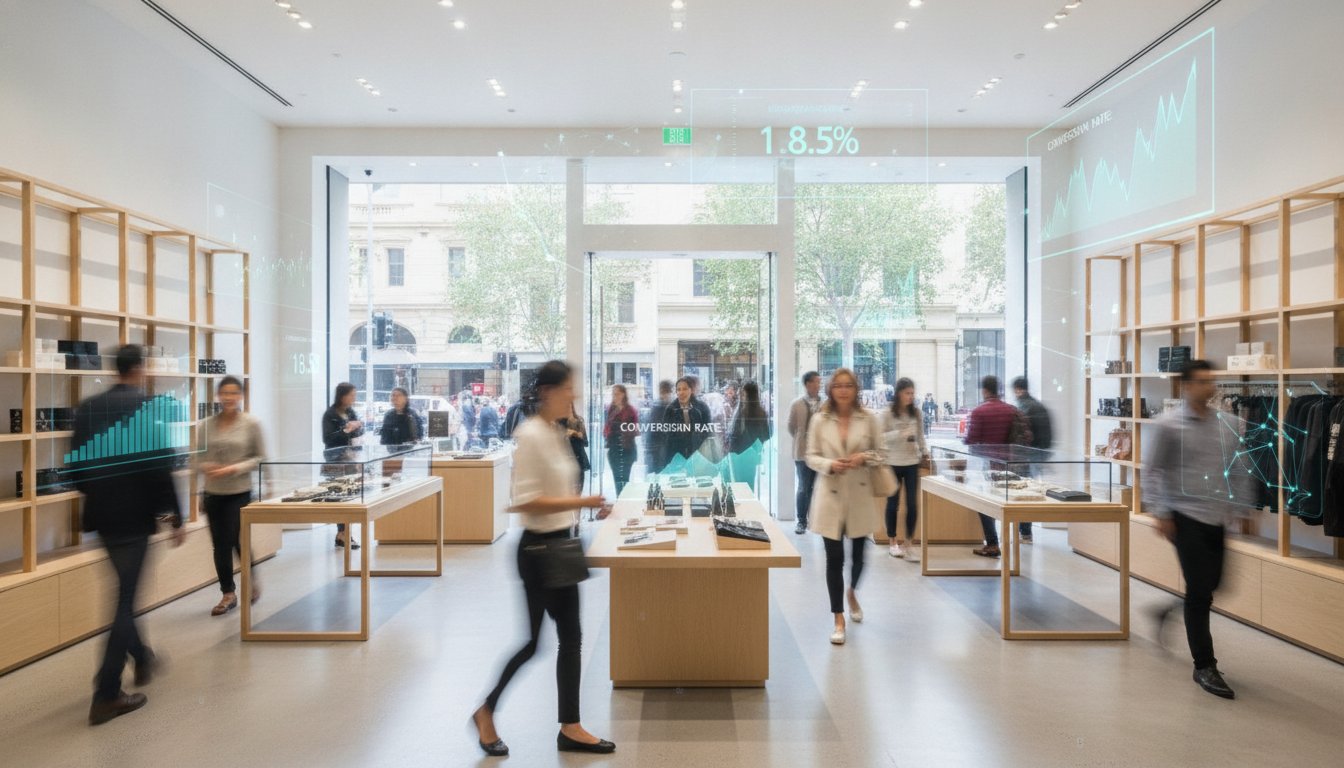
To determine your store’s performance, use the standard formula: (Total Transactions / Total Footfall) x 100. This calculation often reveals a disconnect between “Power Hours,” where traffic is highest, and “Conversion Peaks,” where the highest percentage of visitors actually buy. You might find that your most profitable periods occur when the store is quieter, allowing staff to provide more personalised service. Sales Conversion Rate is the most critical KPI for physical retail health in 2026. Using this metric helps you allocate resources where they’ll have the most significant impact on the bottom line.
The Technical Implementation: Connecting FootfallCam Hardware with POS Systems
Capturing high-accuracy visitor data starts with the FootfallCam Pro2. This sensor provides 99% accuracy, ensuring the foundation of your analytics is reliable. Raw counts are only half the equation. To achieve true foot traffic attribution, these numbers must reside in a unified environment. FootfallCam V9 Software serves as this central hub, pulling in transaction data to sit alongside visitor metrics.
Footfall Australia acts as the expert partner providing this technological bridge. We don’t sell or replace your POS system. Instead, our solution works alongside your existing infrastructure. This non-intrusive approach ensures your daily sales operations continue without disruption while the backend systems begin integrating people counters with POS data for deeper analysis. It’s a seamless way to upgrade your business intelligence without a total hardware overhaul or operational downtime.
Data Synchronisation Methods: Automated APIs and CSV Uploads
Automation represents the gold standard for modern retail efficiency. API integration allows V9 Software to fetch transaction data in real-time, removing manual entry errors and providing up-to-the-minute conversion rates. This is the most effective way of integrating people counters with POS data for high-volume environments. For Australian businesses using legacy systems without API access, manual CSV uploads offer a practical alternative to ensure no data is left behind. If you already have existing hardware installed, FootfallCam Centroid can assist by unifying data from various sensors into one cohesive stream. If you need guidance on which method suits your store, our team offers technical implementation support to get your systems talking.
Optimising Business Operations Through Integrated Data Analytics
Comprehensive retail footfall analysis provides the clarity needed to distinguish between a marketing failure and an operational bottleneck. If your storefront successfully draws visitors in but your conversion remains low, you’re likely facing a service problem rather than a lack of brand interest. By integrating people counters with POS data, you can validate marketing spend by comparing the “attraction rate”-those who entered-against the “conversion rate”-those who purchased. This helps identify if a campaign brought in the “wrong” type of shopper or if the store failed to close the deal.
This level of insight offers a substantial long-term ROI by preventing the common pitfall of overstaffing during quiet periods. It ensures you capture every possible sale during peak times without inflating your overheads. Using high-accuracy hardware like the FootfallCam Pro2 allows management to present reports with quiet confidence. You’re no longer guessing why sales are down; you’re proving it with a lexicon of measurement and strategy that supports sustainable growth and empirical decision-making.
Staffing to Sales: Aligning Roster Costs with Real-Time Traffic
Identifying service gaps is essential for maintaining a healthy bottom line in the competitive Australian retail market. When high traffic coincides with low conversion, it often points to inadequate floor coverage or overwhelmed staff. You can use footfall data analysis to determine the optimal staff-to-customer ratio specific to your store’s layout and category. By integrating people counters with POS data, you can adjust rosters based on historical traffic patterns aligned with transaction density. This structured approach transforms the roster from a fixed expense into a dynamic tool for revenue growth.
Transforming Retail Insights into Strategic Growth
Moving beyond raw visitor counts allows you to see the true narrative of your store’s performance. By integrating people counters with POS data, you transform vanity metrics into actionable intelligence that drives conversion and operational efficiency. You’ve seen how high-accuracy sensors and unified software eliminate data silos, providing a clear path to optimised staffing and validated marketing spend. Footfall Australia makes this transition seamless. Our AI-powered sensors offer 99% counting accuracy and are compatible with over 60 global POS providers. Supported by a national Australian technical network, you can implement these sophisticated systems with total confidence in their reliability. Don’t leave your retail health to guesswork when empirical evidence is within reach. Request a technical consultation for your POS integration today to start making data-driven decisions that secure your business’s future.
Frequently Asked Questions
Do I need to buy a new POS system to integrate with FootfallCam?
You don’t need to replace your existing POS system to start integrating people counters with POS data. FootfallCam V9 Software is compatible with over 60 global POS providers, allowing it to work alongside your current infrastructure. Our role is to provide the technological bridge that unifies your visitor numbers with your transaction records without requiring a costly hardware overhaul or system migration.
Is the data integration process secure and GDPR/Privacy Act compliant?
Security and privacy are built into the core of our integration protocols. The system complies with the Australian Privacy Act by processing data on-device and avoiding the storage of personally identifiable information. This ensures your business remains compliant while gaining deep insights into customer movement. You can rely on a secure environment that prioritises data integrity and consumer anonymity at every step.
What happens if my POS system is offline or uses a legacy database?
Your analytics remain intact even if your system faces connectivity issues or relies on older technology. For legacy databases without API access, the V9 Software supports manual CSV uploads to ensure no data is lost. If your system goes offline, the software can synchronise historical records once the connection is restored. This flexibility ensures a continuous narrative of your store’s performance regardless of technical hurdles.
How long does it take to see the first conversion rate reports after integration?
You will begin seeing preliminary conversion rate reports almost immediately after the first successful data synchronisation. Most Australian retailers find that meaningful, actionable insights become visible within 24 hours of integrating people counters with POS data. This rapid turnaround allows you to start identifying service gaps and adjusting staffing levels based on empirical evidence rather than waiting weeks for manual calculations.