Data Anonymization for People Counters: A Practical Guide
A people counter can show when a space is busy without creating a record of who passed through. That’s the central privacy question for Australian organisations assessing data anonymisation techniques for people counters. A camera-free approach alone doesn’t make data anonymous. Processing, aggregation, access and retention all shape the risk.
To choose proportionate safeguards, understand what information the system creates, where it goes and what decisions it needs to support. This guide explains the difference between anonymisation and pseudonymisation, compares practical techniques by the risks they address and the insight they retain, and outlines what to review across processing, reporting, access and retention. The aim is useful footfall trends without unnecessary detail about individual visitors.
Key Takeaways
- Distinguish anonymisation from pseudonymisation by assessing whether information can still be linked to a person, directly or indirectly.
- Compare data anonymisation techniques for people counters by how much privacy risk they reduce and how much useful footfall insight they preserve.
- Camera-free sensing may reduce exposure, but privacy also depends on how data is processed, accessed, reported and retained.
- Build a practical workflow around clear measurement goals, limited collection, controlled access and regular retention reviews.
What Data Anonymisation Means for People Counters
People counters can produce useful operational measures without identifying visitors. Anonymisation involves reducing the ability to link data to an identifiable person. Whether the result is anonymous depends on the data’s detail and what other information could be combined with it. For a broader overview of the concept and common approaches, see What is Data Anonymization?
Anonymisation is not the same as pseudonymisation. Replacing a name with a code may conceal someone’s identity in a dataset, but if the code can be linked back to them, the data remains pseudonymised rather than anonymous. Aggregation combines records into summaries, such as hourly visitor counts. However, very small groups or unusually precise time intervals may still reveal patterns. Deleting names or obvious identifiers alone may not prevent identification through other details.
Useful outputs can include entry counts, occupancy levels, dwell time and movement patterns. The practical goal is to retain the measures needed for decisions while limiting unnecessary detail about individual journeys.
When Can People-Counting Data Still Be Personal Information?
Fine-grained timestamps, precise location data and persistent identifiers can make records easier to connect with a person, especially when combined with information from another source. A camera-free sensor may reduce exposure to image data, but it doesn’t automatically make every stage of a workflow anonymous. Processing, transmission, reporting, access and retention all matter.
Anonymisation reduces the reasonable ability to link data to an identifiable person, but its effectiveness depends on context and the information available for comparison. Assess data anonymisation techniques for people counters against both privacy risk and the operational insight they preserve.
Compare Data Anonymisation Techniques for People Counters
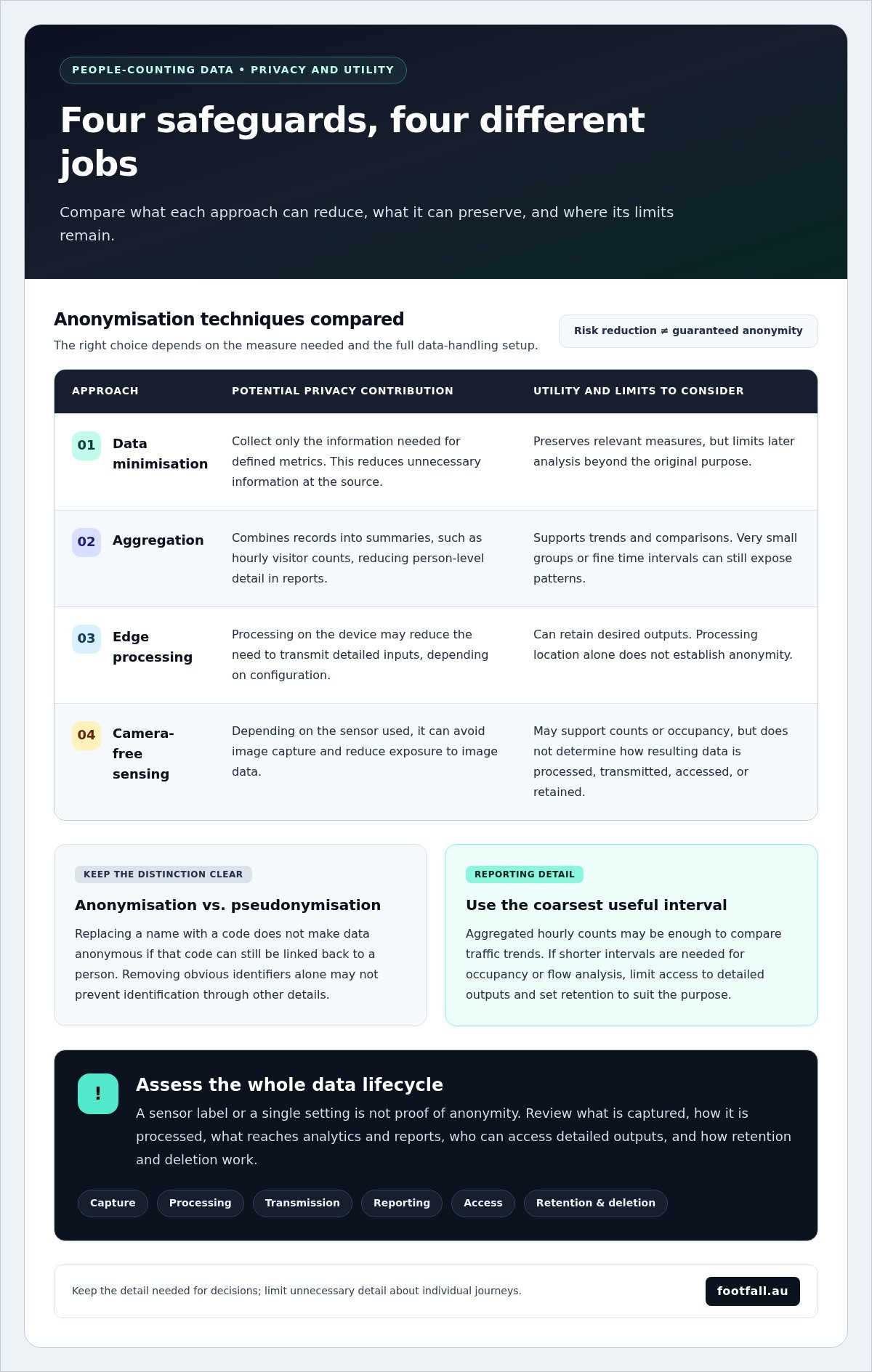
Different safeguards address different parts of the data lifecycle. Data minimisation limits what is collected; aggregation reduces detail in reports; edge processing describes where data is handled. Camera-free sensing describes a sensor type, not an anonymisation technique. It may reduce exposure to image data, but stored outputs, transmission, access and retention still affect privacy risk. For an overview of approaches such as masking and generalisation, see Data Anonymization Techniques.
| Approach | Potential risk reduction | Utility to consider |
|---|---|---|
| Data minimisation | Collecting only data needed for defined metrics reduces unnecessary information at source. | Preserves relevant measures, but limits later analysis beyond the original purpose. |
| Aggregation | Combining records into totals can reduce person-level detail in reports. | Supports trends and comparisons; very small groups or fine intervals can still expose patterns. |
| Edge processing | Processing data on the device may reduce the need to transmit detailed inputs, depending on configuration. | Can retain desired outputs, but processing location alone doesn’t establish anonymity. |
| Camera-free sensing | Can avoid image capture, depending on the sensor used. | May support counts or occupancy, but doesn’t determine how resulting data is handled. |
Which Privacy Technique Fits Each People-Counting Use Case?
Aggregated hourly counts may be enough to compare traffic trends without retaining finer-grained records. If occupancy or flow analysis requires shorter intervals, limit access to detailed outputs and set a retention period suited to the purpose. Before choosing the reporting interval, identify the decision the data needs to support and use the coarsest interval that still answers it. The least detailed data that still answers the operational question is often the better design choice.
Assess data anonymisation techniques for people counters as part of the whole system, not as a sensor label. Footfall Australia supplies people-counting hardware and analytics that can form part of a workflow designed around useful measures and considered data handling.
Build a Privacy-Aware People-Counting Workflow
Build privacy into the system from the sensor through to reports and data deletion. These steps help align useful footfall measures with proportionate handling:
- Define the metrics. Specify the decisions the system must support, such as entry counts or occupancy.
- Minimise collection. Avoid collecting detail that isn’t needed to produce those measures.
- Configure processing. Map where data is processed and what information is transmitted to analytics tools.
- Restrict access. Limit access to authorised roles and review integrations that receive or use the data.
- Review retention. Set a retention approach for each data type and check that deletion processes work as intended.
For Australian deployments, assess whether the Privacy Act 1988 and Australian Privacy Principles apply to your circumstances, and use current Office of the Australian Information Commissioner (OAIC) guidance. Don’t treat a sensor label or a single setting as proof of compliance.
How to Assess a People Counter’s Data Lifecycle
Trace what the sensor captures, what processing occurs and what reaches analytics and reporting tools. Then review access controls, retention settings, integrations and deletion processes for the selected configuration. In practice, this means checking which data is transmitted, who can view detailed outputs, whether reports can be exported and how deletion is handled. These checks make privacy considerations concrete and testable. A people-counting technology guide can help compare sensing approaches, while a FootfallCam Pro2 buying guide can inform hardware evaluation.
Footfall Australia supplies FootfallCam Pro2 people counters and FootfallCam V9 Software as components of a people-counting workflow. Assess the configuration as a whole rather than assuming a device or analytics platform is anonymous by default. Applying data anonymisation techniques for people counters at the appropriate stages can help protect visitor privacy while retaining actionable operational insight.
Design People Counting Around Useful, Responsible Data
Privacy-aware measurement depends on the full data lifecycle, not just the sensor. Choose data anonymisation techniques for people counters according to the operational questions you need to answer. Collect only the detail required, then review how information is processed, accessed and retained. This approach can reduce privacy risk while preserving practical insight into footfall and occupancy.
Footfall Australia supplies FootfallCam Pro2 people counters and FootfallCam V9 Software as part of its people-counting solution offering. Assess each configuration based on the data it handles rather than assuming a particular device or approach guarantees anonymity.
Explore Footfall Australia’s people-counting solutions for actionable, privacy-aware insights and choose a setup around the measures your organisation needs.
Frequently Asked Questions
Can people counters collect data without identifying individual visitors?
Yes, a people counter can be configured to produce counts or patterns without identifying individual visitors, but that outcome depends on sensor design, processing and what data is retained. Aggregate metrics, such as total entries per hour, describe groups; individual-level records can preserve a sequence of movements. Assess the complete data flow before describing outputs as anonymous.
Is camera-free people counting automatically anonymous?
No. Camera-free sensing can reduce some image-related privacy concerns, but it doesn’t guarantee anonymity. Consider what signals the sensor captures, whether identifiers persist, how processing occurs and what information is retained or shared. A system’s privacy characteristics depend on its full architecture and configuration, not simply whether it uses a camera.
What is the difference between anonymisation and pseudonymisation?
Anonymisation aims to prevent people from being identified from the resulting data, while pseudonymisation replaces direct identifiers with substitutes that may still be linked to a person using additional information. Removing names alone may not be enough. Detailed timestamps, locations or other attributes could still connect records to an individual when combined with available information.
How can businesses keep anonymised footfall data useful?
Start with the decisions the organisation needs to make, then collect only the detail required. Aggregated counts can reveal traffic trends and support staffing analysis, while occupancy or flow analysis may need finer-grained metrics and proportionate safeguards. Apply data anonymisation techniques for people counters with utility in mind, and regularly review reporting settings, access and retention.