Measuring Retail Marketing Campaign Success: A Data-Driven Guide
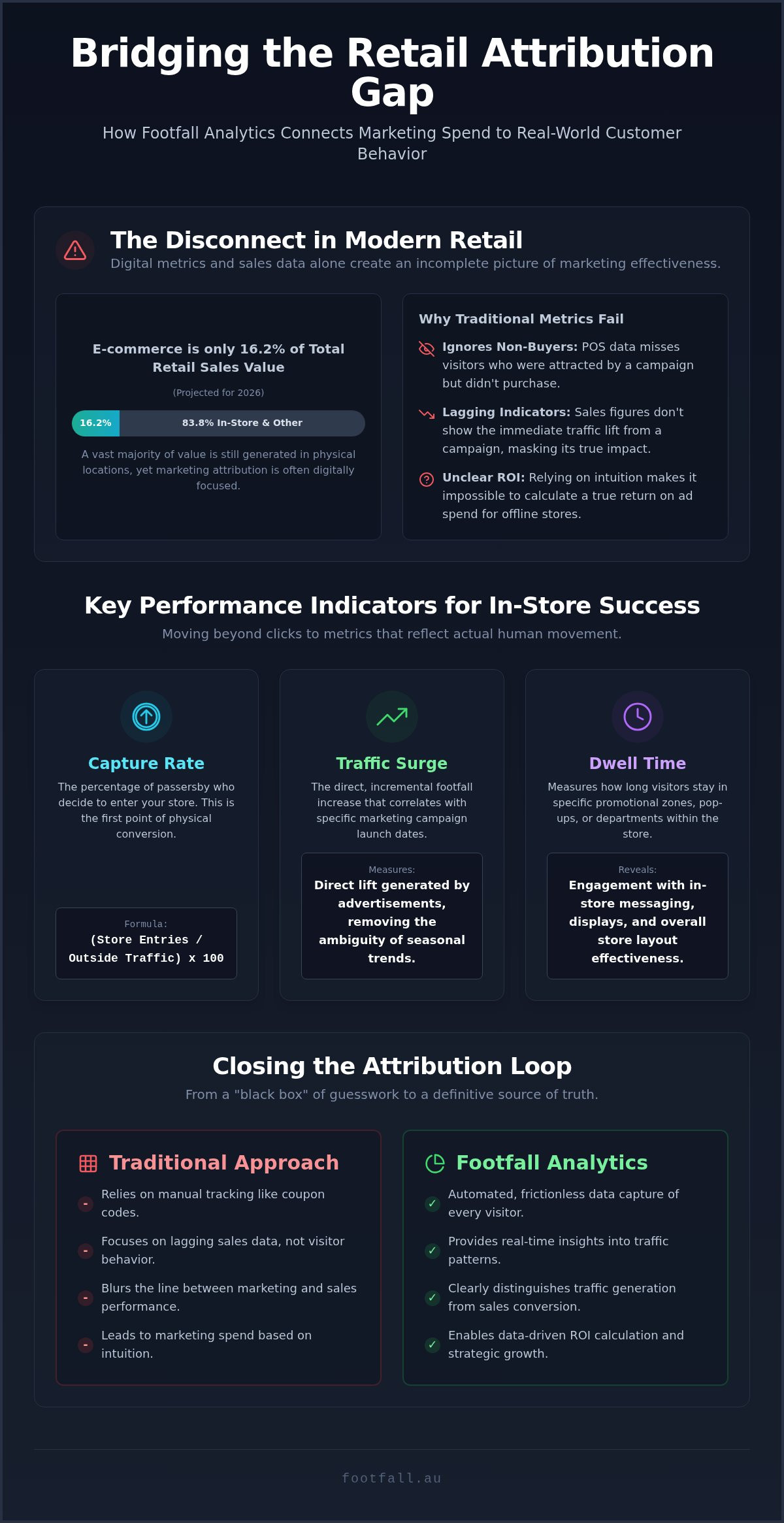
While over a third of retail transactions occur online, e-commerce only represents 16.2% of total retail sales value in 2026. This reality makes measuring retail marketing campaign success a complex challenge for brands trapped by digital vanity metrics. You’ve likely felt the frustration of watching impressions climb while having no clear way to attribute a Saturday afternoon surge to a specific ad. Relying on intuition rather than empirical evidence makes it nearly impossible to calculate a true return on ad spend for offline locations.
This guide offers a clear framework for evaluating impact by focusing on the delta between street-level traffic and store entries. You’ll discover how to leverage precise footfall indicators to align marketing spend with actual visitor behavior. We’ll examine the implementation of people counting systems, like the FootfallCam Pro2, to help you move beyond impressions and toward verifiable sales conversion growth.
Key Takeaways
- Identify the “Retail Attribution Gap” to understand why digital impressions and POS data alone fail to provide a complete picture of marketing effectiveness.
- Master the essential KPIs for measuring retail marketing campaign success, including Capture Rate and Traffic Surge metrics, to quantify campaign lift.
- Align marketing spend with physical store traffic by correlating campaign launch dates with real-time footfall increases.
- Leverage high-accuracy hardware and retail footfall analysis in Australia to turn human movement into actionable strategic insights.
Beyond Digital Clicks: Redefining Retail Marketing Effectiveness
The retail industry faces a significant hurdle known as the “Retail Attribution Gap.” While digital impressions and click-through rates provide a glimpse into online interest, they often fail to account for physical store entries. This gap makes measuring retail marketing campaign success a frustrating exercise in guesswork for many managers. Digital tools track every pixel, yet physical environments often remain a “black box” where the link between an ad and a visit is lost.
Relying solely on Point-of-Sale (POS) data creates an incomplete picture. POS systems record transactions, not human behavior. They tell you who bought something, but they ignore the potential customers who entered your store because of a campaign and left empty-handed. Without understanding the total volume of visitors, it’s impossible to accurately assess marketing effectiveness or identify if a campaign succeeded in driving traffic even if the sales team failed to convert it.
The Limitations of Traditional Retail Metrics
Sales volume is a lagging indicator that often masks the true performance of your creative messaging. A high-impact campaign might flood your store with “interested traffic,” yet sales might remain flat due to poor stock levels or inadequate staffing. If you only look at revenue, you might mistakenly cancel a successful marketing strategy. True optimization requires distinguishing between marketing’s job of driving traffic and operations’ job of converting that traffic.
High-accuracy hardware like the FootfallCam Pro2 establishes a definitive source of truth. Measuring retail marketing campaign success then becomes a matter of observing real-time visitor surges that correlate directly with your promotional windows. This provides the empirical evidence needed for strategic growth, ensuring your marketing spend is backed by data rather than intuition.
Key Performance Indicators for In-Store Marketing Success
Moving beyond digital metrics requires a shift toward physical Key Performance Indicators that reflect actual human movement. Capture Rate serves as the definitive metric for evaluating window displays and street-front marketing. It identifies the percentage of passersby who decide to enter your store. This is the first point of physical conversion. Measuring retail marketing campaign success becomes easier when you use high-accuracy hardware like the FootfallCam Pro2 to observe these shifts as they happen. This level of retail footfall analysis Australia provides the baseline for measuring campaign lift.
Traffic Surge metrics offer another layer of insight. By correlating campaign launch dates with incremental footfall increases, you can see the direct lift generated by specific ads. This removes the ambiguity of general seasonal trends. Dwell Time then measures engagement within the store. It tracks how long visitors stay in specific promotional zones or pop-ups. If a visitor spends five minutes at a new product display, your messaging is working. This is the narrative of movement that turns a simple visit into a sequence of strategic actions.
Calculating the Capture Rate and Conversion Delta
The formula for Capture Rate is straightforward: (Total Store Entries / Total Outside Traffic) x 100. This percentage reveals your storefront’s pulling power. Measuring retail marketing campaign success requires looking at this alongside the “Conversion Delta.” This delta represents the change in sales conversion during a marketing event compared to your baseline. If footfall rises but conversion drops, your campaign might be attracting the wrong audience. This data-driven approach ensures you aren’t just guessing about ROI.
Closing the Attribution Loop with Footfall Analytics
High-accuracy hardware like the FootfallCam Pro2 removes the manual burden of data collection. Traditional methods often rely on serial numbers or coupon codes, which are highly manual and prone to human error at the point of sale. Automated systems capture every entrance without friction, providing a clean dataset that reflects actual human behavior. This precision is vital for measuring retail marketing campaign success because it eliminates the “silent” visitor problem where people are influenced by ads but don’t use a specific code. It turns physical presence into a sequence of human actions that can be objectively interpreted.
Strategic implementation of retail footfall analysis Australia allows brands to establish a reliable baseline of “normal” traffic. By integrating these traffic streams directly with your marketing calendar, you can visualize ROI in real-time within a unified dashboard. This technical integration helps managers move beyond retrospective reports. Instead, it offers a live view of how specific digital or physical placements are pulling people through the door. It ensures that every marketing dollar is accounted for through empirical evidence rather than intuition.
Implementing a 2026 Measurement Framework
A modern measurement framework follows a logical sequence designed to isolate marketing impact from general market noise. This process transforms raw movement into strategic intelligence.
- Establish a traffic baseline: Deploy people counting systems Australia to record standard traffic patterns for at least two weeks before the campaign launch.
- Monitor promotional windows: Observe real-time entry data via the FootfallCam V9 Software to detect immediate surges following ad placements.
- Isolate marketing impact: Compare campaign-period footfall against historical averages to calculate the specific lift generated by your spend.
This structured approach provides the quiet confidence that your decisions are backed by data. It ensures that measuring retail marketing campaign success is a standard operational procedure rather than an after-the-fact guess.
Empowering Your Retail Strategy with Empirical Evidence
Transforming human movement into actionable intelligence is the final step in bridging the gap between digital interest and physical sales. By focusing on metrics like Capture Rate and Traffic Surge, you move beyond the uncertainty of vanity metrics. You gain the power to validate every marketing dollar spent. Measuring retail marketing campaign success no longer requires intuition when you have access to precise, automated data.
Footfall Australia provides the technological foundation for this clarity. With AI-powered 99.5% counting accuracy and seamless integration with FootfallCam V9 Software, our solutions have been trusted by Australian retailers since 2004. Optimise your marketing ROI with FootfallCam today and start making decisions backed by the narrative of movement. Your path to optimized growth begins with seeing the full picture of your store’s performance.
Frequently Asked Questions
How do I attribute a specific sale to an offline marketing campaign?
Attribute sales by correlating campaign launch dates with incremental traffic surges and POS data. By calculating the conversion delta, you can see if a rise in revenue matches a rise in campaign-driven entries. This method provides a more accurate picture than coupons alone, as it captures every visitor influenced by your messaging, even if they don’t use a discount code.
What is a good capture rate for a retail store in Australia?
Capture rates vary by sector, but a standard benchmark for specialty retail often falls between 8% and 15%. High-traffic environments might see lower percentages due to the sheer volume of passersby. For specialty brands like Pet ID Tags Australia, monitoring your baseline before a promotion is essential for measuring retail marketing campaign success, as it allows you to identify a meaningful percentage lift in your storefront’s pulling power.
Advanced systems like the FootfallCam Pro2 utilize AI-based staff exclusion to maintain data integrity. Staff members can wear specialized tags that the sensors recognize and automatically subtract from the total count. This ensures your conversion rates and traffic surges reflect genuine customer behavior rather than employee movements. It is a critical feature for maintaining accuracy during high-traffic promotional events.
How long should I track footfall to see the true impact of a marketing campaign?
Establish a baseline by tracking traffic for at least fourteen days before your launch. Continue monitoring throughout the campaign and for one week afterward to capture “halo effect” visits. This longitudinal approach is the most reliable method for measuring retail marketing campaign success. It helps you distinguish between immediate campaign impact and long-term shifts in consumer behavior.