People Counter Maintenance: Ensuring Data Integrity and ROI in 2026
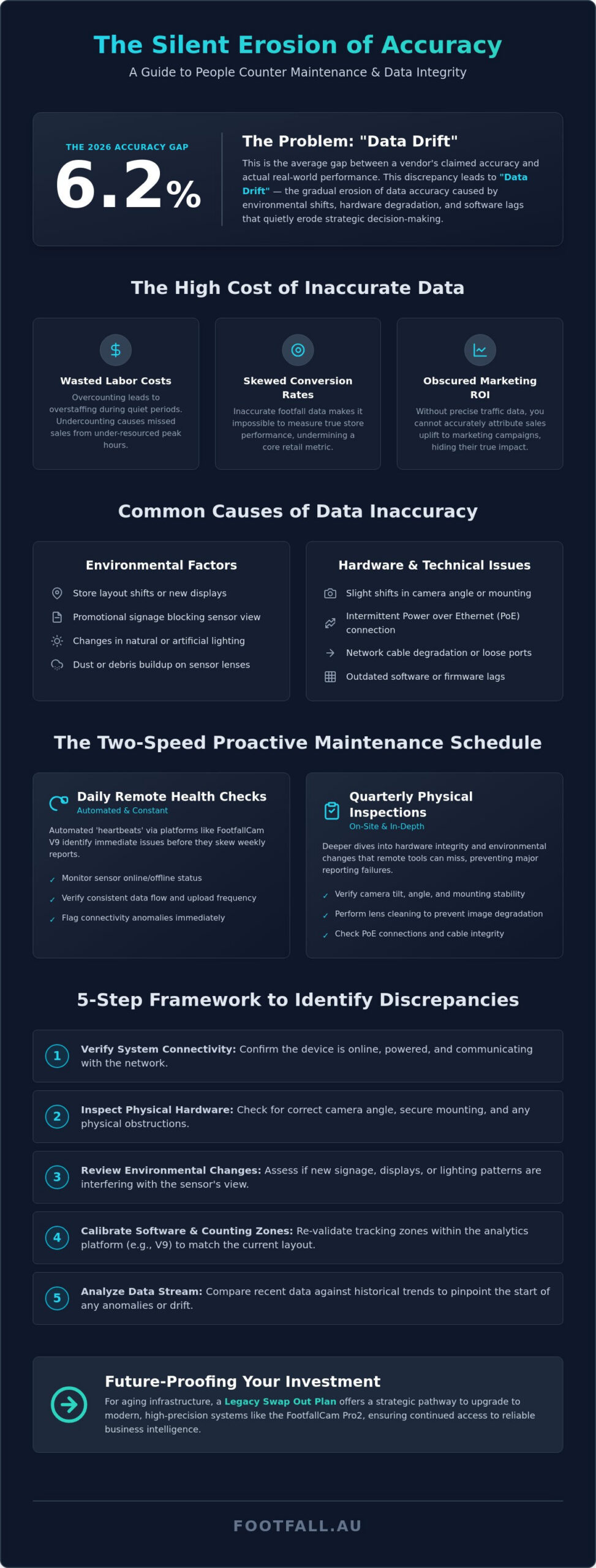
Did you know that in 2026, the gap between a vendor’s claimed accuracy and actual real-world performance averages 6.2 percentage points? This discrepancy often stems from a lack of consistent people counter maintenance, leading to a slow intelligence decay that quietly erodes your strategic decision-making.
You likely understand that accurate footfall data is the backbone of your conversion rate reporting and labor scheduling. It’s frustrating when hardware downtime during peak Australian trading periods or unexplained data drift leaves you guessing about your store’s true performance. We’ll show you how proactive maintenance transforms your sensors from simple hardware into high-precision strategic assets. You’ll discover how to secure 100% data reliability for board-level reporting while extending the lifespan of your FootfallCam Pro2 and Centroid systems. This guide covers the essential steps for validating data integrity, managing software updates within the V9 analytics platform, and identifying when a Legacy Swap Out Plan is the most efficient path forward for your infrastructure.
Key Takeaways
- Understand how consistent people counter maintenance prevents “data drift,” ensuring your analytics remain a reliable foundation for board-level reporting.
- Learn to distinguish between physical sensor upkeep and the software-level calibrations required for advanced AI devices like the FootfallCam Pro2.
- Evaluate the total cost of ownership between internal IT management and professional support plans to maximise your system’s efficiency.
- Implement a structured five-step diagnostic framework to identify the root causes of data discrepancies before they affect your strategic KPIs.
- Discover how the Legacy Swap Out Plan offers a logical pathway for upgrading aging infrastructure to maintain high-precision footfall intelligence.
The Critical Role of People Counter Maintenance in Data Integrity
Effective people counter maintenance is far more than a simple cleaning schedule. It functions as a dual-track process that combines physical upkeep with meticulous algorithmic calibration. While the physical sensor captures movement, the software interprets it. If either side of this equation fails, your data loses its utility. People counter technology has evolved from basic infrared beams to sophisticated AI-driven systems, yet the need for human oversight remains constant. Without regular intervention, systems succumb to “Data Drift.” This is the gradual erosion of accuracy caused by environmental shifts or software lags that occur over time.
For businesses relying on retail footfall analysis Australia, this drift isn’t just a technical glitch; it’s a strategic risk. Decisions regarding staff rosters, leasing agreements, and marketing spend all depend on the precision of these metrics. Relying on unverified, inaccurate data leads to poor resource allocation and missed revenue targets. Consistent maintenance ensures that your investment continues to provide the empirical evidence required for organizational management. It transforms a simple piece of hardware into a reliable source of business intelligence.
The High Cost of Data Drift
Precision is the currency of retail analytics. A seemingly minor 5% error margin in your footfall count can translate into thousands of dollars in lost labor efficiency. If your system overcounts, you might overstaff during quiet periods, wasting budget on unnecessary wages. If it undercounts, you miss sales opportunities during peak traffic because your floor is under-resourced. This inaccuracy directly skews your conversion rate calculations and obscures your true marketing ROI. Data Integrity is the state of information being accurate, consistent, and reliable throughout its entire lifecycle, from the moment a sensor detects a person to the final board-level report.
Environmental Factors Impacting Australian Systems
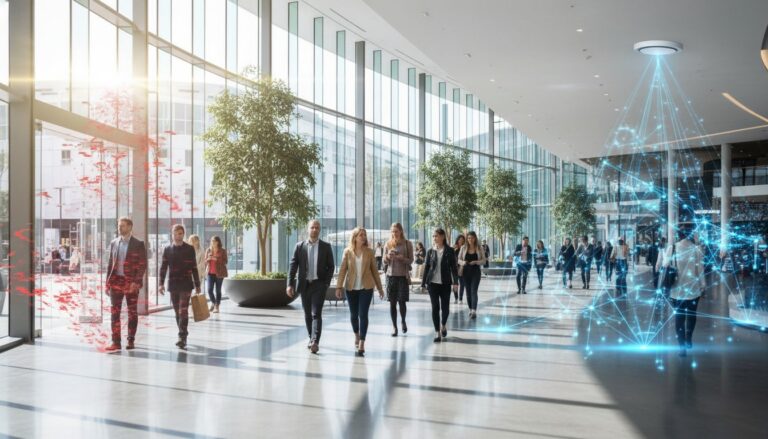
Australian retail environments are dynamic. Seasonal store layout shifts or the installation of new promotional signage can inadvertently block a sensor’s field of view. Even changes in natural lighting throughout the day can affect how AI sensors distinguish between shoppers and shadows. Regular lens cleaning for ceiling-mounted FootfallCam Pro2 units is essential to prevent dust buildup from degrading image quality. Physical obstructions like hanging decorations or tall displays often require recalibrating the sensor’s tracking zones to maintain peak performance. Proactive people counter maintenance identifies these physical and environmental barriers before they compromise your data streams.
Technical Components of a Robust Maintenance Schedule
Effective people counter maintenance operates on two distinct but interconnected layers. Hardware maintenance ensures the physical sensor remains operational and correctly positioned, while software optimization ensures the AI interprets the captured data with maximum accuracy. High-performance units like the FootfallCam Pro2 require both to function as intended. Without this dual focus, even the most advanced hardware can produce flawed metrics that undermine your strategic goals.
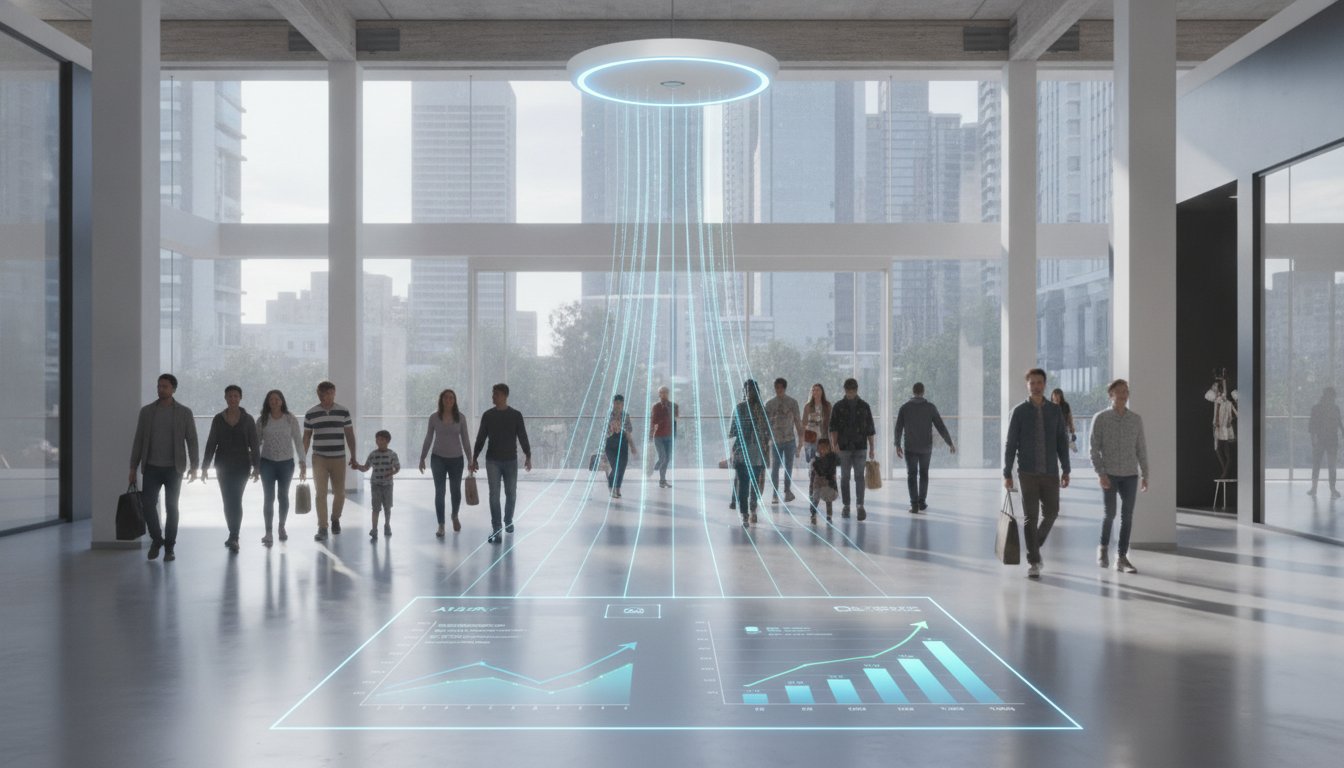
A robust schedule operates on two speeds. Daily remote health checks, often automated through FootfallCam V9 Software, identify immediate connectivity or data flow issues. These automated heartbeats monitor sensor status and data upload frequency, flagging anomalies before they skew your weekly reports. Quarterly physical inspections allow for deeper dives into hardware integrity and environmental changes that remote tools might miss. This proactive approach prevents small drifts from becoming major reporting failures during peak Australian trading periods. If managing these technical layers internally feels complex, a structured Premium Support Plan provides the peace of mind that experts are monitoring these variables for you.
Hardware Calibration and Physical Care
Verify camera tilt and mounting stability during every site visit. Even a slight shift in angle can significantly alter the counting zone, leading to consistent overcounting or undercounting. Check the integrity of Power over Ethernet (PoE) connections and cabling. Cable degradation or loose ports are frequent causes of intermittent hardware downtime that can be difficult to diagnose remotely. Proactively replace components that show signs of wear or aging before they fail during high-traffic events. This ensures you don’t lose critical peak-trading data when it’s most valuable for your conversion analysis.
Software Updates and AI Refinement
Firmware updates are vital for maintaining the edge in object recognition and background subtraction. In 2026, advancements in people counting technology allow for better filtering of non-human objects and more precise tracking in crowded spaces. When you redesign a store entrance or change the layout, you must re-tune the AI zones. FootfallCam V9 Software provides the tools to adjust these virtual lines, ensuring the AI correctly identifies “ins” and “outs” despite new physical configurations. These refinements are essential for distinguishing between customers and staff or filtering out strollers and shopping trolleys with high precision.
Managed Support vs. In-House Maintenance: A Strategic Comparison
Choosing between in-house management and a managed service provider is a critical decision for any data-reliant organization. While assigning people counter maintenance to an internal IT department may appear cost-effective on a balance sheet, the total cost of ownership (TCO) often tells a different story. Internal teams typically lack the specialized forensic tools required to diagnose “silent” data drift. This results in hidden costs: lost data during peak seasons, incorrect labor allocations, and the eventual need for expensive emergency repairs. A professional support plan functions as insurance for your data accuracy, shifting the burden of technical vigilance from your staff to specialized experts.
Managed services offer a level of continuity that internal teams can’t always guarantee. When an IT manager leaves or priorities shift, maintenance schedules are often the first to suffer. In contrast, a specialized partner provides a steady, logical path toward long-term data reliability. This strategic approach ensures that your hardware doesn’t just stay “online,” but stays accurate. For businesses with aging infrastructure, the Legacy Swap Out Plan serves as a powerful maintenance-minimization strategy. It allows you to trade in outdated sensors for modern AI units, effectively resetting your maintenance clock and dramatically reducing the need for physical interventions.
The Limitations of General IT Troubleshooting
General IT teams excel at maintaining network stability, but AI-driven people counting systems Australia require a more nuanced approach. A sensor might be online and “pingable,” yet it could be capturing completely inaccurate data due to a subtle shift in the AI background subtraction model. If an unauthorized system reset occurs, custom-tuned zones and exclusion lines are often wiped, leading to catastrophic data loss that can take weeks to rectify. Specialized systems demand specialized knowledge to ensure that software adjustments don’t inadvertently compromise the integrity of your historical data.
Benefits of Managed Footfall Australia Support Plans
The Footfall Australia Premium Support Plan moves beyond reactive troubleshooting to provide a proactive safety net. It includes a “Proactive Health Check” feature that identifies system anomalies before you even notice a discrepancy in your reports. If a sensor shows unusual traffic patterns or connectivity drops, our team intervenes immediately to identify the root cause. For national clients, priority response times ensure that hardware issues are resolved before they can compromise a full week’s worth of analytics. You can explore the specific tiers of comprehensive people counter support to find the right fit for your operational scale and reporting requirements.
Troubleshooting and Proactive System Health Monitoring
Maintaining high-precision analytics requires a structured approach to identifying and resolving technical friction. While managed support plans provide a comprehensive safety net, empowering on-site managers with “First-Look” diagnostics can significantly reduce system downtime. The FootfallCam V9 dashboard serves as your primary diagnostic tool, offering real-time visibility into sensor health. Understanding the nuance between system alerts is the first step in effective people counter maintenance. For instance, an “Offline” alert typically indicates a total loss of power or network connectivity. A “Data Gap” suggests the sensor is operational but failing to upload packets to the cloud server, often due to local network restrictions.
Proactive monitoring transforms reactive repairs into a predictable management routine. By following a logical 5-step framework, you can isolate variables and determine whether an issue requires a simple physical adjustment or specialized remote re-calibration. If these steps don’t resolve the discrepancy, you can contact Footfall Australia for technical support to restore your data integrity immediately. This structured approach ensures that decisions remain backed by empirical evidence rather than guesswork.
Identifying Connectivity and Power Issues
- Step 1: Verify PoE switch status. Check the physical port activity lights on your Power over Ethernet switch. A dark port often points to a failed cable or a power surge that has tripped the port’s internal breaker.
- Step 2: Audit network and firewall permissions. Ensure that local network changes haven’t blocked the specific ports required for V9 data uploads. AI sensors require a stable outbound path to transmit processed metadata to the central analytics platform.
- Step 3: Perform a controlled power cycle. If the hardware is unresponsive, reboot the device by cycling the PoE power. This clears the local cache and restarts the internal operating system without risking the loss of historical data stored on the cloud.
Addressing Data Discrepancies and Inaccuracy
- Step 4: Inspect the Live View. Access the V9 dashboard’s “Live View” feature to check for new physical obstructions. Recent store renovations or hanging promotional banners can frequently enter the sensor’s field of view, confusing the AI’s tracking logic.
- Step 5: Execute a validation sample. Compare the system’s recorded count against a 15-minute manual sample. If the variance exceeds 2%, it indicates that environmental changes have necessitated a software-level refinement.
When discrepancies persist after these checks, escalate the issue to the Footfall Australia technical team. Our experts can perform remote re-calibrations, adjusting the background subtraction models and tracking zones to account for new floor patterns or lighting conditions. This ensures your people counter maintenance remains evidence-based and effective throughout the year.
Future-Proofing Your Investment with Footfall Australia
As your infrastructure ages, the strategy for people counter maintenance must evolve to match the lifecycle of the hardware. Most sensors reach a performance plateau after five to seven years of continuous operation. At this stage, the frequency of physical component fatigue increases, and the gap between legacy processing power and modern AI requirements widens. Consistent maintenance throughout the early years of a device’s lifecycle is the most effective way to delay significant capital expenditure. By protecting the hardware from environmental degradation and keeping firmware current, you extend the utility of your initial investment well beyond the industry average.
There is, however, a logical point where the cost of ongoing repairs outweighs the value of an aging sensor. Recognizing this inflection point is vital for maintaining the strategic value of people counting. When maintenance becomes a cycle of reactive fixes rather than proactive optimization, it’s time to consider a more structural update. Footfall Australia provides a clear pathway for this transition, ensuring your analytics remain modern without the friction of a complete system overhaul or data loss.
The Legacy Swap Out Plan: Modernising Your Infrastructure
The Legacy Swap Out Plan is designed specifically for businesses hampered by outdated sensors that no longer support advanced V9 features. This plan allows for a seamless transition to the FootfallCam Pro2, replacing older units with minimal site disruption. It’s a far more cost-efficient approach than attempting to maintain end-of-life hardware that lacks the processing power required for 2026-standard AI accuracy. A key advantage of this plan is the ability to integrate historical data streams into the modern V9 analytics platform. This ensures your long-term trend analysis remains intact, providing a continuous narrative of movement from your old sensors to your new AI-powered infrastructure.
Scaling Support for National Operations
For large retail chains, people counter maintenance requires a centralized, high-level perspective. Footfall Australia manages maintenance for national operations by providing a unified view of system health across every Australian location. Instead of managing dozens of individual store issues, executives receive centralized reporting that flags exceptions and confirms data reliability across the entire fleet. This macro-level oversight ensures that board-level decisions are always based on a 100% reliable data set, regardless of the store’s location or the age of its specific hardware.
The next step in securing your data integrity is a comprehensive audit of your current system performance. Review your recent accuracy checks and identify any persistent data gaps or hardware lags that could be skewing your conversion metrics. Whether you need to optimize your current FootfallCam Pro2 units through a Premium Support Plan or replace aging infrastructure via the Legacy Swap Out Plan, professional intervention is the only way to guarantee long-term ROI. Contact our technical team today to ensure your analytics remain a precise reflection of human behavior in your physical spaces.
Securing the Precision of Your Strategic Analytics
Maintaining accurate footfall metrics in 2026 requires more than high-quality hardware; it demands a commitment to consistent people counter maintenance. You’ve seen how proactive health monitoring prevents the silent erosion of data integrity and how managed expertise outweighs the hidden costs of DIY troubleshooting. By treating your sensors as strategic assets, you ensure that organizational decisions remain rooted in empirical evidence rather than intuition. This steady focus on technical precision is what transforms raw movement into a reliable narrative of human behavior.
Footfall Australia has delivered national support since 2004, providing the specialized logic required to manage complex AI ecosystems. Our services include proactive AI health monitoring to identify anomalies before they impact your conversion rates. For those with aging infrastructure, our specialized Legacy Swap Out Plan provides a logical path to modern precision without the friction of a total system overhaul. Protect your data integrity with a Footfall Australia Support Plan today. Secure the clarity you need to lead your organization with confidence.
Frequently Asked Questions
How often should I clean the lens of my FootfallCam Pro2?
Clean the sensor lens every three to six months to prevent dust accumulation from degrading the AI’s object recognition capabilities. In high-traffic environments or locations with significant airborne particles, a quarterly cleaning schedule is recommended. Use a dry, soft microfiber cloth to gently wipe the lens, ensuring you don’t shift the camera’s mounting angle or tilt during the process.
What is the “Legacy Swap Out Plan” and how does it work?
The Legacy Swap Out Plan is a strategic program designed to replace aging infrastructure with modern FootfallCam Pro2 hardware. It allows organizations to trade in sensors that have reached their performance plateau after five to seven years of use. This transition resets your people counter maintenance lifecycle and ensures your data streams remain compatible with the latest V9 analytics features.
Can my internal IT team handle the maintenance of our people counters?
Internal IT departments can manage basic network connectivity and power issues, but they often lack the specialized forensic tools required for AI calibration. While your team can verify PoE port activity, professional support plans are necessary for auditing algorithmic accuracy and background subtraction models. Specialized oversight ensures that subtle data drift doesn’t compromise your board-level reporting.
Why is my people counter showing 0 visitors when the store is open?
A zero-visitor reading typically indicates a total loss of power or a blocked data upload path. Check the activity lights on your PoE switch to confirm the sensor is receiving power. If the hardware is online, audit your local firewall settings to ensure the FootfallCam V9 software has the necessary permissions to transmit data packets to the cloud server.
Does the Premium Support Plan include hardware replacement?
The Premium Support Plan focuses on proactive system health monitoring and remote technical intervention to maximize data integrity. While specific coverage details depend on your service agreement, this plan is designed to identify hardware fatigue before a failure occurs. You should review your specific contract terms or contact our team to confirm the hardware replacement protocols for your national fleet.
How do I know if my people counter needs re-calibration?
Perform a 15-minute manual validation count to determine if your system requires re-calibration. If the variance between the manual count and the system’s recorded data exceeds 2%, it’s an indication that environmental changes or store layout shifts have impacted the AI’s tracking logic. Regular people counter maintenance includes these validation checks to ensure your conversion rates remain accurate.
Will a software update delete my historical footfall data?
No, software updates do not affect your historical footfall data stored in the cloud. Firmware updates are designed to refine object recognition algorithms and improve system stability at the sensor level. Your long-term data trends remain secure within the V9 analytics platform, allowing for continuous year-on-year performance comparisons without any risk of information loss.
What happens to my data if the internet connection goes down?
FootfallCam sensors include internal memory to cache data locally during internet outages. Once the network connection is restored, the system automatically uploads the stored metadata to the V9 dashboard without any loss of information. Most high-performance AI units can store several weeks of data locally, providing a reliable buffer against temporary connectivity issues in Australian retail environments.