The Strategic Impact of Inaccurate Footfall Data on Australian Business ROI
If your footfall sensors are 90% accurate, you aren’t just missing 10% of your visitors; you’re likely misallocating a significant portion of your A$30-per-hour labor budget during critical peak periods. Many Australian operations managers feel the quiet frustration of inconsistent data across national sites, making it nearly impossible to justify staffing levels to a skeptical board. The strategic impact of inaccurate footfall data goes beyond a simple counting error. It creates a ripple effect of inefficiency that erodes your bottom line at a time when business insolvencies in Australia have risen by 17.3%.
You deserve a baseline of truth that mirrors the reality of your physical space. This article provides a clear framework for calculating the financial value of precision, helping you eliminate the “Accuracy Gap” through high-integrity people counting. We’ll explore how shifting from “good enough” sensors to 98% accurate systems like the FootfallCam Pro2 can protect your margins. By the end, you’ll have the confidence to make data-driven decisions that reduce operational costs and reflect the true human behavior within your environments.
Key Takeaways
- Establish a 98% accuracy threshold to transition your people counting from vague statistical trends to absolute, actionable truth.
- Quantify the strategic impact of inaccurate footfall data by learning how a 10% counting error can result in a 50% distortion of your conversion insights.
- Optimise labor budgets by using high-precision data to implement demand-led staff scheduling that aligns with real-world visitor peaks.
- Identify the environmental factors, such as shadows and reflections, that compromise data integrity and learn how 3D Stereo Vision eliminates these errors.
- Utilise the FootfallCam Pro2 and a national support network to ensure data consistency and reliability across every site in your Australian portfolio.
The Strategic Value of High-Accuracy Footfall Data
Data serves as the foundation of modern Australian business strategy, but not all data carries the same weight. For years, organizations accepted “indicative” figures, numbers that suggested a general direction without providing a precise count. In 2026, this approach is no longer sustainable. High accuracy, specifically the 98% threshold, marks the point where data transitions from a vague suggestion into an actionable asset. When you rely on indicative trends, you’re essentially gambling with your operational budget.
The negative impact of inaccurate footfall data often manifests as a lack of trust between floor managers and the head office. If a store manager knows their count is off by even 10%, they’ll revert to intuition when scheduling staff or managing inventory. This creates a disconnect where corporate strategy is ignored because the underlying metrics don’t reflect the reality of the physical environment. Decisions based on “good enough” data can be more damaging than those based on no data at all, as they provide a false sense of security while leading the business toward expensive errors.
Data Integrity vs. Statistical Noise
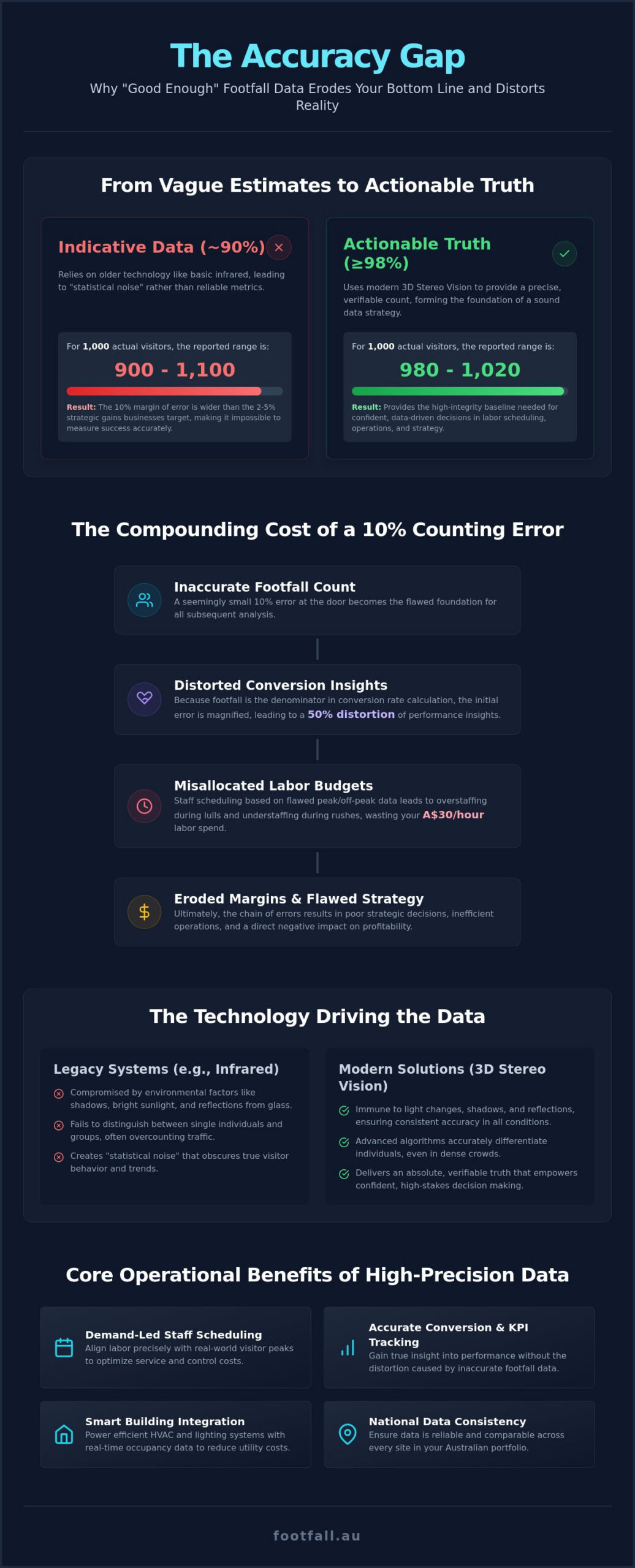
Legacy systems, such as basic infrared (IR) sensors, frequently fail to distinguish between a single shopper and a group entering together. They struggle with shadows, changing light levels, and reflections from glass storefronts. These errors create “statistical noise” that masks true consumer behavior. Modern people counting technology has evolved to filter out this noise, providing the absolute truth required for complex decision-making. High-accuracy people counting is defined as a system that maintains ≥98% precision across all lighting conditions and traffic densities. This level of integrity ensures that management can act with total confidence, knowing their empirical evidence is sound.
Why 2026 Demands Higher Precision
The requirements for physical spaces have shifted toward deep integration. Australian organizations now utilize footfall metrics to power Smart Building initiatives, where real-time occupancy data controls HVAC systems and lighting to reduce energy costs. If your data is inaccurate, your building’s automation will be inefficient, leading to wasted A$ in utility expenses. Integrating these metrics into a broader Business Intelligence (BI) ecosystem allows for a holistic view of performance. For those establishing a new data strategy, the ultimate guide to people counting offers the necessary context for driving growth. Precision isn’t just a technical specification; it’s a core KPI for every operations manager aiming for long-term stability and efficiency.
The Cost of Inaccuracy: The Accuracy Gap Explained
Many business owners view a 90% accuracy rate as a high grade. In the context of physical analytics, it’s often a failing one. The impact of inaccurate footfall data is rarely linear; it compounds as it moves through your reporting pipeline. This phenomenon, known as the “Accuracy Gap,” occurs when small counting errors at the door lead to massive distortions in high-level business intelligence. When your primary metric is flawed, every secondary insight derived from it becomes a liability.
Consider a store with 1,000 actual visitors. A sensor with 90% accuracy provides a range of 900 to 1,100 people. A high-precision system like the FootfallCam Pro2, operating at 98% accuracy, narrows that window significantly to 980 to 1,020. While a difference of 80 people might seem minor on a spreadsheet, it’s critical when you realize that most strategic gains in retail or facilities management are found in the 2% to 5% margins. If your data’s margin of error is wider than your expected growth, you simply can’t prove your strategy worked.
Compound Errors in Conversion Rate Tracking
Conversion rates are the lifeblood of retail performance. They’re calculated by dividing sales transactions (the numerator) by total footfall (the denominator). Because footfall is the larger number, even slight inaccuracies in the denominator create disproportionate errors in the final percentage. If your system overcounts visitors by 10% because it can’t distinguish between a family and an individual, your sales team appears 10% less effective than they truly are. Conversely, undercounting leads to a false sense of success, masking the reality that your team is missing a large volume of opportunities walking through the door.
Precision is vital for resource allocation. Academic research on footfall patterns highlights that visitor flow is highly non-linear, meaning errors during peak hours have a much larger impact on staffing decisions than errors during quiet times. Relying on skewed traffic numbers leads to wasted marketing spend, as you may attribute a sales lift to a campaign that actually failed to drive new traffic.
The Financial Risk of Bad Data
The financial impact of inaccurate footfall data is most visible in occupancy management and safety compliance. If a building manager relies on a sensor that misses 15% of entrants, they risk breaching fire safety regulations or overtaxing HVAC systems. This isn’t just an operational headache; it’s a legal and financial liability. Many Australian businesses are currently stuck with outdated hardware that lacks the AI-driven processing power to handle modern architectural challenges like glass entries or complex shadows.
Upgrading to a high-precision solution often pays for itself within months by reclaiming lost labor hours and optimizing marketing attribution. If you’re currently managing a fleet of inconsistent sensors, the Legacy Swap Out Plan provides a structured path to modernize your infrastructure without a massive capital overhaul. You might consider auditing your current sensor accuracy to see exactly how much margin is leaking through the gap.
Core Operational Benefits of High-Precision People Counting
Precision in data collection yields immediate dividends in operational efficiency. When you eliminate the impact of inaccurate footfall data, you stop managing by averages and start managing by reality. High-precision sensors allow you to identify the exact moments when your physical environment is under-leveraged or over-stressed. This clarity transforms people counting from a passive observation tool into an active driver of ROI, particularly for Australian businesses navigating high overheads and competitive retail environments.
Beyond simple counts, high-accuracy data empowers you to negotiate leases based on verified traffic volumes rather than landlord estimates. It also enables sophisticated queue management. Real-time occupancy alerts can trigger immediate staffing adjustments, reducing wait times and preventing “walk-aways” during peak periods. These operational refinements rely entirely on the integrity of the count; if the data is wrong, the response will be too.
Optimising Labour Costs in the Australian Market
Australian businesses operate within a unique economic framework characterized by some of the highest award rates globally. Managing labor costs isn’t just about reducing hours; it’s about demand-led scheduling. By aligning your staff rosters with actual visitor peaks, you ensure that high-cost labor is present only when it can generate the most value. Over-staffing during quiet periods is an expensive drain on resources that often goes unnoticed without precise metrics. Conversely, under-staffing during unpredicted surges leads to missed sales and poor customer experiences. Implementing a strategic retail footfall analysis in Australia allows managers to justify staffing levels to stakeholders through empirical evidence, ensuring every A$ spent on wages is an investment in conversion.
Marketing ROI and Attribution
Marketing budgets are often the first to be scrutinized during economic headwinds. High-precision people counting provides the data necessary to protect these budgets by proving attribution. You can move beyond gut feel to measure the “Capture Rate” of your window displays or the “Power of Attraction” between different store entrances. If a local promotion drives a 20% increase in traffic but sales remain flat, the data identifies the problem as an in-store conversion issue rather than a marketing failure. This level of insight allows you to compare the effectiveness of various campaigns across multiple national sites with total confidence. Using high-accuracy data to justify marketing spend ensures that your strategy is based on human behavior rather than optimistic projections, reinforcing your position as a data-driven leader.
How to Ensure and Audit People Counter Accuracy
High-precision data doesn’t happen by accident. It’s the result of specific hardware choices and rigorous validation protocols. While many providers claim high accuracy, the impact of inaccurate footfall data often remains hidden until a formal audit is conducted. Ensuring your data reflects reality requires moving beyond simple motion detection and embracing sophisticated edge-computing hardware that can process complex human behaviors in real time.
The Australian retail environment presents unique challenges. Large glass storefronts, varying sunlight intensity, and high-gloss flooring can confuse lower-tier sensors. To maintain a 98% accuracy rate, your system must distinguish between a customer, a shopping trolley, and a shadow cast across the entrance. Hardware with on-device AI processing ensures that these calculations happen locally, maintaining both data speed and privacy compliance without relying on constant cloud-side bandwidth.
AI Video Analytics vs. Traditional Sensors
The FootfallCam Pro2 utilizes advanced AI to solve the limitations of 2D or infrared sensors. By employing 3D Stereo Vision and Time-of-Flight (ToF) technology, the device gains depth perception. This allows it to accurately count individuals within a group and ignore non-human objects. Traditional sensors often struggle with group counting, leading to significant overcounting or undercounting depending on the traffic density. For a deeper technical dive into how these systems function, explore our guide on people counting technology. This transition to AI-driven video analytics is the primary defense against the data integrity issues that plague older infrastructures.
The Audit Process: Verifying Your Data
Trust but verify is the standard for operational excellence. An Accuracy Validation Audit (AVA) should be a routine part of your data management strategy. This process involves a video-to-count audit where recorded footage is compared against the system’s digital output. A professional audit should compare at least 100-200 manual counts against the system output to establish a statistically significant accuracy percentage. If the deviation is higher than 2%, the sensor likely requires remote calibration to account for environmental shifts like new display units or changes in lighting.
Ongoing maintenance is equally vital. Remote support plans allow technicians to fine-tune your sensors without the need for an on-site visit, ensuring that your data integrity remains high long after the initial installation. If you’re unsure whether your current data is reliable, you can request an accuracy audit for your current sensors to identify where your margins might be leaking. Establishing this baseline of truth is the only way to mitigate the long-term impact of inaccurate footfall data on your business ROI.
Implementing High-Accuracy Solutions with Footfall Australia
Achieving enterprise-wide data integrity requires a partner capable of managing large-scale deployments without compromising on precision. Footfall Australia provides a unified approach to people counting, ensuring that all retail chains, from regional outlets to flagship stores, receive the same high-standard metrics. Our national deployment capabilities address the logistical challenges of maintaining consistent data across diverse Australian environments. By standardising your hardware and software across all sites, you eliminate the fragmentation that often leads to a negative impact of inaccurate footfall data on your corporate reporting.
The FootfallCam Pro2 stands as the primary hardware solution in our portfolio, specifically engineered to provide 98% accuracy through AI-driven 3D vision. This device works in tandem with the V9 Software, an analytical engine that translates raw entry counts into sophisticated visualizations of conversion rates and dwell times. For organisations with significant existing infrastructure, the FootfallCam Centroid offers a strategic middle ground. It allows you to leverage your current IP cameras as AI-powered sensors, providing a cost-effective path to upgrading your data integrity without a total hardware replacement.
National Support and Maintenance
Local Australian support is a non-negotiable component of a sustainable data strategy. Our support plans are designed to ensure your sensors remain calibrated and online, providing proactive health checks that identify potential issues before they skew your weekly reports. Maintaining a 98% accuracy rate requires ongoing attention to environmental shifts, such as new store layouts or lighting changes. For a detailed look at the technical specifications and installation requirements for our primary sensor, refer to the FootfallCam Pro2 guide. This local expertise ensures that your investment continues to yield high-utility information year after year.
Next Steps: From Data to Strategy
Your move toward high-precision analytics should begin with a clear understanding of your current “Accuracy Gap.” Transitioning from simply counting visitors to optimising the entire customer journey requires a foundation of absolute truth. We recommend starting with a comprehensive data integrity audit to quantify the impact of inaccurate footfall data on your current ROI. This baseline allows you to see exactly where your staffing rosters or marketing attributions are being misled by faulty metrics.
Precision is the only way to protect your margins in a tightening Australian market. When you stop guessing and start measuring, you gain the quiet confidence to make bold operational shifts. You can consult with a Footfall Australia expert to design a high-accuracy roadmap tailored to your specific facility needs. Let us help you turn your physical environment into a source of empirical evidence and strategic advantage.
Securing Your Operational Future with Data Integrity
Transitioning from indicative trends to absolute truth is the most significant step an operations manager can take in 2026. By establishing a 98% accuracy threshold, you eliminate the compounding errors that distort conversion rates and lead to expensive staffing mistakes. High-precision people counting ensures that your strategic decisions are rooted in the reality of human movement rather than statistical noise. Addressing the long-term impact of inaccurate footfall data allows you to reclaim lost margins and justify every dollar of your marketing and labor budgets.
Footfall Australia provides the infrastructure needed to maintain this precision across your entire national portfolio. With the FootfallCam Pro2 offering guaranteed 98%+ accuracy and V9 Analytics Software delivering real-time insights, you gain a partner dedicated to your data integrity. Our national support and installation network ensures your systems remain calibrated and effective. It’s time to stop managing by intuition and start leading with evidence. Optimise your business with high-accuracy data from Footfall Australia and build a resilient, data-driven roadmap for growth.
Frequently Asked Questions
What is considered a high accuracy rate for a people counter?
A high accuracy rate is generally defined as 98% or higher. While older technologies often plateau at 85% or 90%, these lower levels create a significant impact of inaccurate footfall data on retail conversion metrics. For modern Australian businesses, 98% precision is the benchmark required to transition from vague trends to actionable operational intelligence that can be trusted by executive stakeholders.
Can people counters distinguish between staff and customers?
Modern systems like the FootfallCam Pro2 distinguish between staff and customers using specialized AI algorithms or physical staff exclusion tags. These tags ensure that employees entering or exiting the premises don’t skew visitor counts during shift changes or deliveries. This level of granularity is essential for calculating true conversion rates and ensuring that your labor budget is allocated based on actual customer traffic.
How do high-accuracy counters handle groups and families?
High-accuracy counters use 3D stereo vision and AI processing to identify individual human shapes within a group. Unlike 2D sensors that might count a family as a single large object, these AI systems perceive depth and volume. They accurately separate adults, children, and groups walking closely together, which prevents the undercounting or overcounting errors that often compromise the data integrity of legacy systems.
Does high accuracy require more bandwidth or storage?
High accuracy doesn’t demand higher bandwidth because modern sensors utilize edge computing to process data locally. The hardware analyzes the video feed on the device itself and only transmits numerical counts to the cloud. This approach minimizes data usage and storage requirements while ensuring that your network isn’t bogged down by heavy video streams, making it ideal for national deployments across multiple sites.
Can my existing CCTV cameras achieve high counting accuracy?
Standard CCTV cameras typically lack the depth perception and specialized mounting angles needed for 98% accuracy on their own. However, you can leverage existing infrastructure by integrating it with the FootfallCam Centroid. This device applies AI-driven video analytics to your current camera feeds, transforming them into high-precision sensors that provide a much more reliable baseline for strategic planning and conversion rate benchmarking.
What environmental factors most commonly affect sensor accuracy?
Shadows, glass reflections, and rapid changes in ambient light are the most common factors that challenge sensor accuracy. High-gloss flooring and swinging glass doors can also create “ghost” counts in lower-tier systems. High-precision AI counters are specifically designed to filter out these environmental anomalies, ensuring that the impact of inaccurate footfall data doesn’t compromise your reporting during different times of the day or changing seasons.
How often should a people counting system be audited for accuracy?
You should perform a formal accuracy audit at least once or twice a year to ensure your sensors remain calibrated. It’s also vital to re-audit the system after any major storefront renovations or significant changes in interior lighting. Regular Accuracy Validation Audits (AVAs) help maintain the integrity of your metrics and give management the confidence that their data-driven decisions are based on physical reality.
Is high-accuracy people counting GDPR and privacy compliant in Australia?
High-accuracy people counting is fully compliant with Australian privacy regulations, including the latest reforms to the Privacy Act 1988. Modern sensors use “privacy-by-design” principles, where images are processed into anonymized numerical data at the edge. No personally identifiable information is stored or transmitted, ensuring that your business meets mandatory national standards while gaining deep insights into visitor behavior without compromising individual privacy.